Daily insights for city builders, delivered every morning at 6 AM ET. I’m Brandon Donnelly — a Toronto-based real estate developer and founder of Globizen. I’ve been writing here since 2013.

Tag: blog

  • Louis Vuitton’s Big Duck

    When I first saw this picture of Louis Vuitton’s flagship store in Manhattan I thought it was AI. That is where we are right now. When something looks wild, I just automatically assume it’s fake. But alas, it’s not fake. Louis Vuitton is renovating their flagship store at the corner of 57th Street and 5th Avenue and so, naturally, they decided to completely cover it with luggage facade wraps.

    These wraps make the entire building look like six grey trunks stacked on top of each other and are a nod to a 19th century luggage design from the company. They even used real metal details throughout. Apparently the heaviest luggage handle weighs something like 5,000 pounds.

    This is wild and remarkable in so many ways. The scale of it is remarkable. This is a 15 storey building concealed entirely by luggage trunks. It also speaks to the scale and dominance of New York as a city. Not every city can absorb a pile of giant luggage trunks and not bat an eye. But in New York, it’s just another noteworthy thing within its relentless urban grid.

    I also can’t help but think of the work of architects Robert Venturi and Denise Scott Brown. In 1972, they published a book called Learning from Las Vegas. And in it, they defined two types of contrasting buildings: decorated sheds and ducks. Decorated sheds are, as the name suggests, nondescript buildings. Think big box stores. These buildings get their specificity from signage and other ornament because, without this, they’d just be nondescript sheds.

    Duck buildings are, on the other hand, buildings that take on a symbolic form. In other words, their shape and construction tell you what they’re all about. The term duck comes from an actual building that looks like a duck, namely The Big Duck on Long Island. This is a building that was built in the 1930s to help promote the owner’s duck farming business and is now on the US National Register of Historic Places.

    The Big Duck is and was an actual building, whereas Louis Vuitton’s trunks are just temporary construction wrap. So they’re not exactly the same thing. Still, the similarities are there. Both were erected to promote their respectiveness businesses. And both tell you, through their form, what’s meant to happen inside. So in this sense, Louis Vuitton has just created its own Big Duck.

    Photo by Brad Dickson via Dezeen

  • How to design a mountain house in the French Alps

    This is the chalet that our group has been staying in for the last week:

    • We’ve been calling it a tree house. It is 5 levels in total. And you circulate through the house using a spiral staircase in the center of it. It’s space efficient, but there are a lot of stairs.
    • The site is downhill from the road, which, as we have talked about before, creates a more challenging build than uphill from the road.
    • You enter the chalet on the third level, which itself houses 2 bedrooms. One floor below and one floor above also have 2 bedrooms, meaning there are 6 bedrooms in total. On the lowest floor is an indoor hot tub, a shared parking garage, and a shared ski/snowboard room.
    • Every mountain house needs, at a minimum, two things: a fireplace and a hot tub. Ideally the latter is outside.

    • As is typical in the mountains, the main living space is on the top floor (level 5 in this case). You want this for the views. If you’re building into a sloping site, the lowest floors are usually somewhat constrained.
    • We did the same thing with Parkview Mountain House. But it does mean that you circulate through the more “private” spaces within the house before reaching the more “public” ones. This is the opposite of what happens in most homes.

    • The underground parking garage is accessed by way of a small parking elevator that lowers you down two floors. Initially this seemed excessive, but it is a shared elevator/garage. The chalet is semi-detached chalet, if you will, and so this was probably the only way they could get enough parking on the site. Assuming our attached neighbor is of a similar size, that’s 12 bedrooms.
    • It also creates an important pathway so that people don’t need to bring their skis and snowboards through the house.

    Every site has its challenges and that is especially the case in the mountains.

  • Risk, uncertainty, and opportunity

    For two reasons, I really like Fred Wilson’s recent blog post on hypothetical value to real value. Firstly, it is structured in the way that I think good blog posts are structured. He starts with a personal story (about this son) and then uses that to take a position and impart some knowledge about the venture capital industry. It makes for a more engaging read. Secondly, I like how he describes the journey and spread between hypothetical value and real value:

    Venture capitalists and seed funds and angel investors make or lose money on the journey from hypothetical value to real value. And when the spread between the two narrows, the money we make is less. When the spread increases, the money we make is more. It is easier to drink your own Kool Aid in the world of hypothetical values. You handicap the odds of winning more aggressively. You trade ownership for capital at work. You accept the new normal. Real value doesn’t move so fast. Because it is right in front of you. You can see it. So it is not prone to flights of fancy. I try to keep this framework front and center in my brain as we meet with founders and work to find transactions that work for everyone. I find it to be a stabilizing force in an unstable market.

    All of this is related to the notion that you make real money when you’re right about something that most people think is wrong. Because that would be hypothetical value. If it were real value, then everyone would simply believe it. It would be “right in front of you.” And this is pretty much true of all competitive marketplaces, including the real estate industry. Risk and uncertainty create opportunity.

    Photo by James Sullivan on Unsplash

  • Five year anniversary

    Today is the five year anniversary of this daily blog. That’s over 1800 posts. 

    It’s almost hard to believe that it has been that long. It seems like just yesterday I was on year 2 or 3. But at the same time, it’s almost hard for me to remember a time when I didn’t blog every day. I guess we’re calling it a habit at this point.

    One of the most common questions I get regarding this blog is: “Do you pre-write posts?” The answer is never. Okay, almost never. Sometimes I’ll pre-write a post if I know I’m going to be on a plane for 12 hours and I won’t make the timezone cutoff. But generally as a rule I don’t.

    Part of the reason I don’t is because it breaks the habit. This is something I do every day. And I like that routine. I also want the posts to be timely and I want to be able to write about things that may be on my mind that day.

    Momentum is a powerful thing. And when you’ve been doing something for a number of years, and especially something as public as this daily blog, there’s a powerful incentive to keep doing it. That’s how streaks work.

    However, in the world of development, five years is perhaps not that long. It’s maybe one project. Streaks take a lot longer to establish.

    This summer One Delisle by Studio Gang went public and you’re now starting to see (bright neon) teasers for Junction House. Both of these projects are many years in the making. The Junction House story started in early 2016.

    So I reckon that this blog needs at least another five years so that there’s enough time for the really juicy stories to surface. I’ll endeavor to do exactly that. 

    Thanks for reading and making this community what it is. See you tomorrow.

  • In defense of the gig economy

    Bill Gurley – who by the way is an investor in Uber – has an interesting piece up on his blog about the thing he loves most about Uber. It is the ability for the network to level load on its own. And here’s what he means by that:

    In spite of all the ink that journalists, analysts, and pundits have spilled on Uber over the years, no mainstream article has focused on what I consider to be the most elegant feature of this now ubiquitous, high growth global service — no driver-partner is ever told where or when to work. This is quite remarkable — an entire global network miraculously “level loads” on its own. Driver-partners unilaterally decide when they want to work and where they want to work. The flip side is also true — they have unlimited freedom to choose when they do NOT want to work. Despite the complete lack of a “driver-partner schedule” this system delivers pick-up times that are less than 5 minutes (in most US cities (with populations over 25K) and in 412 cities in 55 other countries. The Uber network, along with Mr. Smith’s invisible hand, is able to elegantly match supply and demand, without the “schedules” and “shifts” that are the norm in most every other industry.

    When surveyed, most people seem to prefer a job where they set their own schedule and get to be their own boss, compared to a steady 9 to 5 job with benefits and a fixed salary. Assuming that’s true, then this is a feature worth talking about.

  • Today I am N+1

    Today is my birthday. 

    I am one year older, at least at face value. This got me thinking about something I read a number of years ago on Fred Wilson’s blog called The N+1 theory. The basic premise is as follows: whatever it is, there could be one more. It is an optimistic viewpoint that emphasizes continuous improvement and change.

    For example, let’s say you’re designing a building and you’re trying to make it as energy efficient as possible. You might think that you’ve arrived at the most efficient outcome, but in fact you’re probably just sitting at N. Stretch yourself. Go for N+1.

    Let’s say you’re working out at the gym and you feel you’ve done as many reps as you could possibly do. Well, if you stretched yourself, you could probably do N+1. People who lift weights will also tell you it’s that one additional rep that counts the most. 

    The mantra: Do as many or as much as you can possibly do (N), and then do one more (+1). The N+1 theory is a growth mindset. And if you apply this thinking throughout your life, I am sure you would see many benefits.

    At the same time, one could imagine this theory being applied in a destructive way. In a relationship, for instance, is it healthy to think of your significant other as N, meaning that you should be looking for someone better? That N+1. This strikes me as an unhappy way to live. I would prefer to apply this theory in a productive way. 

    Whatever the case may be, today I am firmly N+1. And I feel good about that.

  • That emotional connection

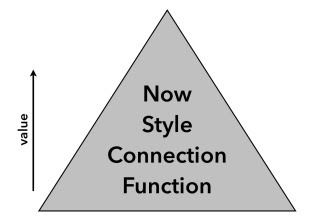
    Marketing guru Seth Godin recently published this value
    triangle on his blog
    :

    image

    No matter what business you’re in, it’s worth giving some thought to this. What do you offer?

    At the bottom of the triangle is function. A hotel room functions as a place
    to sleep. A smartphone functions as a device to make calls, send text messages,
    and download some apps. A condominium functions as a place to live, eat, sleep, have sex, and so on. But all functions being equal, most of us will buy whatever product is the cheapest.

    That is until there’s an emotional connection. I love the
    way Seth frames it: “Where do people like me do things like this?” It is about defining
    who you are. Am I the kind of person who buys A or am I the kind of person who buys
    B? If I care deeply about the environment and B promises to respect that, I am
    likely to buy B.

    But then, moving even further up the triangle, if two items offer the same function and the
    same emotional connection, many of us will go for the one that appears sexier, shinier (the new iPhone 7 is very shiny), and more
    stylish. It just deepens the connection.

    Finally, at the very top of the triangle is now. This is
    about scarcity. What’s hot right now?
    Think of that new restaurant that just opened downtown that you haven’t been
    able to get a table at. It’s now and you want to Instagram the food so badly so
    that you can show everyone you were there. You want to be now.

    The point of all of this is that we consume things for
    reasons that go well beyond simple function. That’s just the start of it all.
    One could argue that all of this is simply smoke and mirrors, but that’s a
    topic for another blog post. This is our reality.

    To relate this topic back to architecture and real estate, I
    am curious how many of you have made a housing decision that you believe went
    beyond function. How much of it was based on connection and style?

    Not surprisingly, for me, architecture and design matter a
    great deal.

    Earlier this summer I was driving around the city with my
    father and he was pointing out to me all of the new build single family homes
    that were sprouting up. He then asked me what I thought of them. I responded: “They’re
    shit.”

    What I was really saying with that glib remark was that
    those homes – no matter how expensive – didn’t reflect my own belief system
    about the world. Sure they served their function, but they didn’t offer the
    connection and style that “people like me” like to praise. To borrow once again
    from Seth: we are all part of a certain tribe.

    What tribe do you belong to? And does your housing choice
    reflect that?

  • Open for business

    I just received the September issue of Monocle magazine. One of the features I always read is the “Observation” on the very last page. It reads as the editor in chief’s personal blog.

    In this issue he talks about the recent EU referendum and the changes he is making to his business in response to that. Monocle is headquartered in London, but he is now finding it challenging to be “an international media business in a country that hasn’t figured out how it’s going to move forward.”

    His response?

    They are shoring up the Zürich office. They are looking at the possibility of a second bureau somewhere on the continent. And they are similarly looking to increase staff in both Toronto and Singapore.

    When one place closes up, the companies and talent will find other cities that are open for business. 

    As someone who is closing one chapter this week and starting a new one, Tyler Brûlé’s Observation also reminded me of the importance of change. Oftentimes change feels uncomfortable. But that’s not necessarily a bad thing. In fact, it’s more likely a sign that you’re on to something.

    What have you done lately that made you feel uncomfortable?

  • 3 years of daily blogging

    image

    This past Sunday was the 3rd anniversary of this blog. That is 3 years of me writing something here every day (I think I’ve only missed 2 days in the past 3 years). So I have now written almost 1,100 blog posts.

    Admittedly, they weren’t all masterpieces. But that doesn’t really matter. To do good work, I think you have to be prolific and show up every day.

    The big change this year was that I “unbranded” this blog and started writing just under my personal name, as opposed to Architect This City. I got some initial pushback when I did that, but I continue to believe it was the right decision for what I am trying to achieve here.

    I recently had someone ask me if there was any change in traffic after the switch. And the answer is no. If anything, traffic increased. 

    Over the last year, this blog received about 225,000 page views. Of course, this doesn’t include the 14,000 or so people who read via email subscription and Tumblr, and never actually land on this site.

    But honestly, I don’t care about the numbers anymore. I used to. But not anymore. I blog because it:

    – Forces me to stay current on the topics that matter to me

    – Allows me to clarify my thoughts in a way that thinking alone can’t do

    – Holds me publicly accountable for the things I say and the stances I take

    – Connects me with people I would never otherwise meet

    – Exposes me to new business opportunities

    – Gives me a distribution channel for discussion and sharing

    – Allows me to learn from readers who know more than I do

    – Feeds my desire to create things (creating > consuming)

    – Allows me to exert my personal independence (I write what I want here)

    – Promotes greater transparency and, hopefully, better city building

    I could go on, but those are some of the most salient points.

    At the same time, the world of blogging and social media is all about giving first. So I do try to curate content and posts that I think would be valuable to the readership of this blog. If there’s something else you’d like to see on here, I am always open to suggestions.

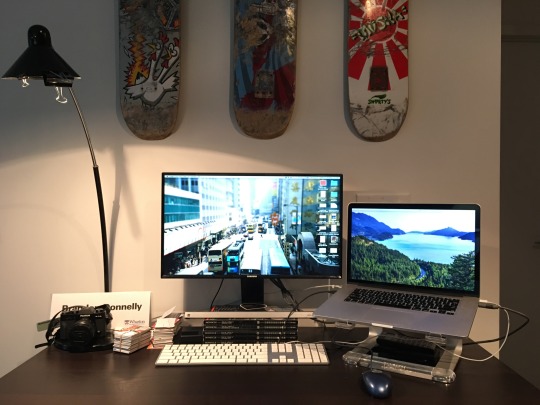
    Thanks for reading! Regular scheduled programming will resume tomorrow. And yes, those are my old skateboard decks hanging on the wall behind my desk.

  • Compact and constrained

    I was walking by a tight construction site last night and it got me thinking. Besides the obvious environmental benefits of building up, as opposed to out, compact urban sites can force something else: intent.

    One of the ways I think about good design is that it is intentional. It is about seeing problems and/or opportunities and then being deliberate in how you respond. Every creative decision needs a reason why. I like how John R. Moran talks about design in this blog post from 2014:

    “The opposite of design, then, is the failure to develop and employ intent in making creative decisions. This doesn’t sound hard, but, astonishingly, no other leading tech company makes intentional design choices like Apple. Instead, they all commit at least one of what I term the Three Design Evasions.”

    The three design evasions he goes on to talk about are (1) preserving, (2) copying, and (3) delegating.

    The thing about compact and constrained urban sites is that they can force you away from the three design evasions that Moran lists in his post. You can’t just repeat what was done in the past or copy what someone else has done, because that precedent probably didn’t have the same challenges you face.

    Of course, if this were enough to promote great design, our cities would look a hell of a lot different. Still, it’s one of the reasons why I’m attracted to compact forms of development such as laneway housing and other urban infill.