
Daily insights for city builders, delivered every morning at 6 AM ET. I’m Brandon Donnelly — a Toronto-based real estate developer and founder of Globizen. I’ve been writing here since 2013.

Tag: bitcoin

  • It doesn’t matter what Bitcoin is trading at right now

    Steven Johnson has a terrific piece in New York Times Magazine called: Beyond the Bitcoin Bubble. Here is a snippet:

    The only blockchain project that has crossed over into mainstream recognition so far is Bitcoin, which is in the middle of a speculative bubble that makes the 1990s internet I.P.O. frenzy look like a neighborhood garage sale. 

    But the point of the article, as its title suggests, is to talk about what all of this craziness could mean for the future of the internet and how, in some ways, it could be a return to what the internet was always intended to be.

    The real promise of these new technologies, many of their evangelists believe, lies not in displacing our currencies but in replacing much of what we now think of as the internet, while at the same time returning the online world to a more decentralized and egalitarian system. If you believe the evangelists, the blockchain is the future. But it is also a way of getting back to the internet’s roots.

    Some are calling this new, decentralized internet version 3.0. We are currently living with internet 2.0. Practically speaking though, what could this shift really mean for us?

    One example that is given in the article has to do with urban mobility – a topic that is particularly relevant to this audience. 

    Internet 2.0 has created a winner-take-most economic model. And in the case of mobility – at least in the world of apps – that winner is Uber. But with internet 3.0 and the blockchain, this could be possible:

    Just as GPS gave us a way of discovering and sharing our location, this new protocol would define a simple request: I am here and would like to go there. A distributed ledger might record all its users’ past trips, credit cards, favorite locations — all the metadata that services like Uber or Amazon use to encourage lock-in. Call it, for the sake of argument, the Transit protocol. The standards for sending a Transit request out onto the internet would be entirely open; anyone who wanted to build an app to respond to that request would be free to do so.

    Cities could build Transit apps that allowed taxi drivers to field requests. But so could bike-share collectives, or rickshaw drivers.

    I don’t know about you, but I find this perspective a lot more interesting. I recommend you read Steven’s article. It will help you cut through a lot of the Bitcoin noise.

  • Mastering Bitcoin

    I’m still in the office right now (wading through Excel models) and I’m late for a Christmas party. So by necessity today’s post is going to be a short one.

    Below is a podcast from the Kevin Rose Show called “Bitcoin’s true potential”. It’s with Andreas M. Antonopoulos, who is the author of a number of books on the topic including: Mastering Bitcoin, The Internet of Money, and Mastering Ethereum.

    If you’re pressed for time, here are a couple of time stamps that may interest you:

    18:12 – Global opportunities and challenges for expanded Bitcoin use 
    28:00 – Why Andreas spends Bitcoin almost every day
    29:38 – How reduced volatility will help Bitcoin achieve mass adoption
    32:38 – Bitcoin’s potential market capitalization
    35:35 – Bitcoin versus Visa for consumer transactions
    1:06:10 – The most compelling application areas Andreas is tracking
    1:22:54 – The future of cryptography: ECDSA and SHA-256

    And if you can’t see the embedded podcast below, click here.

    https://embed.simplecast.com/bd660142

  • So the tech works. What’s next?

    Below is a keynote talk by Benedict Evans about what’s going on in tech today and what may happen in the next ten years. It covers: the growth of mobile; S-curves; Google / Apple / Facebook / Amazon (who knew Amazon had so many employees?); machine learning; autonomous vehicles/impact to cities; mixed reality; crypto-currencies; and so on.

    For those of you interested in crypto-currencies – and that appears to be everyone these days – it’s interesting to hear how Evans describes their current position at the beginning of the curve: “The tech works, but what’s the use case?” This is not to say the potential isn’t huge. It is. Automated trust. Distributed and programmable money. But the future is still unclear.

    If you can’t see the video below, click here.

    [youtube https://www.youtube.com/watch?v=cVYDkPidXrU&w=560&h=315]

  • Beware of scam ICOs

    There’s certainly lots of buzz these days around the Blockchain and cryptocurrencies. 

    Some of it is negative. 

    Here is a recent New York Times article talking about how celebrity-endorsed “initial coin offerings” have created a new gold rush. Most of these ICOs are scams.

    But some of it is quite promising. 

    Here is a brief summary of how the Blockchain is being leveraged for the real estate industry. Many jurisdictions are already using it, or experimenting with it, for their land registries.

    I’ve been writing about Bitcoin sporadically since about 2013. But I really should spend more time getting deeper into this world. Many believe it will underpin the next wave of innovation in the tech space.

  • What are bubbles?

    Social Capital (Silicon Valley VC firm) recently published an interesting series on (economic) bubbles: what they are, how they form, when they are useful, and so on. It’s worth a read – you can start here.

    Here’s a taste:

    “Prices in markets turn out to have two roles: they tell us something about the past, and they influence our actions — and therefore, their own price — in the future. Sometimes, in a big way, this dual role makes a particular asset class — tulip bulbs, railway stock, Canadian real estate, a digital token — become attractive solely because its price is going up. George Soros characterized and mastered this phenomenon, known as Reflexivity: when our views and our actions reinforce each other. If an expensive price means that something is high quality or otherwise attractive, we will tend to buy more of it and drive the price higher, independently of whether or not the thing is any good. It’s true for sunglasses, it’s true for ICOs, and a whole lot more.”

    For obvious reasons I couldn’t resist posting this quote. Notwithstanding the shot at Canadian real estate, bubbles are a fascinating topic. They happen time and time again because we are greedy.

  • Crypto Valley is emerging in this small Swiss canton

    There are 26 cantons in Switzerland. One of the smaller cantons is Zug. It has a population of around 122,000 people and an area of 239 square kilometers. The capital of the canton is the town of Zug, which itself has a population of about 29,256 (as of December 2015) and an area of 21.61 square kilometers. 

    To help put that into perspective, a single municipal ward in downtown Toronto (Ward 28 – Toronto Centre-Rosedale) had a population of over 66,000 people back in 2011.

    But as small as Zug may be, it is known as one of the most business friendly jurisdictions in the world. It has some of the lowest corporate taxes and the local revenue service prides itself on calling each taxpayer a “client” as opposed to a “debtor.” 

    As of 2010, the canton’s registry listed more than 29,000 companies, with more than 1,000 arriving and being started each year. There are about as many companies in the canton as there are people in the town of Zug.

    It’s a classic example of jurisdictional arbitrage and it’s one that Zug seems determined to keep. In July 2016, the town of Zug began accepting digital currencies, such as Bitcoin, as payment for city fees. 

    The impetus for doing so was to help advance Zug’s position as a global center for cryptocurrency innovation. There’s a very real government supported push to make Zug into “Crypto Valley.” And startups from around the world who are working in this space are starting to take notice. To me this feels like a natural extension given the canton’s existing strengths and reputation. (More reading here and here.)

    I’ve been to Zug maybe twice and, at first blush, it could easily pass for your average sleepy-yet-affluent Swiss town. But then you think about all of the money that flows through this place and you quickly understand why that modest, but very tasty, breakfast sandwich just cost you all of the CHF’s in your wallet. 

    Of course, if the entrepreneurs in Zug get their way, we won’t be carrying around wallets anymore. We’ll be paying with some sort of crypto varietal. And that would only strengthen this canton’s story: You don’t necessarily need to be big to be globally impactful – just put the right policies in the place. 

    Oh, and have a very high quality of life and an immensely beautiful natural setting. Those things help as well.

    Photo by Martin Sattler on Unsplash. The above photo is actually of Morschach in Switzerland, not of Zug. I couldn’t find a royalty free image of the latter. Please forgive me for the false advertising.

  • Business model innovation

    Fred Wilson has a great post up on his blog today about open protocols. By open protocols he is referring to things like TCP/IP (transmission control protocol and internet protocol), HTTP (hypertext transfer protocol), and SMTP (simple mail transfer protocol). Whether you realize it or not, you rely on these protocols every single day if you go on the internet, browse the web, and write emails.

    If you’re interested in these sorts of nerdy things, I recommend you read his post. I’m not going to write about open protocols today – though I do find them fascinating. Instead, I would like to talk about the last paragraph of his post. 

    Here it is:

    “I believe that business model innovation is more disruptive that technological innovation. Incumbents can adapt to and adopt new technological changes (web to mobile) way easier than they can adapt to and adopt new business models (selling software to free ad-supported software). So this new protocol-based business model feels like one of these “changes of venue” as my partner Brad likes to call them. And that smells like a big investable macro trend to me.”

    This is interesting to me for 2 reasons.

    First, business model innovation is incredibly powerful. Once a company has built itself up around an existing model, it can be painfully difficult to change. Imagine you have a 200 person sales team that would become unnecessary should you pivot your business model. Are you going to fire them and make the switch?

    This is also one of the reasons why some tech companies can exist for so long before they make any money. Sometimes – but not always – it’s because the investors believe that if the company has users, attention or whatever it may be, that they will figure out a way to monetize them/it. And maybe, just maybe, it’ll be a business model that no one has ever thought of before.

    Second, look how he is publicly sharing his investment thesis. Why would he do that? Shouldn’t he just go off and do it and not tell anyone? Clearly, he too believes that there’s greater value in being open and transparent.

  • Towards decentralized city building

    One of the
    most profound shifts taking place today – because of new technologies – is
    that of decentralization. I’ve written about this before, but I keep coming
    back to it because I find it so fascinating.

    It’s
    happening to varying degrees, but as a general trend, I believe it is leading
    to better data (less information asymmetries), more efficient markets, and the
    removal of many middle people. In the past, some intermediaries were necessary in
    order to act as proxies for portions of the market. But I believe that is
    changing.

    So what’s
    an example of this? Bitcoin. Bitcoin is an example of decentralization because
    no one entity controls it. It operates through a decentralized public ledger.
    And because of this, it has the potential to be highly disruptive to the way we
    think about currencies today.

    Put another
    way, I see decentralization as a way to leverage the wisdom of crowds. I am
    convinced that large groups of people can be incredibly intelligent when they’re
    allowed to contribute in the right ways. And I think this could solve many
    different problems, from the infighting we see within cities to broader market phenomena.

    As another example,
    there’s something new in the venture capital space called DAO – which stands
    for Decentralized
    Autonomous Organization
    . Essentially it’s a decentralized VC platform based
    off of a Bitcoin derivative currency.

    But perhaps
    the most noteworthy and relevant feature is that it allows its large pool of
    investors to anonymously vote on which investments to pursue. This is in
    contrast to a more centralized approach where an investment committee would
    meet behind closed doors in a big boardroom and make a decision. This would be the
    more typical approach.

    If you’re
    not in the tech space, the above may not seem all that exciting to you. But I
    see many parallels between venture capital and real estate development, which is
    one of the reasons I follow the space. So I can’t help but wonder what this
    trend could ultimately mean for real estate, design, and other city building industries.

    I can
    certainly imagine a world where the forces that shape our cities are more
    collective and decentralized in nature. It’s already starting to happen through crowdsourcing, social media, ridesharing, and other online platforms.

  • Getting distribution and how that is changing

    Aaron M. Renn recently published an article in The Washington Post talking about carless cities and driverless cars. It’s an interesting read, but I’m not going to talk about those topics today. So if that’s what you’re looking for, you’ll have to read his piece.

    I do, however, want to focus on one particular aspect of it. 

    In it, he talks about how Tesla is shifting the “locus of power in the auto industry” from Detroit to Silicon Valley and, at the same time, changing the way cars are sold. Tesla sells direct to consumers through its corporate stores, whereas franchise laws in almost every U.S. state mandate that new cars need to be sold through dealers.

    I’m not sure how these laws came to be, but it’s interesting to note yet another example of technology and the internet sparking disintermediation. That is, the removal of middle people, distributors, brokers, and so on. It’s the same thing that is happening as a result of companies like Uber and technologies like Bitcoin.

    I would imagine that lot of these legacy distribution models exist today because it was previously the most efficient option. If you were a car company based in Detroit, a network of local franchisees all across the country working to sell your cars was probably a great thing. But now there are other options, as is the case with many other industries.

    So what’s next? 

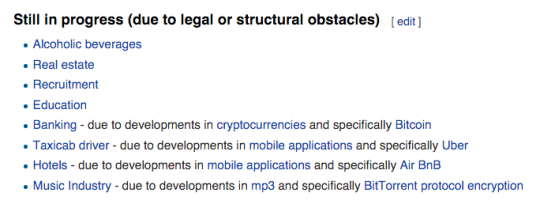
    Wikipedia calls out the following industries as still being in the midst of disintermediation:

    I bet you all know which one I’m watching closely.

  • The Business Blockchain Series

    I just backed this project on Kickstarter.

    https://www.kickstarter.com/projects/wmougayar/the-business-blockchain-books/widget/card.html?v=2

    I haven’t backed a lot of projects on Kickstarter, but I definitely enjoy the process of discovering a project that I’m interested in and then providing a small, seemingly insignificant, sum of money to help make it a reality.

    In this case, it’s a collection of two books by William Mougayar about Bitcoin, blockchains, cryptocurrency, and decentralization.

    These are all topics that I’ve touched on before on this blog, albeit with much less rigor than what I’m sure William will be applying to his books. I wrote this post about 2 years ago, when I first started wrapping my head around Bitcoin. And more recently, I wrote posts about how the blockchain could transform home buying and how Honduras is building a decentralized land registry system using the blockchain technology.

    So while at first glance it may seem like these books having nothing at all to do with city building and real estate, I am betting that they will over the long term, which is why I am doing my homework today.

    Here’s a snippet from William’s Kickstarter page:

    “The fundamental characteristics of blockchains are puzzling to consumers, corporations, governments, policy makers and regulators, because their implementation challenges centrally orchestrated trust, and enables a new kind of trust: one that is distributed, decentralized, from peer to peer, and not centrally managed by any single entity. Take any service, and add “without previous center-based authority”, and replace by “peer to peer, trust-based network”, and you will start to imagine the possibilities.”

    If all of this isn’t enough to pique your interest, then you should also know that William is from Toronto. Great things come out of this city 🙂