Daily insights for city builders, delivered every morning at 6 AM ET. I’m Brandon Donnelly — a Toronto-based real estate developer and founder of Globizen. I’ve been writing here since 2013.
I am very interested in bitcoin because of the underlying technology behind it – namely the blockchain. And that’s because it has the potential to be applied to and to disrupt many different industries and sectors, including real estate.
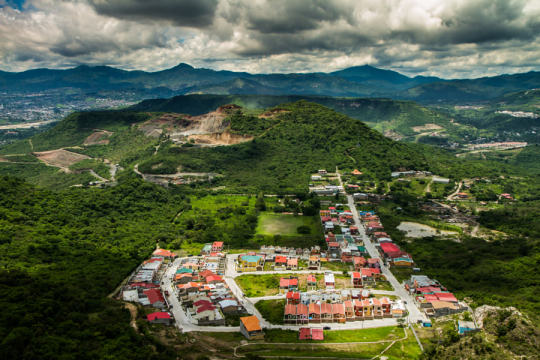
That’s why I was fascinated to learn over the weekend that Honduras, with the help of a Texas-based company called Epigraph, is in the midst of building a permanent land title registry system based on the blockchain architecture.
This is particularly important for Honduras because the country currently suffers from a significant amount of land fraud. And according to Reuters, 60% of land is actually undocumented. So the impact of a secure blockchain-based registry system could be transformational.
Obviously the impetus for Honduras doing this is to fix the broken system that they currently have in place. But there’s no reason that it couldn’t also be done in the developed world to reduce transaction costs and improve overall transparency in the marketplace.
Hopefully Honduras will show us how it is done.
If you’re curious and would like to learn more about the blockchain, here’s a short primer. Once you’ve read that, you can then check out this post I wrote talking about how the blockchain could be applied to real estate.
I recently heard Brad Burnham (venture capitalist at Union Square Ventures) say in a talk that if you’re thinking about Bitcoin just as a currency, then you’re thinking about it in the wrong way. If you take nothing else away from today’s post, I think you should remember that. Bitcoin, and the underlying block chain architecture, have the potential to be very transformative.
The Fast Company article was written by Matt Weiss of IDEO (the powerhouse design and innovation firm). Here’s an introductory snippet:
Insert block chains: a relatively new and promising technology that could transform the way we digitally exchange value, similarly to how Internet protocols, like TCP/IP, transformed the way we exchanged information. For example, to transfer ownership of a home today, there are countless check of authenticity and intermediaries involved to insure the transfer is legitimate. By using a distributed database (a.k.a. “a block chain,” the same technology behind Bitcoin) to prove authenticity, we could legitimately transfer ownership immediately without the need of a middleman. In fact, when we think about block-chain technology and the industries it could disrupt, real estate tops the list. While Trulia, Redfin, Angie’s List and others have brought some transparency to the opaque world of home buying and home ownership, most of our experiences in this industry are fraught with incomplete, inaccurate, and asymmetric information.
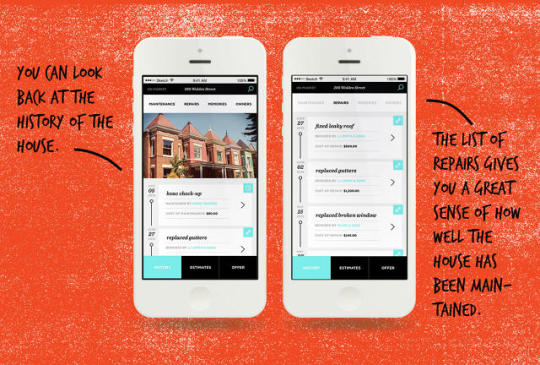
Following this, he goes on to talk about what it might be like – each step of the way – to buy a house using the block chain technology. There are even mockups of what the app could look like. I highly recommend you give it a read if you’re interested or involved in this space.
The real estate industry hasn’t seen a lot of innovation. It remains an opaque market with lots of information asymmetries. I have no doubt that will one day change; it’s just a question of when. Perhaps it’ll be the block chain that makes that happen.
To start off the year, I thought I would talk about something pretty geeky, but very forward looking: Bitcoin.
I wrote about Bitcoin just over a year ago when I was first starting to wrap my head around it, but a lot has happened since then. Many of you might know that 2014 was a terrible year for Bitcoin and that its price has declined significantly (chart from Coinbase):
But does that mean Bitcoin is a flop, or that the hype has just died down a bit?
If you follow what’s being discussed within the tech community, you’ll know that there are still lots of people who are bullish on Bitcoin. But more precisely, they are bullish on the underlying architecture behind Bitcoin and something that is called the Blockchain.
I’m not going to get too technical in this post (if you want that, go here), but I do want to talk about three things (that I’ve mostly learned from the folks over at Union Square Ventures): the Blockchain, why it matters, and what it could mean for specific industries such as transportation and real estate. I promise to make it relevant at the end.
The way to think about all of this is in layers.
The Blockchain is the foundation or base of Bitcoin. It’s essentially a decentralized public ledger that keeps track of all the Bitcoin transactions. Decentralized means that not one single person or company owns the database. It’s free for anyone and everyone to see. This structure is important because it enables peer-to-peer transactions across the internet, as opposed to going through a bank or other intermediary.
But the key takeaway is that Bitcoin is simply one example of a “protocol” built on top of the Blockchain. And there are many others in the works, including a protocol for realtime ride sharing (Lazooz) and a protocol for a decentralized peer-to-peer marketplace (OpenBazaar). And so the real innovation is the Blockchain, not Bitcoin itself.
Why does this matter?
It matters because these protocols are, again, not owned by a single entity, which is remarkably different than the way most things work today. Take for example the residential real estate industry. In the Greater Toronto Area, the data that emerges from home listings and sales is owned by the Toronto Real Estate Board.
And since this data is privately owned, a lot of it remains only accessible to “members” or real estate agents. The Competition Bureau has been fighting for more openness, but the Toronto Real Estate Board obviously wants to keep as much of this data as it can to itself. Who can blame them.
But what if somebody came along and created a new protocol for a decentralized peer-to-peer home marketplace? In that case no one would own the data, which means everyone would have access to it. And that would completely change the landscape. I’m fuzzy on what this protocol would even look like, but it seems entirely possible given what else is in the works.
And if this Bitcoin Blockchain revolution does actually take place, it wouldn’t be restricted to only non-tech legacy industries. Joel Monegro of Union Square Ventures believes that “decentralized protocols” such as Lazooz and OpenBazaar (mentioned above) could even have a big impact on companies such as Uber and eBay, respectively.
I’m still trying to wrap my head around all of this, but I want to understand it and I thought you all might as well. Because even though it seems very tech right now, the implications would also be very non-tech if it turns out to be true.
While New York still came out on top in the 2nd poll, the most notable difference is the rise of Chinese cities. Behind New York is Shanghai, Hong Kong and Beijing. And in a way, this order makes sense to me. China would like to see Shanghai on top of Hong Kong, because it’s perceived as being more Chinese (Hong Kong is still too British). But both are still more economically important than Beijing.
Still, my own belief is that China is going to need to go through some structural changes before its cities really have a chance of dethroning New York (or London, depending on your vote in the first poll). And I think it has to do with openness, transparency and freedom. Fred Wilson probably put it best when he said to basically invest in whatever China blocks:
As our [Bitcoin] panel was winding down, Superintendant Lawsky asked what countries were doing it right. I didn’t answer that question but instead decided to talk about one that isn’t doing it right and brought up China and noted that a fantastic investment strategy would be to have invested in every Internet service that China has blocked. My point being that the services China likes to block are the really important ones that have been built on the Internet.
He then goes on to say that he believes there’s a strong correlation between innovation and freedom. And I would agree. So until China stops blocking the innovation that is likely going to drive the world forward, I think it’s going to struggle to assume a true leadership position.
Truthfully, it’s only been over the past few months that I’ve really started to wrap my head around how Bitcoin works and what the implications of it might be. But the more I learn about it, the more it strikes me as something enormous in the making.
Essentially though, it’s a decentralized and open source digital currency that’s managed using networked computers, as opposed to any one government. And functionally, it works as a distributed public ledger that logs every single bitcoin transaction. What this means is that when you buy or sell something using bitcoin, no exchange of bitcoin actually takes place. Instead, the distributed public ledger (called a block chain) gets updated to show who owns which coins both today and previously.
This is potentially a big deal for 2 reasons.
The first is that many people view Bitcoin as the first internet native currency. The decentralized architecture of Bitcoin matches the decentralized architecture of the internet. And so it has the possibility of becoming the transactional protocol for the internet and global commerce.
The second reason (and this is where your mind will really get blown) is that transactions can be logged in the block chain/ledger with additional information embedded into each bitcoin. What this means is that you can use Bitcoin to create contracts, such as deposits, escrows, loans and so on. And since Bitcoin is designed to function in low trust environments (ie. where nobody knows each other), there’s an opportunity to really optimize the way we buy and sell almost anything.
In fact, if you dig deeper into what’s being contemplated with Bitcoin, you’ll find things like “smart property.”
“Smart property is property whose ownership is controlled via the Bitcoin block chain, using contracts. Examples could include physical property such as cars, phones or houses.”
Of course, it’s still early days for Bitcoin. But if it truly does become the transactional protocol for the internet, then I certainly do think we’ll see dramatic changes in the way we buy things like cars and real estate.