Daily insights for city builders, delivered every morning at 6 AM ET. I’m Brandon Donnelly — a Toronto-based real estate developer and founder of Globizen. I’ve been writing here since 2013.

Tag: bitcoin

  • Crypto is really hard to explain, but things are happening

    I was at a dinner recently where the topic of crypto came up. Only two of us at the table were full-on believers, and the rest were generally sceptics. So naturally, the two of us started talking about why we think crypto is important. But in moments like this, it always becomes immediately clear that crypto is really hard to explain in a succinct and compelling way. Like, I don’t know how to do it. Thankfully, venture firm a16z just released their latest State of Crypto report, and so here are a handful of interesting takeaways.

    The number of crypto addresses continues to grow. Currently it’s at an all-time high of approximately 220 million, which roughly mirrors the adoption curve of the internet back in the 90s (log scale). It is, however, important to note that one crypto address does not necessarily correspond to one human being. For example, I have many different crypto addresses. So if you dig a little deeper, you’ll see that their net estimate is somewhere between 30-60 million real human beings transacting using crypto every month. This is the estimated active user base and it continues to grow.

    The number of mobile crypto wallet users is also growing rapidly outside of the US, namely in countries like Nigeria, India, and Argentina. This is the result of a number of factors: population growth, mobile phone adoption, government support, inflation, and many others. I mean, since 2010, the Argentine Peso has lost basically 99% of its value against the USD. So of course you’d rather put your money somewhere else, such as in stablecoins.

    Stablecoins are cryptocurrencies that have their value pegged to something else, such as a fiat currency. Today, they are one of the most popular crypto products and virtually all of them (more than 99%) are pegged to the USD dollar. This is viewed by some as an opportunity to strengthen the dominance of the US dollar at a time when it’s waning (see above). But more importantly, stablecoins already serve two important functions in the market: one, it’s as stable as the US dollar; and two, the cost of sending a stablecoin anywhere in the world is now basically free. Say goodbye to bank wire transfers.

    It’s worth reiterating that a16z is a venture capital firm that is heavily invested in the crypto space. And so reports like this are naturally a form of marketing and a form of lobbying. Still, there’s a lot of great information in here that you can use to form your own opinions about the sector. It may not be succinct, but if you take the time, I think you’ll find it compelling.

  • An Ethereum story

    We’ve spoken about Vitalik Buterin before.

    He is the inventor of the Ethereum blockchain, and its most prominent figure. He also happens to have grown up in Toronto. He went to the University of Waterloo. So when I wrote this post back in 2021, I asked: Why the hell is nobody talking about this? Why are we not celebrating the fact that our great city helped birth one of the most important technologies of our time? You couldn’t ask for a better economic development story. Well, I guess the answer is twofold. Crypto isn’t mainstream. Even back in 2021 when things were frothy it wasn’t. And, we’re awful at promoting and driving a global brand for our city. Both of these things need to change. So if you’re interested in learning more about Vitalik and Ethereum, you should check out this new movie (trailer) called Vitalik: An Ethereum Story. To watch it, go to ethereumfilm.xyz and mint the NFT for $20. You’ll then be able to stream it. I haven’t done this yet, but I’ll be doing it very soon. All of the proceeds from the NFT sales will go toward getting a more mainstream distribution deal.

    So by watching, you’re helping.

    Update: I watched it. It’s great.

  • What might happen in 2024

    Yesterday we looked in the rear-view mirror. Today we’re looking forward:

    • The market consensus right now is that this cycle of interest rate increases has come to an end, and that we should see rates start to come down next year. Having confidence that rates won’t go any higher in the near future is what markets need in order to start making more decisions. So this is, of course, positive. At the same time, I don’t think anyone should expect a return to ultra-low rates. Rates today are still low when viewed historically.
    • Lower rates are good for levered assets such as real estate, but I don’t think that our industry has fully felt and processed the impacts of higher rates. Unfortunately, I think that things will get worse (in 2024) before they get better (maybe toward the end of 2024 or perhaps in 2025). This is when a “risk-on” approach will return in commercial real estate. A year ago today, I thought 2023 would be the year for this, but as I said yesterday, I was overly optimistic in terms of my timing.
    • On the residential resale side, I think we will see greater optimism sooner, certainly for the most in-demand cities and areas. There is pent up demand waiting on the sidelines and, once we can get past the current bid-ask spreads and deadlock, I believe we’ll return to a more balanced market in 2024. To be clear, I’m not expecting bidding wars and the like. And because of our housing affordability crisis, I also think the Bank of Canada will be more resistant to lowering rates compared to other central banks. This will help the Canadian dollar.
    • If you’re a buyer of real estate, I generally believe that 2024 will turn out to be a pivotal year for you. Roughly speaking, you win acquisitions in one of two ways: either (1) you pay the most or (2) you believe in something that most other people in the market don’t. This second approach is harder to achieve in bull markets. But in slower markets, the door is open and history has taught us that it can be the foundation in which great fortunes are made.
    • As I mentioned yesterday, I agree with the prognostications that hard costs will soften further next year (perhaps even more than 5% on average). Obviously every market is different. But here in Toronto, I just don’t see us returning to the level of construction starts that we have seen over the last number of years.
    • Since 2021, I have used my hyper scientific Jimmy the Greek Reopening Index to keep tabs on office utilization and the overall return to office. And based on this, 2023 was a positive year. Initially, souvlaki consumption appeared dramatically lower on days like Monday. But I noticed discernible increases as the year went on. However, if you look at actual data, such as what we have from swipe cards, the great return to office seems to have stalled out at around 50%. I don’t think this will hold, though. I continue to believe that of the people who work in offices, most will spend > 50% of each week there. And we will see that in 2024.
    • 2023 was the year of AI. But Fred Wilson makes an excellent point, here. AI is 40+ years in the making. Last year only became the year of AI because a consumer-facing app — ChatGPT — was revealed that captured everyone’s attention. Crypto will eventually have this moment, but it will likely need to marinate a bit longer. Instead, I think 2024 will be the year of augmented reality (AR) and a further blurring of our offline and online worlds. Think digital art, fashion, and other collectibles (such as NFTs).
    • Right now, autonomous vehicles feel like they’re in the trough of disillusionment (within the hype cycle). There were moments last year where it felt like we were finally moving beyond this phase. But then some very suboptimal things happened. I think AVs are our reality in the next 5+ years, which means that for next year we likely want to be focused on the inputs: vision/LIDAR, battery tech, etc.
    • Zooming out, we should be thinking about the above two trends in the context of a broader shift toward greater automation. I think it will feel more insidious than immediate (certainly in 2024), but the longer-term impacts are going to be profound for our society. The so-called gig economy is likely to be impacted first. Eventually the overall economy will create new jobs, but we are still going to need to manage this transition toward more automation.
    • TikTok Shop is where to look for the future of shopping. I think the platform will continue to see strong adoption and ultimately prove to be a dominant e-commerce platform throughout 2024. Amazon, Meta, and others will see this, and try their best to catch up and copy it.
    • At the time of writing this post, the total crypto market capitalization is about $1.74 trillion. This is down from nearly $3 trillion at the peak of the market in 2021. The recent gains suggest that the so-called “crypto winter” might be over, and so combined with lower interest rates and more real-world use cases, I think that 2024 will be another strong year for crypto. Total crypto market cap at the end of the year will exceed its 2021 peak.

    And there you have it. My current thoughts for this upcoming year. I should note that I’m not an economist, analyst, or an expert on souvlaki demand for that matter. But I enjoy writing this post as an annual discipline. It forces me to think critically about the topics that interest me. And in the paraphrased words of Howard Lindzon, it gives me an archive that I can go back to and either cringe at or think to myself, “hey, I could have been a somebody!”

    And with that, a big thanks to everyone who has read this daily blog over the last year. This year marked its 10th anniversary. I wish you much success and happiness in 2024. Happy new year!

  • What could happen in 2023

    The central bank tightening and interest rate hikes that we saw last year will come to an end in the first quarter of 2023 as inflation gets under control. This will ultimately lead to a recession but my sense is that it will be more mild than severe. For this reason, I don’t think anyone should expect ultra-low rates to return in the short-term.

    Much of the real estate sector went on pause in the second half of 2022. But ultimately this reset to a more balanced market is going to be necessarily painful for some. And I think we will see that pain play out in the first half of the year. This will obviously be bad for some, but it will create opportunities for others.

    Construction costs tempered in the second half of 2022 and started to show some evidence of price softening. I think we will see more of this in 2023, which will be healthy for the market. Cost management over the last few years has been a meat grinder for the development industry.

    Pre-construction condominium sales for well-located projects will return in a more fulsome way by the spring. This will be driven by buyers now having clarity around where interest rates will be hanging out in the short-term and, in the case of Canada’s largest cities, by record-high immigration levels.

    For the tertiary/fringe housing markets that saw big run ups in pricing during the pandemic, I unfortunately think it will take many years for prices to fully rebound. The price increases we saw in these submarkets were of course a result of low rates, but it was also driven by a view on urban decentralization that in my view did not actually materialize.

    The desire to add more housing to single-family neighborhoods will continue to pick up steam across North America. How exactly this plays out will be market specific, but in Toronto I expect to see new planning policies put in place, as well as supportive building code changes.

    Public transit ridership will remain below pre-pandemic levels throughout 2023. This will continue to exacerbate public finances.

    Autonomous taxis will grow rapidly this year. Companies, such as Cruise, will expand into a number of new US markets and, at some point during the year, I will take my very first ride in an autonomous vehicle.

    2023 will be a big year for augmented reality and “phygital” goods. Last year I thought Apple would release a new product in this space. That didn’t happen, but it will this year. At the same time, we will see more companies releasing products that blur the lines between our online and offline worlds (hence “phygital”). This will include NFTs and other crypto-related things that will start to operate more seamlessly in the background of consumer-facing products/services.

    I continue to be bullish on Ethereum and I think it will overtake Bitcoin in terms of market cap in the next 2-3 years. But I was very wrong about Solana last year. And now I am struggling with its value proposition. Today, layer 2 chains such as Polygon feel more likely to win out. Broadly speaking, I suspect 2023 will be a positive year for crypto, but not a record-setting one.

    In summary, I think we are going to see more pain at the beginning of 2023, but that on the other side of it will be healthier and more balanced markets. This means that we can look forward to the end of the year feeling much better than it does right now. All of this said, please keep in mind that I’m often wrong and that nothing in this post should be construed as actual advice.

    Happy 2023, friends. I’m excited to get going.

  • Buying condos with crypto

    If you happen to have made boatloads of money in crypto (which sadly isn’t me), one sensible thing you could do is put some of that money into luxury residential real estate. You know, to diversify your portfolio.

    According to this recent WSJ article, it is already happening, with some developers and some homeowners now accepting cryptocurrencies in lieu of US dollars and other fiat currencies. This is helpful if you’ve managed to accumulate a bunch of crypto and don’t want to convert it. It can also be easier when it comes to moving the funds around:

    Avi Dabir, vice president of business development at FTX US, said he sees real estate as a growing sector for the company because crypto transactions are faster and more efficient than traditional deals, which rely on an often-cumbersome banking system.“If I want to send a wire transfer today using my traditional bank account, it’s got to be banking hours, I need to make sure I hit that wire cutoff time and I can’t do it on the weekends,” he said. “That’s not a problem with cryptocurrency. It’s open 24/7.”

    But of course it is still early days for crypto. The article suggests that most developers and owners are arranging for any crypto received to be immediately converted into US dollars at closing. This is presumably because of how volatile cryptocurrencies tend to be — at least right now.

    To accept crypto, PMG had to partner with a regulated exchange that could quickly convert crypto to U.S. dollars, then convince an escrow agent to accept down payments from the exchange, rather than directly from the developer. Mr. Shear said most escrow agents looked at him like he was crazy, but “20 lawyers, one year later, and a lot of brain damage, everybody got comfortable.”

    There are also tax considerations (that I am really not an expert on). If you bought $100 worth of Ethereum and it is now worth $10 million, you are responsible for paying tax on this gain if/when you sell, trade, or otherwise dispose of the crypto. And it is my understanding that if you were to use this $10 million in Ethereum to buy something like a condo in Miami, it would also be considered a taxable event.

    Maybe all of this becomes commonplace or maybe it doesn’t. But it sure is interesting to see crypto already starting to flow into hard assets like real estate.

  • My predictions for 2022

    As promised, below is a list of some of my predictions for this coming year. I have tried to be both punchier and more precise in my prognostications; because, well, obvious predictions are boring and precision will allow me to better evaluate my thinking at the end of the year. So here goes.

    1. 2022 will be the year that COVID-19 becomes endemic and finally fizzles out to a point where it no longer factors into our decision making in the same way that it has for most people over the last two years or so. I think this will happen by as early as the summer.
    2. As a result, I think the majority of people will be back in their offices by this September at the very latest, with many coming back much earlier. The whole hybrid/flexible work thing won’t completely disappear, but the majority of people who used to work in offices will be back.
    3. Recreational/fringe residential real estate will soften in 2022 as a result of 1) its tremendous run-up during this pandemic and 2) the renewed pull of urban/office life. Conversely, urban apartment rents will continue to rise and eventually surpass their pre-COVID levels. The SF Bay Area could be one exception.
    4. The explosion of travel that I thought was going to happen in 2021, will truly happen this year. The summer will mark its official return, with European travel volumes (to give just one example) returning to their pre-COVID levels.
    5. We will see meaningful efforts to further breakdown the hegemony of single-family zoning throughout many North American cities. This has been building for a number of years and I think we will see some tipping point-like moments in 2022. Specifically, expanded permissions for multi-unit housing and greater densities.
    6. I wish I could say that autonomous vehicles are destined to do something truly remarkable this year, but I think we are still a few years out (2024-2025?) before a large chunk of us are ride-hailing AVs. But on a related note, I do think that Uber will come into its own this year and finally become profitable (and not just with adjusted profits).
    7. Public transit ridership will, unfortunately, remain depressed and below its pre-COVID levels for this entire year. The beneficiaries of this will continue to be cars (not good), bikes, and micro-mobility solutions like e-scooters.
    8. 2021 was a huge year for NFTs and other fun stuff like digital fashion. Given these trends, I believe there will be growing demand from people to better integrate their digital and physical lives through technologies like augmented reality. Snap has been at the forefront of this space for many years and 2022 will be an important year for its Spectacles (AR glasses). But Apple and others will also make major announcements.
    9. Miami’s ascent as an important tech hub will get interrupted by questions surrounding the climate crisis and its own resilience. At the time of writing this post, the price of carbon on the EU’s Emissions Trading System (EU ETS) is about €80 per tonne. I think we will see it break €125 per tonne this year, and possibly go even higher.
    10. Ethereum, Bitcoin, and Solana (in this order) will be the top three cryptocurrencies according to market cap by the end of the year. At the time of writing this post, their market caps are $446 billion, $895 billion, and $55 billion, respectively. I am also expecting some breakout web3 consumer applications that will push, maybe, 40% of Canadians and Americans into the crypto space.

    Photo by Dave Xu on Unsplash

  • Crypto energy consumption

    One of the main criticisms of cryptocurrencies is that they consume a lot of energy and are therefore not sustainable. But all blockchains are not created equal and there are different ways in which transactions on a blockchain can be validated.

    Bitcoin and Ethereum use something known as “proof of work” (though Ethereum plans to change this sometime next year). This method of validation does indeed use quite a bit of energy.

    But another way to validate and maintain security on a network is through something known as “proof of stake.” This is what Solana and many other blockchains are now using. Put differently, there’s no “mining” required, which is the work that is so energy intensive.

    To demonstrate the difference, the Solana Foundation recently published this comparison chart:

    To try and further put this into context, the entire Solana network is currently doing about 20 million transactions per year. Right now, they are claiming that this is equivalent to the electricity usage of about 986 American households.

    If you’d like to take a look at the footnotes, click here.

  • Optimistic and excited

    With seemingly so much happening in the world these days — everything from COVID to climate change — it is perhaps easy to feel a little discouraged about the current state of affairs. But I am an optimist. And as I mentioned on Twitter a few weeks ago, I haven’t been this excited about the future of tech and the internet in a long time.

    We are seeing the auto industry quickly transition to electric vehicles (though, in my opinion, not driving at all is still better for our cities than driving something that is electric). Norway has created the world’s first ever zero emission, autonomous cargo ship. And LIDAR vision systems are looking pretty promising as one of the technologies that will ultimately power fully autonomous vehicles.

    I believe in the resiliency of cities and, as I have been arguing on this blog all throughout COVID, I think the claims about the demise of our cities have been greatly exaggerated. In fact, I think this pandemic has forced us rethink a lot of things about our urban environments, including how we allocate and use our public spaces (think patios). Some of these changes have been for the better and they’re not going to go away.

    I think the benefits of working in close proximity to others are too great to have everyone working remotely. Yes, we have learned that decentralization is possible. But there’s an overwhelming amount of research telling us that we’re all more innovative and productive when we cluster together in cities and in offices.

    I have been back in the office almost 100% of the time since it has been possible to do that. And I am much happier and more productive as a result. There’s also research suggesting that there are psychological benefits to a reasonable commute. It creates a break in our day, allows us to detach from our work, and gives us time to process stuff in our mind.

    I think things like digital fashion and augmented reality are going to have profound impact on the way we consume things. You could also argue that there’s a sustainability angle to more digital and less physical. And of course, I am excited about the transformations that I believe cryptocurrencies and blockchain technologies will continue to bring to many different industries (if not most).

    This morning I was reading a Financial Times article about cryptocurrencies in the developing world. It it perhaps no surprise that many of these countries are providing to be early adopters. People are leapfrogging over to cryptocurrencies because their existing currencies and financial systems aren’t effective enough. That has lead to adoption and penetration that looks something like this according to FT:

    There is, of course, many other things to be optimistic and excited about. But I’ll leave that for the comment section below. What are you excited about these days?

  • Two sides of the same bitcoin

    Warren Buffet recently said in a Yahoo Finance interview that when you buy cryptocurrencies you’re not actually investing. Instead, you’re speculating – speculating that “somebody else will come along and pay more money tomorrow.” Investments need to generate a return. And nobody is at all clear on how to value these crypto-assets. This is noteworthy, of course, because it’s Buffet.

    But I thought Fred Wilson wrote a good rebuttal on his blog where he points out that, while, yes, a discounted cash flow model isn’t going to be very useful in helping you determine value in this instance, what we are actually seeing is, “the creation of a new internet, built upon protocols that allow for decentralized networks to form…” We’ve talked about this many times before on the blog.

    So where I stand on this debate is that I agree with both Warren and Fred. I don’t see crypto-assets as something I want to start putting a lot of money into right now because I don’t know how to calculate what the IRR may be. But at the same time, if crypto-assets are creating decentralized infrastructure that will one day power the “new internet”, I am positive this new internet will eventually create businesses that will fit into Warren’s definition of an investment. 

  • Attract and extract

    Chris Dixon’s recent piece on why decentralization matters is currently making the rounds online. It clearly explains the first two eras of the internet and how the third era is developing as we speak. Cue decentralized cryptonetworks.

    I particularly like how he describes the relationship that centralized platforms – like Facebook – have to their users and to their complements (other businesses, software developers, creators, and so on). 

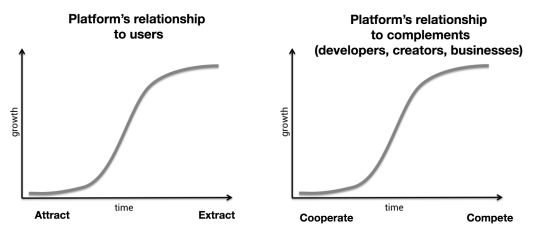
    Here are two graphs from his article:

    In the early days it’s all about cooperation and doing everything you can to attract users. The platform gets more valuable the more users are on it and so the immediate goal is to build up the network effects and lock people in.

    But as the platform grows, the relationship flips (top of the S-curve). In Dixon’s words, it becomes a zero-sum game whereby to continue growing the platform starts extracting data from its users and competing with its complements.

    The promise of cryptonetworks is that they will do away with many of these negative externalities, but at the same time empower the kind of sophistication that we see today with centralized platforms.

    The venture capitalists are circling because a fundamental shift in the architecture of the internet will mean disruption. I’m following it because I want to understand how it may apply to real estate and the built environment.