Daily insights for city builders, delivered every morning at 6 AM ET. I’m Brandon Donnelly — a Toronto-based real estate developer and founder of Globizen. I’ve been writing here since 2013.

Tag: bike share

  • Bike sharing around Toronto

    I love cycling. And I have been using Toronto’s bike share system to get around over the last few weeks (both for work and personal stuff). There’s no better way to get around when the city is busy. But it was also a reminder that we have a lot of work to do when it comes to cycling infrastructure.

    Here are a few observations:

    • The Bike Share mobile app has got to be the worst app that I have ever used. First of all, it’s called PBSC. I think this was a deliberate choice so that it’s impossible to remember and impossible to locate on your phone. Because once you do find it, it’s an awful experience.
    • I struggled to make it from downtown up to midtown a few days ago. Can I blame the Bike Share bike instead of my lack of physical conditioning? I can’t see the majority of people wanting to do this sort of ride. This is where e-bikes and e-scooters come in.
    • Many of the bikes have something wrong with them.
    • We don’t have enough bike lanes and bike-friendly streets. I know that some you don’t want to hear this. But it’s the truth. There are a lot of streets in Toronto where it is terrifying to be on a bicycle. This is true even in the center of the city.
    • If you’re not familiar with Toronto, you won’t get this point. But Queens Quay is a seemingly complicated street for many people to navigate. Cycling along here in peak summer is an exercise in dodging people as they meander across the bike lane.
    • We need dockless bikes. I’m sure that the team is doing their best to load balance across the network, but it is often a challenge to find an available dock at the end of a trip. There are ways to do this that avoid bikes being left everywhere.
    • And while we’re at it, we should also add e-scooters to our roster.

    What would you add to this list?

  • Segways, scooters, and AI-powered electric shoes

    The original Segway launched in 2000 and was supposed to revolutionize micro-mobility and the “last-mile problem” associated with getting around cities. Instead, only about 140,000 units were sold in the following two decades and, in 2020, the company stopped production on the namesake vehicle. In hindsight this seems kind of obvious. Segways are/were clunky and expensive. There’s a learning curve. And it’s infinitely difficult to look even remotely cool while riding one.

    But one thing they did get right was the problem. There was in fact a need for micro-mobility solutions, which is why we have seen bike share and e-scooter ridership grow, like this, since the late 2000’s. I think it remains to be seen just how ubiquitous things like e-scooters will become in our cities. But in 2021, there were 900,000 electric scooters sold in France alone. So we’re already doing much better than the Segway did during its lifetime.

    As I have said before, I am a big fan of electric scooters. And I wish that Toronto would stop being so conservative with allowing them in the city. But I remain open to other ideas, so here’s another last-mile solution to consider: $1,400 AI-powered electric shoes. Casey Neistat recently reviewed them in New York City and, I can safely say, that they look Segway-like in terms of their clunkiness and overall attractiveness. They’re still in the prototype phase and they do make you walk about 250% faster; but I’m not yet convinced.

    How about you?

  • Micromobility ridership in the US from 2010 to 2021

    The National Association of City Transportation Officials (NACTO) has just published this report on shared micro mobility in the US from 2010 to 2021. And it’s a good look at how this space has evolved over the years. According to the report, the first modern North American bike share system was installed in Montréal in 2009 and the first in the US was in 2010. Though a quick Google search has Washington DC claiming this title in 2008.

    Whatever the case may be, bike share ridership started somewhere around 321k per year in the US and trip volume is now close to 50 million per year. Electric scooters also joined the mix in 2018, and 2019 was a banner year for this mode of transportation. The report suggests this was due to cheap VC money subsidizing these rides. Electric scooters have seen their average trip cost 2x between 2018 ($3.50) and 2021 ($7), despite the average trip distance remaining more or less flat (1.3 to 1.2 miles).

    Naturally, the pandemic was bad for shared mobility. But it is interesting to see how much this space has rebounded and how resilient it seems to be. Prior to the pandemic, bike share usage had clear morning and evening peaks, coinciding with people commuting to work. Since then, we have seen a shift to both a wider range of trips (i.e. to do things like get groceries) and more trips throughout the day.

    To download a full copy of the report, click here.

  • Bikes and property in Paris

    I have been reading Fred Wilson’s blog for over a decade now (and he has been blogging for almost two decades). A lot of the time it is about venture capital and tech, but similar to what I do here, it can be about almost anything. Today he wrote about the two weeks that he just spent in Paris with his wife (the Gotham Gal). And the post covers everything from real estate to relationship advice. But here are two points that will be particularly relevant to what we usually talk about around here:

    • Paris has done an excellent job of prioritizing cycling and building a ton of new lanes over the last number of years. We know this. But another good point that Fred makes is that Paris has allowed competition in their micro-mobility ecosystem. It started with Velib, but now you can also use Dott and Lime. The last time I was in Paris I used Lime bikes and scooters, mostly because I already had the app and because they were everywhere. Competition is good and Toronto should probably allow the same. Our bike share system — specifically the mobile app — is incredibly cumbersome to use, and the last time I checked most of the e-bikes were consistently out of service. Let’s see if someone else can do a better job. We should, of course, also add scooters to the mix while we’re at it.
    • Next, Fred describes Paris’ real estate market as being more “stable.” And by this he means that, for whatever reason, values and rents seem to be more moderated. This has some benefits. Restaurants and other retail businesses seem to stick around for decades, whereas according to Fred, “it’s hard to find a shopping street in Manhattan that doesn’t have multiple vacant stores”. I’m not exactly sure why this is the case in Paris (assuming it is). I don’t believe that they have any sort of vacant store tax. Though they do have a tax on unoccupied homes. Maybe this is just what happens when you’re a little less capitalistic. (This is me deliberately avoiding the term socialism.)

    If any of you have more insight into the real estate market in Paris, I would love to hear from you in the comment section below.

  • Toronto’s downtown streets broke over the weekend

    Canada Day weekend was a lot of fun in Toronto. This city was alive and it felt like people had come far and wide to visit downtown. But it was a good reminder that even if all of our cars were electric and even if they were all able to drive themselves, we would still have this problem:

    I was in an Uber on Saturday afternoon heading over to the west side of downtown and we had no choice but to declare bankruptcy and hop out in the middle of Bay Street. We thought about waiting for the Ontario Line to be ready, but that seemed a bit far out.

    So we rented bikes instead and rode along the waterfront, which was a considerably better experience. But then we couldn’t find any docks with available slots, so we had to ride up into Liberty Village, drop our bikes off there, and then walk back down to Ontario Place.

    Of course, this was still the better option. I’m fairly certain that we’d still be in that Uber had we stuck it out. And maybe not finding a bike dock is just part of life in the big city on a beautiful long weekend in the summer.

    Still, it was frustrating. So I’ll use this opportunity to once again ask our city leaders to reconsider their ban on dockless electric scooters. Toronto clearly needs all the mobility support it can get.

  • Scooter trips surpassed bike share last year

    According to the National Association of City Transportation Officials (NACTO), scooter trips in the US surpassed station-based bike share trips for the first time in 2018. Here is a chart taken from Streetsblog:

    Dockless electric scooters have created a public nuisance in many of our cities, but what is clear is that the demand is there. Which perhaps isn’t all that surprising given that they require less effort than traditional cycling.

    The other interesting takeaway from NACTO’s analysis, which is likely also not that surprising, is that bike share trips are heavily concentrated in a select few cities.

    In 2018, there were about 36.5 million bike share trips across the US. And about 84% of them took place in just 6 cities: New York, Boston, Chicago, DC, Honolulu, and San Francisco.

    Almost half of the 36.5 million trips were on NYC’s Citi Bike network.

  • Inaugural meet-up: Planners on bikes getting coffee

    Remember my post from a few weeks ago about “planners on bikes getting coffee?” Well it happened. That’s the potential of blogging and Twitter. (I sold $TWTR too early.) 

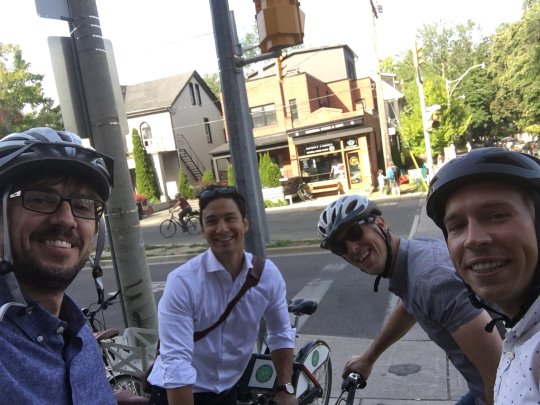
    Here is the selfie to prove it:

    Jason Thorne and I met up with Gil Meslin and Liam Hanebury (Liam needs Twitter) of Artscape and they toured us around a few of their projects, including one of their first artist live/work projects on Queen West.

    I do, however, have to confess that we didn’t have any coffee. I can’t drink coffee in the evening because it keeps me up at night. I already have too many things on my mind.

    Trying to hold a group conversation on a bike is also not as easy as talking in a car, but I would still label the inaugural session a success, even if I was posing as a planner without a bicycle helmet.

    If any of you have any suggestions for the next meet-up or I would like to join, drop me/us a line on the Twitter machine.

  • It doesn’t matter what Bitcoin is trading at right now

    Steven Johnson has a terrific piece in New York Times Magazine called: Beyond the Bitcoin Bubble. Here is a snippet:

    The only blockchain project that has crossed over into mainstream recognition so far is Bitcoin, which is in the middle of a speculative bubble that makes the 1990s internet I.P.O. frenzy look like a neighborhood garage sale. 

    But the point of the article, as its title suggests, is to talk about what all of this craziness could mean for the future of the internet and how, in some ways, it could be a return to what the internet was always intended to be.

    The real promise of these new technologies, many of their evangelists believe, lies not in displacing our currencies but in replacing much of what we now think of as the internet, while at the same time returning the online world to a more decentralized and egalitarian system. If you believe the evangelists, the blockchain is the future. But it is also a way of getting back to the internet’s roots.

    Some are calling this new, decentralized internet version 3.0. We are currently living with internet 2.0. Practically speaking though, what could this shift really mean for us?

    One example that is given in the article has to do with urban mobility – a topic that is particularly relevant to this audience. 

    Internet 2.0 has created a winner-take-most economic model. And in the case of mobility – at least in the world of apps – that winner is Uber. But with internet 3.0 and the blockchain, this could be possible:

    Just as GPS gave us a way of discovering and sharing our location, this new protocol would define a simple request: I am here and would like to go there. A distributed ledger might record all its users’ past trips, credit cards, favorite locations — all the metadata that services like Uber or Amazon use to encourage lock-in. Call it, for the sake of argument, the Transit protocol. The standards for sending a Transit request out onto the internet would be entirely open; anyone who wanted to build an app to respond to that request would be free to do so.

    Cities could build Transit apps that allowed taxi drivers to field requests. But so could bike-share collectives, or rickshaw drivers.

    I don’t know about you, but I find this perspective a lot more interesting. I recommend you read Steven’s article. It will help you cut through a lot of the Bitcoin noise.

  • Form follows parking

    “Form follows function” is a famous axiom of 20th century Modern architecture. It is based on the rational notion that architecture and its associated shapes, geometries, and spaces should be a direct result of their function. 

    It was a way of trying to eliminate the arbitrary ornament that had adorned previous architectural movements. In this case, if it had no function, then it should be stripped away.

    There have been many bastardizations of this pithy statement over time, but one of my favorites is: “form follows parking.” Obviously derogatory, it is this idea that much of the built environment is a result of parking requirements, rather than of more human factors.

    We see this in suburban building typologies (large surface parking lots), but also in urban infill projects where the below grade parking begins to dictate the structural grid and layout of the upper floors. It is, of course, necessary in many cases, but there’s also something subversive about parking having such a lasting impact on the spaces we occupy.

    That said, we know where the trend line is headed when it comes to parking. Streetblogs recently posted an article about the scarcity of parking in Manhattan and cited number of interesting stats.

    Because of the city’s bike-share program (introduced in 2013) and because of all of the bike lanes that have been added in recent years, the city has (rightly) removed approximately 2,330 on-street parking spaces in Manhattan south of 125th Street.

    Here’s another set of stats: 

    In 1998, New York City had about 810 parking lots and garages south of 60th street. Together, they accounted for approximately 112,826 parking spaces. As of last year (2016), the number of lots and garages had dropped to about 643 and the number of parking spaces to approximately 95,000. That’s a decline of about 16%, during a period of when the population of Manhattan grew by more than 100,000 people.

    I would also imagine that these pressures are increasing. So it is quite possible that “form follows parking” could be on its way toward obsolescence. I certainly feel it waning.