Daily insights for city builders, delivered every morning at 6 AM ET. I’m Brandon Donnelly — a Toronto-based real estate developer and founder of Globizen. I’ve been writing here since 2013.

Tag: athiscity

  • WeWork launches first co-living space in New York

    I’ve written about co-living spaces before – here and probably elsewhere on this blog.

    Well this morning, WeWork (the co-working startup currently valued at a cool $16 billion) unveiled its inaugural co-living space on New York’s Wall Street. It’s called WeLive and Vanity Fair describes it as “Soho House meets Airbnb meets a tricked-out Restoration Hardware storeroom, but for the Slack Set.” 

    Got it?

    Ultimately, this location at 110 Wall Street will have 600 fully furnished WeLive apartments, but they’re coming online in tranches. This first release includes 200 units. Here’s a bit of information on pricing from Fast Company:

    “There are 200 units available—ranging from $1,375 per person in shared apartments to $2,000 for an individual studio—all with the option of either a month-by-month or yearly lease (a $125 monthly fee covers amenities). The apartments are about 450 square feet on average, with the largest units topping out at 1,000 square feet (one-bedroom apartments in the area, by comparison, range in prices from about $2,850 for 451 square feet to $3,500 for 700 square feet). Each apartment comes fully furnished, minimally decorated, and set up with cable and Internet at move-in.”

    But this is not just about price. The WeLive concept is about creating a strong sense of community within the building. Every floor, for instance, has some sort of common area to foster interaction – a space for yoga classes, a laundry room with a big pool table, and so on.

    I am interested in seeing how this concept pans out because I’ve had discussions before with people in the industry about how condos/apartments might be programmed to feel a bit more like hotels. Years ago, I even spoke to a major European company about trying to pioneer a model like this.

    Because there’s something very social about being in a hotel – something that I really like. You can walk down to the lobby bar by yourself and you never know who you might meet. That’s not really the case in many multi-family buildings.

    Now, part of that might have to do with the fact that people tend to be more open when they travel. But maybe WeLive can help create that kind of social interaction within the apartment building. I think that would be a positive thing.
  • Un bosco verticale

    At the end of 2015, the Council on Tall Buildings and Urban Habitat awarded Bosco Verticale in Milan the “2015 Best Tall Building Europe” and the “2015 Best Tall Building Worldwide.” It was the 14th Annual of these awards.

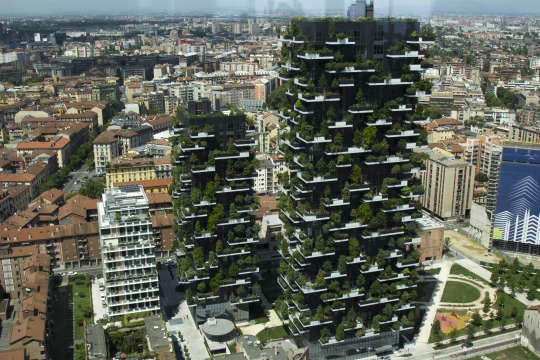
    What makes Bosco Verticale (or Vertical Forest) special is its integration of landscape into the tower building typology. In fact, the architect, Stefano Boeri, describes the project as a “skyscraper for trees that also takes humans.”

    Here is a photo of the two towers via Wikipedia:

    And here is description of the plantings via Houzz:

    “The more than 17,000 plantings include 780 full-size trees of 60 species on all sides of both towers for a suspended-garden visual effect. Among the plantings are holly oak, ornamental apple and beech trees, as well as a great mass of smaller plants, such as lavender, azaleas and camellias, positioned among the trees with taller crowns. The plantings provide shade in summer and help filter the air. The number of trees in each building is the equivalent of 1.7 acres of forestland and 18.5 acres of an urban area with single-family dwellings. The vegetation is watered with a greywater filtration system.”

    This idea is something that has appeared a lot in theoretical projects. But it is still in its infancy in terms of realized projects. So the architect has also published a book explaining – using drawings and photos – how the project works and how it could be reproduced in other cities. It’s in both Italian and English.

    With so many cities trying to build up, as opposed to out, it makes a lot of sense for us to figure out how to make up as livable, enjoyable, and sustainable as possible.

    Photo by Luca Nebuloni from Milan, Italy – Milan_7899, CC BY 2.0, Wikipedia

  • Young, rich, childless, and white

    Whenever I’m not sure what to write about, I just read. That’s one of the big benefits of daily blogging – it forces me to do that.

    This morning I stumbled upon the blog of Jed Kolko. Jed is an economist and, up until 2015, he was Chief Economist and VP of Analytics at Trulia.

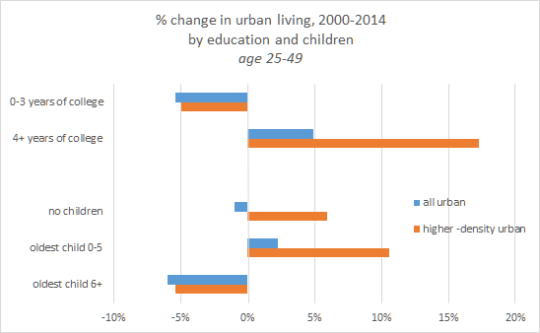
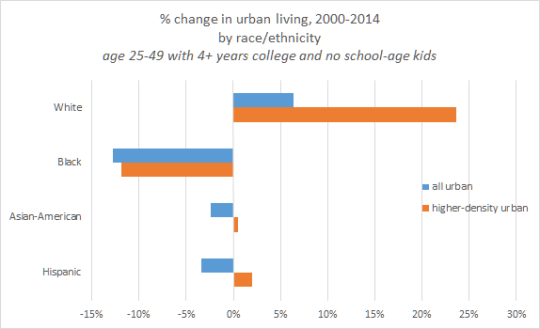
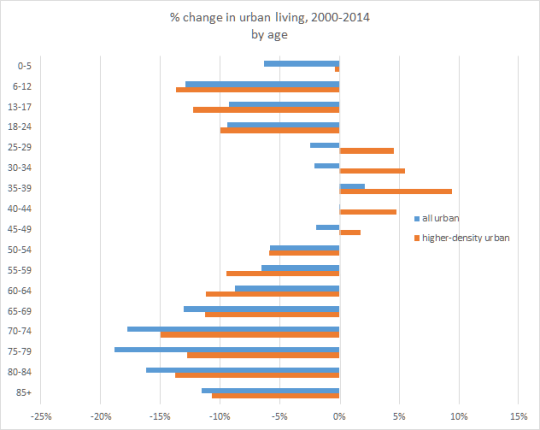
    His most recent post argues – naturally with lots of data and charts – that for all of our talk of (re)urbanization, it’s actually a specific subset of the population that is far more likely to be have urbanized between 2000 and 2014: the young, rich, childless, and white. (Note: His post is talking specifically about U.S. cities.) 

    Below are a few of his charts. 

    In all cases, the x-axis represents % change in urban living between 2000 and 2014. All of the data is from Public Use Microdata Samples (PUMS) – 2000 decennial Census and from the 2014 one-year American Community Survey (ACS).

    Here is age:

    image

    Household income:

    image

    Education and children:

    image

    And here is race/ethnicity:

    image

  • Getting older

    Yesterday I promised that today’s post would be less sad. I am sticking to that promise, but I am also sticking with a somewhat similar theme: getting older.

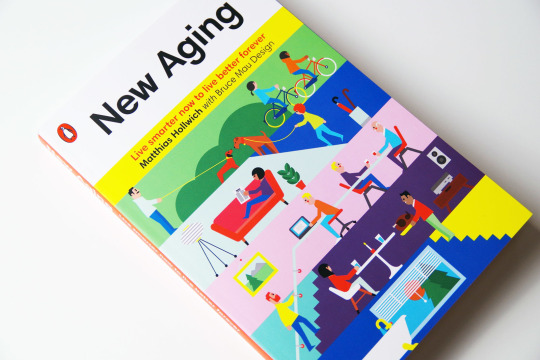
    Fast Company recently published an interview with New York-based architect Matthias Hollwich. The topic is aging and the kinds of spaces that we have created for people as they age: retirement communities, nursing homes, and so on.

    The reason this is getting airtime right now is because Matthias has just published a book on the topic called, New Aging: Live smarter now to live better forever

    image

    But this isn’t a new focus. Matthias actually taught at the University of Pennsylvania while I was there and I remember his design studio being focused on this topic. (I wasn’t in his studio, unfortunately.)

    The sound bite that I really like from the interview is this one:

    “I think the biggest flaw is that it’s age segregation. You take all of the people who are above 75, 85, or 95, depending on what type of environment it is, and put them into one place. And then you’re just surrounded by old people, people who have social and physical challenges, and you’re not around the vibrancy of a multi-age environment, which is something that we experience all life long. I think that is something that society really has to rethink.”

    Not only do I agree with him, but I think it exemplifies one of the things that I love about architecture. The idea that the way things are done today is usually not some sort of universal truth. Instead, everything can be questioned, rethought, and reinvented for the better. It’s a very entrepreneurial way of operating and I don’t think that parallel, between entrepreneurs and architects, is drawn or leveraged nearly enough.

    I also don’t think we’ve given enough design consideration to this topic of aging. I mean, why can’t the spaces that people end their lives in be as (or more) sexy and enjoyable as (or than) the spaces they live the rest of their lives in? That’s what I want when I’m 95.

    So kudos to Mattias and the rest of the team at Hollwich Kushner (his firm) for caring about and working on this

    Book image from Matthias Hollwich’s Facebook.

  • Zaha Hadid dies at 65

    Today the world lost one of the most important architects of our time: Zaha Hadid. She was only 65.

    But the thing about architects, particularly famous “starchitects” such as Zaha Hadid, is that when they pass, they leave behind a rich legacy through their buildings. So probably the best way to write a sad post like this one is to just share her work. Courtesy of the Guardian (she was an Iraqi-British architect after all), here are: Zaha Hadid’s 10 best buildings in pictures.

    I did, however, want to add a few more thoughts. 

    When I found out about her death I was sitting in the St. Lawrence Market having lunch. I had my phone out and the news had completely flooded my social feeds. I immediately started messaging a few people because, well, she was Zaha Hadid – a figure you don’t go through architecture school not talking about. But it also hit me because she was only 65. This is the age that some people retire at. It’s the age that some people work their entire lives for.

    Whenever this happens I can’t help but think to myself: Why are we so afraid of risks? (I know that this is part of the reason.) And are we even focused on the right risks? So many of us are afraid of sticking our neck out and potentially failing, and yet we all have an expiry date, which means there’s the big risk of potentially dying without having done all the things we want to do. Logically, this should probably be the greater risk.

    I realize that this may sound a bit trite, but it feels appropriate. Zaha Hadid took big risks. Her architecture was way out there and that meant she struggled early on. Not only was she a female in a male dominated industry (she was the first woman to win the Pritzker Prize), but her work carved out an entirely new architectural language. She embedded technology into the world of architecture – something we talk a lot about on this blog.

    The sad thing about death – besides the obvious death part – is that it can take someone dying to remind you of the shortness of life. So to end, I’m going to leave you all with an excerpt from a recent essay by Paul Graham aptly called, Life is Short.

    “If life is short, we should expect its shortness to take us by surprise. And that is just what tends to happen. You take things for granted, and then they’re gone. You think you can always write that book, or climb that mountain, or whatever, and then you realize the window has closed. The saddest windows close when other people die. Their lives are short too. After my mother died, I wished I’d spent more time with her. I lived as if she’d always be there. And in her typical quiet way she encouraged that illusion. But an illusion it was. I think a lot of people make the same mistake I did.”

    I promise that tomorrow’s post will be less sad.

  • Moving to the big city

    When I was 18 years old, I
    moved from the suburbs of Toronto to Waterloo, Ontario, which is about an hour
    west of the city.

    I largely did this for two reasons.

    Firstly, I had started
    visiting friends at both Wilfrid Laurier University and the University of
    Waterloo while I was in high school, and I thought that I wanted
    that kind of University town experience.

    Secondly,
    I started University as a Computer Science student and I figured that Waterloo
    was a pretty good place to study that. Research In Motion (later renamed to
    Blackberry) was an important company at the time and interesting things were happening.

    Though
    to be clear, I was a student at Laurier and not at the University of Waterloo – the better of the two schools for Computer Science – because I didn’t have
    the grades for the latter.

    But a
    funny thing ended up happening. I hated living in Waterloo. I felt so out of
    place. So much so that I spent every weekend back in Toronto visiting my
    friends who had instead decided to go to the University of Toronto.

    And I
    remember vividly how I felt during those weekends. I would stand in my friend’s
    apartments – most of which had dens and solariums that were hacked into
    bedrooms so that they could afford to live there – and I would look across the skyline and
    think to myself: why the hell do I not live here?

    So I
    transferred to the University of Toronto. And that solved that.

    The
    reason I bring up this story today is that I was reminded of it while reading a recent CityLab article by Richard Florida called, The
    Self-Confident City
    .

    The three
    main arguments in the article are:

    (1) Where
    we choose to live has a massive impact on our life outcomes.

    (2) Self-confident
    people – according to a recent study – seem to be drawn to big cities.

    (3)
    Self-confidence can also be a self-fulfilling prophecy
    for people in big cities.

    Now,
    I don’t know if it was really self-confidence and youthful hubris that told me I needed to live in a bigger city than Waterloo. (It was probably part of it.) All I know is that I
    wanted to live in a super dynamic place that felt bigger than me. I wanted to
    feel like I was a small fish in a big pond trying to make some sort of
    meaningful dent.

    That
    was true for me when I was 18. And it remains true for me today at 32.

  • The Death and Life of Great Italian Cities

    image

    I am sure that a lot of you know where the title of this post comes from. It’s a riff on one of the most important and influential books in the world of city planning: The Death and Life of Great American Cities by Jane Jacobs (1961).

    But when Jane Jacobs first wrote this book, there was no such thing as smartphones and nobody was “checking-in” to hipster dive bars on Foursquare

    So instead of leveraging big data, her analyses and arguments were based on observation. She walked the streets of New York and Toronto and figured out what made cities thrive and what made cities die. That was her brilliance.

    Today, however, we have data – lots of it. And so recently, a group of researchers set out to test Jane Jacob’s theories using mobile phone data. The study was called, The Death and Life of Great Italian Cities:
    A Mobile Phone Data Perspective
    .

    More specifically, they set out to test the following 4 essential conditions:

    “She [Jane Jacobs] argued that, to promote urban life in large cities, the physical environment should be characterized by diversity at both the district and street level. Diversity, in turn, requires four essential conditions: (i) mixed land uses, that is, districts should serve more than two primary functions, and that would attract people who have different purposes; (ii) small blocks, which promote contact opportunities among people; (iii) buildings diverse in terms of age and form, which make it possible to mix high-rent and low-rent tenants; and (iv) sufficient dense concentration of people and buildings.”

    To accomplish this, the team assembled and studied data from the following sources:

    • Mobile phone activity (specifically internet activity)
    • OpenStreetsMap Data
    • Census Data
    • Land Use Information
    • Infrastructure Data
    • Foursquare Data (Venues API)

    Ultimately, they determined that Jane Jacobs knew what she was talking about. The above conditions are essential to urban vibrancy and they apply to Italian cities, just as they did and do to American cities. But this test was valuable, because the more that we can measure and quantify cities, the better I think we’ll get at creating and promoting urban vitality. 

    Now imagine if you overlaid the findings of their report with residential and commercial rents. I bet you’d also find that there’s a strong business case for urban vitality.

    I’ve heard a number of people say that, eventually, every company will be a software/technology company. And I don’t think we’re far off from that reality. To me, this study feels like an early example of what that might look like for city building.

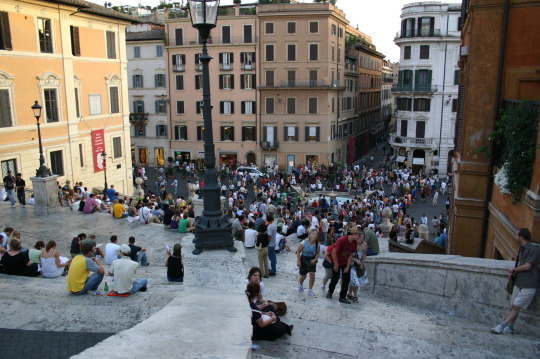
    On a side note, the picture at the top of this post is of the Spanish Steps in Rome. I took it on a weekend trip in 2007. I was living in Dublin at the time.

  • Why pessimism sounds so smart

    Tom Gardner and Morgan Housel (The Motley Fool) recently published a LinkedIn article called, Why Does Pessimism Sound So Smart? (Especially When Things Are So Good.)

    Here is the gist of it:

    If you say the world has been getting better you may get away with being called naïve and insensitive. If you say the world is going to go on getting better, you are considered embarrassingly mad. If, on the other hand, you say catastrophe is imminent, you may expect a McArthur genius award or even the Nobel Peace Prize.

    Part of the reason for this is that we, as humans, respond more strongly to losses:

    There’s clearly more at stake with pessimism. Daniel Kahneman won the Nobel Prize for showing that people respond more strongly to loss than gain. It’s an evolutionary shield: “Organisms that treat threats as more urgent than opportunities have a better chance to survive and reproduce,” Kahneman once wrote.

    The behavioural economic theory being referred to above is called Prospect Theory. I wrote about this back in the fall of 2013 and made the argument that Prospect Theory might explain why NIMBYISM is so common in city building. 

    Change to our communities is perceived as risky. And in the face of these uncertain situations, we tend to place more emphasis on the potential losses (traffic, congestion, shadowing, and so on) rather than the potential gains (increased vibrancy, improved streetscape, creation of more housing, and so on). It’s human nature.

    Having said all this, I show up here every day and try to make this blog a positive place on the internet. Sure, I make suggestions about things I think we should do, but I generally focus on them as opportunities. Hopefully that comes through, because I’m a big fan of optimism.

  • Prerequisites for a successful pedestrian-only street

    image

    A few of us had a really great discussion on Twitter recently about pedestrian-only streets. It was kicked-off by a tweet about Spark Street Mall in Ottawa, which many argue needs a rethink.

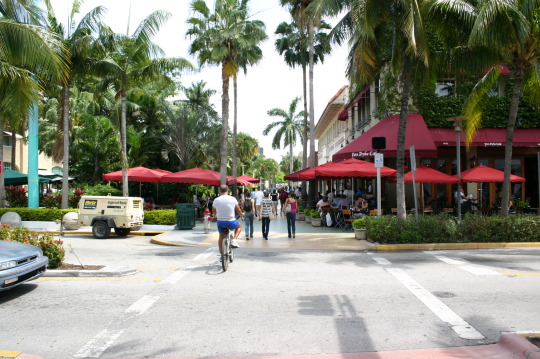
    One of the comments was that a lot of people tend to overvalue their worth. And I will admit that I am probably one of those people. If you’ve ever visited places like Grafton Street in Dublin, Lincoln Road in Miami Beach, or Kensington Market in Toronto on a pedestrian Sunday, you can’t help but think to yourself: why don’t we do more of this? They’re such great places to be.

    But the research suggests that these success stories are few and far between. 

    Below are the key findings from a report that was shared on Twitter during our discussion. It’s by Cole E. Judge and it’s called, The Experiment of American Pedestrian Malls: Trends Analysis, Necessary Indicators for Success and Recommendations for Fresno’s Fulton Mall.

    – Pedestrian malls in the United States have an 89% rate of failure. Most have been removed or repurposed. Only 11% have been successful.

    – Of the 11% successful pedestrian malls, 80% are in areas with populations under 100,000.

    – Certain indicators need to be present for a pedestrian mall to be successful in the United States: near or attached to a major anchor such as a university, situated in close proximity to a beach, designed to be a short length in terms of blocks, in a town/city with a population under 100,000, and/or located in a major tourist location such as Las Vegas or New Orleans.

    – Cities that have embraced the Main Street and Complete Streets models have experienced turn-arounds in their downtowns with more investment, higher occupancy rates and more pedestrian traffic.

    Though the report lists proximity to a beach as helping pedestrian malls, this is more about having a strong anchor than it is about climate – which is a commonly held excuse for why they don’t work. The report cites lots of failed pedestrian malls in California.

    Furthermore, if you look at the list of successful pedestrian malls, about half of them are in colder climates. And if you search the report for the word “weather” it only comes up once. The word “climate” doesn’t come up at all. 

    So I don’t believe that they’re not possible in colder climates. Ski resorts, for example, usually have great pedestrian-only spaces because they have a strong anchor – the mountain.

    But I do agree that pedestrian-only streets aren’t possible everywhere. And the more I think about this topic, the more I agree that we are overvaluing pedestrian-only. I guess that’s why our focus today is more on complete streets.

  • Why Toronto needs a night mayor

    Recently I wrote about the first Night Mayor Summit being held in Amsterdam. As part of this, I spoke about Amsterdam’s first night mayor – Mirik Milan.

    Since then (but obviously not because of my post), the idea has seemingly taken off. Below are a couple of excerpts from a recent Guardian article.

    This pragmatic and classically Dutch notion is now being copied across Europe: Toulouse, Zurich, Paris as well as several other Dutch cities have night mayors too.

    This week the mayor of London, Boris Johnson, announced plans for a “Night-Time Commission”, a six-month assessment of how to protect and manage the city’s £66bn night-time economy which is likely to recommend the creation of a “night-time champion” role. 

    Berlin is considering it too, and in April, Amsterdam will host the first global Night Mayors’ Summit.

    Why is this happening? Simple:

    “Late-night people are typically young, educated, creative, entrepreneurial – people you want in your city, and who work in the creative industries and startups you also want. If places like Berlin have flourished, it’s not just because of low rents. It’s because they’re nightlife capitals.”

    So if you’re reading this, Mayor John Tory, now is probably your last chance to make Toronto a North American leader in this regard. 

    It’s great that we are trying to push the Toronto – Waterloo region as a global startup hub, but so is every other major city and region in the world. A focus on startups is so commonplace in today’s economic development strategies, that at this point it almost feels meaningless. What are we going to do to stand out in this competition for the world’s best talent?

    If everyone believes something to be true – such as, there’s value in having a robust startup ecosystem – then it’s no longer innovative. It’s just the way things are. To take it to the next level, we’re going to have to do things that will probably feel uncomfortable at first – particularly for old establishment Toronto.

    I’m not saying that having a night mayor is going to be the silver bullet for our startup ecosystem. There’s no such thing. But I am saying that it should be one component of our larger strategy. 

    Because already there’s a growing number of European cities who have come to this one simple realization: people are drawn to kickass places.

    If you agree with this post, I would encourage you to leave a comment below and also tweet the Mayor of Toronto.

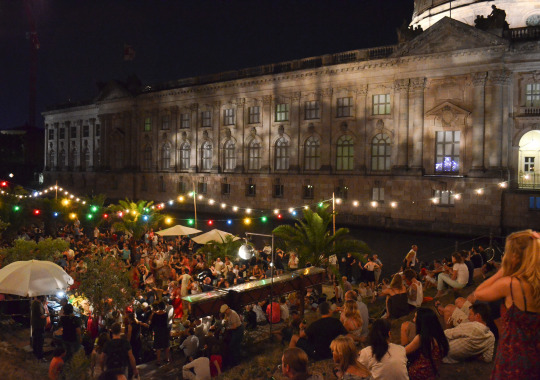
    Image: Berlin nightlife by Tom Stromer