Daily insights for city builders, delivered every morning at 6 AM ET. I’m Brandon Donnelly — a Toronto-based real estate developer and founder of Globizen. I’ve been writing here since 2013.

Tag: atc

  • Big cities have rebounded the fastest since 2008

    Josh Lehner of the Oregon Office of Economic Analysis published a study earlier this summer where he looked at employment growth according to city size across the US.

    What he found since the Great Recession of 2008-2010 is that larger metros – with populations greater than 1 million people – have rebounded the fastest. They are shown in the light blue line below:
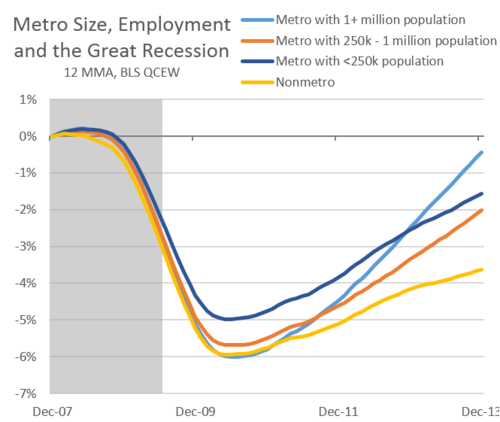
    According to Josh:

    This is at least partially due to the fact that all those good economic things — agglomeration effects, knowledge spillovers, clustering, etc — happen in certain locations, which are usually bigger cities.

    However, if you go back to the 1980s, you find that this trend isn’t consistent. Large metros outperformed in the late 90s. But they were more or less on par with smaller metros during the housing boom of the early 2000s and actually under performed in the early 90s recession.
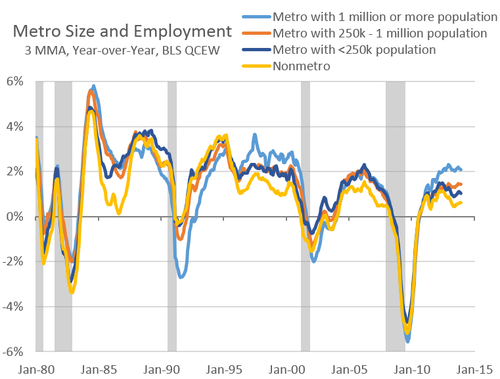
    One possible explanation for this – which Josh proposes – is that the recent housing boom acted as a sort of equalizer for smaller metros. It created stronger population growth outside of the bigger cities.

    I buy that.

    But then does that mean that going forward big cities will continue to outperform? Is this going to be more or less the new norm? Intuitively, I would think yes.

    You can find Josh’s blog post, here. Richard Florida also wrote one for CityLab, here.

  • The will to try new things

    image

    I’m a big fan of wine. But in particular, I like and I support Ontario wines. And last night I was in Niagara-on-the-Lake for the Stratus Vineyards annual harvest party. It happens every year and, as the name suggests, it kind of marks the end of the growing season for the vineyard. I say kind of because not all varietals have been harvested by this time.

    At one point during the evening, I was speaking with the winemaker, J-L (Jean-Laurent) Groux, who is a native of the Loire Valley in France and first learned how to make wine in Burgundy and Bordeaux. And I asked him: why Niagara? Why did you bring your talent to Niagara? (When he came, Niagara would have had a great reputation for crappy wines.)

    He first responded by saying that he had been traveling around the world to different wine regions, and Niagara just so happened to be where he was when he ran out of money. But he went on to say that he saw Niagara as a place of opportunity. It was a region on the rise and he knew that he would have the creative freedom to experiment and do whatever he wanted.

    And that just wasn’t the case in France where tradition dictated. Good for Niagara.

    But as he was telling me all of this, I couldn’t help but think that it’s the classic business story of incumbents and disruptors. I’m not saying that French winemaking will get disrupted. I’m just saying that in a world of established wineries, corporations and other groups, it would seem impossible for them to be threatened in any way by upstarts. They, the incumbents, have more money, more people, and more resources all around.

    But what they sometimes lose along the way, is the will to try new things.

  • The story of two urban giants

    This morning I stumbled upon an interesting documentary (via The Urbanophile) about two New York skyscrapers that were built in the 1930s as telecommunications buildings: the Western Union Building and the AT&T Long Lines Building. It’s fascinating to see how they have evolved along with technological change. Click here if you can’t see the video below. It’s only 8 minutes long.

    //player.vimeo.com/video/97945495

  • London garage to sell for £550,000

    image

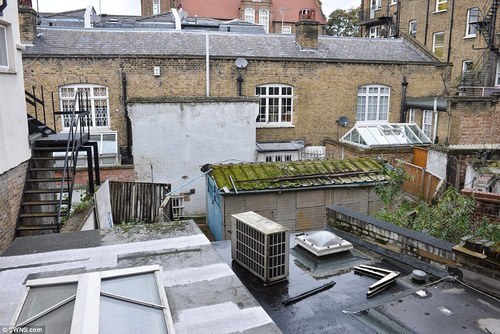
    The garage shown above (with the pseudo green roof) is located in the Chelsea neighborhood of London. It measures about 11’ x 7’ and it – along with the site it sits on – is about to go up for auction.

    It’s expected to go for more than £550,000 according to the DailyMail UK, which would make it the most expensive garage ever sold in the UK. The site area is 535 square foot – about the size of an average 1 bedroom condo in Toronto.

    Below is an aerial view of the site. It basically looks to be residual land.

    image

    But as awkward as this site might appear, the expected value is being driven by the fact that planning permissions were granted to turn it into this:

    image

    It’s a 2 bedroom house that feels a lot like a laneway house. It certainly fits the description of “a house behind a house”, which is often how laneway housing gets described here in Toronto.

    I wanted to share it because it supports my belief that, sooner or later, Toronto will come around to laneway housing. As property prices rise and affordability continues to erode, people will – quite justifiably – start looking in all sorts of new places for a decent urban home.

    Many thanks to my friend Adrian for sending me the link.

  • Avoiding driving

    If you’ve been reading Architect This City since last winter, you might know that every year I go on one big snowboard trip with a group of guys I went to grad school with at Penn. Last year we went to Jackson Hole and Vail, and this year the plan is to go to Banff and Revelstoke.

    We start planning it by the fall and so already we’ve been trying to sort out the details for this winter’s trip. But as we finalize the plans, one thing I’ve noticed is how I’ve automatically been trying to minimize the amount of driving that we’ll need to do. In fact, in a perfect world, we wouldn’t have to rent a car at all.

    Now, small mountain towns aren’t usually the best for public transit, but there are often ways to get around that. When we were in Jackson, we took the public bus to get to the mountain every day, as did most people who lived or stayed in town.

    This winter, the plan is to fly into Calgary and stay in Banff for the first leg of the trip. So I’ve been trying to figure out if there’s a train that can get us from Calgary to Banff and which hotels offer shuttle buses to the mountains. Because I’d rather not drive, and I know many of my friends feel the same way. It’s an added cost and it gets in the way of après ski.

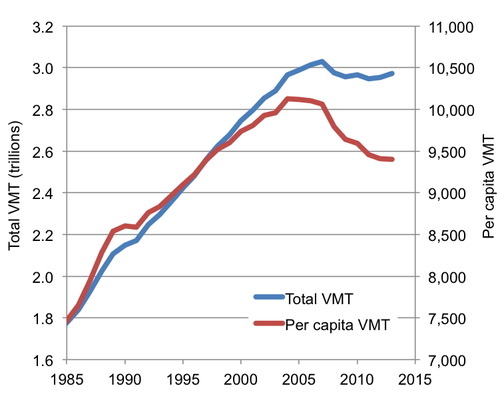
    What’s interesting about this, is that not only do I try and minimize the amount of driving I do here in Toronto, but I do it when I travel as well. And if you’ve been following the macro trends, you might know that many other people feel the same way. That’s why total Vehicle Miles Traveled in the US has been in falling since about the mid-2000s:

    image

    People are falling out of love with driving, and many believe that this shift is permanent. Here’s a recent report from the US PIRG Education Fund talking about just that:

    //platform.twitter.com/widgets.js

    I also think this shift is permanent – until maybe the nature of driving changes and cars start driving themselves. But at that point, it won’t be called driving anymore and there will probably be many other changes. So on this rainy Wednesday morning, my big bold prediction is that future generations will no longer drive.

    What do you think?

  • Flux launches Austin Preview to help streamline development

    image

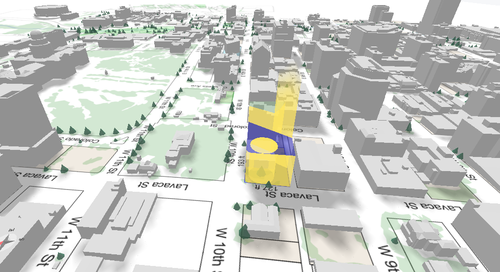
    I recently wrote about a startup called Flux.io in a post titled: How technology could completely change the real estate development industry. Given that I received a lot of positive feedback on this post, I thought I would let you all know that, as of today, you can now test out the product yourself for free online.

    Here are a few snippets from today’s announcement:

    At Flux we believe that data, analytics, and visualization can help bridge understanding between stakeholders and result in smarter growth and faster development and faster building. The Austin Preview of Flux Metro is an important first step in this direction.

    Flux Metro aggregates geographic data from public and private sources to build a three dimensional visualization, starting with downtown Austin. Alongside a rendering of the existing landscape, Metro shows what can be built on a lot or parcel under the zoning code. It considers more than 10,000 code sections for land use guidelines, height limits, floor area limits, setbacks, and view access rights as well as the locations of protected trees and daylight shadows to project what can be built and how it fits into the existing environment.

    We believe that everybody should be able to understand what a zoning code means for their city and that visual representations are the best way to create a shared understanding.

    Click here to signup and give it a try. It is based on Austin’s development code and on the same building site that was shown in the video I shared in my post.

    Image: Flux

  • Multi-modal cities are the new reality

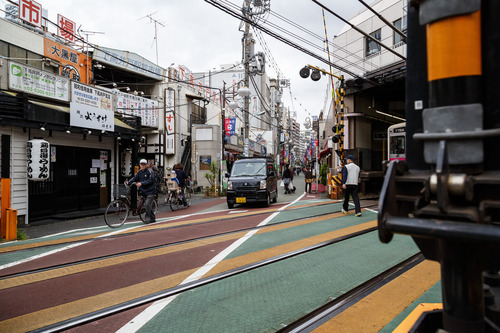
    CityLab published an article last week on multi-modal cities that caught my attention (because it used a picture of Toronto with about 3 or 4 streetcars stacked up along Queen Street). The premise of the article is that all of this car vs. transit debate is actually missing the bigger picture: our cities are multi-modal and we need to be planning for that.

    That’s not to say that the shift away from cars isn’t a good thing. It is. But it’s not as simple as saying that, instead of driving, people should now only take transit. In today’s cities people walk, bike, take streetcars, take buses, take subways, take taxis, take private shuttles, use Uber, and, yes, they still drive.

    From my own experience, this is absolutely how I get around Toronto today. I walk to the gym. I ride my bike whenever I’m going somewhere downtown. I take the subway to my office in midtown because it’s far and I would be too sweaty if I biked there. I use Uber and Hailo when I’m going out at night. And I drive when I need to go to the suburbs or leave the city.

    But the key takeaway here is that we now have a much tougher challenge on our hands. When we were only optimizing for cars – however detrimental to our cities that was – we only had one mode to plan for. Now we have several. Some of which are public and some of which are private.

    However we also have access to technologies that we didn’t have before. We are networked in ways that weren’t possible before and we’re at the dawn of many profound mobility changes, such as driverless cars. (Have you read about Tesla’s new Autopilot feature yet?)

    So as I’ve said before, I really believe that we need to look at this, not as a war on the car, but as a war on inefficiency. The problem we are trying to solve relates to mobility: What’s the best way to move lots of people around dense urban regions? Stop focusing so much on the technologies and focus more on the people.

    Image: Flickr

  • Doing new things

    image

    I just finished reading Peter Thiel’s new book, Zero to One: Notes on Startups, or How to Build the Future. For those of you who may not be well-versed in the world of technology geeks, Peter Thiel is an entrepreneur and investor. He was one of the founders of PayPal back in 1998 and was the first outside investor in Facebook in 2004. He invested $500,000 for a 10.2% stake in the company!

    While the focus of the book is obviously on technology startups, it’s less about “here’s how you build a startup” (there is no formula) and more about “here’s how to think about the world, humanity, and the future of our civilization.” So even if you’re not a founder, or startup and technology enthusiast, I think you’d still find it really interesting.

    As one example, Thiel makes the distinction early on in the book between what he calls “vertical or intensive progress” and “horizontal or extensive progress.” The specific example he gives is of typewriters and word processors. If you take one typewriter and figure out how to make 100 of them, you’ve made horizontal progress. However, if you’ve just replaced typewriters with word processors, you’ve made vertical progress.

    In other words, vertical progress is doing new things and horizontal progress is just copying things that we know already work. In the grand scheme of the world, he argues that globalization is really just a form of horizontal progress. The rise of China is a result of them copying what has already worked in developed countries. But the true way to advance our economy and civilization is to not just copy – that’s easy – it’s to do, new, things.

    That, of course, is a lot harder to do. But to build the future, you need to build things and do things that haven’t been done before.

    Which is why Thiel actually gives $100,000 to a handful of college students every year so that they can drop-out and pursue a startup. In his mind, our education system is just perpetuating the status quo. MBAs move money around without creating anything new. Lawyers just preserve value and mitigate risk, also without creating anything new (Thiel is trained as a lawyer). And so he doesn’t believe that is the best way forward.

    This may not sit right with many of you, but questioning the status quo is a prerequisite if you’re trying to do new things.

  • A video of Melbourne’s laneways

    Yesterday UrbanToronto.ca published a post talking about Melbourne’s laneways (something I also wrote about here on ATC a few months ago). As part of their post, they included the video that I’ve embedded below. I think it does a good job of showing the vibe and energy in these repurposed laneways, and so I wanted to share it with you all as well. What are your thoughts on these spaces? I think they’re great.

    If you can’t see the video below, click here.

    [youtube https://www.youtube.com/watch?v=j-Qb31cUyRE]

  • Revisiting Charlotte

    image

    Earlier this week, I wrote about the Charlotte Apartments in Berlin and tried to back into some of the numbers for the project. I wanted to compare the economics behind a mid-rise project in Berlin to one in Toronto.

    After I wrote that post I forwarded it to Michels Architecture – who are the architects behind the project. I thought they might be interested in reading about my (crappy) back of the napkin type of assessment and I was also hoping that they might be able to shed some additional light on the details.

    Well, they responded and graciously offered to do exactly that. So today I thought I would write a follow-up post with some additional details. I obviously don’t have everything – because they weren’t the developer for the project – but I still think you’ll find the information I got interesting.

    The building has a total of 3 parking spots and they’re all on the ground floor (you can see them in this post in the second photo towards the right). They were for the penthouse maisonette/duplex units. This means that there’s only one level below grade and it’s basically for mechanical systems, storage, and waste disposal. So why does this matter?

    It matters because it means lower construction costs and the ability to develop smaller sites where you may not be able to properly layout a parking garage without car elevators and other clever strategies. This is possible because, unlike Toronto, Berlin doesn’t have any parking minimums or maximums

    With respect to unit sizes, the penthouse units are 135 square meters or 1,453 square feet which, according to the architect, are small. From the 2nd to 6th floor, there are 4 units per floor and the sizes are 37 sm / 398 sf, 65 sm / 699 sf, 68 sm / 732 sf, and 81 sm / 872 sf. On the ground floor there are 5 units and they’re at 34 sm / 366 sf (x 2), 42 sm / 452 sf, 45 sm / 484 sf, and 76 sm / 818 sf. I would say that this is comparable to what you might find in a downtown Toronto condo project. Side note: Apparently the smallest units sold the quickest.

    As of December 2011, the average sale price was 4,120 € per square meter. At today’s exchange rate, that would convert to $5,815 per square meter or $540 per square foot (in Canadian dollars). If we translate that into 2014 dollars, that’s about $575 per square foot, which would be low for prime locations/buildings in Toronto.

    A big thanks to Michels Architecture for providing this additional information. It’s always great to get local insights. I hope you all enjoyed it – happy Friday.

    Images: Werner Huthmacher