Daily insights for city builders, delivered every morning at 6 AM ET. I’m Brandon Donnelly — a Toronto-based real estate developer and founder of Globizen. I’ve been writing here since 2013.

Tag: atc

  • The threat to big box retailing

    image

    Earlier this week, I was having a conversation with a number of smart real estate people about the future of retail in today’s internet and smartphone world. This, of course, isn’t a new topic. The industry has been discussing it for years. And while internet retailing still accounts for a relatively small percentage of overall retail sales (~10%), we all know that change is coming.

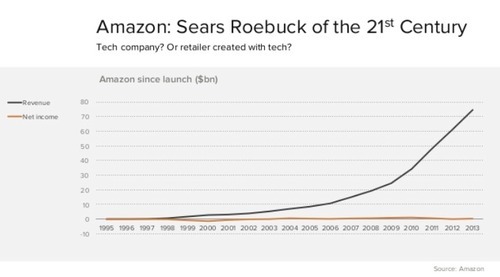
    One company that came up during our discussion was not surprisingly Amazon.com. But the initial comment was that they don’t make any money. Fortunately for me I had just gone through a presentation by venture capitalist Benedict Evans the night before called: Mobile is eating the world. And so I pulled out my phone and presented this slide:
    image

    The fact that Amazon operates with basically no net income is on purpose. Look at their revenue growth! So I wouldn’t dismiss them as being a fad. They may only account for 1% of all US retail sales today, but I’d put money on that percentage growing.

    The other reason I bring up Amazon is because, in some ways, I think of them as the online equivalent of a big box store. Just like a Walmart or Costco, where you can buy everything from tires to groceries to prescription drugs, I buy a lot of different things, besides just books, off of Amazon.com. You might do the same as well. And this is where I see the immediate threat to offline retailing and retail real estate: big box stores.

    In the second half of the 20th century, big box stores were incredibly disruptive to the retail landscape (and to cities). They used cheap land on the outskirts of cities, cheap buildings, and economies of scale to offer rock bottom prices to consumers. The value proposition was about cheap, not about differentiation. But as cheap as they may be, the internet can still do it cheaper.

    And retailers know this, which is why I think they all now sell groceries. Groceries have a very low online penetration. Basically everybody still buys groceries in-person. So if you offer that, you have a reason to draw people inside your store, where they will hopefully buy all the other stuff that they need. But as the online value proposition continues to get stronger, I think we’ll see many other, more significant, changes.

    Image: Flickr
  • In search of affordable housing

    Earlier this week I stumbled upon this entertaining article from the Guardian talking about how expensive housing is in London. The author’s tongue-in-cheek suggestion was to setup a new miniature London in the middle of nowhere where everyone could flock for affordable housing, but where many of London’s attributes could be exported: “We can all refuse to wear socks and sell each other overpriced cocktails in jam jars.”

    All joking aside, the article is yet another reminder that big global cities are expensive places to live. And in these cities, one of the most precious commodities is, quite simply, personal space. That’s why a garage in London can sell for £550,000 and why a 35 square foot storage cage in New York can sell for $75,000

    But affordable housing is not the reason why people want to live in places like London and New York. If it were, they wouldn’t be coming. Instead, they come for lifestyle, wealth creation, and the dating market – among other things. However, at a certain point, usually when they form families and start to need/want more space, they start looking around.

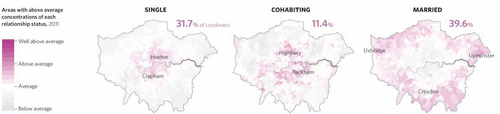
    Here’s an infographic via the Atlantic showing how relationship status impacts where people tend to live in London. The purple areas indicate an “above average concentration” of a particular relationship status. As you can see, single people tend to live in the core of the city, and when they get married, they move out to the periphery. Intuitively, this probably makes sense to you.

    image

    However, I’m always curious as to whether this trend happens more because of consumer preference (people don’t want to raise kids downtown) or because of economic necessity (they can’t afford anything beyond a shoe box apartment). Because if it is largely out of economic necessity (and the Guardian article would suggest it is), then we’re not creating the inclusive cities and neighborhoods that all city builders like to talk about.

    So how do we get better at this?

    In my view, and I’ve argued this before, the first step should be about improving supply. That is: get more housing built. And the way to start doing that is to make land available and improve the approvals process for new developments. In a recent McKinsey report, they referred to my first point as “unlocking land.”

    “Land cost often is the single biggest factor in improving the economics of affordable housing development. It is not uncommon for land costs to exceed 40 percent of total property prices, and in some large cities, land can be as much as 80 percent of property cost.”

    The reason this is important is because most big cities operate with massive supply deficits. There simply isn’t enough housing. And so if you can address that at a fundamental level, you can actually do a lot to start improving affordability.

  • The first summit on laneways

    image

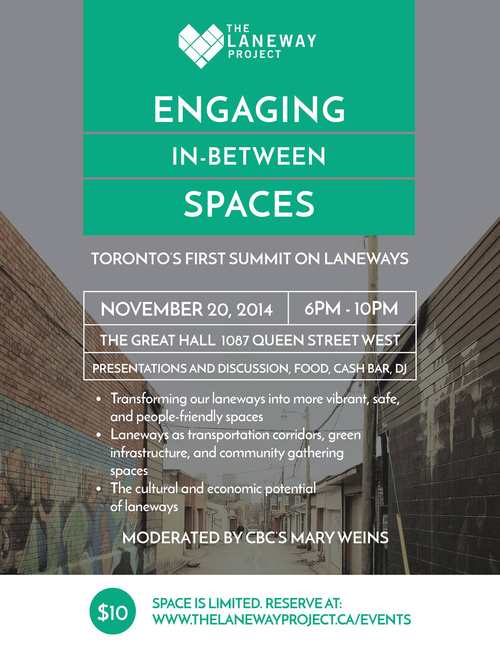
    Last month I wrote about an upcoming city building event in Toronto called called Engaging In-Between Spaces. It’s being hosted by a non-profit group called The Laneway Project and it’s going to be this city’s “first summit on laneways.”

    While many people associate the potential of Toronto’s laneways with laneway housing, the focus of this event will be on laneways in a much broader context. Laneway housing will certainly be a part of it, but the event will also look at our laneways as public spaces, gathering spaces, and so on.

    I’m going to be giving a short presentation that looks at Toronto’s laneways from a real estate development perspective, and so I hope that you’ll be able to attend. The event is only $10 and the money will help support the group’s mission of transforming our laneways into vibrant, safe, and people-friendly spaces. 

    Click here to reserve your spot. And if you are attending, please tweet me so that we can connect at the event!

  • How Toronto voted

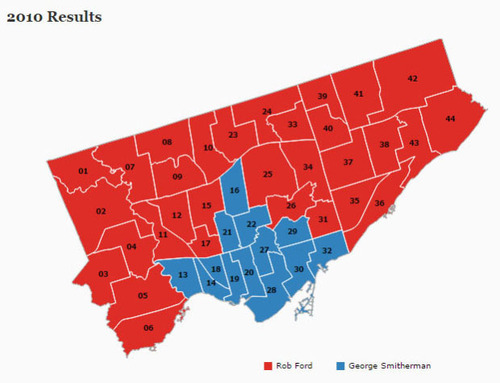
    In 2010, Toronto voted for its new mayor, Rob Ford, like so:

    image

    It was basically the core of the city (old Toronto) versus all of the boroughs. And it was perfect ammunition for anyone who believed that Toronto’s amalgamation was a mistake. (I personally don’t think it was.)

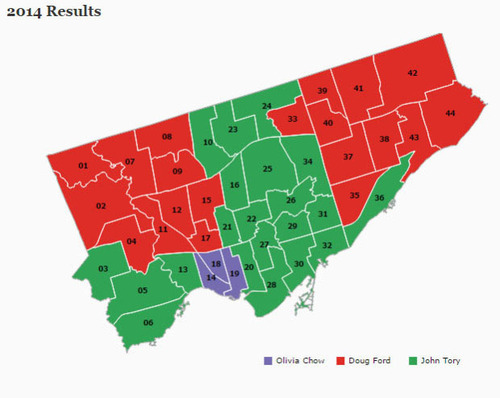
    Yesterday, Toronto did better.

    While we’re still a divided city — with Etobicoke and Scarborough largely remaining loyal to Ford Nation — we’re not quite as divided as we were 4 years ago:

    image

    However, there is one thing that Torontonians did largely agree on last night: the next mayor should be white and male. And this got the Guardian Cities out of the UK asking why one of the most multicultural cities on the planet (apparently we’re third behind Luxembourg City and Dubai), continues to elect middle-aged white guys.

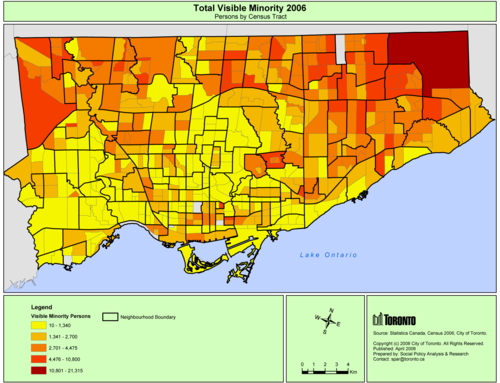
    Now, I’m not a fan of the article. And I take offence to the way Toronto is portrayed. But it did get me thinking. And I thought it would be interesting to see how some of Toronto’s demographic data overlays on top of these election maps.

    Looking at 2006 census data (2011 isn’t available in map form yet), here is a map showing the total number of visible minorities broken down by census tract. The darker the red the more visible minorities.

    image

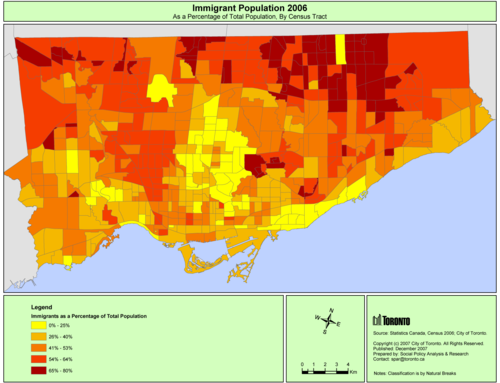
    And here is a map showing immigrants as a percentage of the population. Again, the darker the red, the higher the percentage.

    image

    What should be apparent from these maps is that Ford Nation is actually, in some ways, immigrant and visible minority nation. In the above map, the darkest red areas indicate that immigrants represent anywhere from 65-80% of the population. That’s a significant number.

    So why didn’t this group vote for the Hong Kong-born Olivia Chow? It’s because she wasn’t telling them the right story. Rob and Doug Ford, on the other hand, were.

  • It’s voting day in Toronto

    Today is municipal election day in Toronto.

    About 8 months ago I publicly announced here on ATC who I would be supporting, and my position hasn’t changed. I was disappointed by the fact that he ended up backing away from his initial promise of a true downtown relief subway line (see blog post), but I nonetheless continue to support his candidacy.

    In the words of Mike “Pinball” Clemons, he’s “the right man at the right time.” Click here if you can’t see the video below.

    [youtube https://www.youtube.com/watch?v=ouqv782giyw]

    But I’m not here to try and sway your vote. That is ultimately your decision. However, I am here to encourage you to get out and vote. Regardless of who you might be supporting, I think it’s important that you get out and take a position. So I hope you do that today.

    Happy Monday!

  • Comparing taxis to ride sharing services

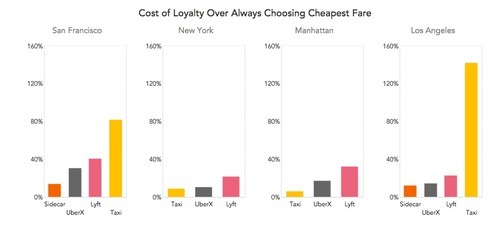
    This morning I woke up to a post from venture capitalist Fred Wilson talking about the cost of loyalty when it comes to local transportation markets. More simply, it was a cost comparison between regular city taxis and ride sharing services such as a UberX, Lyft, and Sidecar in San Francisco, Los Angeles, and New York.

    The data was sourced from whatsthefare.com and looks like this:

    The way to understand this chart is to think about it as the answer to this question (from whatsthefare.com): If I were to take 1,000 rides over my lifetime with one individual service, how much more would I pay than if I compared prices and always picked the cheapest option?

    What you should immediately see is that regular taxis are far more expensive in San Francisco and Los Angeles compared to all of the ride sharing services. In the words of Fred Wilson: “That is crazy. They are going to go out of business in those markets with that pricing.”

    In my words: They are fucked.

    I wonder where Toronto would place against these cities. My gut tells me that we would be closer to San Francisco than New York. And if that is the case, I think you can figure out what that means.

    I thought this would be an interesting post given yesterday’s point about our cities being multi-modal. We urbanites have many more options at our disposal than we did only a few years ago. And if they’re cheaper and more convenient, we’re going to use them. I think that’s a good thing.

  • Riding the new streetcar

    image

    This afternoon I rode Toronto’s new streetcar for the first time on my way home from Chinatown. I had been meaning to do it for weeks now, but this was my first opportunity.

    The experience was infinitely better than what you get today on our current streetcars. I felt like I was in a new city. The proof-of-payment system makes onboarding much faster and the 4 loading doors means you just get on the train where there’s the most room – instead of getting on at the front and fighting your way to the back.

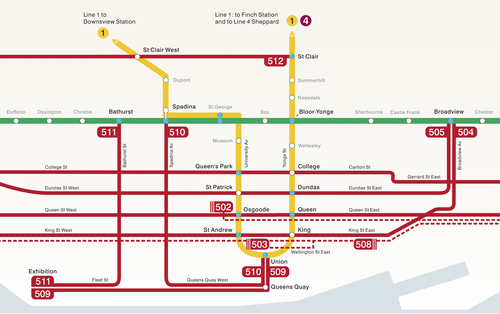
    The other thing I liked is that they now have a map of our streetcar network within the train (see above image). Toronto never used to do this. For whatever reason, we didn’t like mixing subway lines with streetcar lines on the same map. 

    But why be so pedantic?

    For one thing, our subway map looks pathetic without these additional streetcar lines on it. So for the sake of Torontonian morale, please fill it up with what you can.

    But the other reason why I think it’s important to include them is that we shouldn’t be thinking about our cities just in terms of specific technologies (subway, streetcar, and so on). Our cities are now multi-modal. Which means we navigate them using many different means, from subways and streetcars to bikes and Uber cars. What people care about is getting from A to B in the most efficient and enjoyable way possible.

    This may seem like a subtle distinction, but it’s an important one. And maybe, just maybe, these new maps will serve as an important reminder to us that there’s a lot of fixed rail in this city and that it could be far better optimized if we just tried a little harder.

  • How wise are crowds?

    Earlier this week I wrote a post about a new build home under construction at 37 Canerouth Drive in the west end of Toronto. As part of that post, I asked people what they thought the home would be valued at when it was completed. There were just under 10 responses (many thanks!) and I thought it was really fascinating to see the ranges.

    A lot of you responded in the comment section of the post, but a bunch of the other estimates came in via Facebook, Twitter, and email. It isn’t a huge data set, but I’ve nonetheless consolidated the ones I could remember I received:

    $2,375,000
    $2,750,000
    $1,800,000
    $3,000,000
    $8,500,000
    $2,600,000
    $3,500,000
    $1,750,000

    If you average these estimates, you come to a value of $3.3M. However, the clear outlier is the $8.5M. So let’s take that one out and see how the number changes. If you do that, you then get an average estimate of $2.5M. A pretty big swing.

    Now, I don’t know offhand how accurate that number really is, but I’m fascinated by this idea of “the crowd” determining value. Particularly for markets such as housing where supply can be completely heterogeneous and there isn’t a lot of transaction volume to refer back to (compared to other types of markets).

    Because my strong belief is that under the right circumstances and with enough data points, this number could end up being hugely accurate. And, it could also be more forward looking since it’s capturing current market sentiment as opposed to being based on historical transaction prices.

    If you have any thoughts on this, I’d love to hear from you 🙂

  • Top 10 (US) cities for young smart people

    image

    I’m always on the lookout for great websites and communities dedicated to cities. And today, thanks to a friend of mine, I found a new one called City Observatory. It’s my new favorite site for city geeks.

    They describe themselves as a “data-driven platform for sharing, analyzing and discussing the success of cities.” As soon as I read that, I immediately subscribed. I’m a big believer in using data to elevate the discussions happening around our cities and to cut through the bullshit.

    I’m looking forward to digging into more of their articles, but I did already take a look at the first report they published, which is called: “The Young and Restless and the Nation’s Cities”. Click here to download the PDF.

    What the report talks about is a demographic group that they refer to as “Young and Restless”, and which they define as being 25-34 years old and having a 4-year degree. And they focus on this group because they see it as critical to driving local economic development.

    They’re the next generation who are going to start those companies and drive growth and innovation. And since the data shows that as people age, they become less willing to relocate (which intuitively makes sense), cities today are quickly realizing that they need to capture this group of smart people while they’re still restless (i.e. mobile).

    So if this is important, which cities (in the US) are winning right now? Here are the top 10 cities via City Observatory:

    1. Washington D.C. 8.1%
    2. San Francisco 7.6%
    3. Boston/Cambridge 7.6%
    4. San Jose 7.5%
    5. Denver 7.5%
    6. Austin 7.0%
    7. New York 6.6%
    8. Minneapolis 6.6%
    9. Raleigh 6.5%
    10. Seattle 6.1%

    The percentage represents the portion of the population that’s 25-34 years old and has a 4-year degree. I’ve just listed the cities here, but in reality they reference the entire metro areas.

    Do any of the cities on this list surprise you? None are surprises for me. It’s more or less what I would have expected to see, except maybe for the absence of Chicago (it’s 12th according to this ranking).

    Is your city doing enough to capture this group?

    Image: Flickr

  • The middle class myth — a conversation with Marc Andreessen

    New York Magazine recently published a really great conversation between Marc Andreessen and Kevin Rose. Marc cofounded Netscape way back when, and now runs a venture capital firm.

    In addition to technology, the conversation touches on a bunch of different topics such as why it’s beneficial to be an optimist and why change can be difficult for people to accept.

    But they also hit on a number of broader economic shifts, such as the replacement of labor by machines, and the rise and decline of industrial production in the US. Here’s a snippet on that latter point:

    You’ve described the middle class of the 20th century as a myth.

    There are two middle classes. There’s the historical middle class—which is the bourgeoisie—starting in the, like, 1600s. This was the businesspeople and the traders, the merchants, the butcher, the baker, the general-store manager, the guy who was going off to China to go get silk and bring it back. Businesspeople.

    But in the 1940s something really significant happened, which is we bombed the rest of the industrialized world. And so the industrial base of Germany was obliterated. Japan was reduced to rubble. The rest of Continental Europe was bombed. England was bombed. The industrial base of the world was bombed. The one major industrial country that wasn’t bombed was the United States. So the United States became the monopoly producer of industrial goods.

    The army bombed the American middle class into existence?

    It was an accident of history. We had a window of opportunity which we took full advantage of. We had this window from basically 1945 to 1966, 1968, in which we were basically running unopposed. In that window, all kinds of wonderful things happened. One of the things that happened was the rise of this new idea of the middle class, which there was no historical precedent for, which was college-level wages for high-school-level education. As long as there’s no competition, it’s all well and good. The minute the Japanese show up, the minute the Germans show up, it just all falls apart.

    Click here for the full conversation. It’s an interesting read.