Daily insights for city builders, delivered every morning at 6 AM ET. I’m Brandon Donnelly — a Toronto-based real estate developer and founder of Globizen. I’ve been writing here since 2013.
I went snowboarding today and so I’ve got it on the brain right now. It’s one of my passions. But besides the actual act of riding down the mountain on a flexible board, there’s something much more about the sport to me.
First, I love the small villages that develop – ideally organically – at the base of ski mountains. Here’s a neat video of Zermatt, Switzerland that makes it look like a “miniature" town. Click here if you can’t see it below.
And second, I love the vistas that you get. I don’t know exactly how to describe it, but I find that they really pull you away from your everyday life. Here’s a stunning time-lapse video called the Mountains of Valais (Valais is the Swiss canton that Zermatt is located in). You need to watch it. Click here if you can’t see it below.
The town of Zermatt is almost completely surrounded by high mountains and is home to Switzerland’s highest peak at 15,203 feet above sea level. I think it’s time I added it to my bucket list.
Yesterday my friend Sachin Monga published a really great article on Medium called, 2014: My Year in Review. It was broken down into a few sections that included everything from his favorite blog posts of the year to all of the images he posted on Instagram. He called it “a stream of personal observations, data, and highlights for the year.”
One section that really stood out for me though was Places & Transit. Using a mobile app called Moves, Sachin extracted an incredible data set for where he physically spent his time and how he got around in 2014. I can’t believe I haven’t heard of this app yet – it’s totally in my wheelhouse. But I’m clearly late to the party. Facebook bought them in the first half of last year.
The data set included how many hours he spent at home and at work. His top 3 most visited coffee shops. His top 5 most visited friends. How many nights he stayed in a hotel. His average daily commute time. And his total distance walked and cycled, among many other things. It was fascinating. I love data – especially when it was previously impossible or difficult to collect it.
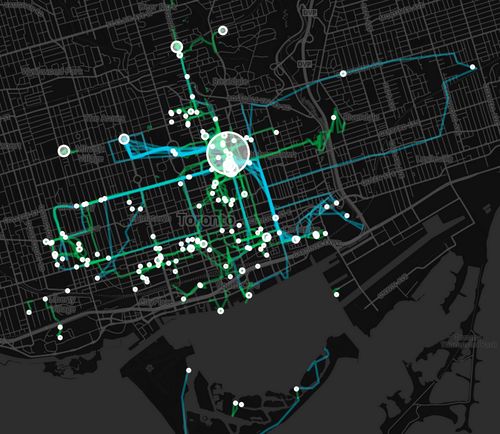
He was also able to translate his data into a set of beautiful maps, showing where he spent his time and how he got around. Here is his personal map for Toronto. The larger the circle, the more often he was there. Blue lines are cycling. And green lines are walking.
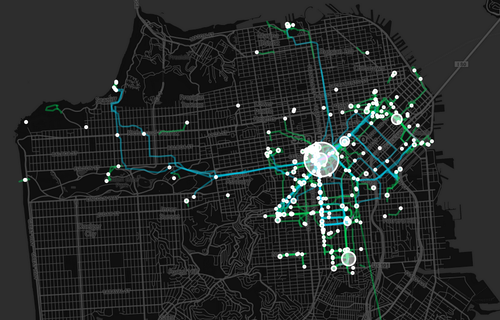
And here’s San Francisco (where he now lives):
After reading his post, I immediately downloaded Moves. And I can’t wait to see how my personal map of Toronto will look like in a few weeks and months. Once I have enough data points, I’ll be sure to share it with you all here.
In the interim, do you have any ideas for what this kind of data might be used for? I can certainly think of many. Let us know in the comment section below.
To start off the year, I thought I would talk about something pretty geeky, but very forward looking: Bitcoin.
I wrote about Bitcoin just over a year ago when I was first starting to wrap my head around it, but a lot has happened since then. Many of you might know that 2014 was a terrible year for Bitcoin and that its price has declined significantly (chart from Coinbase):
But does that mean Bitcoin is a flop, or that the hype has just died down a bit?
If you follow what’s being discussed within the tech community, you’ll know that there are still lots of people who are bullish on Bitcoin. But more precisely, they are bullish on the underlying architecture behind Bitcoin and something that is called the Blockchain.
I’m not going to get too technical in this post (if you want that, go here), but I do want to talk about three things (that I’ve mostly learned from the folks over at Union Square Ventures): the Blockchain, why it matters, and what it could mean for specific industries such as transportation and real estate. I promise to make it relevant at the end.
The way to think about all of this is in layers.
The Blockchain is the foundation or base of Bitcoin. It’s essentially a decentralized public ledger that keeps track of all the Bitcoin transactions. Decentralized means that not one single person or company owns the database. It’s free for anyone and everyone to see. This structure is important because it enables peer-to-peer transactions across the internet, as opposed to going through a bank or other intermediary.
But the key takeaway is that Bitcoin is simply one example of a “protocol” built on top of the Blockchain. And there are many others in the works, including a protocol for realtime ride sharing (Lazooz) and a protocol for a decentralized peer-to-peer marketplace (OpenBazaar). And so the real innovation is the Blockchain, not Bitcoin itself.
Why does this matter?
It matters because these protocols are, again, not owned by a single entity, which is remarkably different than the way most things work today. Take for example the residential real estate industry. In the Greater Toronto Area, the data that emerges from home listings and sales is owned by the Toronto Real Estate Board.
And since this data is privately owned, a lot of it remains only accessible to “members” or real estate agents. The Competition Bureau has been fighting for more openness, but the Toronto Real Estate Board obviously wants to keep as much of this data as it can to itself. Who can blame them.
But what if somebody came along and created a new protocol for a decentralized peer-to-peer home marketplace? In that case no one would own the data, which means everyone would have access to it. And that would completely change the landscape. I’m fuzzy on what this protocol would even look like, but it seems entirely possible given what else is in the works.
And if this Bitcoin Blockchain revolution does actually take place, it wouldn’t be restricted to only non-tech legacy industries. Joel Monegro of Union Square Ventures believes that “decentralized protocols” such as Lazooz and OpenBazaar (mentioned above) could even have a big impact on companies such as Uber and eBay, respectively.
I’m still trying to wrap my head around all of this, but I want to understand it and I thought you all might as well. Because even though it seems very tech right now, the implications would also be very non-tech if it turns out to be true.
It felt like a frenetic year for me, and so I have to say that I’ve been really enjoying this holiday break. I needed the downtime. I needed the time to think and strategize. And I got all of that this holiday. (The only thing that would make this break even better would be some more snow on the mountains.)
I’m super excited for the new year and what’s ahead, but before getting into that, I thought it would be worthwhile to look back at what happened in 2014.
I was initially going to list out some of my thoughts, but then I figured that a better way would be to simply list out the most read Architect This City posts. That way it’s my (daily) thoughts, but curated according to what readers cared about most this past year.
I continue to be amazed by the unmet demand for real estate (development) education here in Canada.
Following yesterday’s post on the real estate development process, I received a few emails from readers asking about the best university programs (MBA, MRED, etc.) and the best approaches for becoming a developer.
I also had a good conversation on Twitter, which covered off some details that I had left out from my post (for simplicity) and which resulted in me suggesting that a real estate development school needs to be started here in Toronto:
@donnelly_b I’m game. The Donnelly-Hassan Institute for the Dark Arts.
Now, part of the reason things are the way that they are, I think, is because the real estate industry has been historically dominated by private rich families. People didn’t go to school to learn how to be developers. They learned by doing and that was then passed down to the next generation. All it took was chutzpah.
But as the real estate industry continues to institutionalize and become run by pension funds and large publicly traded companies, I think the point of entry will also become increasingly institutionalized. And that’s where dedicated real estate programs will continue to come in.
I’ve spoken to a few people at the Rotman School – where I did my MBA – and there doesn’t seem to be a huge interest in a dedicated program such as a Master of Real Estate Development (they already offer real estate courses). It’s more of a “longer term” strategy.
But I think that’s a mistake.
I’m confident there’s strong demand from the student side, so hopefully a wealthy donor will step forward to help make this happen. The University of Toronto has both a great business school and a great architecture school. That feels like a great recipe for a first-in-kind joint degree offering.
Really enjoyed reading this post about being a real estate developer. I was just wondering if you could do a write up on the various jobs and functions in a typical real estate development company so that people like me, who intend to work for a developer can roughly know what kind of skills are required or demanded in order to work there.
It’s a great question and so I will try and answer it today. The first thing I should say though is that real estate developers are typically very lean on people. I’ve worked for big publicly traded real estate companies and small boutique ones, and the development teams are always fairly small.
It’s that way because development projects can be messy and intermittent. The industry itself is also prone to regular market cycles and so the strategy is generally to remain fairly lean and outsource a lot of the work. You ramp up consultants and suppliers on a per project basis – as you need them.
With that said, let’s talk about the typical development process and some of the key skill sets required. A simplified process might look like this:
Buy development site (Acquisitions)
Design a project (Consultant Coordination)
Make sure project is feasible (Finance)
Obtain approvals for said project (Planning & Approvals)
Sell/lease space (Sales, Leasing & Marketing)
Build project (Construction)
Make money (The goal)
Depending on the size of the firm, one person may be responsible for managing many if not all of these steps, or they may be split up into different departments. So you could end up with a department list like this:
Acquisitions
Development/Project Management
Finance
Sales, Leasing & Marketing
Construction
From my experience as a developer, you’re going to be involved in all aspects. And that’s part of what makes development so exciting. But let’s talk about some of the key areas:
Planning & Approvals
After tying up a winning development site, securing your approvals (commonly referred to as “entitlements” in the US) is usually the first major step. The reason this step exists is because oftentimes what you want or hope to build isn’t what you’re actually allowed to build as-of-right.
So you have to go through a process to make that happen. It can take years depending on where you might be doing business, but there’s typically a significant amount of value creation at this stage. Some developers only focus on this stage and don’t actually build.
City planning is a good background for this function. You need to understand the local planning policies and frameworks.
Consultant Coordination
As I mentioned before, development teams are often small. And that’s because all developers rely on outside consultants to make a project happen (architects, engineers, and so on). So a big part of being a strong developer is just being a strong project manager. The expression often thrown around the industry is that development is like herding cats.
Having some sort of a technical background helps for this function. You end up dealing with a lot of technical details (which I find super interesting), and so it helps to have a bit of a background or an interest. If you’re not inclined in this way, you might find this area boring.
Financial Modeling
Building project pro formas and managing budgets is obviously a key component of the development process. From the moment you first look at a site up until project completion, you’ll be building financial models and constantly refining them as you get more information. The first version might be on the back of a napkin and the last version might be a complex Excel spreadsheet.
Banking and finance is obviously a good background for this function. But you also need to understand the real estate business. Models are only as good as the information you feed it, so your assumptions have to be sound.
Sales, Leasing & Marketing
I cannot over emphasize the importance of this function. If you are not selling units or leasing space, then you do not have a project. So no matter how amazing you might be at all the other functions (even fundraising from investors), if your firm is not bringing in money from your customers (purchasers or tenants), then you are dead.
When I was at Penn, a lot of the real estate professors used to tell us that leasing is the best way to get started in the industry. And I don’t disagree with that – even though I didn’t start there. This is often handled by a separate department and/or outside team, but you’ll need to be intimately involved.
Construction
If you’re at this stage, that’s usually a good sign. It usually means you’ve managed to sell a bunch of units and/or lease a bunch of space. Some developers (with enough scale) will have a construction team in-house, but many others will just outsource it to a 3rd party. Regardless of the setup, it once again helps to have a technical background.
If I missed anything or you want to add more detail, please let me know in the comment section below. I’m always happy to receive questions and post ideas, so feel free to tweet or email me. Tweets will almost always get a faster response.
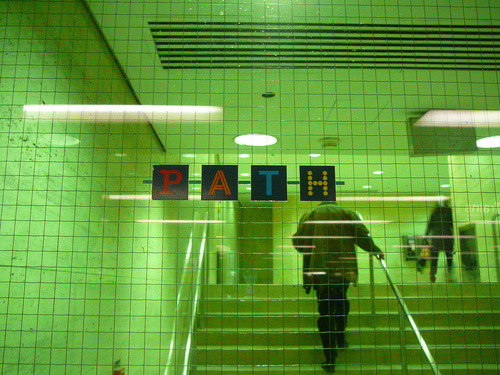
A few years ago, I was touring a friend from the US around Toronto’s Financial District and the first thing he said to me was: “You have no retail.” And that’s certainly what it might look like at first glance.
But there’s actually lots of retail. It’s just all underground in an over 30 kilometer long network of walkways called the PATH.
Initially conceived of as the antidote to Canadian winters, “underground cities” are a kind of uniquely Canadian form of urbanism. Toronto and Montreal have the largest ones in the world and they continue to grow. As new towers are built, new connections are added.
But the downside to all of this is that it pulls street life down underground. And it can conceal a lot of the urban vibrancy that is actually take place. So maybe we need to come up with design solutions to better connect these subterranean cities back to street level and also not forget about the street.
I’m thinking about this today because of a CBC documentary I watched this morning called Life Below Zero. It basically argues that – unlike other cold climate cities and countries – the vast majority of Canadians actually hate winter. And underground cities are our way of trying to ignore it.
Well, I don’t hate winter. In fact, I love it because it signals snowboarding season for me. But I may be in the minority. What’s your position on winter?
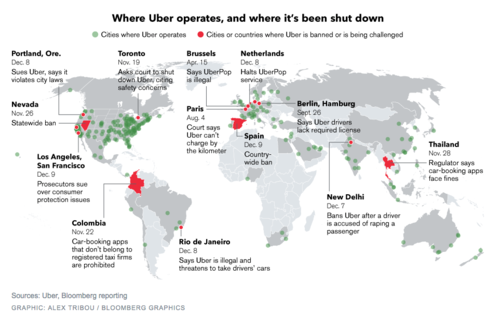
Earlier this month, Bloomberg published this map showing where Uber operates and where it’s been banned (or is being challenged). You can click on the map for a larger version.
Uber operates in about 250 cities across the world. But it’s being challenged in a lot of them, including Portland, San Francisco, Los Angeles, Toronto, Rio de Janeiro, Paris, Berlin, as well as others.
I don’t want to dismiss any of the safety concerns that have arisen lately, because those are very serious and they need to be addressed. Life safety is paramount. But I continue to believe that banning a service that many people clearly want to use isn’t the right solution.
On top of that, I think it could lull many of the local taxi communities into a false sense of security about the future. Uber is moving incredibly quickly. UberX launched in Toronto in September of this year. And UberPOOL – their new carpool service – is likely next.
With these releases, Uber is working towards a specific vision for the future: Their goal is to eliminate the need for private vehicle ownership. Should they be successful, this will not only impact taxis, but also car manufacturers and urban mobility in its entirety.
So as difficult as it might seem right now, I think urban leaders would be better served trying to figure out how to harness these innovations. Cities have been trying for decades to get people out of their cars. Uber wants to do the same.
It was built to correct what had become a major slum on the east side of downtown Toronto. And like many cities around the world, this type of built form was viewed as the solution. Urban slums were crowded and dirty. Density was bad. The solution was to spread people out and surround them with green space.
But that didn’t work out so well. Regent Park failed. So today we are once again starting again. Phase by phase, the old is being demolished and the new is being built. However, unlike the last time, I think this time it’ll be for the better.
But there’s something very ironic about this story.
Before Regent Park became Regent Park, it was called something else: Cabbagetown. That neighborhood of course still exists in Toronto – it’s adjacent to Regent Park – but it’s now a bit smaller having given up a portion of its land to the first iteration of Regent Park.
Today, what remains of Cabbagetown has become an affluent and desirable inner city neighborhood with, allegedly, the largest stock of Victorian housing in North America. But of course it wasn’t always that way. At the time that Regent Park was being conceived, Cabbagetown was a slum. And that’s why we built Regent Park version 1.0. It was the solution for this entire section of the city.
The photo at the top of this post is the southeast corner of Gerrard Street East and Parliament Street. The building at the corner is the Hotel Gerrard. The photo is from 1919, which means it’s a photo of Regent Park when it was still called Cabbagetown. It’s part of what we demolished to make way for the new.
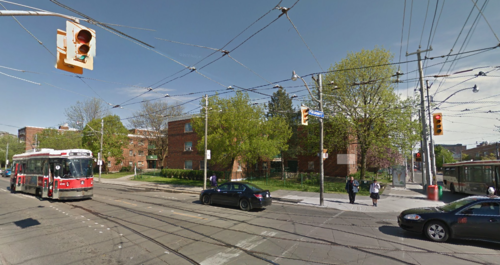
In 2013, that same corner looked like this:
What’s ironic about all of this, is that the area we spared from grandiose urban renewal plans actually became the richest part. And where we intervened is where things got screwed up. So much so that we’re now starting entirely from scratch, again. All of this just makes wonder whether Cabbagetown, in its entirety, would have ultimately taken care of itself had we just left it alone.
But what’s in the past is in the past.
So to end on a positive note, I’d like to share a short video that somebody recently shared with me called Spectrum of Hope. It was co-directed by 7 young artists from the neighborhood who are calling it “a piece for Regent Park, by Regent Park.”
I think it’s a great example of the positive momentum developing in this neighborhood. I hope you’ll give it a watch and then share it around. Click here if you can’t see the video above.
Today is Christmas Day. I hope that you are all having a wonderful day and spending it with family and friends. That is exactly what I’m doing here in Toronto.
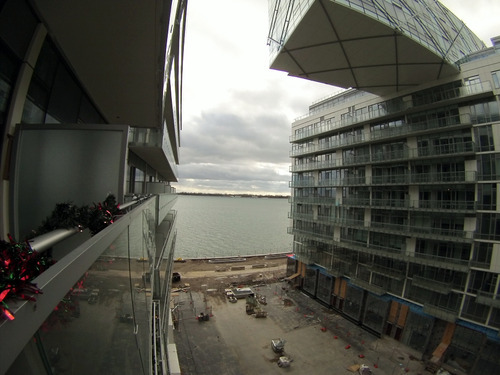
It’s certainly nice to have a bit of downtime. I’ve been playing around with my new GoPro (see above photo), which had been sitting unopened on my shelf for the past few weeks.
The photo above was taken at the Pier 27 condos. It’s still very much a construction zone. The area at grade in the photo will be a linear public park that connects the main street to the waterfront. I’m looking forward to seeing it come together.