Daily insights for city builders, delivered every morning at 6 AM ET. I’m Brandon Donnelly — a Toronto-based real estate developer and founder of Globizen. I’ve been writing here since 2013.
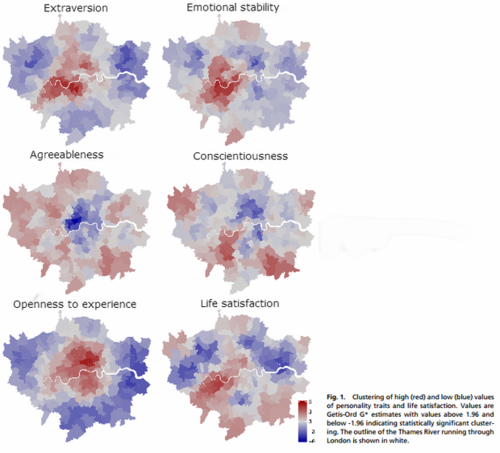
This morning Richard Florida published an interesting CityLab article that talks about how different personality types cluster within cities. The study he references was done by a team of psychologists that surveyed 56,000 people in the London metro area.
Here is a summary of what they found (darker red indicates higher concentration of each personality trait):
Probably the most interesting personality trait is the “openness to experience” one, as there appears to be a clear divide between people who live in the center of London and people who live in the suburbs.
Here’s how Florida describes it:
The most clustered personality trait the researchers found was “openness to experience” (bottom left map), which is concentrated in the center of London. Openness to experience, according to a wide body of psychological studies, is associated with creativity, innovation and entrepreneurship. This type is concentrated in higher density neighborhoods, with higher housing prices, more ethnic and religious diversity and higher crime rates. Meanwhile, the blue concentrations at the periphery indicate that there are fewer people open to experience in metro London’s suburbs.
It’s fascinating to think about the role of psychology in city building. It’s not something we often talk about, but it’s there.
I live downtown and I would definitely classify myself as extraverted and open to experiences. How would you classify yourself?
The headline immediately caught my attention because conventional economic wisdom would suggest that supply constraints – whether natural or artificially created – generally have a negative effect on housing affordability.
To be clear though, I support Ontario’s greenbelt. I think an urban growth boundary is the right thing to have if we want to build sustainable, walkable, and transit-oriented communities. But I’m also not blind to some of the potential (negative) externalities.
However, Keesmaat’s article got me wondering just how prevalent those externalities might be and to what extent our greenbelt is actually impacting housing affordability in Toronto. In her article she cites a recent report by the Pembina Institute that very clearly argues the following:
“There is no shortage of land throughout the GTA [Greater Toronto Area] to build single-family homes for decades to come, but this land is predominantly located far from the City of Toronto and other established centres of employment in the GTA.”
More specifically, the report found that of all the land available for development in the region (within our growth boundary), 81% of it is projected to still be unused by 2031. This got me thinking: it’s not that there isn’t land still available in the region; it’s that there isn’t land in the areas where demand is the greatest.
Put differently, young families aren’t clamoring for single family homes in High Park and Leslieville because the greenbelt has restricted their ability to find new housing. They’re doing so because they want to live in neighborhoods like High Park and Leslieville.
If you dive into the data, the report shows that in 2004 the average price of a detached home in Toronto was about $117,000 more than the rest of the Greater Toronto Area. As of 2013, that spread had grown to about $200,000. And indeed the data shows that it’s the core of the city where home prices seem to be appreciating the fastest.
So when it comes to housing affordability and supply, the greenbelt may actually be a red herring. Releasing it would not increase the supply of housing in areas where demand is already high, which is probably why this same report also found that – with or without an urban growth boundary – most Canadian cities are seeing similar increases in home prices.
So what should we be doing?
I think we should do two things: (1) focus on accommodating more growth in the areas that people already want to live in, and (2) figure out ways to transform the less desirable areas into more desirable ones. This second one will be the hardest, because it’s likely going to mean changing car dependent areas into transit-oriented ones, which is no easy task.
The good news though is that we are already doing these things. There’s more that I would like to see happen, but we’re headed in the right direction.
If your city has a greenbelt or you have experience with greenfield development in the Toronto region, I’d love to hear your thoughts in the comments. This is an area of development that I’ve never really been involved with.
I’ve written about the Tenderloin neighborhood in San Francisco before. It’s an infamous neighborhood in the center of the city that has for decades resisted gentrification (which was the topic of my post).
But as the technology sector continues to urbanize, many fear that it’s only a matter of time before it does eventually gentrify. A new nickname has even emerged for the neighborhood: the Twitterloin.
However, a local nonprofit called the Wildflowers Institute is trying to ensure that gentrification doesn’t erase the cultural assets currently housed in the neighborhood. Through a project called “Hidden Gems”, the group is literally knocking on doors to find active artists within the community (many of whom live in single rooms) and then supporting them through fellowship programs and other investments.
What’s fascinating about their approach is that they are actively seeking out the informal activities taking place within the community – activities that would otherwise be hidden and then potentially lost. Once discovered, they then do a number of mapping exercises to keep track of this data.
As somebody who believes city building will become a lot more data driven in the future, I think this is a really interesting initiative. And as gentrification pressures continue to increase in San Francisco, I’m sure this information will help guide the discussions. You can’t account for something you don’t know exists.
In it, Shawn Achor argues that we’ve got it all wrong and backwards when it comes to our happiness. We constantly set (moving) goals and then tell ourselves that once we achieve those goals we’ll be happy.
We tell ourselves that once we get that degree, buy that new home, or secure that new promotion, that we’ll be happier. And I’m definitely guilty of that sometimes. I think many goal oriented people are.
But his argument is that if happiness sits outside of those moving targets, we’ll never be as happy as we could be. Happiness needs to sit within those goals. In other words, we need to focus on being happy today, not tomorrow.
But the other powerful thing about this approach is that greater happiness has been shown to improve productivity. So if you simply flip this equation, you’ll probably be not only happier but more successful.
At the end of last year, somebody told me that they were really enjoying my blog because of how positive I always seem to be about the future of cities and the world.
And that was honestly one of the nicest things to hear from a reader, because I truly believe that optimism, not pessimism, is what moves the world forward.
One of the projects that I’m most excited about here in Toronto is the renovation and addition to One Spadina Crescent. The building sits in the middle of a roundabout along Spadina Avenue and occupies what is easily one of the most ceremonial positions in the city.
But for as long as I can remember, the building hasn’t been living up to its full potential. So much so that in the 1960s it was going to be demolished in order to make way for the proposed Spadina Expressway. That would have been an absolute tragedy. Thankfully, our friend Jane Jacobs stopped that one.
Today, exciting things are happening at One Spadina Crescent. The Daniels Faculty of Architecture, Landscape, and Design at the University of Toronto is in the midst of renovating and expanding the building, and will eventually relocate there from its current location on College Street.
When it’s all said and done, One Spadina Crescent will look something like this (via Daniels).
From the south:
From the west:
From the north:
What’s most exciting to me about this project are the following 3 things:
First, it’s an opportunity to connect One Spadina Crescent to the surrounding urban fabric. Today, it feels very much like an island in the middle of the street.
Second, it’s a wonderful example of the new layering on top of the old, which is something that I believe we should aspire to do in our cities. The University of Toronto has become quite good at doing that on campus.
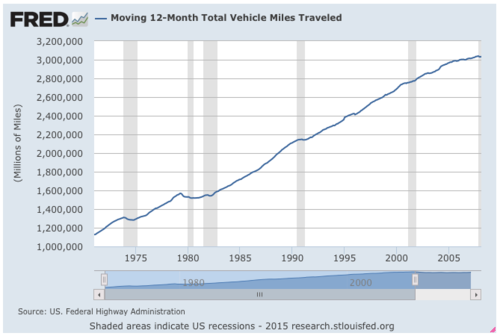
The total number of vehicle miles traveled in the US used to largely do only one thing: go up. This is made it fairly easy for the Federal Highway Administration (FWHA) to forecast how much more Americans were going to drive in the coming years – they just extended the trend line.
Below is what that looked like since the early 1970s (via FRED Economic Data). You’ll see that the total vehicle miles traveled went from somewhere around 1.1 trillion miles to around 3 trillion miles in and around the late 2000s. The shaded areas represent recessionary periods.
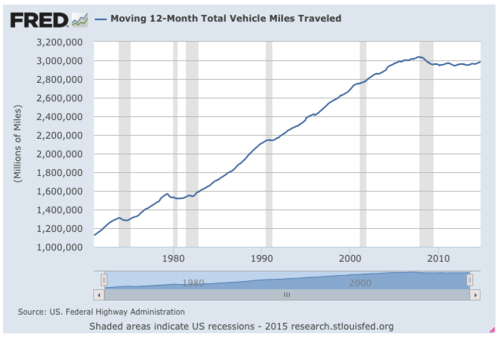
But then in 2007, something happened. Total vehicle miles traveled peaked, declined, and then flat lined at just under 3 trillion miles. Here’s what that looked like (the ending time period is October 2014):
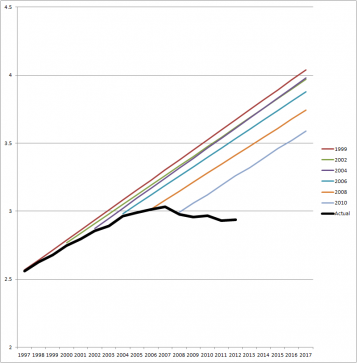
However, since this was new for the FHWA, they continued to believe that this would ultimately correct itself and that total VMTs would eventually continue on their linear ascent. So here’s what their projections looked like (via State Smart Transportation Initiative):
Clearly things didn’t go as planned.
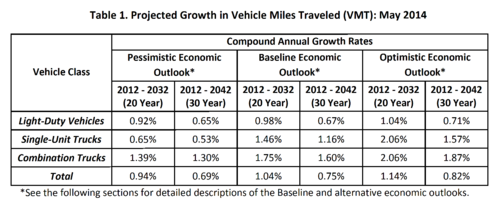
But then in May of last year (2014), the FHWA finally changed its tune and released this forecast, which had the following projections:
It outlined 3 economic scenarios: a pessimistic one, a baseline one, and an optimistic one. In their baseline outlook, they believed that the annual growth rate for total vehicle miles traveled in the US would be 0.75% over a 30 year period running from 2012 to 2042.
At the same time, they also stated that population growth would average about 0.7% per year through this same period. This means that the FHWA has more or less conceded that total vehicles traveled per person will likely remain flat, which is a significant change from previous forecasts.
Now, given their track record, I don’t think any of us should put a lot of faith in the accuracy of these numbers. Per capita driving could flat line. But it might also go down, which is what it has been doing over the past few years.
Either way, I do think it’s worth thinking about this shift. It’s a pretty big deal.
Most of you have probably heard of the STEM subjects. STEM stands for Science, Technology, Engineering, and Mathematics. These academic fields have been the focus of many federal governments around the world as they have been seen as the key to driving innovation.
But what you may not have heard of is something called STEAM. I hadn’t heard about it until this morning. STEAM is an initiative being led by the Rhode Island School of Design to integrate art and design into national agendas pertaining to STEM. STEM + Art = STEAM.
The goal is to foster the true innovation that comes with combining the mind of a scientist or technologist with that of an artist or designer. RISD offers endless examples of how art and design education teaches the flexible thinking, risk-taking and creative problem solving needed to solve today’s most complex and pressing challenges – from healthcare to urban revitalization to global warming.
I couldn’t agree more with this initiative. As somebody who thought a lot about how to combine design and technology in my own career, I believe that there are huge benefits to a multidisciplinary approach to problem solving and innovation. In fact, it’s one of the reasons I decided to go to Rotman for my MBA (see Business Design).
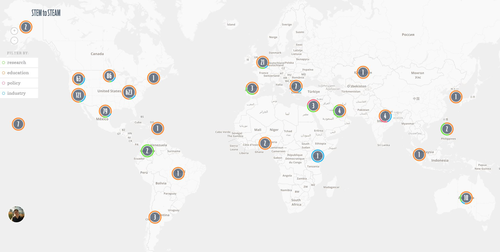
So if you feel the same way, I would encourage you to add yourself and/or your company to the “STEM to STEAM map” that RISD has created. Click here to do that.
You can read more about the initiative here, but all you have to do is tweet your resolve using #CityResolve. One person will be selected for a one-on-one meeting with Toronto’s Chief Planner, Jennifer Keesmaat – where you could then pitch your idea directly to the top 🙂
For me though, I feel like I’ve already been acting on my resolve, which is this blog. When I started writing every day back in August 2013, I did so for myself, but also for a clear mission: To promote the building of beautiful, sustainable, and globally competitive cities. I don’t profess to have all the answers, but I hope to initiate the right kind of discussions.
If that feels like a cop out though, here’s another:
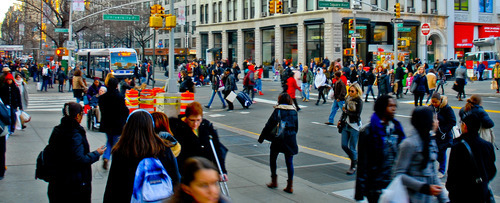
I love technology. My #CityResolve is to use my phone less in public and talk to more people (strangers). People are what make cities great.
Last week I wrote (yet another) post about Uber where I argued that leading cities will be the ones that engage with the sharing/rental economy (as opposed to try and outright ban it) and that Uber is going to continue to impact current beliefs around vehicle ownership.
As to be expected, some people agreed with me and some people didn’t:
But I also discovered following that post that there are groups, and hopefully cities, who are working to adapt to the changing realities brought about by disruptive innovation.
One of those groups is The National League of Cities – which I truthfully don’t know that much about. But they have created something called “The Sharing Economy Advisory Network.”
“Cities across the country have been struggling to respond to the rapid emergence of the Sharing Economy,” said Clarence Anthony, National League of Cities executive director. He continued, “Cities are looking for ways to update and improve their current regulatory framework to ensure that regulations like safety and health protect residents, while at the same time supporting the growth of new businesses. It is imperative for cities to learn how this industry operates and discover ways to engage in order to support these new modes of doing business and to create jobs.”
It sounds like the right kind of initiative and I wish them lots of success. I hope it’s effective and I hope that Toronto will look at how it too can properly manage these economic changes. This is going to take both the private and public sectors working together.
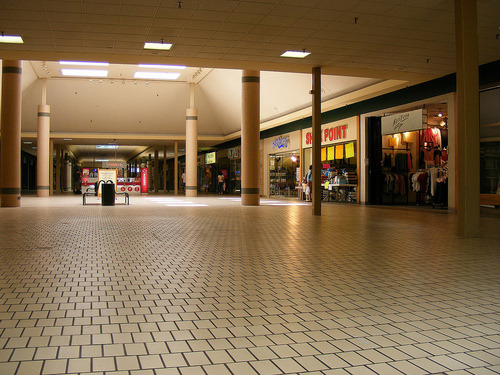
A lot of shopping malls are dying. You’ve probably heard this before. But how bad is it and what exactly is happening?
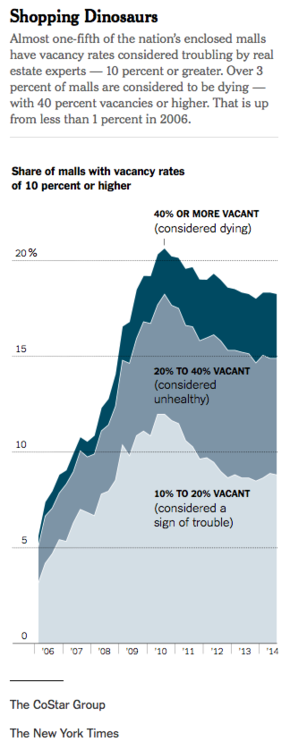
Well, a new report by CoStar (heard through the New York Times) found that nearly 20% of the 1,200 malls in the US are presently in trouble. “Trouble” is defined as a mall with a vacancy rate of 10% or more.
But what’s perhaps most disconcerting about this number is that, as recently as 2006, only about 5% of the malls in America would have been pegged as being “in trouble.” Here’s a chart from the New York Times (I’d love to see this same graph with a longer time horizon):
But not all malls are dying. The general sentiment seems to be that the high-end A malls are and will continue to thrive, and that it’s only the B and C malls that are dying:
Tom Simmons, who oversees the mid-Atlantic shopping center division of Kimco, another real estate giant, is more blunt. “There are B and C malls in tertiary markets that are dinosaurs and will likely die,” he said, but “A malls are doing well.” (NY Times)
So why is this happening? Some think it’s because the US is over-retailed. And some think it’s because of rising income inequality – which would explain why the high-end malls continue to thrive. But the experts seem to agree that it’s not the result of more people shopping online:
One factor many shoppers blame for the decline of malls — online shopping — is having only a small effect, experts say. Less than 10 percent of retail sales take place online, and those sales tend to hit big-box stores harder, rather than the fashion chains and other specialty retailers in enclosed malls. (NY Times)
I wrote a post 2 months ago where where I argued that big box stores will be the most impacted by online shopping (which is why so many of them now sell groceries). But I don’t believe that they are the only retailers that will be affected. Quite the opposite: Every retailer is or eventually will be impacted by the internet.
This threat is real.
Millennials have no hesitations about buying things online and, in many cases, they would prefer to do so. It has already been well documented that we (I’m a Millennial) don’t like driving as much as previous generations. So what makes you think we’d enjoy the process of driving to a mall?
But the other factor at play, I think, is that malls are no longer the “public space” of young people. Their position as a kind of cultural institution is waning. At the same time, more and more people are craving uniqueness. They like independent shops, not malls that all look and feel the same. And as these young people become old people, we might find that even the A malls start becoming impacted.
I don’t believe, for a second, that retail nodes within cities will ever disappear. But I think our attention would be better spent figuring out what the mall of the 21st century will be, as opposed to hiring PR firms to try and spin doctor our way out of this dead mall phenomenon.