Daily insights for city builders, delivered every morning at 6 AM ET. I’m Brandon Donnelly — a Toronto-based real estate developer and founder of Globizen. I’ve been writing here since 2013.

Tag: apple

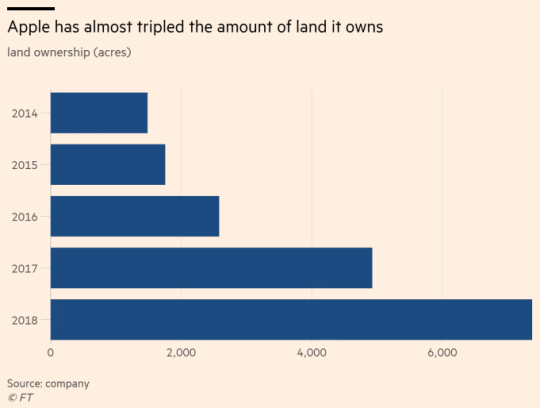
  • Apple now owns 7,376 acres of land

    In 2011, Apple owned 584 acres of land.

    As of this year, and according to the Financial Times, the company now owns about 7,376 acres. 

    Apple uses its “facilities and land for corporate functions, R&D and data centres.” The latter would include server farms for its various online services, such as iMessage, Apple Music, and the App Store.

    It can be easy to think of “the cloud” and the online services we use every day as existing only in some ethereal world up in the sky or in a distant land.

    But the reality is that these services have very real physical space requirements. The above chart begins to speak to that.

  • The world’s best brands — 2018 edition

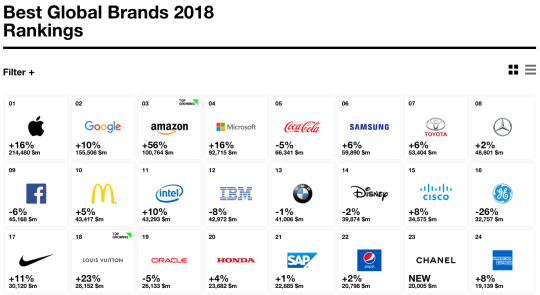
    At the beginning of this month, Interbrand released its annual ranking of the world’s best global brands. This year’s 2018 report marks the 19th year of the study. If you’d like to download a free copy of the report, you can do that here. But below is a snapshot of the first 24 brands:

    Apple and Google are in top position for the 6th year in a row. And Amazon is on a hockey stick trajectory with its brand value jumping by 56%. More than half of the list is comprised of the following five sectors: Automotive (16), Technology (13), Financial Services (12), Luxury (9), and Fast-Moving Consumer Goods (9). Luxury is currently the fastest growing sector.

    In their report, they outline five themes that have emerged and that are helping these brands outperform. They are:

    1. Positive utility – not enough to just make people feel good through storytelling; you need to create real value and a positive impact in the world
    2. Subscription mindset – there’s an increasing amount of brand value in subscription-based businesses (29% in 2018 compared to 18% in 2009); you need to offer your products and services with the least amount of friction as possible
    3. Customer-centricity – bring the voice of your customer into every aspect of your business; be nimble enough to respond quickly
    4. Learning from luxury – the top performing category in this year’s ranking; about exclusivity and authenticity
    5. Role of brand – make your brand part of the decision-making process; build brand equity and trust

    I’ll stop there and let you all dig into the rest of the report if you’re interested. 

    But one thing I found particularly interesting about the study is that they used – insert buzzwords here – “AI-powered social listening” to try and measure the emotion and sentiment floating around on the internet around specific brands. The goal was to pin down the perceived trustworthiness of specific brands.

    Not surprisingly, they found a pretty strong correlation between customer trust and purchasing intent. Makes sense to me.

  • Apple and the Milanese piazza

    image

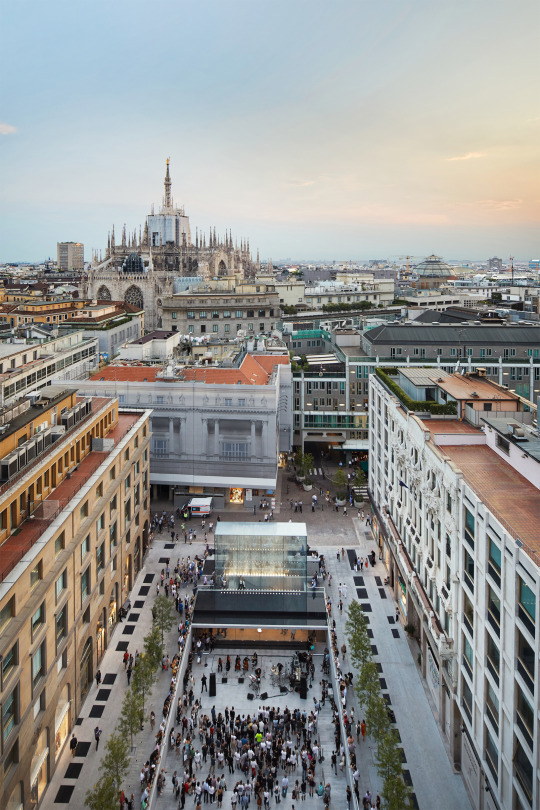
    This past July, the Apple Piazza Liberty opened in Milan. Above is a photo from the opening via Apple. There’s a band playing in the middle of the piazza.

    The store is central to Apple’s vision of transforming its retail locations into “town squares.” And in this case, the store is quite literally an Italian piazza.

    There’s a lot that is interesting about this store and this strategic move, as well as what this could signal about the future retail. (Curbed discusses that here.)

    The urbanists who read this blog will likely lament the privatization of public space. Because at the end of the day, it is a gray area. Can I hang out an Apple Town Square all day and just read a book?

    But at the same time, this is not necessarily a new idea. From the very beginning, the modern shopping mall was intended to be a new kind of town square. Or at least that’s how Victor Gruen saw it.

    However, what is perhaps new is this appropriation of public spaces for the purposes of what is arguably a new kind of retailing experience – one that almost feels paradoxical. 

    In the case of Apple Piazza Liberty, as well as in some of its other town squares, the actual retailing space is mostly hidden. Here it is underground. (How much to rent the basement?)

    And yet, Apple’s presence feels monumental and almost sublime. Glass box, waterfall, and subtle Apple logo sitting in the middle of a beautiful Milanese piazza.

    What a statement.

    Image: Apple

  • Apple and the humanities

    image

    This morning I came across two news item that are interesting in their own right, but also have a noteworthy relationship.

    $AAPL now has a market cap that exceeds $1 trillion. And not surprisingly, everyone, from the New York Times to Bloomberg (photo essay), is talking about it.

    But the one thing that continues to stand out for me about this story is what Steve Jobs said back in 2011 when he unveiled iPad 2.

    He said that fundamental to Apple’s DNA is its ability to marry technology with the liberal arts and the humanities. Its secret sauce is not technology alone.

    Now let’s move on to the second piece of news that caught my attention.

    As of 2017, less than 5% of college and university students in the US were studying one of the big four humanities majors – a sharp cliff-like drop from 2011 according to this data.

    That’s almost certainly because business degrees and STEM degrees are thought to be more valuable and in demand in the labor market. And I’m sure they are right out of school.

    But perhaps we shouldn’t forget Apple’s trillion dollar lesson. And I think this goes for both the tech space and the real estate industry, as well as others.

  • The scale of Apple’s iOS economy

    This is an interesting post on the size of “the iOS economy.” 

    About 70% of customer spending on Apple’s App Store goes to developers. The remaining ~30% is kept by Apple. 

    In 2017, iOS developers earned $26.5 billion. This is up about 33% from the year prior and is higher than McDonald’s revenue in 2016. Cumulatively, Apple has paid out about $86.5 billion to developers.

    And this past new year’s day, a new record was set with $300 million in App Store purchases. According to Horace Dediu, this year should average closer to $100 million per day.

    Also, this year’s App Store revenue is expected to surpass the film industry in terms of global box office sales. And we’re only talking about Apple. This does not include Android revenues.

    Click here to check out the full post.

    Photo by Ben Kolde on Unsplash

  • 10x the scale

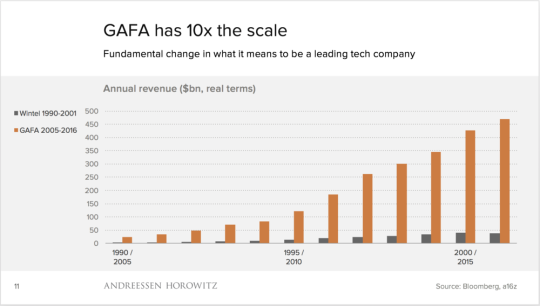
    Below is a chart from Benedict Evans comparing annual revenue from the Wintel era (Microsoft + Intel) to the current GAFA era (Google, Apple, Facebook, and Amazon). 

    His argument is that, today, “the scale of tech winners” is about 10x what it was during the previous cycle.

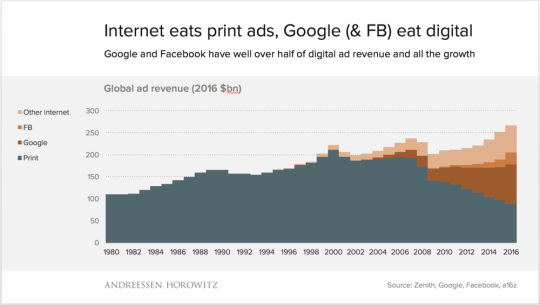
    And here is a chart, from that same post, showing how the internet ate print ads when it comes to global revenue:

    A lot of this has to do with the unprecedented growth of smartphones and the sheer number of people who came and are coming online. Mobile is 10x the PC market.

    But the other interesting narrative from the post is the argument that these companies (GAFA) have learned from previous generations just how aggressive you need to be to survive.

    The shift to mobile posed a structural threat to Facebook. At the time of its IPO, there were serious doubts as to whether the company would be able to pull off this transition.

    Which is why the founder went out and spent 10% of the company to acquire companies that would help with this transition and ensure its survival. That seems to have worked.

    In the words of Andrew Grove: “Only the paranoid survive.“ And in today’s tech world, the rewards for surviving are that much bigger.

  • Sidewalk Labs, Amazon HQ2, and the Milanese Leonardo

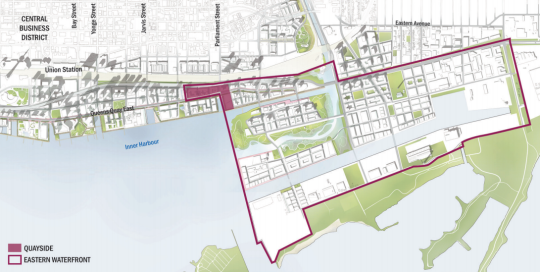
    Earlier this week the WSJ announced that Sidewalk Labs (Alphabet Inc.’s urban innovation organization) is close to a deal with Waterfront Toronto to develop a new 12-acre section of the eastern waterfront. Sidewalk Labs would be their innovation and funding partner. It’s not final yet and it’s still subject to board approval, but the sentiment is that it should go.

    There aren’t a lot of details about the project – other than the fact that it will be fairly big, up to 3 million square feet – but the overall intent is digital city building. It’s about imagining what a city could be if you built it today “from the internet up.” More info about Sidewalk Labs, here.

    I thought of this project as I read Seth Godin’s daily blog post this morning in bed. Here are two snippets from that post:

    When a new technology arrives, it’s often the nerds and the neophiliacs who embrace it. People who see themselves as busy and important often dismiss the new medium or tool as a bit of a gimmick and then “go back to work.”

    There’s never a guarantee that the next technology is going to be the one that moves to the center of the conversation. But it’s certain that a new technology will. It always has.

    Openness matters.

    I’m anxious to learn more details about the project, but this is obviously very exciting. It also creates momentum and strengthens the case for Amazon HQ2 in Toronto. The above 12-acre Quayside area is only the tip of the iceberg. There’s the rest of the eastern waterfront and also East Harbour.
    image

    Some people have been critical of this city’s push for Amazon HQ2. Anthony Lacavera, chairman of Globalive Capital, called this “the biggest Trojan Horse of all time.” His view is that Amazon would simply use HQ2 Toronto as a mechanism for cheaper labor (USD > CAD) and to siphon the best and brightest down to the US.

    Now, I agree that it would be more impactful to create the next Amazon then to simply lure in its second headquarters. Big entrepreneurial successes are what fuel the darwinian evolution of startup hubs. The founders, early employees and investors make boatloads of money and then they start reinvesting that back into the ecosystem by, among other things, backing the next generation of entrepreneurs.

    But does this necessarily mean that an Amazon HQ2 would be detrimental to Toronto by acting as a conduit to the US? Will it discourage entrepreneurship? Should we eschew all US firms out of fear that this may in fact happen? I don’t think so.

    There’s tremendous value in concentrating smart people in one place – ideas build on ideas. And I don’t think technology has been able to disrupt that, at least not yet. One example of this is a theory that Paul Graham calls the Milanese Leonardo:

    You can see how powerful cities are from something I wrote about earlier: the case of the Milanese Leonardo. Practically every fifteenth century Italian painter you’ve heard of was from Florence, even though Milan was just as big. People in Florence weren’t genetically different, so you have to assume there was someone born in Milan with as much natural ability as Leonardo. What happened to him?

    And his reasoning is as follows:

    Nothing is more powerful than a community of talented people working on related problems. Genes count for little by comparison: being a genetic Leonardo was not enough to compensate for having been born near Milan instead of Florence. Today we move around more, but great work still comes disproportionately from a few hotspots: the Bauhaus, the Manhattan Project, the New Yorker, Lockheed’s Skunk Works, Xerox Parc.

    Xerox Parc (Palo Alto Research Company) is a great example of the kind of positive externalities that can happen as a result of smart people being in close proximity to each other while they wrestle with similar problems. It has been well documented that it was Steve Jobs’ visit to Xerox Parc that inspired many of Apple’s early innovations.

    So my view: let’s increase Toronto’s urban metabolism and make it the Florence of 1450.

    Ed Clark – who is leading the charge for HQ2 in Toronto – has been clear that large taxpayer subsidies are not on the table for Amazon. That would not be fair to the existing companies in this city. If that is what it is going to take, then we are not going to win. We will win based on our city, our human capital, and our openness to the rest of the world. That feels right.

    Welcome Sidewalk Labs. Welcome Amazon. This city is open for business and to new ideas. 

    Image: Waterfront Toronto

  • An incomprehensive AirPods review

    Over the past few weeks, I have heard a number of people say that Apple AirPods are hands down the best wireless headphones on the market. 

    Yes, they look like mini hair dryers. But everyone kept telling me that they are simply indispensable if you talk on the phone a lot and/or you’re tired of accidentally unplugging your headphones at the gym.

    I have a wireless headset for my landline at the office and I absolutely love it. I don’t know how I ever worked without one.

    I also fumble over and yank on my headphone cable so often at the gym that my Urbanears are now cutting in and out. I’m not sure if it’s the headphones or my phone’s jack. 

    So I got myself some AirPods. 

    I’m probably late to this party, but they are indeed awesome. They instantly pair with your phone as soon as you take them out of their recharging case and put them into your ears. Want to pause what you’re listening to? Just take one of them out of your ears. It’s all seamless.

    They’re also a game changer if you pair them with the new Apple Watch Series 3. Now you don’t even need your phone to make and take calls.

    Word of mouth: More effective than even Apple’s own superlatives.

  • So, what’s a town square?

    Earlier this week, Apple let us know that it is now calling its stores “town squares.” Not surprisingly, this elicited more than a few reactions. The Verge called it a “pretentious farce.” Others called it arrogant. Who is Apple to think that its stores could ever come close to a real town square?

    It also raised important questions around the actual “publicness” of the spaces within our cities. Traditionally, town squares have indeed been public. But our cities are now also filled with many privately owned public spaces (POPS). Most of the time you don’t know the difference. Though sometimes you do

    The reality is that there is a longstanding tradition of private retail-oriented spaces trying to simulate the experience of a town square, and certainly of a gathering space. The creator of the modern mall, Victor Gruen, always thought of his “garden courts” as a kind of substitute for traditional urban spaces. This was him trying to nobly urbanize the suburbs.

    What is perhaps unique about Apple’s town square nomenclature is that – beyond simply wanting to be a Starbucks-esque “third place” – they seem to be telling us that they want to usurp the public nucleus away from the proverbial “garden court” and place it in their individual stores. 

    And the reactions we have seen are because that feels far fetched.

    However this plays out, this is a very clear acknowledgement by Apple that in today’s world being a store simply isn’t enough. That’s no longer interesting. Consumers have far easier options at their disposable. You need to give us more of a reason to visit you in your store or, dare I say, your town square.

  • Thoughts on labor, and the end of summer

    Well, just like that, the unofficial end of summer. Labor Day weekend. But I agree with Shawn Micallef: “Defy the crowd and keep enjoying summer.” There are still weeks of it left.

    But given that it is Labor Day weekend, here are two things to think about. 

    The first is a Financial Times article by Lawrence Summers where he argues that America needs unions more than ever and that, indeed, the central issue of American politics today is the “economic security of the middle class.”

    Here is an excerpt that speaks to declining bargaining power on the part of labor:

    “But I suspect the most important factor explaining what is happening is that the bargaining power of employers has increased and that of workers has decreased. Bargaining power depends on alternative options. Technology has given employers more scope for replacing Americans with foreign workers, or with technology, or by drawing on the gig economy. So their leverage to hold down wages has increased.”

    It’s also worth mentioning that only about 6.4% of private sector workers in the U.S. are in a union today. This is a decline of almost two-thirds since the 1970s and is a good segue into the second thought of this post.

    Two years ago Fred Wilson wrote a post on his blog (which he reblogged today) where he argued that “labor needs a mechanism to obtain market power as a counterbalance to the excesses of markets and capitalism.” 

    But, that this mechanism needs a refresh. He calls it Union 2.0.

    “However, like all bureaucratic institutions, the “Union” mechanism appears anachronistic sitting here in the second decade of the 21st century. We are witnessing the sustained unwinding of 19th and 20th century institutions that were built at a time when transaction and communications costs were high and the overhead of bureaucracy and institutional inertia were costs that were unavoidable.”

    This makes perfect sense to me. 

    At the same time, we can’t forget – and this is how Summers ends his article – that, today, “the most valuable companies are the Apples and the Amazons rather than the General Motors and the General Electrics.”

    That tells me that what may have worked in the past will likely not work in the future.

    Photo by Jonas Viljoen on Unsplash