Daily insights for city builders, delivered every morning at 6 AM ET. I’m Brandon Donnelly — a Toronto-based real estate developer and founder of Globizen. I’ve been writing here since 2013.

Tag: amazon

  • What e-commerce may do to our streetscapes

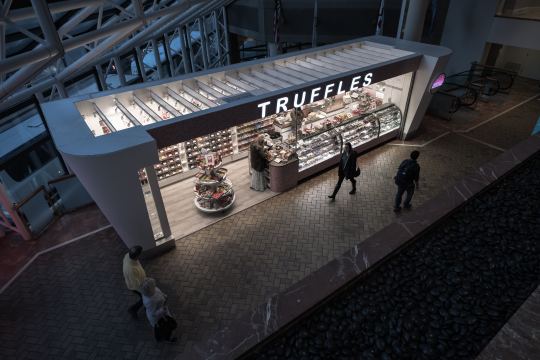
    Sidewalk Labs recently ran a thought experiment where they came up with 5 possible scenarios for the future of retail and, more specifically, what they may mean for our streetscapes. You can read all about them here, but my mind lumps them into 3 broad categories.

    First, there’s the temporary/pop-up/independent scenario. This one is all about flexibility and speed. It’s about web-first retailers who don’t have, need or want permanent stores and about empowering small scale business owners. This makes sense. The internet has decentralizing forces.

    The second one takes retail in the opposite direction. It’s about going all in on physical stores; upsizing them and making them even more over the top and Instagram-able. This one also seems intuitive given that we’re already seeing this trend with malls. Many/most are dying and the surviving ones are trying to go as high end as possible.

    The last scenario takes vacant and underutilized retail on the fringe and turns them into “digital dispensaries.” This one is entirely utilitarian and void of any streetscape/urban considerations. It’s about autonomous electric vehicles picking up your goods through drive-thrus and on-demand drones dispatching your toilet paper after you hit that Amazon Dash Button.

    This feels like a good list. I think you could argue that the writing is on the wall for all of these scenarios.

    Photo by Lance Anderson on Unsplash

  • My prediction for Amazon HQ2

    “Now the trick is that we gotta look like we don’t need this shit and they give us the shit for free.“ –Mike Peters

    This is a line from one of my favorite movies, Swingers. Short video clip here. Mikey and Trent are in a Las Vegas casino trying to play it cool. They’re looking to make a scene at a table and Mikey throws out this gem of a line. He knows that people want what they can’t have and that confidence matters.

    I was reminded of this line today after Amazon announced its HQ2 Request for Proposal (full RFP document here) and every city, from Chicago and Toronto to Philadelphia and Dallas, started swooning over the prospect of housing Amazon’s second headquarters in North America. 

    But to be clear, I do not think this is a bad idea. I actually think Amazon HQ2 is an incredible city building opportunity that would generate countless positive externalities for the selected city. I’m thrilled that Mayor John Tory will be personally “leading the charge” with respect to Toronto’s response.

    Over $5 billion in construction and as many as 50,000 employees making on average over $100,000 per year. Amazon is looking for about 500,000 sf of space in phase 1 (2019) and up to 8,000,000 sf in total. Based on the RFP, they seem to be pegging their capital investment at somewhere around $600 per square foot.

    If I’m being as objective as possible, I honestly believe that Toronto is the city to beat in his competition. I think it will come down to access to talent. Human capital is the lifeblood of a company and Trump’s immigration policies simply put U.S. cities at a disadvantage in this regard.

    Of course, Toronto is also awesome. So that’s my prediction: Amazon HQ2, Toronto.

  • Thoughts on labor, and the end of summer

    Well, just like that, the unofficial end of summer. Labor Day weekend. But I agree with Shawn Micallef: “Defy the crowd and keep enjoying summer.” There are still weeks of it left.

    But given that it is Labor Day weekend, here are two things to think about. 

    The first is a Financial Times article by Lawrence Summers where he argues that America needs unions more than ever and that, indeed, the central issue of American politics today is the “economic security of the middle class.”

    Here is an excerpt that speaks to declining bargaining power on the part of labor:

    “But I suspect the most important factor explaining what is happening is that the bargaining power of employers has increased and that of workers has decreased. Bargaining power depends on alternative options. Technology has given employers more scope for replacing Americans with foreign workers, or with technology, or by drawing on the gig economy. So their leverage to hold down wages has increased.”

    It’s also worth mentioning that only about 6.4% of private sector workers in the U.S. are in a union today. This is a decline of almost two-thirds since the 1970s and is a good segue into the second thought of this post.

    Two years ago Fred Wilson wrote a post on his blog (which he reblogged today) where he argued that “labor needs a mechanism to obtain market power as a counterbalance to the excesses of markets and capitalism.” 

    But, that this mechanism needs a refresh. He calls it Union 2.0.

    “However, like all bureaucratic institutions, the “Union” mechanism appears anachronistic sitting here in the second decade of the 21st century. We are witnessing the sustained unwinding of 19th and 20th century institutions that were built at a time when transaction and communications costs were high and the overhead of bureaucracy and institutional inertia were costs that were unavoidable.”

    This makes perfect sense to me. 

    At the same time, we can’t forget – and this is how Summers ends his article – that, today, “the most valuable companies are the Apples and the Amazons rather than the General Motors and the General Electrics.”

    That tells me that what may have worked in the past will likely not work in the future.

    Photo by Jonas Viljoen on Unsplash

  • Two-hour grocery delivery

    Today it was announced that Amazon is planning to launch its “Prime Now” service in Vancouver and Toronto this November and January, respectively. 

    The pilot program will offer two-hour deliveries for members and, according to the Wall Street Journal, will be be heavily focused on groceries. 

    It’s worth noting that most of Whole Foods’ stores in Canada (now owned by Amazon) are in and around Vancouver and Toronto. And that Amazon has already started lowering prices to make those stores more competitive.

    Right now a “Prime” membership in Canada costs CAD$79 per year. I’m not sure if the price will change at all for “Prime Now”, but let’s assume for the sake of argument that it won’t. 

    If this service was available to you today (or if you’re in a city that currently has it), would you (do you) use it? I would love to hear your thoughts in the comment section below.

    Two common objections around online grocery shopping are that many people want to touch and feel the goods before they buy and that perishable deliveries are a challenging thing to coordinate.

    I think I can work around those objections and would certainly try this today if it was available in Toronto. What about you?

  • Why I write about tech on my city building blog

    I had a friend ask me this week about how I decide what to write on this blog. His comment was that I tend to write about a variety of different topics. He wondered: Isn’t it better to focus on one particular niche?

    The simple answer is that I write about what interests me. And secondary to that is any concern around what will get the most clicks. In fact, I try not to fall into the trap of worrying about the latter. Sometimes it can be paralyzing to fixate on what will appeal most to the tens of thousands of people who read this blog on a regular basis.

    The reality is that my interests are much broader than, say, just design and real estate; though these two topics are clearly central. 

    I learned a long time ago while studying architecture and art history that what we make as a society is generally a product of the cultural milieu at the time. In other words, the built environment doesn’t happen in a vacuum. It is the physical manifestation of what we believe to be true at a particular moment.

    Today, it’s pretty hard to ignore the importance of tech. Think of some of the most valuable companies in the world right now: Apple, Google, Amazon, Facebook, and so on. Now, technology has always shaped our cities, but what makes this moment different is the decisive shift toward software.

    It’s arguably no longer about who can build the best mousetrap. It’s about who can build the best software layer on top of that mousetrap.

    In 2011, venture capitalist Marc Andreessen (previously the co-founder of Netscape) published a widely shared essay called, “Why Software Is Eating the World.” And over the past 6 years he has been proven to be very right.

    The 3 main points he aimed to make with that essay are as follows:

    1. Every product or service that can become software will become software.
    2. Every company will have to become a software company.
    3. The winning companies will be the best software companies.

    Depending on your industry, this may sound ludicrous to you. Certainly in 2011 it probably seemed that way. 

    But a perfect example of this phenomenon is the iPhone. The phone itself is manufactured in China, albeit where a lot of great hardware innovation is taking place. 

    But at this point, phones have become fairly commoditized. The profits that Apple makes from the iPhone disproportionately come from the software layer and the app ecosystem it has developed.

    You could make a similar argument with Tesla. Autonomous navigation – which most of us can agree will have a profound impact on cities – is largely a software challenge. 

    And so if you believe that autonomous vehicles will be a fundamental part of the future of mobility, then it’s not that hard to believe in point number three: the winning car company will also have to be the best car software company.

    Some industries have been less touched by tech and software – real estate being one of them. But if Andreessen is right and it’s not a question of if, but a question of when, then it behooves all of us to think about the potential impacts.

    I love how Andreessen ends this podcast discussion with Barry Ritholtz of Bloomberg and so I’m going to repeat it here to close out this post. He says: “There are no bad ideas. There are only early ideas.” 

    And that’s why I write about tech on my city building blog.

    Photo by Michal Pechardo on Unsplash

  • Motivation and coordination

    Albert Wenger of Union Square Ventures recently gave a talk at the 2017 Blockstack Summit about “Decentralization and the Knowledge Age.”

    He starts by talking about motivation and coordination.

    The state, he argues, is good at coordination, but not so good at motivation. The market, on the other hand, is good at motivation, but not so good at coordination. Money and self-interest are powerful incentives.

    He then talks about how networks have improved the market, the firm, and the state. When the cost of sharing information drops, everything gets better.

    But there are downsides to networks. For one, they form monopolies. Consider Facebook in social. Google in search. Amazon in ecommerce.

    They also create environments ripe for censorship and “algorithmic abuse.” Everything you see in your feeds is optimized to make you respond and/or feel a certain way. The line between delivering you relevant content and deliberate manipulation is perhaps a fine one.

    So what’s the solution? Decentralized blockchain networks are one exciting possibility. But they also have their own limits and drawbacks. Albert touches on those in his talk.

    The video is about 24 minutes. If you can’t see it below, click here.

    [youtube https://www.youtube.com/watch?v=LgQT874KHuw?rel=0&w=560&h=315]

  • From retail to logistics

    Over the past few weeks we’ve been talking about the future of the mall on this blog. It’s a topic that I’m very interested in.

    Yesterday the Wall Street Journal published an article talking about the trend of converting retail/shopping facilities to logistic centers. 

    Here’s an excerpt:

    “In Mesquite, Texas, FedEx Corp. next month will open a 340,000 square-foot distribution facility on what once was the site of the former Big Town Mall. Located along U.S. Highway 80 in Texas, the mall declined after newer malls were built nearby. It was demolished in 2006 and the land was later rezoned for industrial use.”

    It turns – and we’ve talked about this – that good retail locations are also good distribution locations. They are usually located close to humans and infrastructure.

    Here’s another example from the article:

    In North Randall, Ohio, Amazon.com Inc. is considering the site of the former Randall Park Mall as a fulfillment center, according to Port of Cleveland, a local government agency focused on spurring job creation and economic growth in Cuyahoga County. Amazon didn’t immediately respond to requests for comment.

    For a short time when it opened in 1976, Randall Park Mall was the largest shopping center in the world and had been “a thriving heartbeat” for the local economy, according to Mr. Davis. But the mall closed in 2009 as stores struggled with fewer shoppers.

    Assuming this trend continues and people continue to buy things online, one has to wonder about the placemaking that should or needs to happen in these areas.

  • Online shopping and “last mile” real estate

    The Globe and Mail recently published an excellent article on “how e-commerce is driving a real estate revolution.” This is a topic that I’m very interested in: how online manifests itself offline.

    Not surprisingly, the article talks a lot about Amazon, including their 4th warehouse in the Greater Toronto Area, which is an 850,000 square foot facility in Brampton equipped with 350-pound robots (8050 Heritage Road).

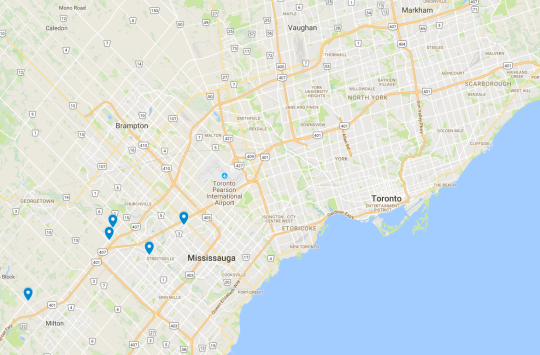
    The first thing I did after reading the article was figure out the location of all of Amazon’s fulfillment centers in the GTA. Amazon doesn’t seem to publish this. But according to TaxJar, they are here (I mapped out the addresses):

    There are two in Brampton at the precise location where Hwy 407 (toll route) and Hwy 401 meet. The other three are distributed along Hwy 401 in Milton and in Mississauga.

    Now let’s get back to that Globe and Mail article:

    – In 6 years, Amazon has leased over 2 million square feet of warehouse space in Canada.

    – Toronto is the third largest warehouse market in North America. It represents 43% of Canada’s total inventory.

    – Average net rents have increased 9.7% over the past year and vacancy rates have dropped to 2.7% (CBRE data). In Vancouver, those same numbers are 5.1% and 3%, respectively.

    – Online shopping is thought to account for about 6.5% of all retail sales in Canada. But in Toronto, 23% of all industrial space is already e-commerce-related (CBRE data, again).

    – CBRE believes that every $1 billion in new online sales per year requires an additional 1.25 million square feet of warehouse space. 

    – Based on online sales projections, Canada needs another 27.5 million square feet of industrial space over the next 5 years. We don’t have that much space in the pipeline.

    – Clear heights are increasing for stacking purposes. Amazon’s new Brampton facility is 45 feet tall / 4 floors. 10 years ago new warehouses were 26 feet tall.

    – Average sale price of warehouses in the GTA has gone from $119.35 psf to $142.19 psf over the last year.

    Perhaps the most interesting takeaway from the article is the discussion around “last mile” distribution hubs. These are fulfillment centers located closer to the city, which are used to offer shorter delivery times: 

    “…instead of having inventory stored for days or months, these fulfilment centres will turn over their inventory in one day, sometimes twice a day.”

    This is something that I addressed in my recent presentation about the “mall of the future” at B+H’s retail design charrette. Where do these physical distribution centers want to be as online sales continue to grow and delivery times continue to compress? Where’s the future growth?

    According to this article, it’s going to be in “last mile” fulfillment real estate – relatively smaller spaces that are located very close or directly in the city center.

    Photo by Samuel Zeller on Unsplash

  • The grocery wars: Why Amazon bought Whole Foods

    The big news on Friday was that Amazon has agreed to buy grocery chain Whole Foods for $13.4 billion.

    Some people – such as Bruce Berkowitz, who manages the $2.3 billion Fairholme Fund and who is the second largest shareholder of Sears Holdings Corp. – believe that this says to the market that “there is a need for physical space in retailing.” Everything can’t be online.

    I obviously agree that there’s value in real estate / physical locations, but I don’t see this as Amazon capitulating in any way. This is not Amazon saying to itself: “Well, AmazonFresh hasn’t grown as quickly as we’d like, so let’s forget this ecommerce thing.” No, Amazon is determined to win.

    Indeed, the fact that shares of supermarket operators tumbled across the U.S., Canada, and Europe, probably signals that the market is expecting something other than the status quo following this acquisition. 

    All of this is a big deal because grocery is a big deal

    There’s a reason Wal-Mart ramped up grocery (and now derives over half of its revenue from it). There’s a reason why drug stores are proliferating across our cities (and expanding their grocery offerings). In Toronto it’s Shoppers Drug Mart and Rexall. In New York it’s Duane Reade.

    We buy groceries frequently and we overwhelmingly still buy them in person. So online grocery is the holy grail of ecommerce of right now. Everyone wants to nail it first.

    How does this acquisition help Amazon do that? Here are two thoughts.

    1) The real estate still matters. 

    Even in a world where most groceries are purchased online, you need still need physical distribution centers in close proximity to lots of customers.

    Whole Foods has more than 460 stores across the U.S., Canada, and Britain. Their formatting would obviously evolve, but the bones are there for Amazon to leverage.

    Startups such as Instacart have tried to circumvent this requirement by fulfilling only the delivery portion. And arguably their pitch to other grocers may now be stronger: “You need to offer this to compete with Amazon/Whole Foods.” (Instacart currently provides this service Whole Foods.) But you can bet Amazon will want to squeeze/control this part of the supply chain.

    2) The data.

    Many analysts are already assuming that Amazon will work to automate away cashiers, similar to what it’s trying to do with its Amazon Go concept store. If you combine this with other offerings such as 15 minute pickup (Amazon Fresh PIckup), you can easily imagine a world where us customers get weaned off of in-person shopping.

    For example, if my regular grocery store made better use of its data, it would probably come to the conclusion that I generally buy things like orange juice, milk, and avocados (I’m a Millennial) every X days. I’m sure if you look at my shopping habits, I’m pretty predictable. Whenever I go to a new store it always takes me 100% longer to shop because I don’t generally wander. I target my stuff.

    Now if I could get somehow prompted to re-order my regular items every X – 1 days, chances are I would gladly tap order. And now I’m shopping for groceries online. Get ready for the grocery wars.

  • The importance of shareable experiences for retail

    image

    There is no shortage of articles talking about the disruption currently taking place in the retail space. Just this past weekend the New York Times wrote: Is American Retail at a Historic Tipping Point? With nine U.S. retailers filing for bankruptcy protection in the first three months of 2017 alone, one could certainly make this argument.

    The obvious explanation is the shift to online shopping. Mobile spending now also makes up > 20% of total digital dollars spent. But you already knew that. Nothing new here. Perhaps less trite is one of the explanations that Derek Thompson offers up in this Atlantic article: Americans are spending less on material possessions and more on meals and experiences with friends.

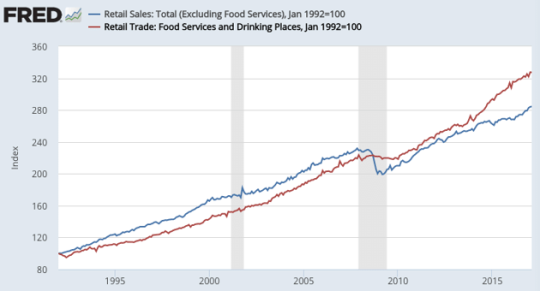
    Take a look at this FRED (Federal Reserve Economic Data) chart taken from the article:

    image

    According to Thompson, spending at “food services and drinking places” has grown twice as fast as all other retail spending since 2005. Americans now spend more money in bars and restaurants than they do in grocery stores. Last year was the first year that happened.

    But the possible reason behind all of this is arguably the most interesting: young people are looking for ways to create great social media content. And going out for gluten-free dinners with friends and traveling to Tulum “with bae” are clearly far better fodder for that than scouring the sale racks at J.C. Penney. 

    Social media is redirecting discretionary income. This is our new reality. Whether you’re a city builder or a retailer, you must now ask yourself: How shareable is the experience that I am trying to create?