Daily insights for city builders, delivered every morning at 6 AM ET. I’m Brandon Donnelly — a Toronto-based real estate developer and founder of Globizen. I’ve been writing here since 2013.

Tag: amazon

  • Is it only a matter of time before Amazon enters the delivery business?

    Yesterday I ordered something from Amazon Prime. The guaranteed delivery time was today before 9pm, but within an hour of ordering the delivery estimate was updated and it ended up arriving on the same day about 5 hours after my order. I thought this was pretty amazing, particularly because the package was a bit time sensitive.

    Delivering to individual residences is more expensive than delivering to more centralized businesses and stores. And with the rise of online shopping, UPS now delivers as many as 31 million packages every day. Because of this, every little detail counts. 

    Last year the company started installing Bluetooth receivers on the inside of its delivery trucks. If a driver incorrectly loads a package that isn’t on their route, it pushes out a loud beep. (This is one of the many tech and data-driven projects that UPS is working on to ensure it stays competitive.)

    Previously there was no final check. If there was a rogue package on the truck, it meant the driver would have to stray from their route, coordinate a handoff, or delay the package for another day. These mishaps can really add up when you’re delivering 31 million packages in a single day.

    With Amazon squeezing delivery times and with the rumors that it’s going to start its own delivery business (to compete directly with UPS and FedEx), one has to wonder about the impact that these volumes will have on our cities. Perhaps autonomous vehicles will really become the new roaming retail outlet – ready to deliver as soon as we click buy.

  • Why Detroit lost the Amazon HQ2 bid

    Dan Gilbert – billionaire Detroit promoter and owner of the Cleveland Cavaliers – penned this statement in response to the city’s failed Amazon HQ2 bid. He chalked up the loss to reputational hangover:

    We are still dealing with the unique radioactive-like reputational fallout of 50-60 years of economic decline, disinvestment, municipal bankruptcy, and all of the other associated negative consequences of that extraordinarily long period of time.

    This was the “elephant in the room”, though his statement is primarily centered around both talent and transportation – the two critical and lacking ingredients that allegedly disqualified Detroit.

    He ends by stressing the importance of physically visiting Detroit 2018. That is the only way, he says, people will fully appreciate the change and momentum that has taken hold in the city. (I experienced Detroit 2016 so I guess I’m overdue.)

    In response to this, Aaron Renn wrote this follow-up post suggesting that Dan take a page out of Tony Hsieh’s playbook. Tony is the founder of Zappos and the Downtown Project in Las Vegas. 

    To bring people to downtown Las Vegas, Tony – somewhat famously – rented 50 apartments in one of the only high-rises, called them “crash pads”, and offered them out for free to people who wanted to come and check out what was happening in downtown Vegas and with the Downtown Project.

    That’s certainly one way to lower the friction. 

    Equally interesting to me about this strategy, though, is that it was presumably necessary (he did it, right?) just to bring people to another part of Vegas, let alone another city altogether. 

    Full disclosure, I’ve never been to Vegas. But I understand that many people visit the place. So for me it speaks to the kinds of inducements that may be necessary just to revive or kickstart a place.

    Photo by Matthew Brzozowski on Unsplash

  • Amazon’s cashier-less grocery store finally opens

    This morning the first Amazon Go store opened to the public in downtown Seattle. It’s more convenience store than grocery store, but the big deal is that there are no cashiers and no lines.

    You enter the store through a gate and with your phone and Amazon’s app. As you walk around the store and pick up items they get automatically added to your online cart on Amazon.

    So everything goes right into the offline bag you’ll be leaving the store with. Place an item back on the shelf and it is instantly removed from your “cart.” Walk out of the store and you’re automatically charged.

    It’s not yet clear how exactly the technology works, but Amazon says that all of this is accomplished through sophisticated computer vision (cameras), machine learning, and lots of sensors. 

    What’s really remarkable is that it doesn’t rely on every product having a special chip or sensor attached to it. I would think that was one of the biggest hurdles to overcome in order to remove the pain point of grocery store lines.

    Now that this is up and running, I can only imagine the customer behavior data that they must be collecting. Heat maps of every shelf showing conversion rates for every imaginable customer segment. (Are tall people more likely to buy products displayed higher up?) Correlating people’s food purchases to their broader Amazon shopping habits. And the list, I’m sure, goes on. 

    There is even speculation that Amazon will begin licensing this technology to other retailers, similar to what it does with Amazon Web Services. That seems like a reasonable assumption given the data play we just talked about. Assuming the tech works, it’ll get copied. So they may as well embed themselves.

    In case you were wondering, the Bureau of Labor Statistics pegs the number of cashiers in the US at about 3,555,500 (2016 number).

    And this number is projected to remain more or less flat until 2026.

    That doesn’t feel right to me.

  • My even shorter Amazon HQ2 shortlist

    Amazon released its shortlist of HQ2 cities this morning. Below are the 20 metropolitan areas. They were selected from 238 bids, so this shortlist represents 8.4% of the original pool.

    • Atlanta, GA
    • Austin, TX
    • Boston, MA
    • Chicago, IL
    • Columbus, OH
    • Dallas, TX
    • Denver, CO
    • Indianapolis, IN
    • Los Angeles, CA
    • Miami, FL
    • Montgomery County, MD
    • Nashville, TN
    • Newark, NJ
    • New York City, NY
    • Northern Virginia, VA
    • Philadelphia, PA
    • Pittsburgh, PA
    • Raleigh, NC
    • Toronto, ON
    • Washington D.C.

    I saw some people on Twitter say that they were surprised to see Toronto and Miami on this list. I was not. If you remember, I publicly predicted on this blog that Toronto would be selected for Amazon HQ2.

    That said, I thought it would be fun to guess at an even shorter list from Amazon’s shortlist. I have no knowledge of Amazon’s actual selections process, but if I had to guess, here is who I would cross off the list:

    • Atlanta, GA
    • Austin, TX
    • Boston, MA
    • Chicago, IL
    • Columbus, OH
    • Dallas, TX
    • Denver, CO
    • Indianapolis, IN
    • Los Angeles, CA
    • Miami, FL
    • Montgomery County, MD
    • Nashville, TN
    • Newark, NJ
    • New York City, NY
    • Northern Virginia, VA
    • Philadelphia, PA
    • Pittsburgh, PA
    • Raleigh, NC
    • Toronto, ON
    • Washington D.C.

    That leaves us with a list that looks like this:

    1. Boston, MA
    2. Miami, FL
    3. Montgomery County, MD
    4. Newark, NJ
    5. Northern Virginia, VA
    6. Toronto, ON
    7. Washington D.C.

    So why this list? I’m probably wrong, but my reasons are as follows:

    – I think Amazon will opt for a metro area on eastern time.

    – There seems to be a predilection for areas around Washington D.C., so I left Montgomery County and Northern Virginia. 

    – As wonderful as it is, New York City feels too center ice for Amazon – at least in my view. But maybe Newark places them in the catchment area.

    – The area needs to be of a certain scale so Amazon doesn’t overpower it and they have enough human capital to draw from.

    – Miami is my sleeper bet. Most people think of it simply as a resort town, but there’s a huge percentage of foreign born residents and powerful arts/design scene.

    – Talent is number one, which is why I left Boston and Toronto and why I continue to believe in Toronto. Toronto is more dynamic than Boston.

    If I had to pick just three from the above shortlist, my bets would be, in alphabetical order: Boston, Toronto, and Washington D.C. What are yours?

  • Notes from the retail apocalypse

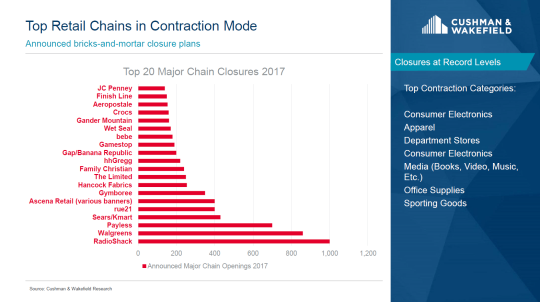
    A friend of mine was in Scottsdale last month for an ICSC conference where Garrick H. Brown (VP of Retail Research for the Americas at Cushman & Wakefield) delivered this retail presentation

    My friend flipped it to me this week and below are a couple of slides that stood out as I scanned through it.

    image

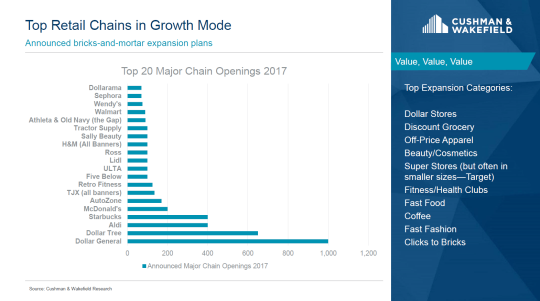
    Apparently over the last five years, a new dollar store has opened every four hours in the US. That’s how quickly this category is growing. A race to the bottom.

    image

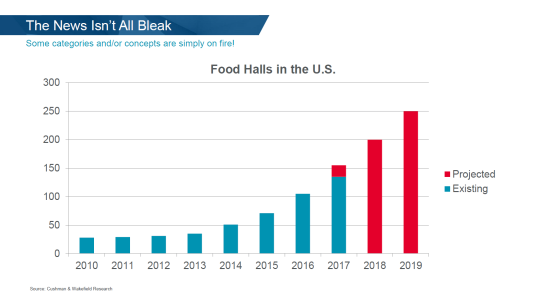
    Food halls are hot and not just in the US. Check out: “5 huge food halls opening soon in Toronto”.

    image

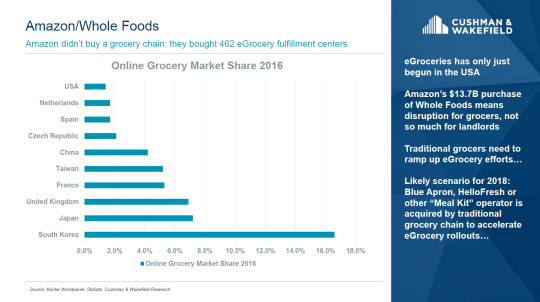
    This is similar to a chart I posted a few weeks ago that pegged online grocery shopping in South Korea at closer to 20%. I’m still fascinated by this market share number and want to better understand what’s driving it.

    image

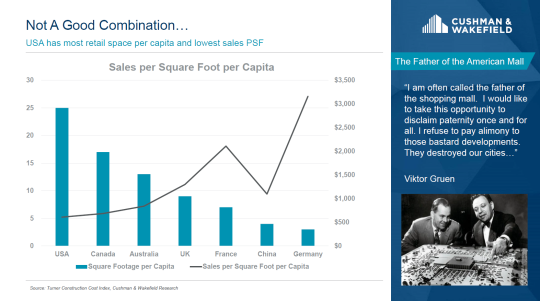
    This is an interesting chart that shows the relationship between retail square footage per capita and sales per square foot per capita. The US has lots of retail space per capita but low sales. Now look at Germany.

    image

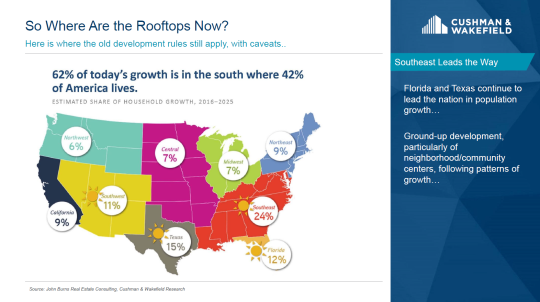
    Finally, this is a chart that shows where household growth is expected to happen from 2016 to 2025. It follows a very clear historical trend of Americans moving from cold places to warmer/hot places.

    image

    For the full presentation, click here.

  • Jeff Bezos’ regret minimization framework

    Who better to talk about on Black Friday than Amazon’s Jeff Bezos. Supposedly he’s now worth $100 billion.

    I just finished watching this short 60 Minutes clip about Amazon from 1999. If you can’t see it below, click here.

    [youtube https://www.youtube.com/watch?v=fjjUOemW-_Q?rel=0&w=560&h=315]

    Amazon was founded in 1994, so this was 5 years in. Already the company had gone public and had a market cap of somewhere around $30 billion.

    Now, keep in mind that this was right in the middle of the dot com bubble, but already Bezos was a billionaire on paper.

    What is clear from the above clip is just how obsessed Bezos was and is on the long game (”I don’t go in for carpe diem”) and on his customers. Here he is worth quite a bit, but driving around in a Honda Accord. 

    Bob Simons, the interviewer, pokes fun at him a few times for his reluctance to spend money. But Bezos says that it’s all about spending money on things that matter to customers and not spending money on the things that don’t.

    That’s customer obsession.

    P.S. The title of this post will make sense once you watch the video.

  • Amazon orange

    This week (Thursday) was the deadline to submit proposals for Amazon HQ2. About 100 cities across North America are thought to have a bid in. 

    New York lit up every single landmark in the city with “Amazon orange” in an “embarrassing attempt” to try and win this thing. That’s how bad cities want this.

    I already think that Toronto has won an incredible prize with Sidewalk Toronto. Arguably, it may turn out to be more impactful to this city than Amazon HQ2. It’s an opportunity to define the future of, not just this city, but all cities. It’s an opportunity to lead.

    At the same time, I continue to believe that there’s no better place for Amazon HQ2 than here in Toronto. Not surprisingly, our bid emphasized the point that I’ve been hammering home on this blog since Amazon first announced the RFP. Toronto’s key competitive advantage: talent. 

    Below is an excerpt from the submission cover letter. The entire letter emphasizes our ability to grow, attract, and retain top talent.

    Thirty-nine percent of the Toronto Region—and 51% of Toronto proper—are born outside of Canada. We welcome more new immigrants each year than New York, LA, and Chicago combined. We speak over 180 languages and dialects. Toronto is heralded as the most multicultural city in the world, and our labour force and economy benefit directly from our diversity and inclusivity. We build doors, not walls. And those doors open to highly-skilled economic immigrants and international students who can easily become permanent residents and citizens.

    For the full Toronto region submission, click here

    Okay, enough about Sidewalk Labs and Amazon. Regular scheduled programming will resume on the blog starting tomorrow.

  • 10x the scale

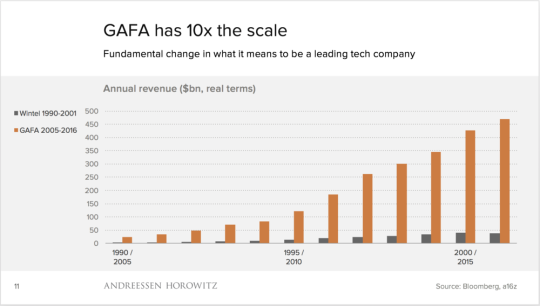
    Below is a chart from Benedict Evans comparing annual revenue from the Wintel era (Microsoft + Intel) to the current GAFA era (Google, Apple, Facebook, and Amazon). 

    His argument is that, today, “the scale of tech winners” is about 10x what it was during the previous cycle.

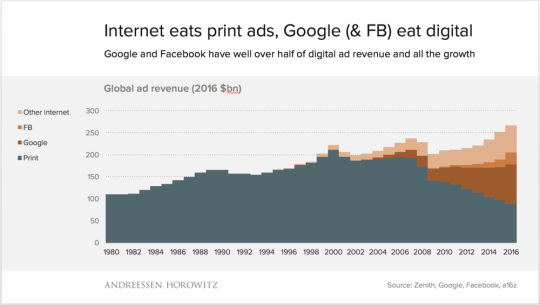
    And here is a chart, from that same post, showing how the internet ate print ads when it comes to global revenue:

    A lot of this has to do with the unprecedented growth of smartphones and the sheer number of people who came and are coming online. Mobile is 10x the PC market.

    But the other interesting narrative from the post is the argument that these companies (GAFA) have learned from previous generations just how aggressive you need to be to survive.

    The shift to mobile posed a structural threat to Facebook. At the time of its IPO, there were serious doubts as to whether the company would be able to pull off this transition.

    Which is why the founder went out and spent 10% of the company to acquire companies that would help with this transition and ensure its survival. That seems to have worked.

    In the words of Andrew Grove: “Only the paranoid survive.“ And in today’s tech world, the rewards for surviving are that much bigger.

  • How to revive the American Heartland

    “Every unemployed American is a failure of entrepreneurial imagination.” -Edward Glaeser

    At the end of September, economist Edward Glaeser returned to the Manhattan Institute to deliver the 2017 James Q. Wilson Lecture. If you’re a regular reader of this blog, you may remember that he was there in 2016 and delivered a presentation called “The End of Work.” 

    This year’s talk continues that theme, but focuses on joblessness and economic stagnation in the US Heartland. 

    The solutions he puts forward are based on a very simple economic model for growth that he refers to as “rules and schools.” Simply put: The rules of a place need to support business and entrepreneurship and the people need to be educated.

    One example he gives is of a woman in Detroit who was trying to start a food truck business but had to wait 18 months for a permit. There’s no reason that should happen. He blames the insider restaurant lobby for working to keep competition at bay. The rules are bad. We have similar problems here in Toronto with our food trucks. I think it’s wrong.

    He also pokes fun at the Bilbao effect. Yes, Frank Gehry created a beautiful piece of architecture. But did it lower the unemployment rate?

    The last thing I’ll mention are his comments regarding Amazon HQ2 because I like how he frames it. 

    Firstly, Amazon is going select a city that doesn’t need Amazon. It’s going to go where there’s already abundant human capital. 

    Secondly, “smokestack chasing” is not the right economic development strategy. The key questions should be: How will this benefit our human capital and how many new firms could it create?

    If you have an hour, check out Ed Glaeser’s talk. If you can’t see it below, click here.

    [youtube https://www.youtube.com/watch?v=e8LvHpRCUYk?rel=0&w=560&h=315]

  • Sidewalk Labs, Amazon HQ2, and the Milanese Leonardo

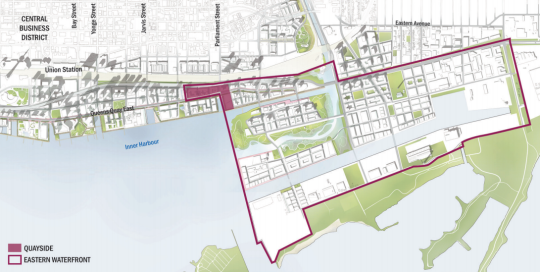
    Earlier this week the WSJ announced that Sidewalk Labs (Alphabet Inc.’s urban innovation organization) is close to a deal with Waterfront Toronto to develop a new 12-acre section of the eastern waterfront. Sidewalk Labs would be their innovation and funding partner. It’s not final yet and it’s still subject to board approval, but the sentiment is that it should go.

    There aren’t a lot of details about the project – other than the fact that it will be fairly big, up to 3 million square feet – but the overall intent is digital city building. It’s about imagining what a city could be if you built it today “from the internet up.” More info about Sidewalk Labs, here.

    I thought of this project as I read Seth Godin’s daily blog post this morning in bed. Here are two snippets from that post:

    When a new technology arrives, it’s often the nerds and the neophiliacs who embrace it. People who see themselves as busy and important often dismiss the new medium or tool as a bit of a gimmick and then “go back to work.”

    There’s never a guarantee that the next technology is going to be the one that moves to the center of the conversation. But it’s certain that a new technology will. It always has.

    Openness matters.

    I’m anxious to learn more details about the project, but this is obviously very exciting. It also creates momentum and strengthens the case for Amazon HQ2 in Toronto. The above 12-acre Quayside area is only the tip of the iceberg. There’s the rest of the eastern waterfront and also East Harbour.
    image

    Some people have been critical of this city’s push for Amazon HQ2. Anthony Lacavera, chairman of Globalive Capital, called this “the biggest Trojan Horse of all time.” His view is that Amazon would simply use HQ2 Toronto as a mechanism for cheaper labor (USD > CAD) and to siphon the best and brightest down to the US.

    Now, I agree that it would be more impactful to create the next Amazon then to simply lure in its second headquarters. Big entrepreneurial successes are what fuel the darwinian evolution of startup hubs. The founders, early employees and investors make boatloads of money and then they start reinvesting that back into the ecosystem by, among other things, backing the next generation of entrepreneurs.

    But does this necessarily mean that an Amazon HQ2 would be detrimental to Toronto by acting as a conduit to the US? Will it discourage entrepreneurship? Should we eschew all US firms out of fear that this may in fact happen? I don’t think so.

    There’s tremendous value in concentrating smart people in one place – ideas build on ideas. And I don’t think technology has been able to disrupt that, at least not yet. One example of this is a theory that Paul Graham calls the Milanese Leonardo:

    You can see how powerful cities are from something I wrote about earlier: the case of the Milanese Leonardo. Practically every fifteenth century Italian painter you’ve heard of was from Florence, even though Milan was just as big. People in Florence weren’t genetically different, so you have to assume there was someone born in Milan with as much natural ability as Leonardo. What happened to him?

    And his reasoning is as follows:

    Nothing is more powerful than a community of talented people working on related problems. Genes count for little by comparison: being a genetic Leonardo was not enough to compensate for having been born near Milan instead of Florence. Today we move around more, but great work still comes disproportionately from a few hotspots: the Bauhaus, the Manhattan Project, the New Yorker, Lockheed’s Skunk Works, Xerox Parc.

    Xerox Parc (Palo Alto Research Company) is a great example of the kind of positive externalities that can happen as a result of smart people being in close proximity to each other while they wrestle with similar problems. It has been well documented that it was Steve Jobs’ visit to Xerox Parc that inspired many of Apple’s early innovations.

    So my view: let’s increase Toronto’s urban metabolism and make it the Florence of 1450.

    Ed Clark – who is leading the charge for HQ2 in Toronto – has been clear that large taxpayer subsidies are not on the table for Amazon. That would not be fair to the existing companies in this city. If that is what it is going to take, then we are not going to win. We will win based on our city, our human capital, and our openness to the rest of the world. That feels right.

    Welcome Sidewalk Labs. Welcome Amazon. This city is open for business and to new ideas. 

    Image: Waterfront Toronto