
Daily insights for city builders, delivered every morning at 6 AM ET. I’m Brandon Donnelly — a Toronto-based real estate developer and founder of Globizen. I’ve been writing here since 2013.

Tag: amazon

  • HQ2 isn’t coming to Toronto

    So I was wrong. Amazon didn’t pick Toronto for HQ2. It instead picked Crystal City, Virginia (Washington) and Long Island City, NY (New York City). More on that, here, in the NY Times. Confession: My prognostication was at least partially about trying to create a self-fulfilling prophecy.

    In any event, it’s interesting to consider the locations that they did pick – as well as the fact that they ended up picking multiple cities. This was not part of their RFP. Though, many have convincingly argued that this process was over before it even began. HQ2 was always going to end up on the east coast, near one of Bezos’ homes.

    Nevertheless, urbanists such as Aaron Renn took the announcement as a direct repudiation of the American heartland. He believed that Amazon would be far more cost conscious in their decision making and ultimately elect for a lower cost locale in the middle of the country. Instead, the coastal hegemony won out. 

    Joe Cortright of City Observatory correctly predicted that Amazon would, for a few reasons, parlay their HQ2 search into multiple smaller locations (HQ2, HQ3, and so on). One of the reasons for this is that it gives the company more leverage when it comes negotiating subsidies on a go-forward basis. If NYC doesn’t want our next round of hires, we’ll take them to Washington.

    Looking at the locations, one of the first things I noticed is that both are just outside of their respective “downtowns” (across a body of water), as well as adjacent or on the way to an international airport. Crystal City is across the street from DCA and Long Island City is a 15 minute drive from LGA. Both are situated on top of higher order transit. Makes sense to me.

    Now, who wants HQ4?
  • In support of narrative memos

    This is not new. It has been reported on before. But I just finished reading this article about Jeff Bezos’ relentless commitment to “high-quality and high-velocity decision making” at Amazon.

    Here are a couple of high level points:

    – There are decisions that cannot be easily reversed (Type 1) and there are decisions that can be (Type 2). Knowing which is which is important. To help get better at this, they are very diligent about tracking the outcomes of previous decisions.

    – Make decisions without all of the info you wish you had, because if you don’t, you’re probably moving too slow. Speed is paramount. If you’ve categorized your decisions properly (see above), being wrong may not actually be that costly.

    – There’s a company philosophy centered around “disagree and commit.” It is about moving forward – since speed is so important – without full consensus. In other words: We may not all agree, but can we disagree and commit to this?

    Perhaps the most interesting, and seemingly paradoxical, aspect of Amazon’s “high-velocity decision making process” is that it is built upon narrative memos, instead of PowerPoint decks. In fact, decks have been banned at the company since 2004.

    The reason for this is that narrative memos are more difficult to write, which means you really have to understand what you’re talking about. It encourages deeper thought and it allows nuances and interdependencies to come through.

    Apparently important meetings start with everyone just sitting in a room reading the narrative memo, which are often between 4-6 pages. Once everyone has read the memo and is on the same page, the meeting starts.

    As someone who writes a daily narrative, this approach really resonates me. It would be a hell of a lot easier if I could just show up here every day and throw down a few bullet points. But then both of us would get far less out of this practice.

    Writing takes time. Bezos has acknowledged that these memos cannot be written in a day or two. But clearly there’s a belief that more time spent up front translates into greater overall speed. Their market cap suggests that is working.

  • The world’s best brands — 2018 edition

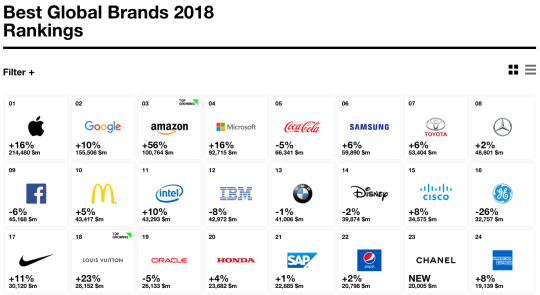
    At the beginning of this month, Interbrand released its annual ranking of the world’s best global brands. This year’s 2018 report marks the 19th year of the study. If you’d like to download a free copy of the report, you can do that here. But below is a snapshot of the first 24 brands:

    Apple and Google are in top position for the 6th year in a row. And Amazon is on a hockey stick trajectory with its brand value jumping by 56%. More than half of the list is comprised of the following five sectors: Automotive (16), Technology (13), Financial Services (12), Luxury (9), and Fast-Moving Consumer Goods (9). Luxury is currently the fastest growing sector.

    In their report, they outline five themes that have emerged and that are helping these brands outperform. They are:

    1. Positive utility – not enough to just make people feel good through storytelling; you need to create real value and a positive impact in the world
    2. Subscription mindset – there’s an increasing amount of brand value in subscription-based businesses (29% in 2018 compared to 18% in 2009); you need to offer your products and services with the least amount of friction as possible
    3. Customer-centricity – bring the voice of your customer into every aspect of your business; be nimble enough to respond quickly
    4. Learning from luxury – the top performing category in this year’s ranking; about exclusivity and authenticity
    5. Role of brand – make your brand part of the decision-making process; build brand equity and trust

    I’ll stop there and let you all dig into the rest of the report if you’re interested. 

    But one thing I found particularly interesting about the study is that they used – insert buzzwords here – “AI-powered social listening” to try and measure the emotion and sentiment floating around on the internet around specific brands. The goal was to pin down the perceived trustworthiness of specific brands.

    Not surprisingly, they found a pretty strong correlation between customer trust and purchasing intent. Makes sense to me.

  • Create things people love

    I just finished listening to this podcast about venture capital and consumer products. One of the underlying questions is whether we are currently in a “consumer downturn.” Rebecca Kaden of Union Square Ventures (USV) talks about the importance of “platform shifts” for venture returns. These are moments where a new technology hits the marketplace and there’s a corresponding mass consumer adoption. When and where will that next shift occur? Maybe it’ll be in real estate.

    I like the discussions at 10:00 and 13:50. The first deals with the importance of non-paid customer acquisition strategies for consumer products. Rather than relying on bought attention, you really need organic growth strategies, which is often an indication that people are passionate about your product. This is arguably more important when you’re fundamentally reliant on massive growth/scale, but whether we’re talking about software or a home, I still believe it’s paramount. Create things people love.

    The second point is about commerce, Amazon, and how USV avoids investing in companies that are unlikely to ever win against Bezos. Kaden’s position is that Amazon’s advantage is and has been more executional than structural. They are simply really good at doing things better. But Amazon wins at logistics, speed, and value. They are not as focused on experience, entertainment, and discovery. And people still want that.

    I’ll stop there. If you can’t see the podcast below, click here.

    [soundcloud url=”https://api.soundcloud.com/tracks/507691569″ params=”color=#ff5500&auto_play=false&hide_related=false&show_comments=true&show_user=true&show_reposts=false&show_teaser=true&visual=true” width=”100%” height=”300″ iframe=”true” /]

  • Amazon and retail

    This is an excellent talk by NYU professor Scott Galloway about Amazon, online grocery, and many other aspects of the retail landscape. The bits about Amazon’s scale and reach are fascinating. There is about 30 minutes of him speaking quickly and then another 15 minutes of Q&A. If you can’t see it below, click here.

    [youtube https://www.youtube.com/watch?v=_HyiY_m_YxI&w=560&h=315]

  • Detroit. Move here. Move the world.

    As part of the Amazon HQ2 bid process, a number of cities produced videos. I only discovered them today and so maybe some of you also missed them when they were released last fall. There are videos from Detroit, Boston, Pittsburgh, Philadelphia, Dallas-Fort Worth, Las Vegas, Louisville, Atlanta, and maybe others that I am still missing. 

    Some of the videos are bad. (I’ll let you make your own judgement calls.) I like the idea behind Atlanta’s video, which is the journey of someone named Georgia physically delivering their bid to Seattle. And Philadelphia’s video made me feel really nostalgic about my time there. Those were some great years. 

    But my favorite video is Detroit’s video. It feels authentic. The footage is outstanding. And it feels powerful. Though it is probably too long. It was a good reminder that I’m overdue for a visit. So here is Detroit’s video. If you can’t see it below, click over to YouTube.

    [youtube https://www.youtube.com/watch?v=DO4J_PC1b5M&w=560&h=315]

  • A global hub for urban innovation

    Dan Doctoroff, the CEO of Sidewalk Labs (and the former deputy mayor of New York City), was recently interviewed by BNN Bloomberg about the company’s plans and ambitions for Quayside here in Toronto. 

    He talks about the project; their interest in timber construction; how the company, Sidewalk Labs, might ultimately make money; and how their mission is to create a global hub for urban innovation.

    This last point is, of course, the most exciting opportunity – both for Sidewalk Labs/Alphabet and for Toronto. And it’s why many people believe that Quayside will end up a far greater (economic development) coup compared to HQ2.

    The interview is only 10 minutes. If you can’t see it embedded below, click here.

    https://webapps.9c9media.com/vidi-player/1.5.1/share/iframe.html?currentId=1461888&config=bnn/share.json&kruxId=InSaVlLc&cid=%5B%7B%22contentId%22%3A1461888%2C%22ad%22%3A%7B%22adsite%22%3A%22ctv.bnn%22%2C%22adzone%22%3A%22ctv.bnn%22%7D%7D%5D

  • How ecommerce is growing in rural China

    This piece in the New Yorker about how e-commerce, and in particular JD.com, is transforming rural China is worth a read.

    In typical New Yorker fashion, it’s a good long-form read, but one that you can also listen to if that’s your thing.

    What’s immediately fascinating are how important trust is to JD’s rural expansion strategy and how locals from these rural communities are used to penetrate the social networks.

    Today, Xia oversees deliveries to more than two hundred villages around the Wuling Mountains, including his birthplace. But, in line with JD’s growth strategy, an equally important aspect of Xia’s job is to be a promoter for the company, getting the word out about its services. His income depends in part on the number of orders that come from his region. Across China, JD has made a policy of recruiting local representatives who can exploit the thick social ties of traditional communities to drum up business.

    This is important because:

    “Chinese people don’t easily believe the good will of strangers,” Liu told me. “Why do you think Chinese fight tooth and nail to get on the bus and subway?” He shook his head and laughed. “It doesn’t matter that it’s less efficient or unnecessary. It’s a complete reflex for them, because it’s what they’ve been taught since they were young.”

    When you have some time, here is the full article

    According to the New Yorker, JD.com is the third largest tech company in the world in terms of revenue. They also have the largest drone delivery platform in the world.

  • Everything delivered on demand

    Last week I had something delivered from Amazon almost every single day. They weren’t necessarily big things though. One day it was a new corn broom for the patio. Another day it was a small set of hooks that I wanted to hang some lights. And the list goes on. 

    This is what Amazon wants us to do. Order every little thing, instantly, as soon as you think about it. And it’s magically convenient.

    Developers and architects are of course thinking about the implications of this shifting shopping habit on new residential developments. Usually it comes in the form of a large “Amazon room” and/or a parcel locker system. 

    I recently measured the package room in my building (geeky, I know). It’s about 10′ x 6′ and it sometimes isn’t enough for the volume of daily packages generated by ~360 units. 

    The other thing that happened last week is that my concierge said to me: “Brandon, we have become a full fledge post office with the amount of packages that come through here every day.” Every evening there’s a lineup of people waiting to collect their packages. 

    That immediately signaled to me that simply providing a larger room probably isn’t enough. This trend is only going to continue. How could we better design and optimize for this shift?

    I am sure that there many companies working on this problem. Hopefully they will surface in the comments and in my inbox following this post.

    Photo by Maarten van den Heuvel on Unsplash

  • Amazon buys video doorbell company

    So Amazon is buying Ring (they make video doorbells, among other things) for north of $1 billion. Supposedly, it is the second largest acquisition that Amazon has ever made – the first was Whole Foods.

    If you consider that Amazon is also looking to enter the delivery business, it should be obvious that they want to control everything related to the home delivery process.

    For one, it likely enhances Amazon Key and helps with the “porch pirate” problem. Apparently Amazon has had to restrict same-day delivery from some high crime neighborhoods because of this exact problem.

    And there’s already speculation about what this could mean for grocery deliveries. Amazon needs to find a frictionless way to get your food orders into your refrigerator. 

    There are also many possible tie-ins to Alexa/Echo. It’s probably safe to assume that Jeff Bezos sees a lot more than just a doorbell with a camera in it.