Daily insights for city builders, delivered every morning at 6 AM ET. I’m Brandon Donnelly — a Toronto-based real estate developer and founder of Globizen. I’ve been writing here since 2013.

Tag: amazon

  • Amazon is just getting started

    image

    The Economist has an article up talking about what a behemoth Amazon has and will continue to become. Here are some interesting stats for you to think about:

    • More than half of every dollar spent online in America now goes to Amazon
    • Amazon’s share price has increased 173% since the beginning of 2015 (12x faster than the S&P 500)
    • With a market capitalization > $400 billion, it is the 5th most valuable company in the world
    • 92% of its value is supposedly being derived from profits expected after 2020 – they are playing the long game
    • Investors believe that revenue will go from $136 billion (2016) to half a trillion over the next decade

    If I can buy something online, instead of in person, I will do it. And that very often leads me to Amazon. In fact, I bought my new camera lens from them last week. Many others seem to be doing the same.

    When I go to a store now it’s because I need something immediately or because I’m looking for a new experience. I want novelty and I want to feel something special when I walk in. That, or I just need groceries.

  • Where do you shop?

    Matthew Townsend of Bloomberg recently published an interesting article talking about the dominance of Amazon.com (and online shopping in general); the shift towards experiences over stuff; and the languishing brick-and-mortar brands that keep saying it’s the macroeconomy, rather their product/approach, which is causing sales to slump.

    Here are a 3 excerpts that stood out for me:

    Lurking behind the cliché is a hard truth these executives are eager to avoid. “All this pleading that the consumer isn’t spending is an excuse, largely from management teams whose product is less relevant,” Kernan said. “The consumer is actually driving the U.S. economy, so it’s a little ridiculous when we hear the excuse of the macro environment is not good.”

    Another hurdle that isn’t going away is the shift to increased spending on experiences such as travel and classes, which make for much better posts on Instagram, Facebook, and Snapchat. “Social media has really fostered a have-done environment, which is not what retailers sell,” Perkins said.

    One characteristic of these struggling brick-and-mortar chains has been direct competition with Amazon. If they don’t go head-to-head with the online giant, they rely heavily on people visiting shopping centers anchored by retailers that do, such as ailing department-store chains Macy’s and Sears. One measure of store visits in the U.S. paints a dire picture, with only a dozen positive weeks over the past two years.

    According to Bloomberg, 55% of online product searches start at Amazon.com. And while online sales in 2016 have only accounted for 11% of all (U.S.) retail revenue, it has represented 54% of all growth! That’s a big number, especially when you think about what that will mean over time.

    Talking about the growth and threat of online shopping has become a boring truism. I know that. But are retail executives taking it seriously? The Bloomberg article gives you the sense that many are not – or at least they’re not publicly acknowledging it.

    When I look around my place right now and think about where I bought each item – everything from the shoes at my door to the protein powder in my cupboard – it’s pretty amazing to think about how much I now buy online. And I’m sure that many of you are the same.

    Groceries aside, I’m probably 85-90% online. What about you?

  • The back-end of our cities

    I love cities. We all love cities right now. 

    Everyone, for good reason, seems to be fixated on both people returning to cities (like those narcissistic Millennials) and people urbanizing for the very first time. This latter scenario is happening rapidly across the developing world and in many cases – but not all cases – it is helping to lift people out of extreme poverty.

    But by most measures, urban areas represent only about 2-3% of the world’s land area, despite housing over 50% of our population. So here’s an interesting thought for this morning: What is happening and what will happen with the remaining 97-98%?

    In this recent talk by architect Rem Koolhaas, he attempts to dissect the future of living, loving, and working through the lens of architecture. However, he starts by saying that architecture is, in fact, too slow to properly capture the zeitgeist of any time period. It is, “an unbelievably slow art.” That said, Koolhaas has a remarkable ability to identify what is happening (see Delirious New York) and then call it out in a way that you probably haven’t thought about. 

    In the above talk, he hones in on the impact of Silicon Valley – certainly the spirit of our time – on the rural landscape outside of our cities. Interestingly enough, he also talks about how the tech industry has begun to borrow terminology from architecture in order to describe itself.

    Screenshot from the video:

    image

    Despite their ethereal appearance, technology giants still have large physical footprints for servers, production, logistics, and so on. But there’s no reason – or way – to accommodate them inside of our cities and so they cluster outside, in the 97-98% areas. These are places like the Tahoe-Reno Industrial Center, which is the home of Tesla’s new Gigafactory.

    Because of sheer scale and because there’s no need for them to possess much in the way of humanistic qualities, these are spaces which are void of architecture, urbanism, and, in some cases, a light spectrum beyond what is absolutely necessary for the specific function of the building (discussed in the video).

    Of course, the periphery has long serviced the core. But Koolhaas’ thinking has, as it often does, made me consider this phenomenon in a slightly different way. He paints a picture of a spiky world where we are all crammed into sensor and app-driven cities (the front-end), all of which are then powered by big mechanistic boxes that many of us may be naive to (the back-end). In some ways it feels like the Matrix. What we see and experience could just be the tip of the iceberg.

    Architecture may be unbearably slow, but as a society we have always built what matters to us most at the time. At one point it was places of worship. But today, at least for part of our landscape, it is boxes not intended for us to really experience. Maybe that’s not really architecture. Maybe it is simply the back-end for our cities.

  • [Video] Gang of Four

    Scott Galloway, professor of Marketing and Brand Strategy at NYU Stern, recently delivered a presentation on the Gang of Four: Apple, Amazon, Facebook, and Google. These dominant companies are also often referred to as the “Four Horsemen.”

    The video is about 16 minutes long and I would highly recommend that you give it a watch.

    It’ll be like drinking from a firehose, but there are so many fascinating takeaways. You’ll also quickly discover how far reaching the societal impacts of these companies have been and will likely be in the future.

    If you can’t see the video below, click here.

    [youtube https://www.youtube.com/watch?v=jfjg0kGQFBY?rel=0&w=560&h=315]

  • The taxi cartel

    https://500px.com/embed.js

    Early this morning Peter Cheney of the Globe and Mail published an article called: How Uber is ending the dirty dealings behind Toronto’s cab business.

    And I highly recommend you read it. He’s been investigating this industry for decades.

    Though the article is specific to Toronto, I know that there are middle people and archaic policies governing the taxi industries in many other cities around the world.

    Here it revolves around taxi licenses issued by the city (known as “plates”), which are expensive and almost impossible to get. Last year the average price of a plate was $118,235 (2014).

    The way it works is that people – typically non-drivers – buy/inherit/get these plates and then charge rent on them to drivers who want to use them. The result is a taxi cartel:

    In fact, Toronto’s taxi plate system is anything but free enterprise. Instead, it is based on the artificial restriction of a natural market, and the granting of licences to a fixed number of participants. Even those who paid top dollar for a plate used to enjoy an annual return of more than 12 per cent. And for those who inherited plates, the return was manna from heaven.

    So it shouldn’t come as a surprise that the taxi industry is grouchy about companies like Uber. But the cost structure of the incumbents is going to need to change if they want to stay in business.

    Jeff Bezos of Amazon is famous for saying, “Your margin is my opportunity.” And that’s exactly what is happening here. A bloated legacy cost structure is being quickly supplanted by better/cheaper.

  • Amazon Dash — foolish joke or disruptive innovation?

    [youtube https://www.youtube.com/watch?v=NMacTuHPWFI?rel=0&w=560&h=315]

    Earlier this week on the day before April Fools’, Amazon launched two new services. The first was called Amazon Dash (see above video) and the second was called Amazon Home Services. The entire internet seemed to think that Dash was actually an April Fool’s joke, but it turns out it’s not. In fact, it’s actually an incredibly smart product.

    The way it works is simple. Each branded Dash Button is about the size of a pack of gum. You mount it in, on, and near things that you replace on a regular basis, such as laundry detergent, coffee refills, and so on. Then all you have to do is push the button and your order gets sent to Amazon. Shortly after the product arrives at your door. I say “shortly” because you can be certain that Amazon’s goal is to make that time frame as short as physically possible.

    I don’t know about you, but I could definitely see myself using this product. There are a number of essentials – such as laundry detergent and toilet paper – that I just hate shopping for. I have to create reminder appointments in my calendar just so I don’t forget. In fact, I did that today and I still forgot to pick everything up on my way home (my phone died).

    But what’s even more interesting about Dash, I think, is that it increases the threat to brick-and-mortar retailing and, more specifically, big box stores. Because if same day and same hour delivery is a big threat to big box stores, just imagine one button and same hour delivery. And, is it only a matter of time before something like this comes to Apple Watch? It seems like the right medium for it.

    Isn’t it interesting how something that most people believe is a silly joke could actually turn out to be a huge innovation? I try to always remain open minded. Sometimes it’s hard. But it’s good practice.

  • Are we becoming more or less entrepreneurial?

    Aaron M. Renn of The Urbanophile, recently wrote an interesting article in Governing called, Where’s America’s Entrepreneurial Economy? In it, he argues that despite the fact that there’s a perception that entrepreneurship is on the rise, overall rates are actually declining.

    The Brookings Institution found that so-called “firm entry rates” have declined since the 1970s and that they suffered a steep fall post-2005. And though millennials are often seen as an entrepreneurial generation, The Wall Street Journal reports that business ownership among those under the age of 30 recently hit a 24-year low. Self-employment has seen a similar downward trend. A study by Economic Modeling Specialists International found that both the total number of self-employed and their share of jobs have fallen since 2006.

    His argument is that outside of tech — where yes, the barriers to entry have fallen significantly over the years — it has actually become harder to start a company in a lot of other cases. And he specifically mentions two industries where he believes that is very much the case: construction and real estate.

    Why is that?

    Well, he cites a number of possible factors, one of which is increased licensing requirements for many industries. But the two most interesting for me are slow disruption cycles and the presence of large dominant firms.

    Real estate has both of those. 

    It’s also a capital intensive industry. And it’s becoming harder for smaller private players to compete with larger institutions and pension funds who struggle with “moving the investment needle”, not with access to capital. Real estate is no longer the fringe asset class it once was.

    In contrast, you have the tech space with fast disruption cycles and low barriers to entry. Yes, you also have large dominant players (Apple, Google, Facebook, Amazon, and so on), but even they don’t have complete immunity in an environment where new ideas frequently trump access to capital.

    A culture of entrepreneurship across all industries is important for our society. I hope we never lose that.

  • The threat to big box retailing

    image

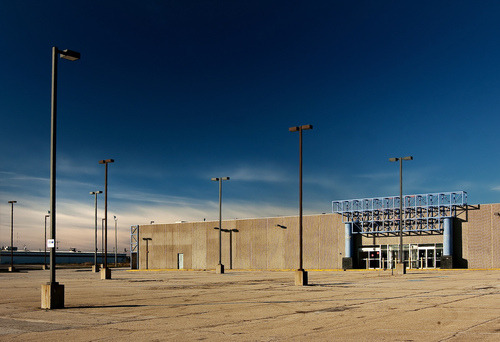
    Earlier this week, I was having a conversation with a number of smart real estate people about the future of retail in today’s internet and smartphone world. This, of course, isn’t a new topic. The industry has been discussing it for years. And while internet retailing still accounts for a relatively small percentage of overall retail sales (~10%), we all know that change is coming.

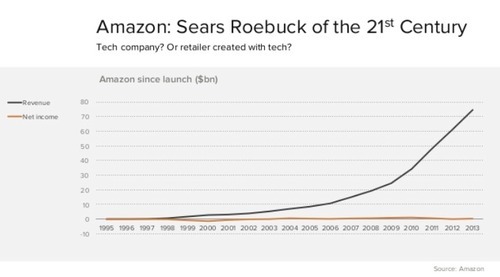
    One company that came up during our discussion was not surprisingly Amazon.com. But the initial comment was that they don’t make any money. Fortunately for me I had just gone through a presentation by venture capitalist Benedict Evans the night before called: Mobile is eating the world. And so I pulled out my phone and presented this slide:

    image

    The fact that Amazon operates with basically no net income is on purpose. Look at their revenue growth! So I wouldn’t dismiss them as being a fad. They may only account for 1% of all US retail sales today, but I’d put money on that percentage growing.

    The other reason I bring up Amazon is because, in some ways, I think of them as the online equivalent of a big box store. Just like a Walmart or Costco, where you can buy everything from tires to groceries to prescription drugs, I buy a lot of different things, besides just books, off of Amazon.com. You might do the same as well. And this is where I see the immediate threat to offline retailing and retail real estate: big box stores.

    In the second half of the 20th century, big box stores were incredibly disruptive to the retail landscape (and to cities). They used cheap land on the outskirts of cities, cheap buildings, and economies of scale to offer rock bottom prices to consumers. The value proposition was about cheap, not about differentiation. But as cheap as they may be, the internet can still do it cheaper.

    And retailers know this, which is why I think they all now sell groceries. Groceries have a very low online penetration. Basically everybody still buys groceries in-person. So if you offer that, you have a reason to draw people inside your store, where they will hopefully buy all the other stuff that they need. But as the online value proposition continues to get stronger, I think we’ll see many other, more significant, changes.

    Image: Flickr

  • Why flying delivery drones are a big deal

    One of the biggest news pieces of the last few weeks—at least in retail and tech circles—has been Amazon’s unmanned aerial delivery drones (also known as Amazon Air Prime). In case you missed it, here’s a video from Amazon showing them in action. 

    image

    The goal:

    “To get packages into customers’ hands in 30 minutes or less using unmanned aerial vehicles.”

    Now, this won’t happen for another few years, if even that soon, but I think it’s pretty clear that this is something epic in the making. If successful, it’s going to completely rewrite, not only the retail landscape, but probably the landscape of our cities.

    If you think about it, cars enabled a certain kind of retail. They enabled big box stores and those, in turn, changed our cities (for the worse, I would argue). Now what happens when the undifferentiated products of a big box store can be flown to my door step in less than 30 minutes? Suddenly getting into my car seems archaic.

    There’s a great article covering Amazon’s drones and the history of American retailing in Atlantic Cities. They do a better job conveying the potential magnitude of Amazon Air Prime and so I suggest you have a read if this topic interests you.