
Daily insights for city builders, delivered every morning at 6 AM ET. I’m Brandon Donnelly — a Toronto-based real estate developer and founder of Globizen. I’ve been writing here since 2013.

Tag: accessory dwelling unit

  • Make Way for Laneway

    I was speaking with a friend this morning and he told me that he had a Pavlovian association between me and laneways. That made me happy. 

    If you’re a regular reader of this blog, you’ve heard me go on and on about the great potential of laneways and laneway housing (accessory dwelling units) in Toronto, as well as in other cities around the world.

    So I won’t do that today. Instead, I’m going to link to a report that was just released by the Pembina Institute called Make Way for Laneway: Providing more housing options for the Greater Toronto Area.

    The report is obviously about Toronto, but there’s no reason that the lessons and ideas won’t also apply to your city. So I would encourage you to give it a read.

    For those of you who have emailed me about my own laneway house, the project is still on hold. And it will likely remain that way until the city becomes a bit more accepting of this housing typology. Hopefully that will happen soon.
  • Pop-up housing (it’s not what you think it is)

    image

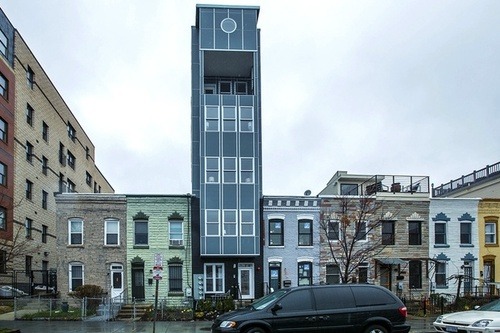
    You were probably expecting some kind of temporary housing solution. Because that’s certainly what I was thinking when Big Ben Myers tweeted me this article yesterday. But it turns out that in D.C., “pop-up housing” has come to mean what you see in the above photo – a pencil thin house rising amongst a bunch of low-rise rowhouses.

    Local bloggers are calling it a “middle finger to taste and scale”, but it’s happening because of what appears to be a real housing supply shortgage in the District. And it’s been said to be hurting not only housing affordability, but also exacerbating income inequality. 

    However, it’s become a threeway debate. You have people worried about aesthetics, local homeowners and residents worried about their own interests, and you have people worried about the overall health of the housing market. As I’ve argued before here on ATC, too much protectionism is often a bad thing for housing markets.

    But policy makers in the District appear to be responding in exactly that way, by clamping down on pop-up housing, as well as on accessory dwellings such as nanny flats (which I’m assuming are similar to what we would call laneway houses here in Toronto).

    I can certainly understand the concerns, but I think that cities need to find that fine line between preservation and growth. Because banning pop-up housing is only addressing the symptom. It doesn’t address the underlying cause, which, in this case, seems to be a housing market in search of more housing options.

    Update: This post was updated to give credit to Big Ben Myers for the article.

    Image: Washington Fine Properties via Citylab

  • Portland adopts the granny flat

    I’ve talked a lot about laneway housing here on Architect This City. I’m a big supporter and I wish that Toronto would get on board and formally allow them. It’s been done and it is being done in cities around the world. Just this morning, a friend of mine sent me this NY Times article talking about how Portland has embraced the “granny flat”, which is one of the many names used for this type of housing.

    Within the article, you’ll find a nice slideshow of “accessory dwelling units” ranging from 300 and something square feet to 700 square feet. (800 square feet is apparently the maximum in Portland.) But what I found really interesting from the article is how quickly these homes have caught on:

    Eli Spevak, a local alternative-housing developer who is among those who lobbied for A.D.U.-friendly policies, said, “The city changed two rules, and all of a sudden it went from 30 a year being built to 200 last year” — an impressive figure, considering the total number of applications approved for single-family houses in 2013 was 800.

    This is a hugely impressive figure that shows that these homes are not really a niche product. Laneway homes have become a meaningful chunk of the new home market in Portland. Given that they’re a relatively affordable and sustainable option, I’m not surprised. But I am surprised that more cities aren’t following suit.