Daily insights for city builders, delivered every morning at 6 AM ET. I’m Brandon Donnelly — a Toronto-based real estate developer and founder of Globizen. I’ve been writing here since 2013.

  • I’d actually like a Tesla bicycle

    I watched Tesla’s We, Robot event last night. As many of you know, Elon and his team showcased a Cybercab, Robovan, and a humanoid robot that dances funny, all of which will be available in the market for purchase at some unknowable date in the future. What was obvious is that Elon himself has no clear idea of when this will be.

    What I will say, though, is that the designs look cool. The Cybercab looks like a Porsche and a Cybertruck had a love child, and the Robovan looks like an Art Deco rendition of what the future is supposed to be like. I first wondered why they’d create a robotaxi with only two seats. But thinking about it now, most Uber rides probably only have 1-2 passengers.

    Despite these pretty designs, the overwhelming reaction to the event seems to be one of disappointment. We’ve heard what was said before. Public transportation is bad (I disagree). Autonomy will free up your time and remove unnecessary parking spaces from our cities (allowing for more public space). And soon you’ll be able to put your under-utilized car to work and earn extra cash.

    Cool, but when?

    Waymo and Uber are not, as far as I know, hosting similarly flashy events. But as far as I can tell, they’re making meaningful progress in advancing toward full autonomy. As of June of this year, Waymo had already logged over 22 million rider-only miles. And in September, they announced a partnership that would bring AVs to Austin and Atlanta by way of the Uber app.

    At this point in the hype cycle, I don’t think anyone is interested in hearing promises about what the future of autonomy will be like, especially without any firm dates. They want to know: Are we there yet? So I think it’s no surprise that people, including investors, weren’t all that pumped up by the event.

    On a more important note, Tesla had bicycles with brightly illuminated wheels circulating around their event set (at Warner Bros.) to presumably demonstrate that their Cybercabs can successfully navigate around moving objects (when brightly illuminated). If you missed them, look at the 29 second mark in the below video:

    I can’t be the only one who thought: “What are those? Now, that’s what I want!” So I’ve asked Elon when they’ll be available and when I can buy one. I’ll keep you all posted on his response.

  • Western resort real estate is in very high demand

    People like ski and snowboard towns. Here’s an excerpt from a recent WSJ article talking about Park City:

    Prices continued to rise in most luxury ski towns this past year, but none grew as much as Park City, a former silver mining town 32 miles east of Salt Lake City. The average home sale price there grew 35% in 2023 from 2022, compared with a 9.4% increase at Vail and Beaver Creek and 3.2% at Aspen, according to the resort report by Summit Sotheby’s International Realty. 

    The main point of the article is this: Park City has gotten really expensive, and so people are now looking and buying homes further out in places like Heber City, Midway, and Kamas. Here’s how expensive expensive is:

    Over the last four years, Covid has stoked demand for western resort real estate. In Park City, single-family homes have sold for a median price of $4 million year-to-date, up from $1.996 million in 2019, according to Redfin, which averaged the monthly median sales prices weighted for the number of homes sold. One home was listed in September for $65 million, which could set a record for the state. It’s now under contract, according to listing agent Paul Benson of Engel & Völkers, who declined to disclose the sale price.

    This, of course, isn’t a novel phenomenon. It’s the whole “drive until you qualify” thing. But what’s interesting about this particular mountain example is that it’s not centered around access to a CBD or downtown; it’s centered around “how fast can I get to a ski and snowboard resort?”

    For example, Deer Valley has a new East Village that is expected to open up in 2025. This brings the cities mentioned above closer in. And buyers seem to be doing that math: “It’s a 25-minute drive today, but next year I’ll be able to get on a lift in 15 minutes. Score.”

    Given that Deer Valley also doesn’t allow snowboarders, it’s interesting to think about how these trends could be bifurcating the region between skiers and snowboarders. I don’t have any data on this, but I bet if you mapped it out, there would be some sort of clustering happen.

    The article also goes on to talk about transportation. Because you can’t talk about new development and real estate without talking about traffic. But I think Bill Ciraco (Park City Council) gets it exactly right in the article: This is a car problem, and less of a people problem.

    In my mind, the Wasatch Range is destined for something like this ONE Wasatch concept, which is/was a proposal to link seven resorts through a handful of new skiable connections. This is similar to what you’ll find in Europe, and it means less driving and more time on the mountain.

    That’s what everyone wants to be doing anyway.

    Photo by Lauren Pandolfi on Unsplash

  • Checking in on office utilization in Toronto

    Let’s check in on office utilization (in Toronto). The last time we talked about this was in April. At that time, the average weekly utilization figure was 63%. The peak day — Wednesday — was 73%. And the low day — Friday — was 40%. Today, well as of September 15, these numbers are now 69%, 79%, and 39%, respectively (see above chart). So we continue to climb. The only slight downward trend is Fridays. People don’t like coming into the office on Fridays. Still, the average is up 6% over the span of about 6 months. This makes you continue to wonder: When does this level off? I also don’t know what this index looked like before 2020. Are we back, or not yet?

  • Dupont Street to become a complete street

    The City of Toronto is proposing to turn Dupont Street — between Dundas Street West and Davenport Road — into a “complete street.”

    Here’s the area in question:

    It’s 4.7 kilometers long.

    And here’s how the city thinks about complete streets:

    “Complete streets” are streets that are designed to be safe for all users: people who walk, bicycle, take transit or drive, and people of varying ages and levels of ability. They also consider other uses like sidewalk cafés, street furniture, street trees, utilities, and stormwater management.

    Right now, the city is in the public consultation phase. If you’d like to provide your feedback, you can do that here. You have until October 30th. The online tool is also pretty neat. You can drop comments on specific areas of the street. And already the map has been totally filled up.

    This is an important and busy artery in midtown. I use it all the time as a pedestrian, cyclist, and driver. It’s not the best street, though. Yesterday it took me 45 minutes to drive from one end of it to the other. Along with better street design, this part of the city could use better transit.

    I’m looking forward to seeing how Dupont ultimately gets designed.

  • Canada’s proptech landscape

    The morning I attended the release of Venturon’s 2024 Sustainable Proptech Report. What’s great is that it includes a list of all the (known) companies that are active in this space in Canada. It also summarizes venture funding by region. Interesting to see Alberta punching above its weight and coming in second behind Ontario. It has roughly half the population of Quebec.

    As part of the event, the following companies also gave short presentations:

    • Panergy — they make a prefabricated insulated wall system
    • Darabase — they are creating an advertising ecosystem around augmented reality; one that will allow building owners to monetize in a new digital world
    • Axe Buildings — they make simple, prefabricated homes; they are optimizing for speed and price, not quality
    • QEA Tech — they use drones with thermal cameras to tell you where your building envelope is leaking and wasting energy

    I don’t know anything about these companies other than what I heard this morning, but all are working on important problems. Darabase is perhaps the most future oriented in that it appears to rely on AR / spatial computing becoming a thing. I believe this will happen, and so I found it particularly interesting.

    The 2024 report is available online, here.

  • One Delisle has fun slab edges

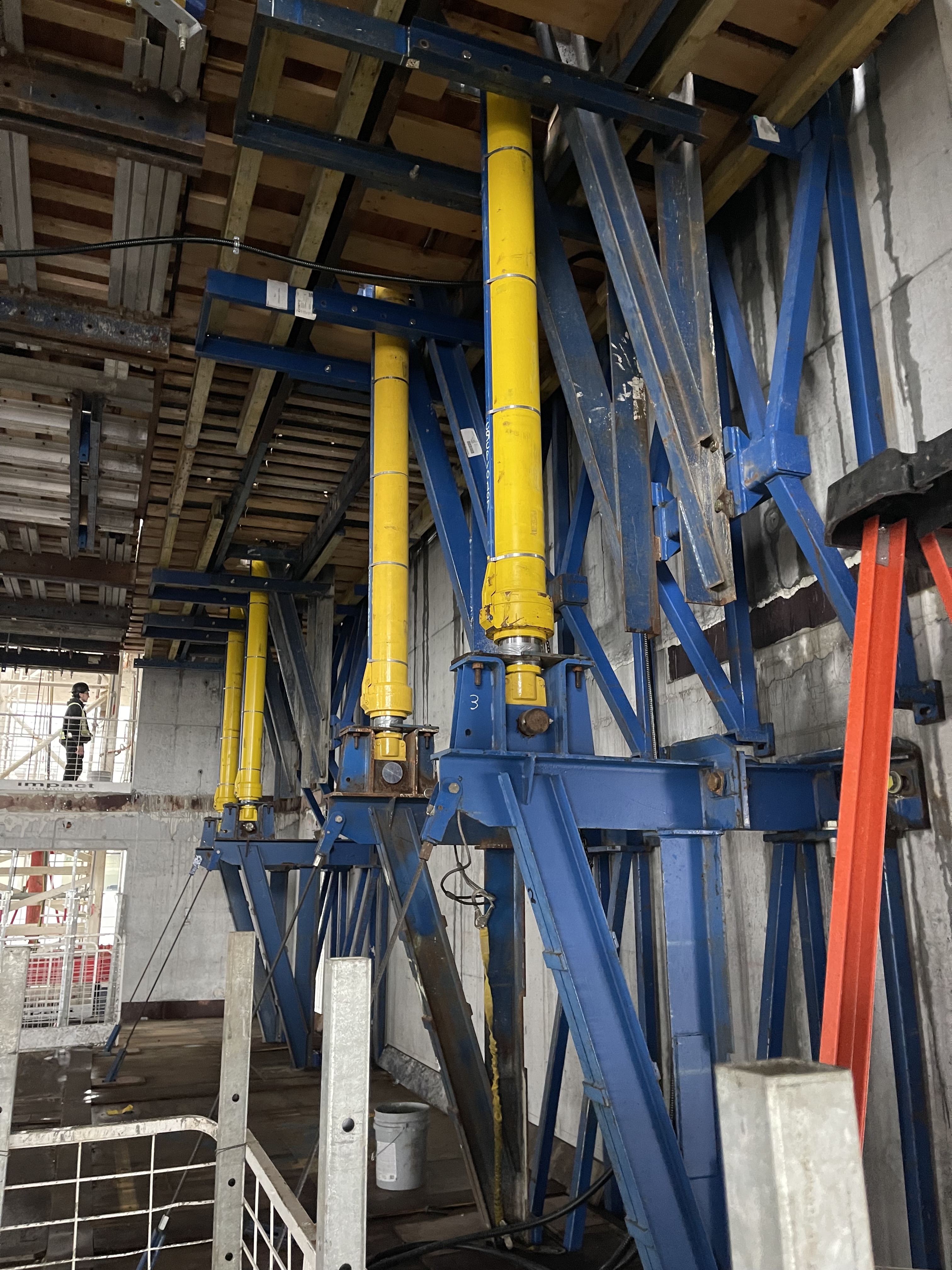
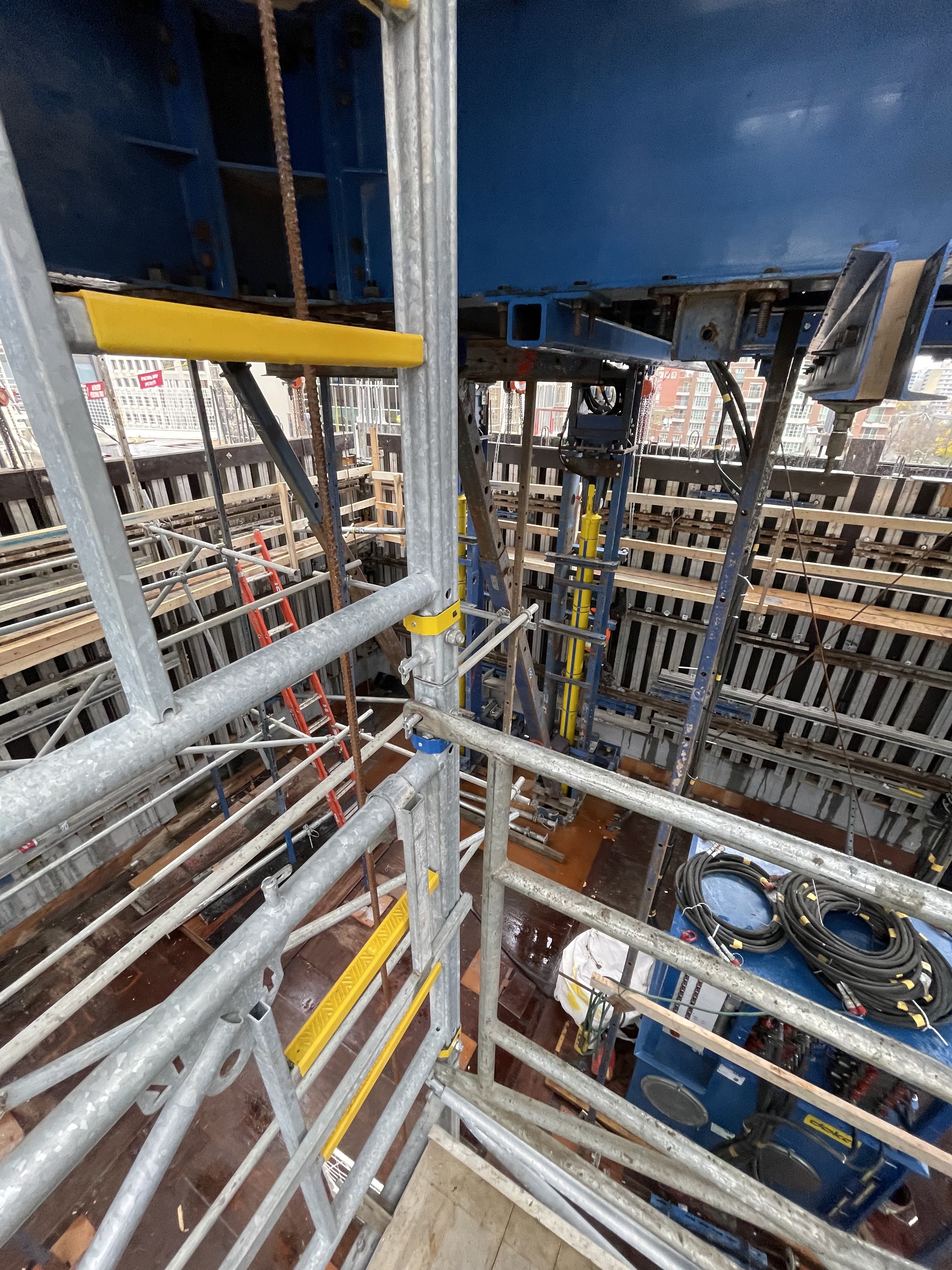
    This morning I was on site at One Delisle with WZMH Architects (AOR) and Studio Gang (design architect). I aim to visit site at least once a week, but lately it’s been more than that. What’s exciting to see right now is that the geometry of the tower is starting to come through in the slab edges. (The architects also made sure to remind me today that they had to draw each and every one of these.) The above photos were taken from the level 2 retail terrace. We always imagined this space becoming an amazing restaurant overlooking Yonge Street — but we’ll see what happens.

    Expect to see a lot more of these fun slab edges over the next few months.

  • Weekend cycle around the city

    On Saturday, I went on a bike ride all around Toronto. We cut across midtown (checking in on One Delisle), stopped at the Chester Hill Lookout (which if you grew up in the east end is where you probably went as a teenager to make out), shot down the Don Valley, and then turned west along the waterfront. The weather was perfect.

    As we were going along the waterfront, we passed the new Aqualuna building that is under construction on Queens Quay East, near Parliament Street. Being the architecture nerd that I am, I immediately noticed that as you pass by — at the speed of a bike — the balconies create this really nice cinematic effect.

    So I stopped to take these photos (I probably should have taken a video now that I think of it):

    I then tweeted a tweet calling it one of the most beautiful buildings going up in Toronto today. Judging from the responses, most people seem to be in agreement, but a few people questioned the practicality of balconies like this. Namely how private and usable they will be. I don’t disagree, but I still think it’s fine looking building.

    What do you think?

  • Toward smaller condominium apartments

    Statistics Canada recently published some data (from 2022) looking at investors in the condominium apartment market. Here is what they believe to be the share of condominium apartments used as investment properties in Ontario’s 10 largest census metropolitan areas:

    It’s worth noting that this is after excluding condominium buildings where every single suite is owned by a single investor. This is/was most prevalent in London, and it’s the result of there being property tax benefits to registering a condominium (individual unit assessments), even though for all intents and purposes it’s a rental building (building in its entirety assessed).

    The article goes on to rightly suggest that the prevalence of investors, and the way that condominiums are financed, could be leading to the construction of more buildings with smaller suites. Here’s the proportion of new condominium apartments under 600 square feet by period of construction:

    The unsurprising takeaway is that condominium suites have gotten smaller. In the 1990s, the average condominium apartment built in the Toronto CMA was 947 square feet. This is compared to 640 square feet after 2016. And the same thing happened in Vancouver, which went from an average of 912 square feet to 790 square feet.

    Investor preferences certainly have something to do with this. But what the article doesn’t specifically mention is that this phenomenon is also a direct response to rising build costs: making suites smaller was how the market tried to maintain some level of affordability. Put differently, imagine how expensive new condominiums would be if the average size was still 947 square feet.

    But there are obviously limits to this. I was with one of our architects the other week and he made an interesting comment to me. He said, “Brandon, before when build costs used to go up and things got less affordable for consumers, we could just make the suites smaller to offset the impacts. But I don’t see how we can go any smaller now. We’ve reached the limit.”

    This is one of the reasons why I think this downturn is going to ultimately be a good thing for Canada’s housing markets. It’s a reset. It’s forcing everyone out of complacency and, hopefully, it means that when the next cycle begins we’ll be starting from a better foundation.

  • Density is good

    Here is an interesting chart (source) showing housing starts in Canada, by type, between 2000 and 2023:

    As recent as 2000, single-family houses accounted for 61% of total starts and multi-family housing accounted for 39%. This flipped somewhere around the financial crisis and, last year in 2023, the percentages were 23% and 77%, respectively. This is a meaningful inversion which has helped our cities become more vibrant and more conducive to non-car modes of transport.

    But in this recent article about Canadian housing, Donald Wright more or less argues: so what? We’ve been densifying our cities for all these years, but it hasn’t helped our affordability problem. Supply must not be the answer to our housing crisis.

    I’m not exactly sure what he believes to be the solution, but I don’t think this problem is as simple as “we’ve built some housing, we made our cities denser, and yet housing is still expensive — more supply must not be the answer. Let’s move on.”

    Among many other things, it’s important to understand what kind of density we’ve been building. Because up until very recently, we’ve basically taken the position that single-family neighborhoods should never be touched, and that density should only go in very specific areas — and only after a lengthy and expensive rezoning process has been completed.

    We’ve designed new housing to be expensive.

    But attitudes are changing all across North America. We are now starting to do two very important things: (1) we are opening up more of our cities to intensification and (2) we are now allowing more multi-family housing on an as-of-right basis. Meaning, no lengthy rezoning exercises and no risk of community opposition.

    These are two fundamental changes that should alter the kind of density that gets built. And in my view, it’s going to be a positive thing for Canadian cities.

  • Pedestrian plaza or parking lot?

    It is maybe comforting to know that even Europe wrestles with the decision of whether a grand urban space should be used for pedestrians, or turned into a parking lot. Take, for example, the Grand-Place in Brussels (pictured above).

    Today, it is a UNESCO World Heritage Site and one of the most important tourist destinations in the city. Perhaps its most famous. But during the 1960s, in what Wikipedia calls a “low period of appreciation,” it was a parking lot.

    This lasted until 1972, when a bunch of people from the community got together and lobbied for it to, you know, not be a parking lot. Not surprisingly, local shop owners were worried, at the time, that this would hurt their businesses. This is often the concern.

    Here in Toronto, where we continue to debate the pedestrianization of Kensington Market, we have surveys showing that 94% of visitors to the area support pedestrian-only zones, but that this number drops to 55% when you narrow to people who live/work/own stuff in the area.

    But if your goal is to sell more things to people, then there’s something to be said about listening to what your visitors want. In the case of Grand-Place, pedestrianizing the square made it far more popular as a tourist destination. And I think the same would be true of Kensington Market.

    For some photos of iconic public spaces in Europe being used as parking lots, check out this Politico article.

    Image: Wikipedia Creative Commons