Daily insights for city builders, delivered every morning at 6 AM ET. I’m Brandon Donnelly — a Toronto-based real estate developer and founder of Globizen. I’ve been writing here since 2013.

  • Chinese architect Liu Jiakun awarded 2025 Pritzker Prize

    March 7, 2025 · View original


    Earlier this week, Chinese architect Liu Jiakun was awarded the 2025 Pritzker Prize. For those of you who may not be familiar, the Pritzker Prize is generally considered to be the architect world’s most prestigious prize. (The full list of laureates can be found, here.)

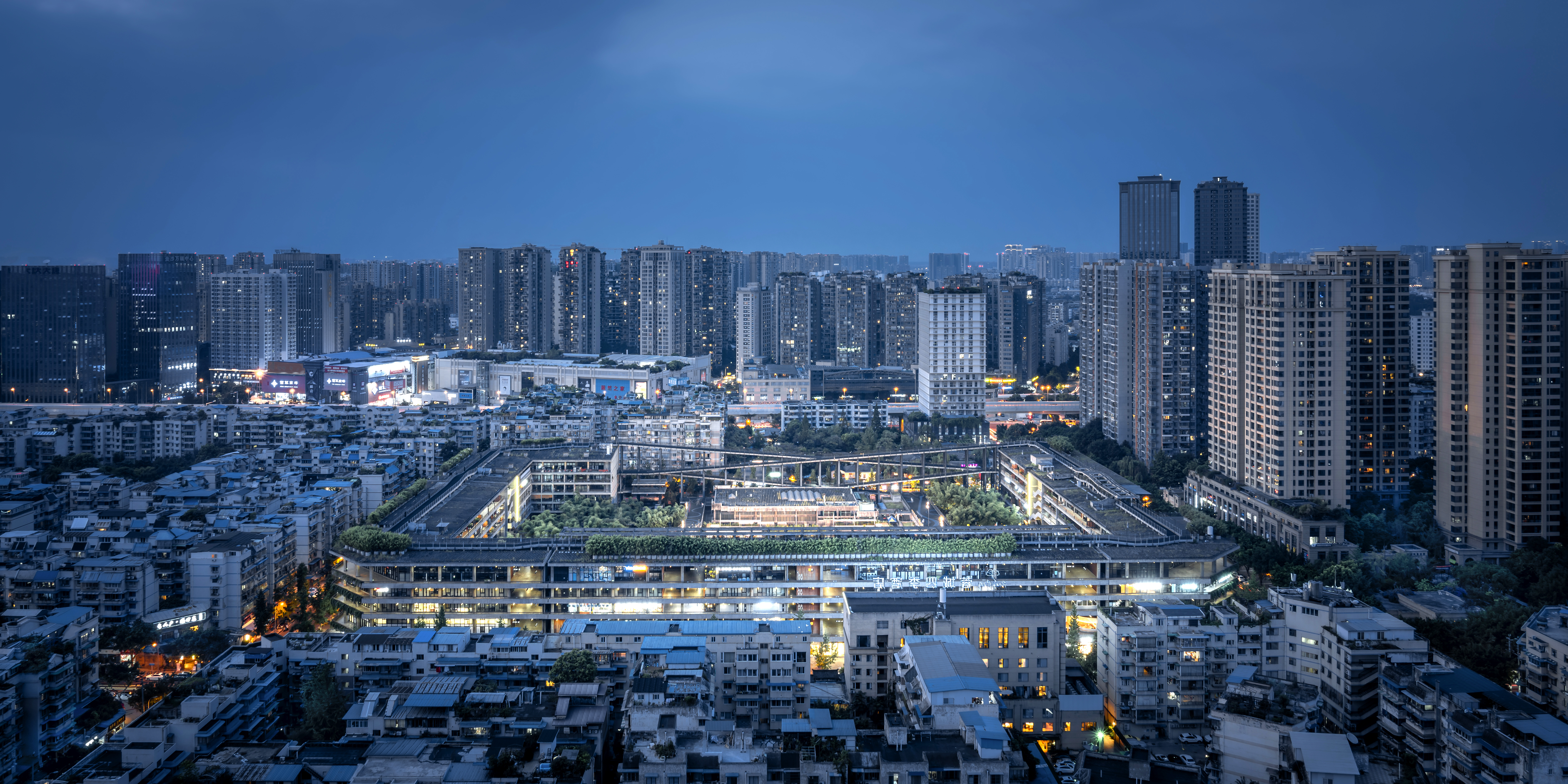
    Jiakun is based in Chengdu, China and he has worked exclusively within the country. His largest project is a mixed-use complex known as the West Village, which is a truly enormous courtyard building that exists at the scale of a neighborhood.

    It houses cultural, recreational, commercial, and office spaces, all of which are connected by an elaborate network of pedestrian and cyclist ramps. Here’s what that looks like from above:

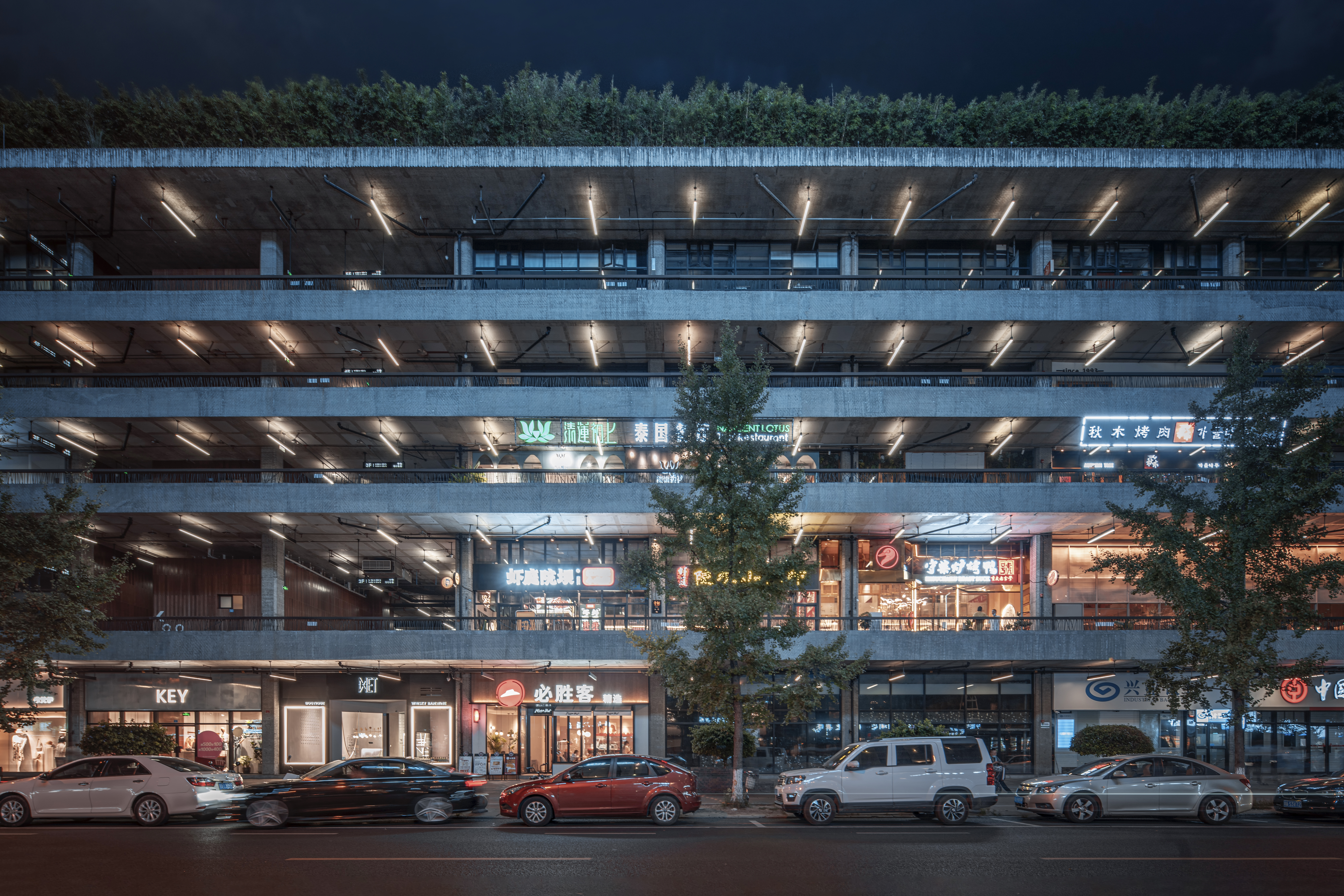
    At first glance, it’s the kind of large-scale development that looks as if it may not work. It looks like it could be the kind of project that sterilizes a fine-grained urban neighborhood. But get closer, and things start to look a little different.

    The true test is seeing how it performs at the scale of a pedestrian. And I found this walking tour helpful in understanding what that might feel like. If you spend a few minutes watching it, or even just scanning through it, you’ll see that the area looks active and busy, even at night.

    YouTube video

    Now, I’ve never visited this project, or Chengdu for that matter, but I suspect that the way to think about this project is not as one giant complex, but as a giant public space flanked by buildings. In other words, it’s not that the complex is enormous, it’s that the public spaces are enormous.

    Jiakun is quoted as saying this:

    > “I always aspire to be like water,” says Liu, “to permeate through a place without carrying a fixed form of my own and to seep into the local environment and the site itself. Over time, the water gradually solidifies, transforming into architecture, and perhaps even into the highest form of human spiritual creation. Yet it still retains all the qualities of that place, both good and bad.”

    The West Village seems to be a testament to this approach. He aspired to not interrupt the flows of the existing environment, and perhaps that’s why it works so well. Or at least, that’s what it looks like on YouTube.

    Photos by Qian Shen Photography

  • Greater Golden Horseshoe added 382,000 people last year

    March 6, 2025 · View original


    Last year, the Feds lowered immigration targets in response to Canadians getting grouchy about the number people entering the country. This is expected to be felt starting this year. RBC estimates that Canada’s overall population will shrink by about 0.2% this year and next, before returning to positive growth in 2027 (albeit at a lower rate).

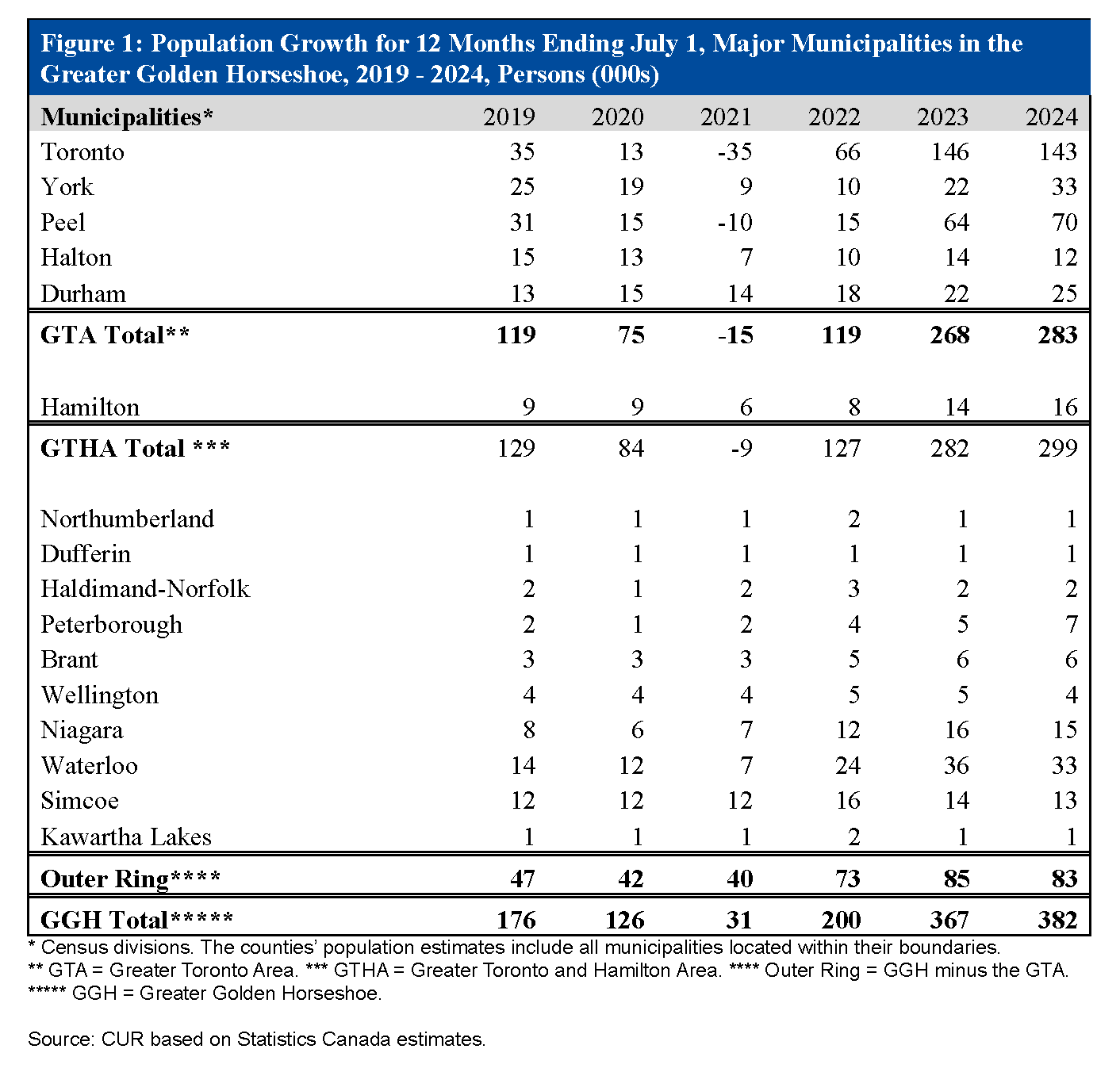
    That said, the data we have at our disposal today is backward looking and for the 12 months ending on July 1, 2024, Canada continued to see impressive population growth. Looking at the Greater Golden Horseshoe specifically, it grew by about 382,000 people. The 2023 figure was also revised upward from 340,000 to 367,000.

    Here’s a table from TMU’s Centre for Urban Research and Land Development:

    Nearly three-quarters of this growth was concentrated in the Greater Toronto Area, and about three-quarters of this growth was concentrated in Toronto and Peel at 143,000 and 70,000 people, respectively. These are big numbers, especially during a period of dramatically fewer housing starts.

    Of course, going forward, lower household formation should alleviate some of the pressures on our housing market. But zero population growth is not sustainable, not unless we want to end up like Japan with a demographic crisis. So there will be tremendous market pressures to return to positive growth.

    At the same time, if we go back to RBC’s insight report, it specifically says: “This lower immigration levels] will help realign housing demand with supply — so long as homebuilding can be sustained near current levels.” Yeah, [that’s not happening. Housing starts in the Toronto region have fallen off a cliff.

    So I continue to feel like 2027 will mark an important turning point for our housing market. It could be the year when population growth broadly returns, when we’ve fully absorbed the supply from the last cycle, and when we suddenly realize we don’t have nearly enough new housing. Or at least that’s my view.

    Cover photo by Richard Hong on Unsplash

  • The development risks you’re not even thinking about

    March 5, 2025 · View original


    Real estate development is a risky endeavor and so a big part of this business is managing those risks. There’s planning risk, market risk, construction risk, bad-drawing risk, and the list goes on. But it’s also important to keep in mind that the risks you worry about the most will invariably change throughout the course of each real estate cycle.

    For example, early on my career, we worried a lot less about construction cost escalations. We’d plug in a 2-3% annual increase into the pro forma and then move on the next line item. Of course, during the pandemic, this is almost all we worried about. What’s our exposure? Do we have enough of an allowance? How are our subcontractor contracts drafted?

    This particular panic has subsided since then, but now there’s new panic: closing risk. We’ve spoken about this before, but given the number of condominium completions expected this year, I think it’s going to remain top of mind for at least another 18 months (in the Greater Toronto and Hamilton Area).

    The simple point I’d like to make today is that it’s important to worry about risks, but it’s equally important to worry about the risks that don’t seem like risks at all today, which is admittedly trickier. Because you just never know. It’s hard, for instance, to predict exactly when your largest trading partner might suddenly start an arbitrary trade war.

    But it can happen, as we’ve learned.

    Cover photo by Tiomothy Swope on Unsplash

  • Tariffs — and then what?

    March 4, 2025 · View original


    Trumps’ tariffs are supposed to take effect today. Here’s a quote from the Globe and Mail, published yesterday:

    > “Very importantly, tomorrow, tariffs, 25 per cent on Canada and 25 per cent on Mexico, and that will start. So, they’re gonna have to have a tariff,” Mr. Trump said.

    But it’s still not clear that he understands how these tariffs will work. Either that, or he’s lying and trying to trick people. Because he continues to deny that tariffs represent a tax paid by US importers (and ultimately US consumers) on things coming from Canada and Mexico.

    Here’s another quote:

    > “It’s not going to be a cost to you [Americans], it’s going to be a cost to another country.”

    Yeah, that’s not how they work:

    > When the US puts a tariff on an imported good, the cost of the tariff usually comes directly out of the bank account of an American buyer. > > “It’s fair to call a tariff a tax because that’s exactly what it is,” said Erica York, a senior economist at the right-leaning Tax Foundation. > > “There’s no way around it. It is a tax on people who buy things from foreign businesses,” she added.

    In any event, in the real world, tariffs are bad. They’re bad for everyone. So much so, that Warren Buffett recently described them in this way:

    > “Tariffs are actually, we’ve had a lot of experience with them. They’re an act of war, to some degree,” said Buffett, whose conglomerate Berkshire Hathaway has large businesses in insurance, railroads, manufacturing, energy and retail. He made the remarks in an interview with CBS News’ Norah O’Donnell for a new documentary on the late publisher of The Washington Post, Katharine Graham. “Over time, they are a tax on goods. I mean, the tooth fairy doesn’t pay ’em!” Buffett said with a laugh. “And then what? You always have to ask that question in economics. You always say, ‘And then what?’”

    So let’s look at “and then what” when it comes to the automotive sector.

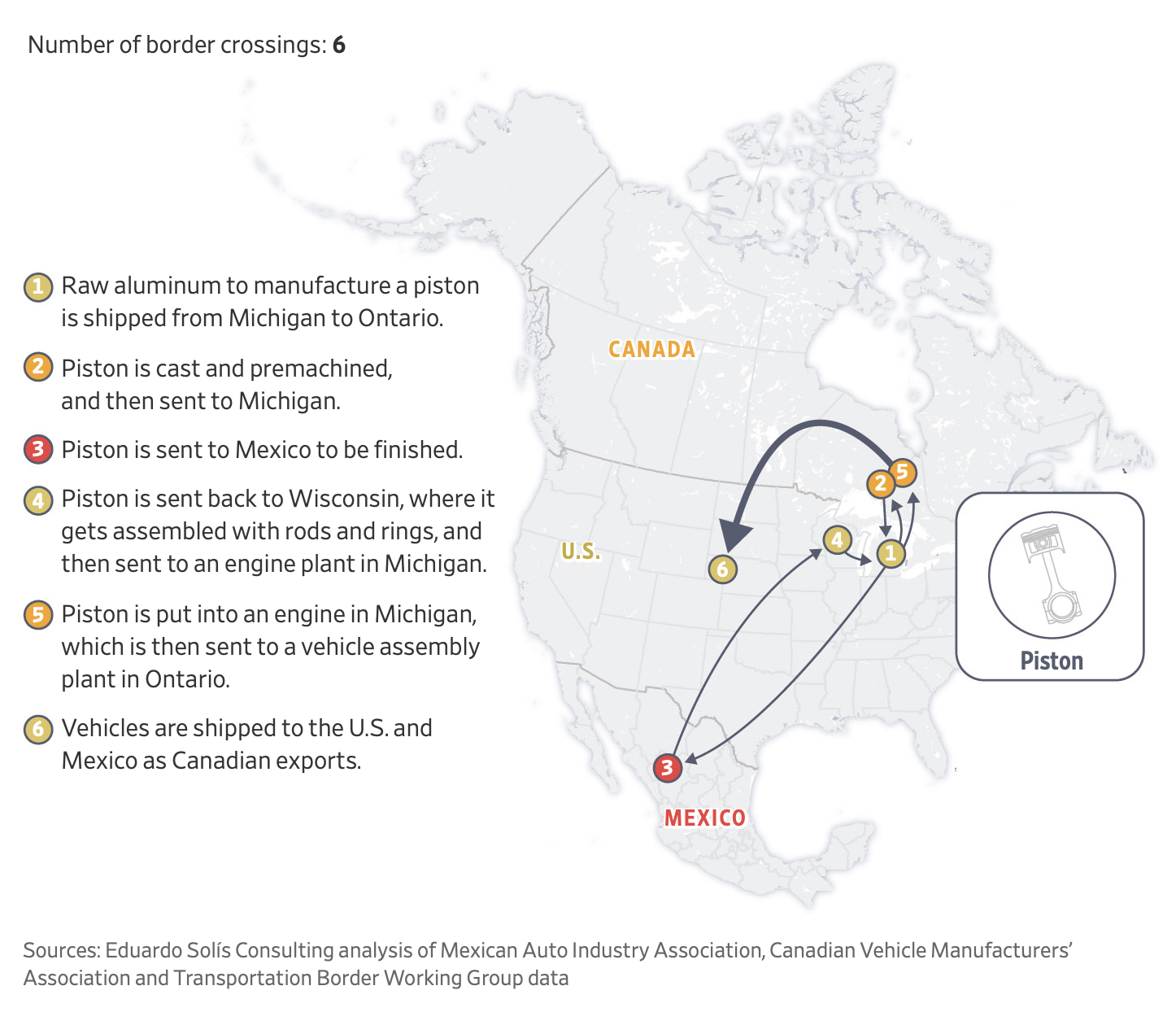
    The auto sector is the largest component of trade across Canada, the US, and Mexico. It makes up 22% of all the goods and services the flow across our borders. And in 2023, we produced some 16 million cars together, which generally include parts and materials from all three countries. We’re extremely integrated. The WSJ recently broke this down, over here, and if you look at something like pistons, you’ll see that this component alone typically crosses a border about 6 times:

    What this means is that if you start forcing US importers to pay a tariff on Canadian and Mexican goods, and then Canada and Mexico retaliate with the same (because we/they have to), the entire model breaks down, unless of course consumers are comfortable paying a lot more. Of course, most of you already knew this. Last year, $1.6 trillion worth of goods moved back and forth across the US, Canada, and Mexico. It would be better for all three of us if this number went up, and not down, this year.

    Cover photo by CHUTTERSNAP on Unsplash

  • Snow report from Sugarbush, Vermont

    March 3, 2025 · View original


    Ski and snowboard resorts have people known as snow reporters. Their job is to get up at an ungodly hour, check out the snow, and then report on the conditions, so that would-be patrons can decide if they want to spend their time and money on it. The snow reporter at a resort called Sugarbush in Vermont is a young lady by the name of Lucy Welch (who in her official bio explains that she has, sadly, no relation to the “mighty Fruit Snack Empire”).

    On the morning of March 1 — the day that JD Vance was trying to ski at Sugarbush — she decided to courageously commandeer the resort’s “platform” to deliver a message. Every snow report subscriber got her letter in their inbox (though I’m told it was quickly pulled from the resort’s website). And since she has a great literary voice, she speaks eloquently about skiing and the mountains, and she delivers a crucial and timely message, I’m sharing it in full with all of you today.

    It may have been pulled from Sugarbush’s website, but this blog lives on a blockchain that cannot be censored and that is intended to act as permanent storage. Its mission is to preserve “humanity’s most important data” and so I’d like to make sure that her actions and this letter do not get erased over time. Here it is:

    > Mar 1st, 2025, 6:49 AM: Today of all days, I would like to reflect on what Sugarbush means to me. This mountain has brought me endless days of joy, adventure, challenges, new experiences, beauty, community, and peace. I’ve found that nothing cures a racing mind quite like skiing through the trees and stopping to take a deep breath of that fresh forest air. The world around us might be a scary place, but these little moments of tranquility, moments I’ve been fortunate enough to enjoy as a direct result of my employment here, give me, and I’d guess you, too, a sense of strength and stability. > > This fresh forest air, is, more specifically fresh National Forest air. Sugarbush operates on 1745 acres of the Green Mountain National Forest. Right now, National Forest lands and National Parks are under direct attack by the current Administration, who is swiftly terminating the positions of dedicated employees who devote their lives to protecting the land we love, and to protecting us while we are enjoying that land. > > This Administration also neglects to address the danger, or even the existence of, climate change, the biggest threat to the future of our industry, and the skiing we all so much enjoy here. Burlington, VT is one of the fastest-warming cities in the country, and Vermont is the 9th fastest-warming state. The National Oceanic and Atmospheric Association (NOAA), a resource I use every day for snow reporting, is crucial in monitoring extreme weather events and informing public safety measures, and is also experiencing widespread layoffs and defunding at the hands of the Administration. > > Sugarbush would not be Sugarbush without our wonderful community. Employees and patrons alike, we are made up of some of the most kind hearted, hardworking people I have ever met. Our community is rich with folks of all different orientations, ethnicities, and walks of life, who all contribute to make this place what it is. They all love Sugarbush because it is a place where they can come to move their bodies, to connect with the land, to challenge themselves, to build character, to nourish their souls with the gift of skiing. > > Many of these people are part of the LGBTQI+ community. Many (well, that’s a stretch, we all know this is an incredibly white-washed industry) are people of color. Half are women. Many are veterans or adaptive skiers who, through Vermont Adaptive, are able to access snow sports in part thanks to federal grants through the Department of Veterans Affairs, which is also facing devastating cuts. Many of our beloved employees moved across the world through an exchange program on the J1 visa to help this resort run, and they are not US citizens. ALL of these groups are being targeted, undervalued, and disrespected by the current Administration. > > The beauty of National Forest land, is that anyone and everyone is welcome to enjoy it. Anyone and everyone can buy a lift ticket. I also imagine it is incredibly difficult, and likely impossible, to say “No” to the Secret Service. I hope that, instead of faulting Sugarbush management or employees for “allowing this to happen”, you can direct your anger to the source — the Administration that, in my oh-so-humble opinion, is threatening our democracy, our livelihoods, our land. > > I want to reiterate how much I admire and respect my fellow employees and managers — they work so hard to make this place operate, to keep you coming back and enjoying it and making lifelong memories. Many of them may feel the same way that I do, but their hands are tied, and for good reason. They have families to support, they have benefits and health insurance to receive, they face far greater and more binding pressure from Corporate. I am in a privileged position here, in that I work only seasonally, I do not rely on this job for health insurance or benefits, and hey, waking up at 4:30 AM isn’t exactly sustainable. Therefore, I am using my relative “platform” as snow reporter, to be disruptive — I don’t have a whole lot to lose. We are living in a really scary and really serious time. What we do or don’t do, matters. This whole shpiel probably won’t change a whole lot, and I can only assume that I will be fired, but at least this will do even just a smidge more than just shutting up and being a sheep. > > I am really scared for our future. Acting like nothing is happening here feels way scarier than losing my job. I want to have kids one day, and I want to teach them to ski. The policies and ideals of the current Administration, however, are not conducive to either of these things, because, at least how things look now, I’d never be able to afford a good life for a child anyway, and snow will be a thing of Vermont history. So please, for the sake of our future shredders: Be Better Here. It has truly been a pleasure writing your morning snow reports — I hope this one sticks with you. With love, peace, and hope, Lucy Welch

    Lucy, thank you for your bravery.

    Cover photo by Joel & Jasmin Førestbird on Unsplash

  • It’s time to build Canada

    March 2, 2025 · View original


    Earlier this month, a group of Canadian founders, entrepreneurs, and business leaders launched a new and important platform called Build Canada. The idea is simple. Every week, an experienced entrepreneur will publish a policy proposal that includes an issue that our country is facing and then a precise policy solution. And if you happen to agree with the recommendations being put forward, there’s an easy way for you to send it directly to your MP.

    Here’s their “about” page:

    > Dear Fellow Canadians, > > Canada should be the world’s richest country. But for decades, small thinking, bureaucratic inertia, and special interests have kept us from realizing our potential. > > The world is changing quickly. Technology, communication, geopolitics, and culture are shifting. If we don’t change with it our moment will slip away. We can’t afford excuses anymore. Canada must break free from the mindset of “this is how things are done”. It’s time to act differently. > > Build Canada is a platform of bold ideas for growth, innovation, and prosperity. > > Every policy is proposed by successful Canadian entrepreneurs with deep knowledge from building in the relevant areas. We’re supported by policy experts with experience in government. Our singular focus is a Canada where people build again. > > That includes: > > – Selling more Canadian products and resources around the world > – Changes to boost productivity and competitiveness > – Developing a culture that celebrates freedom and ambition > – New ways to deliver better services at lower costs > – Tax reforms that drive innovation and investment > > We all know that our country could be so much more than it is. We have the land, the talent, the know-how, and the energy to be the most abundant nation on earth. And our people have a spirit that could take them anywhere they wanted to go. > > Let’s build the Canada you know is possible.

    Not every entrepreneur has to agree with every other proposal on site, but that’s partially the point, not to dilute things down. It’s about creating real dialogue, urging meaningful change, and creating a more prosperous Canada. A fundamental rethink of the status quo has been needed in this country for as long as I can remember. And with all of the geopolitical uncertainty happening in the world today, it has only become more critical to build Canada.

    Cover photo by Tom Carnegie on Unsplash

  • First curtain wall installed at One Delisle

    March 1, 2025 · View original


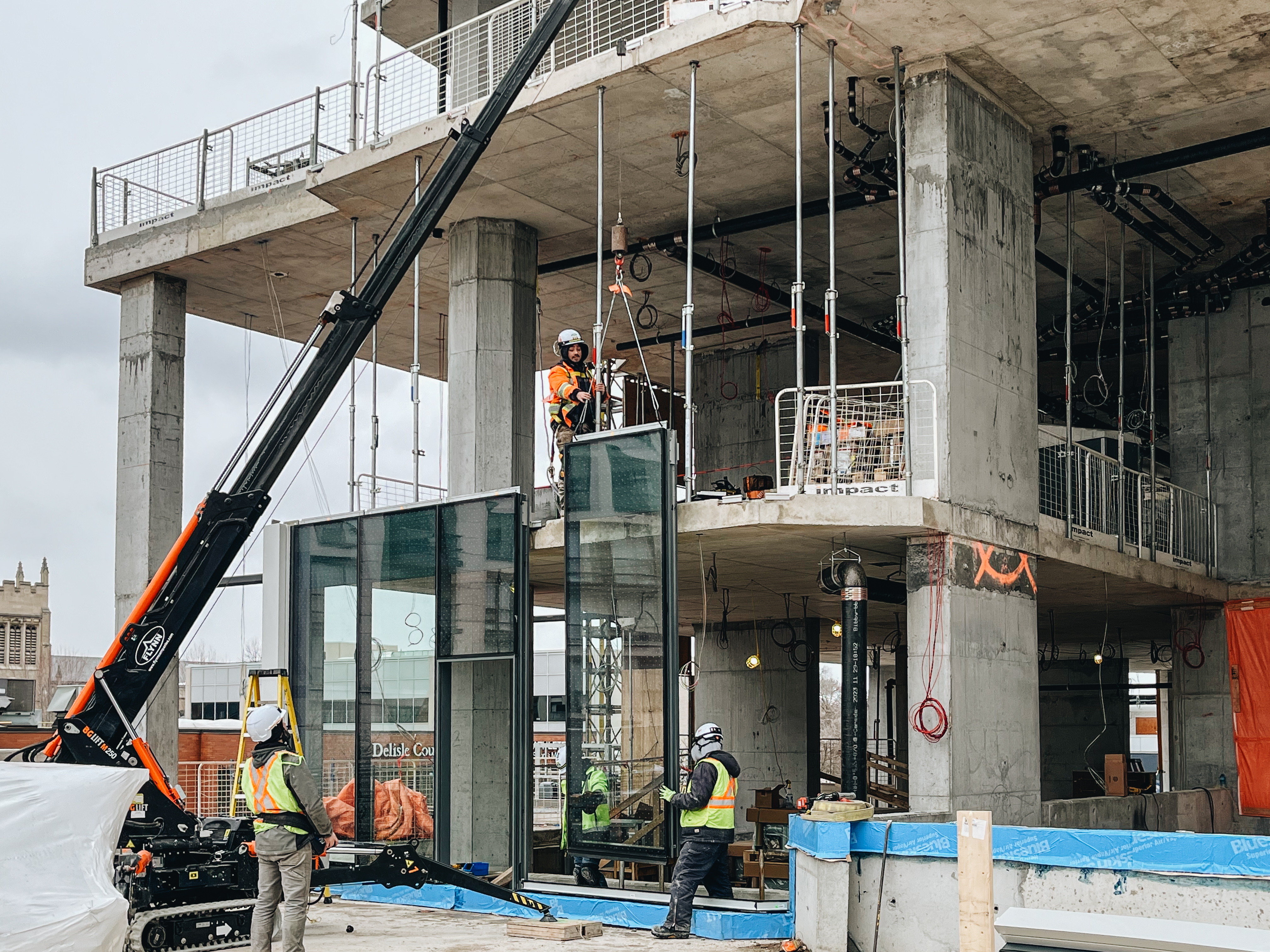
    Yesterday, February 28, 2025, the team installed the first piece of unitized curtain wall at One Delisle (on level two facing the outdoor amenity terrace and beside the indoor pool). Last year I was going around telling everyone that we would have glass up on the building in the first quarter of this year, and so I’m really glad that I was not made out to be a liar. Thanks team. This is a milestone date.

    For those of you who maybe aren’t familiar, there are two types of window systems that are commonly used in high-rise residential buildings. They are usually referred to as window wall and curtain wall. The former is more common in Toronto because it’s, well, the cheapest; but there are curtain wall buildings other than One Delisle. Sometimes the same building might also use both systems. (In saying this, I’m specifically referring to the upper floors, because curtain wall is often used for ground-floor commercial spaces.)

    The key difference is that window wall systems sit between floor slabs and get anchored at the sill and the head (the top of the slab on the bottom and the bottom of the slab on the top). Curtain wall systems, on the other hand, get anchored to the exterior slab edges and also “bypass” them. You can see that in the above photo. There are advantages and disadvantages to both systems, but generally speaking, curtain wall is viewed as higher quality, and the more expensive option.

    In the case of One Delisle, we explored and were open to both options during the design process. But ultimately window wall just didn’t seem like the right system to realize the unique geometries of this building. So we went with curtain wall, worked through a lengthy design-assist process with the subcontractor, built a bunch of mockups to make sure everything looked and worked well, and now it’s being installed on site.

    Level two is likely going to be the most challenging floor because of the double-height pool area. So I’ll be sure to share more photos once it’s all enclosed.

  • Apartment rents in Austin are down 22%

    February 28, 2025 · View original


    Nowhere in the US are apartment rents declining as fast as they have in Austin. Average rents are down 22% from their August 2023 peak. This is according to Bloomberg. What seems to have happened is this: Lots of people started moving to Austin during the pandemic, rents jumped up dramatically, and so the city enacted policies to encourage more housing supply. Developers responded as they do and, between 2023-2024, well over 50,000 apartment suites were completed in the city. Now landlords have very little leverage in the market, and so rents are naturally dropping. It all makes perfect sense, but I will say that I’m surprised by the chronology. Apartment rents jumped 25% in 2021, there was a pro-development policy response, and then increased supply started flooding the market in 2023. How? Then again, Yahoo Finance is reporting that “builders [in Austin] typically take two years to go from buying land to welcoming tenants.” That’s development magic and I’d like some of it.

    Cover photo by Carlos Alfonso on Unsplash

  • Our looming housing shortage

    February 27, 2025 · View original


    The turning point for the Toronto housing market, including pre-construction condominiums, was, I would say, in the spring/summer of 2022. This is when the market turned and sentiment changed dramatically. What that means is that we are about to enter year three of this downturn. Time flies when you’re grinding away. How long it lasts is anyone’s guess, but new sales and completions are a good place to look.

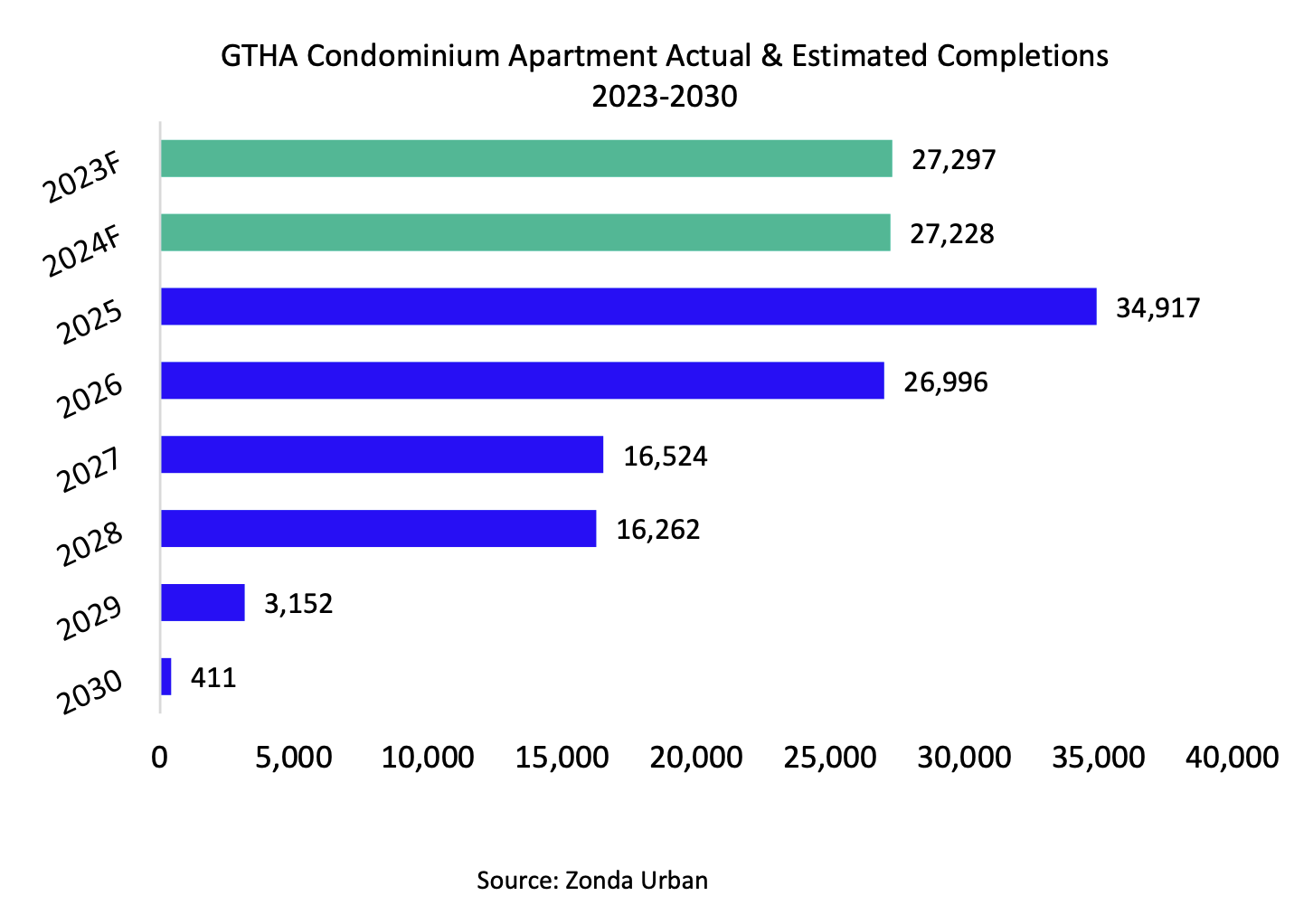
    Last year, the GTHA saw approximately 29,800 condominium homes complete according to Urbanation. This is slightly above Zonda’s estimate of 27,228. Whatever the exact number, it was a high number of completions. And this year, the forecast is for something similar. But given how precipitously new home sales have fallen off, it’s only a matter of time before completions do the same.

    Here’s what Zonda Urban is currently forecasting:

    They are expecting 2027-2028 to be fairly normal. The above figures would be just under the 10-year average. But then completions fall off a cliff starting in 2029 and go down to basically nothing in 2030 — 411 condominium homes could be a single project!

    My sense is that this cliff is going to occur earlier. 2027 will be five years since the market turned. That’s enough time for many, if not most, pre-sales to get through construction. It’s also important to point out the obvious fact that some large percentage of the above completions need to be categorized as new rental housing. So this looming housing shortage will impact both buyers and renters.

    Cover photo by Patrick Tomasso on Unsplash

  • How to improve the feasibility of infill housing (in Toronto)

    February 26, 2025 · View original


    Here’s an interesting Twitter thread by Zoë Coombes describing the crossroads that Toronto finds itself at when it comes to housing. We know we need to build more urban housing geared towards families. But unfortunately, the economics underpinning new housing bias the opposite: smaller homes. And in our current market environment, it’s a real challenge to even build any new housing. Period.

    Zoe argues that we have two options: we can either open up the greenbelt (i.e. sprawl) or we can make it more feasible to build infill apartment buildings catering to families. In her words, “there’s no third option.” I am a strong proponent of the latter over the former, and so here are a few things we really ought to be doing to improve the feasibility of these housing types in Toronto:

    – Greater as-of-right permissions across the city. The new Major Street policies are a huge step in the right direction, but, in my opinion, more will need to be done to unlock a greater number of sites. Land use planning, by virtue of its political affiliation, is an especially iterative process. – Eliminate the Site Plan Control process for larger projects. Currently, projects with more than 10 units are subject to Site Plan Control. This is an unnecessary barrier that adds cost and extends project timelines. My understanding is that this change is already underway. Good. – Eliminate or greatly reduce Development Charges on new infill housing. I’ve already written a lot about this topic, so I won’t repeat myself. But know that it’s material to development feasibility. Here’s some positive news from the end of last year. – Allow buildings with a single exit stair. This is crucial for smaller-scale projects where every bit of efficiency counts (net rentable area to gross construction area). It will also help to unlock better floor plans, including dual-aspect suites. – Streamline environmental approvals. In Ontario, if you are “converting” a site to a more sensitive land use (such as residential), you are required to obtain a Record of Site Condition from the Ministry of the Environment, Conservation and Parks. Depending on the conditions of the site, this process can take years. Human safety is obviously the number one priority, but lengthy review timelines do make small projects entirely infeasible.

    Again, the good news is that some of these changes are already underway. So we’re at least headed in the right direction. But is there anything else you would add to this list?

    Cover photo by Kai Pilger on Unsplash