Daily insights for city builders, delivered every morning at 6 AM ET. I’m Brandon Donnelly — a Toronto-based real estate developer and founder of Globizen. I’ve been writing here since 2013.

  • Zurich’s clever (but underrated) solution to traffic congestion

    April 25, 2025 · View original


    > Tweet: Traffic is horrible in Toronto and it will only get better once we fully embrace a post-car future. Everyone driving around most of the time just isn’t going to work for a city region of our scale.

    We talk a lot about mobility and traffic congestion on this blog — particularly in the context of Toronto — and that’s because it remains a problem and we continue to avoid any sort of big and meaningful moves. Instead, we like to politicize the problem and find scapegoats, such as bike lanes. So I think it’s important to have regular reminders that we do actually know how to address this problem. It’s a choice we and other cities can make.

    Here are three examples and possible solutions:

    – Copenhagen: Over 60% of residents use a bicycle to commute to work or school. It is one of the most bike-friendly cities in the world. You’ve probably heard this before and are prepared to say, “yeah, well, we’re not Copenhagen.” But it’s important to point out that neither was Copenhagen. In the early-to-mid 70s, the modal split for bikes was somewhere between ~10-15%. – Singapore: This is one of my favorite examples. Singapore is home to the world’s first congestion charge zone (1975). And it operates on a dynamic pricing model, meaning that traffic congestion is continually monitored and road prices are adjusted to ensure that traffic always flows at certain minimum speed. It’s a highly effective tool and there’s no shortage of global case studies. Here’s Miami. – Zurich: Despite being one of the wealthiest cities in Europe, car ownership is relatively low (~40-45% of the population, compared to ~60-65% in Toronto). This is due to a great public transit system (Swiss trains and stuff) and because of strict parking policies, among other things.

    Zurich has a hard cap on the number of parking spaces in the central part of the city. It is set at 1990 levels, which works out to about 7,600 total parking spaces.). What this means is that if somebody, like a big bad developer, wants to build off-street parking, they need to simultaneously reduce the parking supply somewhere else. You can’t exceed the cap.

    This obviously discourages car usage and moderates the demand for city streets, but it also serves as a clever way to slowly replace on-street parking with better uses, such as an enhanced public realm. This policy has been in place since 1989 and it has had a dramatic effect on car usage. Between 2000 and 2021, the share of car trips in the city decreased from 40% to 29%.

    I know that many of you will scoff at these solutions and think “yeah, there’s no way.” But this is how you make traffic better. You reduce demand and use our finite amount of road capacity more efficiently. So we can either make bold moves or we can continue to complain about traffic.

    Cover photo by Claudio Schwarz on Unsplash

  • Fastest growing cities in Canada and the US

    April 24, 2025 · View original


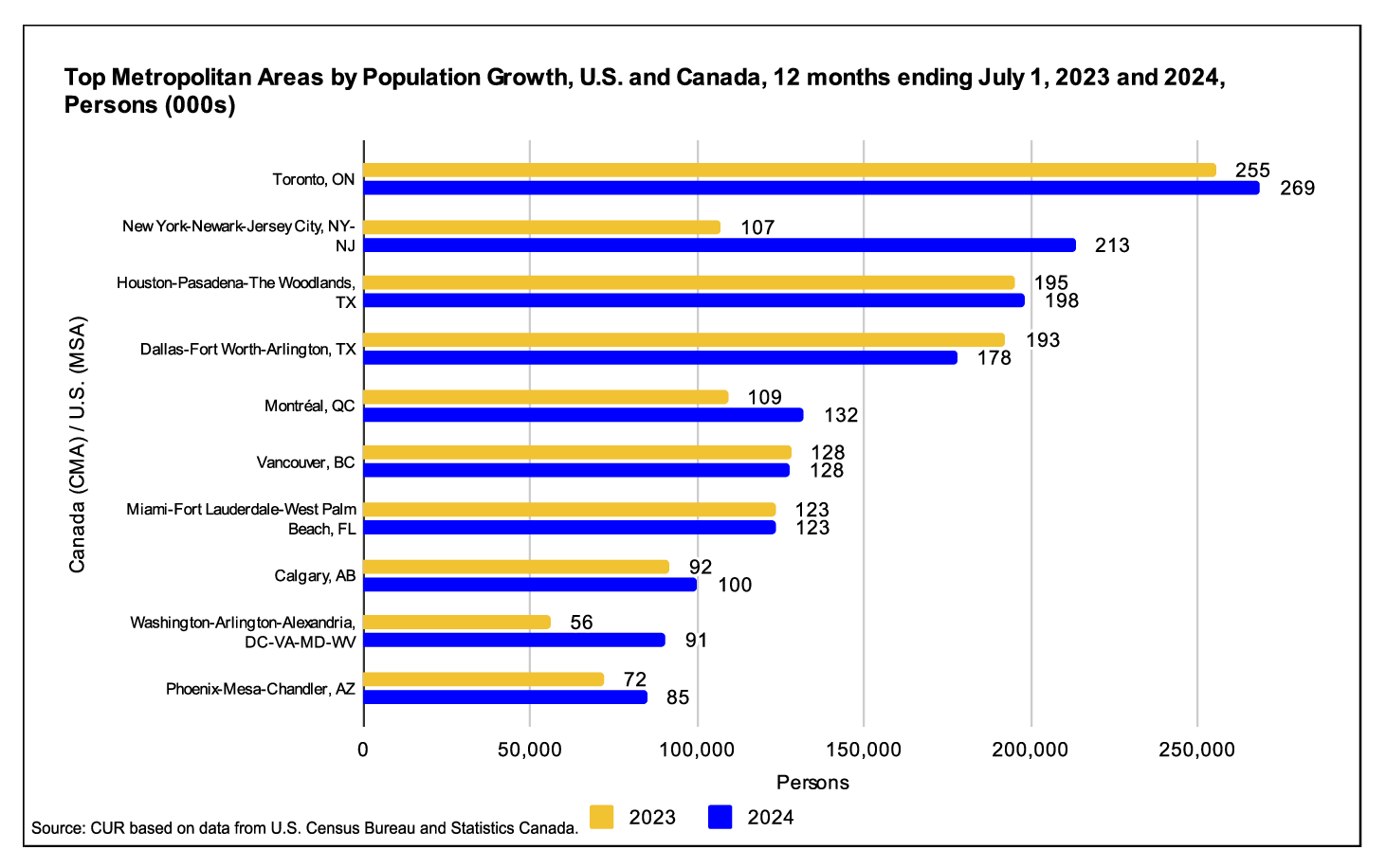
    Toronto may not be selling that many new condominiums these days, but population growth remains high across the region. For the 12-month period ending July 2024, the Toronto census metropolitan area added approximately 269k people. And for the 12-month period ending July 2023, it added about 255k people. In the context of Canadian and American cities, this makes it the fastest growing metropolitan area for two years running (see above chart). Lower immigration targets are expected to bring this number down going forward, and so it’ll be interesting to see what these numbers look like for the period ending this summer, but this is still over half a million people in two years. I think it’s also noteworthy that our housing market turned and pre-construction sales slowed around the middle of 2022, and yet our population growth and immigration levels remained the highest in Canada and the US for at least another two years. Maybe this lag helps us recover sooner than some might expect.

    Chart from the Centre for Urban Research and Land Development at TMU; cover photo by Mikayla Martorano on Unsplash

  • Miami condo market has turned

    April 23, 2025 · View original


    When I was in Miami at the end of last year for the Elevate real estate conference, I was given the impression that every new development project has a luxury brand associated with it and that buyers from all over the world still have an insatiable demand for the city. The Toronto developers in the room had no choice but to commiserate amongst each other and make up excuses for why abundant sunshine and low taxes couldn’t possibly be that nice.

    But things seem to be changing quickly in Miami. I am seeing reports that the condominium market continues to soften and that unsold inventory is starting to accumulate. This seems to be happening for a bunch of reasons: lots of supply, relatively high interest rates, higher insurance costs (due to climate things), more stringent reserve funding requirements (following the tragic collapse of the Surfside tower), and perhaps even the hostile environment that the US is now creating for foreigners.

    I don’t have clear data for the pre-construction side of the market (like I do for Toronto), but typically you need a strong resale market to support new development. And that’s because pre-construction pricing tends to be higher than resale pricing. If the latter is softening, then the value proposition for something new is weakened. On top of all this, there’s right now a risk premium on US assets. The country is being viewed as less safe.

    So it’s easy to be bearish.

    If any of you have any direct insights on the South Florida market, please leave a comment below.

    Cover photo by Tomas Lundahl on Unsplash

  • What removing development charges could do to apartment rents

    April 22, 2025 · View original


    Over the years on this blog, we have spoken about at least two ways to think about development pro formas. In the purest academic sense, you could say that pro formas are a way to determine the value of development land. You start with your forecasted revenues, deduct all of your expected costs, and then at the end you’re left with some amount of money that can be spent on land. Said differently, land becomes the “residual claimant” in your financial model.

    This is an important exercise, but in practice, pro formas sometimes (oftentimes?) need to be worked in the opposite direction. Meaning, the land price is what it is, development charges just increased, and now you’re trying to figure out a way to make the math work. In this direction, you could say that you’re undergoing a “cost-plus exercise.” The costs are the costs and now you’re trying to figure out some justifiable revenue figure that will make everything work.

    If you do this latter exercise for a new rental apartment in Toronto today, you will end up with a rental rate that is likely hovering somewhere around $5 per square foot. This is a broad generalization and every site is of course different, but for the purposes of this post, let’s assume it’s $5. What that means is that a 500 square foot one-bedroom apartment will rent for $2,500 per month and a 1,000 square foot three-bedroom will rent for $5,000 per month.

    A lot of people like to look at rental rates and say, “oh my, greedy developers are charging too much.” But the reality is that this is what the cost-plus exercise is telling developers. There isn’t the option of just charging less because there’s only so much you can do about costs.

    In fact, because development happens on the margin, some degree of optimism is often required to make new projects feasible. What I mean by this is that $5 psf may be what you need to make the project feasible, but there may be zero market comps in your submarket to actually support it. So in order to move forward, you just have to believe that in the future this will be the market rent.

    This is harder to do in Toronto today because rents are not growing, they are declining. I personally believe that will quickly reverse once new housing completions fall off a cliff, but it doesn’t change the fact that it’s harder to underwrite rental growth in this kind of market environment. And because it’s harder to underwrite rental growth, it’s harder to make projects work.

    The other consideration is that pushing rental rates higher is naturally going to slow down absorption. The Law of Demand tells us that as the price of something increases, the quantity demanded decreases. So you take on more risk in multiple ways when you push rates. As a developer, I’d rather be in a position where I could underwrite lower rents and feel more confident about leasing up the building quickly.

    One way this could obviously be done is to lower costs. So as an exercise, I opened up one of our rental pro formas and removed just two cost items: development charges and parkland dedication. The result, in this particular instance, is that we could lower our average rent by almost $300 per month and still have a more or less equally feasible project. That’s meaningful.

    A cynic would say that developers will still charge the higher rent, but again, I would argue this isn’t necessarily true, especially in this market. A cheaper cost structure means that more sites / projects become feasible and that developers should now face lower market risk. I’ll take that. I’ll take a full building with minimal vacancy and lower turnover.

    Cover photo by taufiq triadi on Unsplash

  • Growth paying for a lot of stuff

    April 21, 2025 · View original


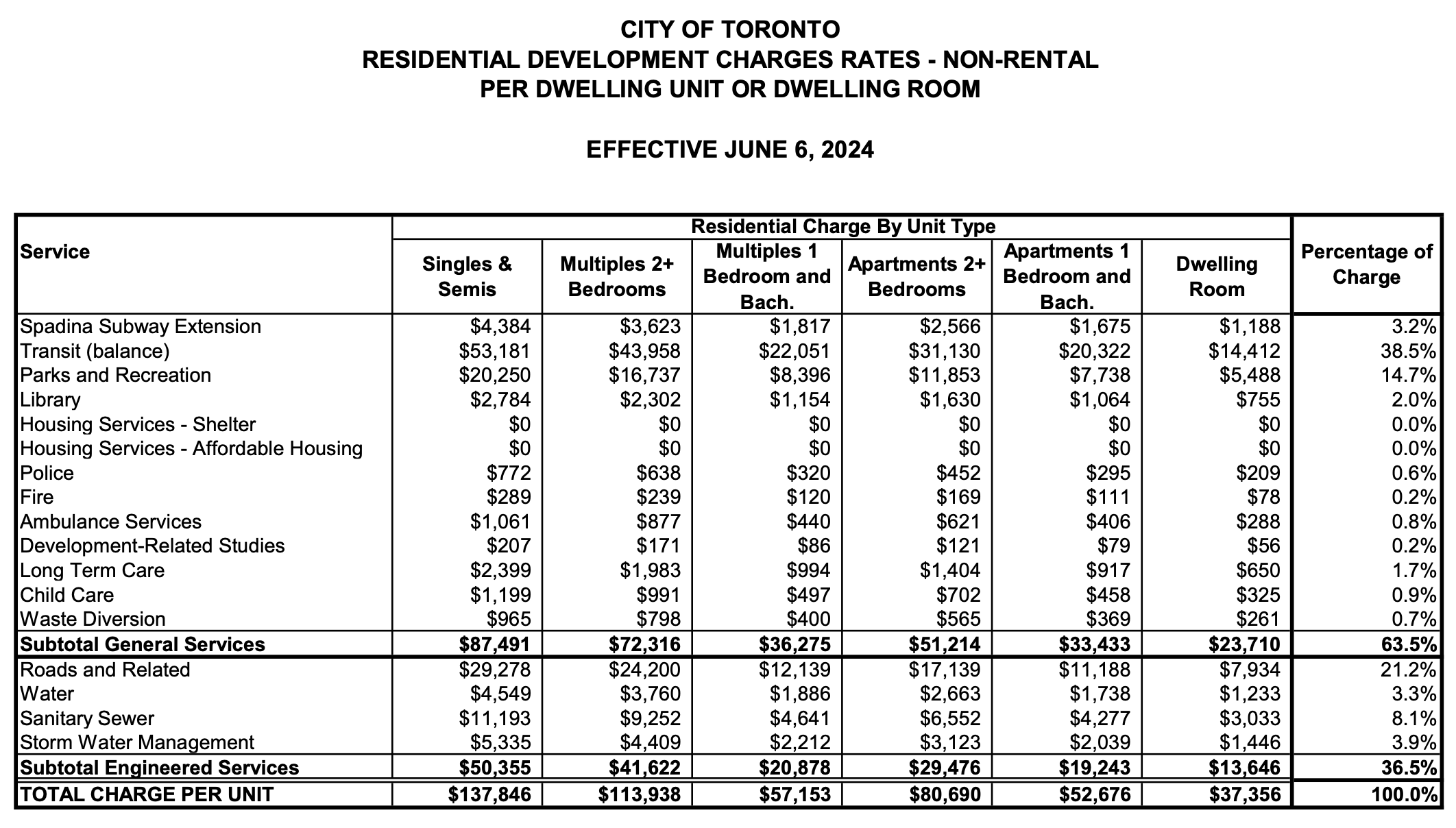
    I am of the strong opinion that, as a general rule, development charges should aim to capture the costs and impacts directly attributable to new development. This is why I prefer the term “impact fee” as opposed to “development charge.” The latter makes it seem like a generic catch-all tax. But that’s not the intent. The intent is that “growth pays for growth.” At the highest level, this makes sense and sounds good. So with all the talk of lowering/eliminating DCs to help with housing affordability, I think a lot of people are rightly wondering: Is this actually feasible? What fees are actually needed to fund growth-related infrastructure? Let’s talk about this today.

    For reference, here are the development charge rates effective June 2024 in the City of Toronto.

    Non-rental housing:
    Rental housing:
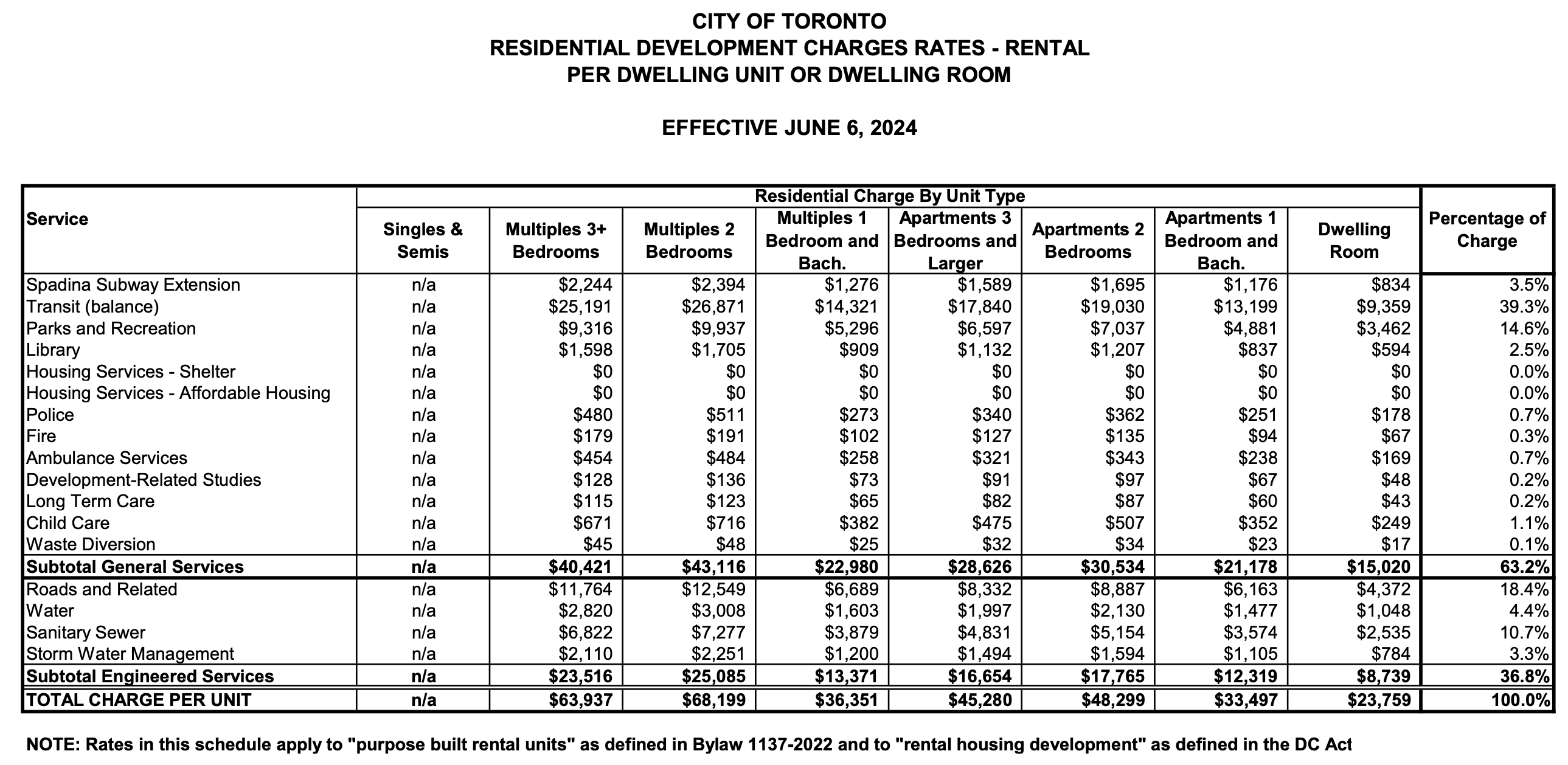
    In other words, if you were building 3-bedroom family-sized condominiums, the development charge would be $80,690 per home. And if you were building 3-bedroom family-sized rentals, the development charge would be $45,280 per home. But keep in mind that in addition to the above development charges, there are also other charges like the Community Benefit Contribution (Section 37), Parkland Dedication, Education Charges, Development Application Fees, HST, and so on.

    Growing development charge reserve funds

    Looking at just DCs, Ontario municipalities collected about $17.5 billion in development charge revenue over the last five years (according to the Missing Middle Initiative). But importantly, these same municipalities only spent $11.8 billion. The rest is sitting in DC reserve funds. Why is that? Well, part of this could be explained by timing. DCs are typically collected when a developer is issued their first building permit. But the costs associated with growth-related infrastructure may not happen at exactly the same time.

    Except that these reserves have been growing. From 2010 to 2022, DC reserve funds across Ontario have increased from $2.6 billion to $10.7 billion (again, according to the Missing Middle Initiative). This is a 316% increase over 13 years. And in the case of Toronto — Ontario’s largest city — reserves have grown 891% over the same period. This suggests that these charges aren’t accurately tuned to actual impacts, because, in theory, these reserves should trend toward zero over long periods of time, as growth-related infrastructure costs are incurred.

    Nexus between development charges and the impacts of new development

    Let’s get a little more specific. Over the last five years, DCs generated about $450 million for social services across Ontario. This includes things like long-term care, affordable housing, day cares, and public health; all of which are important and good things. But can all of these things be considered growth-related impacts? In other words, is it fair to say that because new housing got built, we now need more long-term care homes? I don’t think so. Long-term care homes are certainly needed, but I don’t think it’s fair for new home buyers and renters to shoulder this cost.

    Who is paying for the renaming of Dundas Square?

    Let’s consider another example. Back in 2014, Toronto City Council decided that Dundas Square should be renamed. I personally don’t think this was at all necessary, but it got approved and the cost to do so was estimated at $335,000. At the time, it was also decided that this would be paid for through Section 37 funds as opposed to “taxpayer money.” Section 37 of the Planning Act used to function in practice as “let’s make a deal.” It was a way for cities to extract money from developers in exchange for allowing more density. This has since been replaced by the Community Benefits Charge framework, but the intent is the same:

    > Section 37 of the Planning Act authorizes the City to adopt a community benefits charge (CBC) by-law and collect CBCs to pay for the capital costs of facilities, services and matters that are required to serve development and redevelopment. CBC funding will help support complete communities across Toronto.

    In funding it in this way, the City of Toronto took a position. It basically said, “renaming Dundas Square is important to the city. We must do it. But we don’t want all Torontonians to pay for it. We only want new home buyers and renters to pay for it.” Because that’s the effective outcome of using funds charged only to new developments. Is that fair? Once again, I don’t think so. Because it’s not reasonable to say that because new housing got built, it’s now imperative that we rename Dundas Square. The two are unrelated matters.

    By and large, this is the issue that many take with development charges. It doesn’t appear to be “growth just paying for growth.” It’s growth paying for a lot of stuff. And it has a direct impact on housing affordability. In tomorrow’s post, we’ll expand on this last point and talk about what lowering/eliminating DCs could mean for apartment rents.

  • Carney vs. Poilievre

    April 20, 2025 · View original


    This past week I listened to two podcasts in preparation for Canada’s upcoming federal election. I listened to Prime Minister Mark Carney with Scott Galloway and I listened to Pierre Poilievre with Brian Lilley of the Toronto Sun. If any of you have any other recommendations for an interview that I should listen to, please share it in the comment section below.

    Here’s what I would say. Carney came across as more measured and less direct. But naturally very capable when it comes to understanding the economic implications of our shifting global order. He wasn’t forceful when talking about oil and gas pipelines, but I understand that he fully supports them. This is critical to diversifying our trade and frankly gaining more market power.

    I’m skeptical of government being able to act as any sort of big developer and/or stimulate a thriving prefab construction industry. The latter is being worked on by a lot of the private sector; what is needed are dramatically lower fees and less barriers to development. I was, however, comforted by the fact that Carney did seem to reduce government’s role to an enabler for private enterprise.

    Both are promising dramatic cuts to development charges, which is essential. Poilievre is promising to eliminate the federal sales tax on all new homes priced under $1.3 million, whereas Carney wants to do it for homes under $1 million and only for first-time buyers. Carney also focused a lot on increasing construction trade capacity as a way to dramatically increase overall supply.

    Broadly, Poilievre was more focused on “axing the tax” and removing the barriers to developing new housing. As we have talked about many times before on this blog, upwards of 30% of the price of a new home in Canada can be attributed to government fees and taxes. This is unsustainable, as we have seen, and it needs to change if we are going to improve housing affordability.

    That said, Poilievre did make a specific comment that I didn’t care for. He was talking about family formation and housing affordability and he said, “how can you start a family without a backyard and driveway?” He went on to say that, “people want detached single-family houses.” Now, there’s some statistical truth to this claim, but it’s not like it’s enshrined in our DNA.

    It’s an anti-urban statement. There are lots of cities around the world where kids are raised, just fine, without a backyard and/or driveway. They walk to school, they play in wonderful city parks, and they generally enjoy a high quality of life in an urban environment. I’m not suggesting that this has to be for everyone, but I do believe in removing our cultural biases and letting the market ultimately decide.

    This is a pivotal moment for Canada. Regardless of who is successful on April 28, the status quo cannot continue. We must become a global superpower. And when it comes to housing, I would encourage whoever wins to give me a call after the election. Prime Minister: I’ll walk you through a development pro forma and explain what it will take to make housing more affordable, and get lots of it built.

    Cover photo by Hermes Rivera on Unsplash

  • What does it mean that developers are proposing a lot of new housing?

    April 19, 2025 · View original


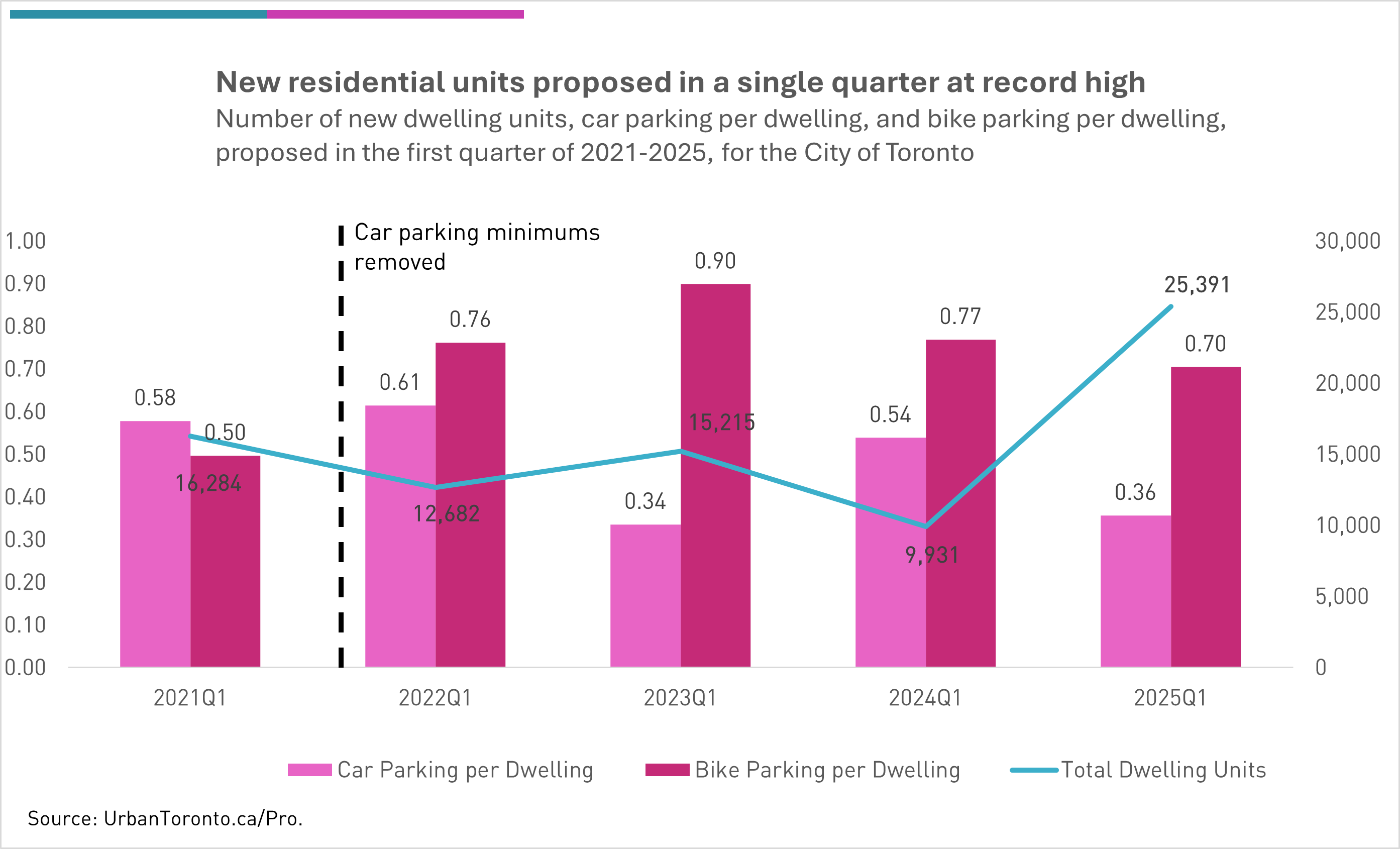
    This week, Urban Toronto reported a record number of residential development applications submitted in the City of Toronto over the last quarter. A total of 25,598 residential homes were proposed across 12 condominium projects, 16 rental projects, and two projects that also include an office component.

    The total area was around 20 million square feet. The total number of buildings was 66. The median height was somewhere around 23 storeys (~86 meters), with the tallest being 67 storeys. And the average parking ratio was around 0.3 spaces per home. (The below chart seems to suggest that parking minimums were previously constraining the market.)

    This is, according to UT, the highest number of proposed new homes in a single quarter over the last five years:

    So, should this be taken as some sort of leading indicator that the market is set to rebound? My view is no. It certainly shows some degree of optimism for the future of our market, but there are lots of reasons why a developer might submit a development application in a down market.

    Developers could be seeking more density as a way to reduce their land basis. If you bought a site for $25 million and you have approval to build 250,000 sf, your land basis is $100 per buildable square foot. If you can now build 350,000 sf, you’ve just reduced your land basis to $71 pbsf. That effectively means it’s cheaper, which is good; but importantly, it now means have more space to absorb. So there’s a trade off.

    Another reason could be that developers are reworking their sites for purpose-built rental (from for-sale condominiums). The figures provided by Urban Toronto show that the majority of the applications were for rental projects. I suspect that this could be a big driver. Converting a project from condominium to rental isn’t as simple as just flipping the legal tenure.

    Lastly, I will say that developers could be pulling the trigger on new development applications simply because they need or want to do something. We all have sites, and we’re programmed to move and get stuff done. Sitting around doesn’t accomplish anything and it frankly doesn’t feel good. Question now becomes: who will be in a position to be patient once they get their approvals?

    It’s hard to pinpoint exactly what drove this surge, but it should not be assumed that it will translate into more new housing in the short term. The real indicator is market absorption. Without it, development density has very little value.

    Cover photo by Bennie Bates on Unsplash

  • Sorry, I don’t have Venmo — stablecoin?

    April 18, 2025 · View original


    Back when Canadians used to travel to the US, it was common for a situation like this to arise: “Hey, I’ll send you money. Do you have Venmo?” And then, as a Canadian, you’d say, “sorry, we don’t have Venmo in Canada. We use our own proprietary system called Interac e-Transfer. Do you have PayPal? I think I still have an account. Let’s try.” Once this exchange was over, both parties would then sit there and wonder why the hell it’s still so expensive and awkward to move money around.

    As another example, take global remittances. These are payments sent by a person back to their country of origin, usually to a family member. And in 2024, it was estimated that some $905 billion was sent around the world for this reason, with about $685 billion of it being sent to low and middle-income countries. But it was also estimated that the average cost of doing this was around 6.62%, which is double the UN’s target of 3%.

    For anyone who has used crypto before, this feels painfully archaic. Sending a wire transfer can cost over $50 and it can take time to clear, assuming that you got in before the bank’s cut-off time. Sending things via a blockchain is cheap (it’s pennies now) and it happens instantly and securely — 24 hours a day, 365 days a year. This was always one of the promises of crypto, but now we’re seeing it play out very clearly with stablecoins. Here’s an example.

    > Tweet: I send money to my family every month (they are in Argentina) and I just need to send USDT to a wallet address and they get it instantly, no requirements, no issues and they can keep some of it in stables instead of our devalued currency. Without crypto, this would be a pain in

    Stablecoins are a type of cryptocurrency that have their value pegged to another asset, such as gold or a fiat currency. And at the time of writing this post, something like 99% of stablecoins are pegged to the US dollar. The benefits of this are twofold. Firstly, it creates price stability. You’re effectively holding US dollars. But now you have a US dollar on a blockchain (or a tokenized US dollar), meaning you can do crypto things with it, like send it around the world instantly and for free.

    The other benefit of this is that it can serve as a hedge against a problematic local currency. Would you rather hold the Argentine Peso or the US dollar? The use cases are powerful. So it’s not surprising that, by some estimates, a quarter of all global remittances now involve some form of cryptocurrency. Argentina also happens to be the leading crypto market in Latin America. Between July 2023 and June 2024, the country recorded about $91 billion in crypto transactions.

    It’s fascinating to think about how all of this will reshape the global financial landscape. Already stablecoin transactions are threatening Visa in terms of overall transactions. All someone needs is a mobile phone and a crypto wallet. And by the way, as soon as you link a wallet to a human, you can also quickly determine how much money they’ve been sending/receiving, figure out tax liabilities, and so on.

    Also noteworthy is the fact that the (vast?) majority of stablecoin transactions settle on Ethereum. It is the substrate powering this market, as well as many others. I don’t know what that exactly means for Ethereum as a crypto asset. But I do believe it means something meaningful. And in this instance, it stems from a fairly simple want: “I would like to send you money cheaply and securely, and I don’t want inflation to then kill my purchasing power.”

    Cover photo by Alistair MacRobert on Unsplash

  • Only 533 new condominiums were sold last quarter in the Toronto region

    April 17, 2025 · View original


    Urbanation just released its Q1-2025 condominium market survey results for the Greater Toronto & Hamilton Area (GTHA). Here’s how things are looking:

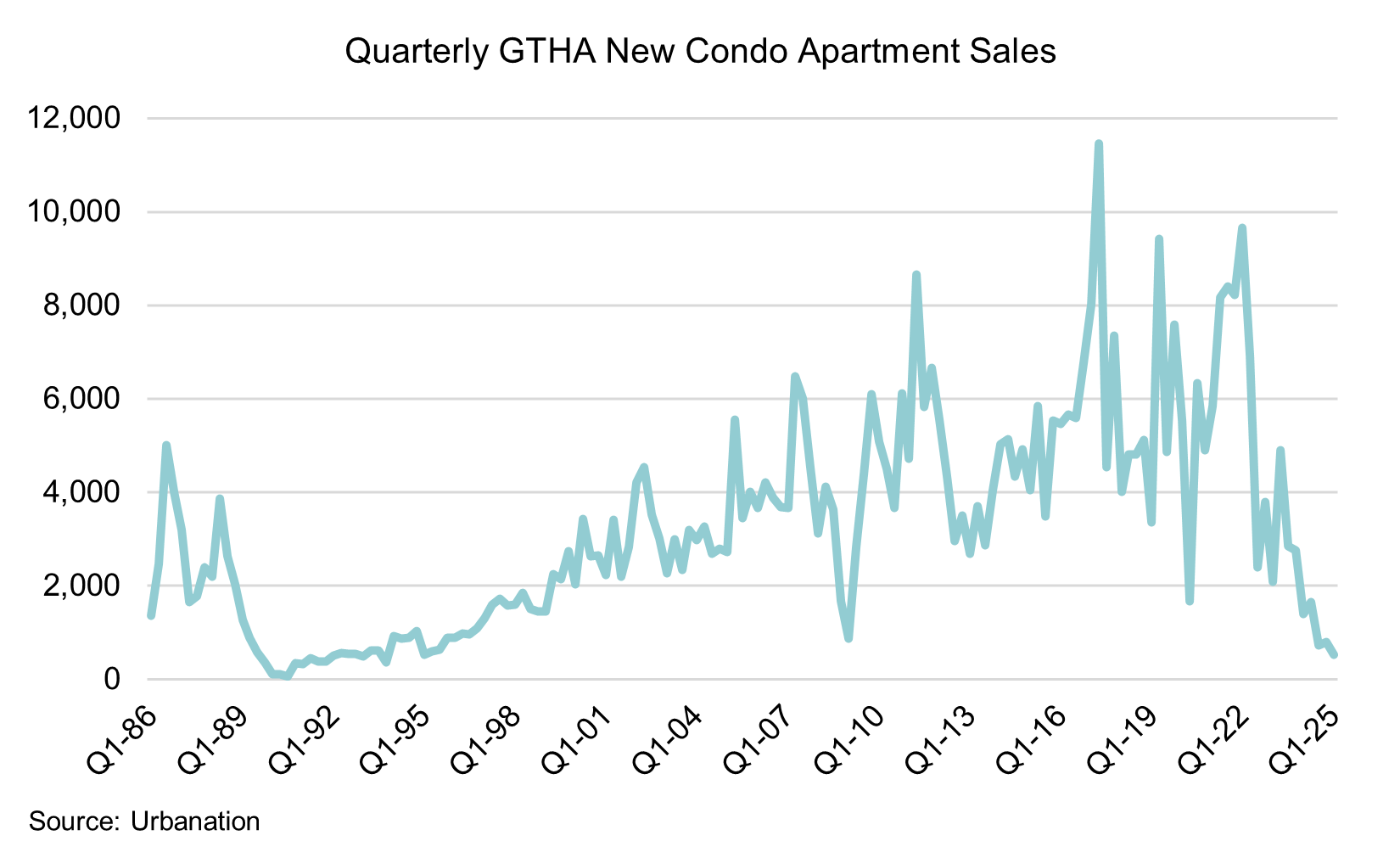
    The entire GTHA recorded 533 new condominium sales and the City of Toronto recorded 215 new condominium sales in the quarter. Once again, and as you can see above, this is the lowest level since the early 90s.

    For all intents and purposes, I think you can look at these sales figures as mostly representing a zero. The numbers are relatively small and a sale doesn’t necessarily equate 1:1 to an eventual new home. The sale needs to be within a project that achieves its requisite pre-sales for construction financing.

    Since the beginning of 2024, Urbanation has tracked a total of 5,734 pre-construction condominiums that have been put on hold, cancelled, placed into receivership, or converted to purpose-built rental.

    So where does this leave us? It leaves us with:

    – 69,042 condominium homes under construction across the GTHA – 10,934 unsold condominiums in pre-construction projects – 11,073 unsold condominiums in projects under construction – 1,911 unsold condominiums in completed projects (standing inventory)

    One hypothetical could be that many/most of the projects currently in pre-construction never actually make it to construction, which would mean that the above 10,934 condominiums just disappear from the market. For argument’s sake, let’s assume this happens. That would leave projects under construction and standing inventory.

    Of the condominium’s currently under construction, 11,073 are unsold, which represents about 16% of the total. For the units that have sold, some will belong to end users, some will belong to investors who have an ability to close, and the rest will be buyers who, frankly, don’t want to close or who can’t close.

    I don’t know what this latter percentage might be, but let’s say that 40% of the condominiums sold and under construction become a problem and need to be “reabsorbed” in the market. That is, they need to find new buyers. That would equal 23,187 condominiums (and hopefully I’m being very conservative). In this scenario we would have:

    – 11,073 unsold condominiums in projects under construction – 23,187 condominiums that become a problem and need to reabsorbed in the market – 1,911 unsold condominiums in completed projects – Total of 36,171 “unsold” condominiums

    So, how long will it take to absorb these new homes? I don’t know. It depends on a bunch of factors, including immigration. But I think we need at least 2 more years just to physically deliver the homes that are currently under construction. Then there may be a period of reabsorption. That continues to suggest to me that 2028 could be the year where we’re on the other side of this.

    Cover photo by Brian Jones on Unsplash