Daily insights for city builders, delivered every morning at 6 AM ET. I’m Brandon Donnelly — a Toronto-based real estate developer and founder of Globizen. I’ve been writing here since 2013.

  • The authoritative architectural guide to Toronto

    It’s late. I just got home from the office. And I’m exhausted.

    But I did just receive my copy of Toronto Architecture: A City Guide. The “handbook” was originally written by Patricia McHugh (1934-2008), but it was recently updated by Globe and Mail architecture critic Alex Bozikovic. (Also, shout out to Vik Pahwa for the terrific photos he took for this guide.)

    When I opened the book, one of the first things that stood out for me were these two lines:

    Toronto has in fact rebuilt itself over and over again.

    This book is, in part, a tool to understand that story.

    In my view, this is one of the biggest compliments that you can pay to a city. Cities should not be static entities. Because if they are, then they will inevitably fail. Change must be a constant.

    As I read through the guide, that wonderful spirit of reinvention is abundantly clear. But I think the real way to experience this handbook is on the streets of Toronto – and probably with a good camera. That’s why it’s called a handbook. 

    The book is primarily structured around 26 distinct walking tours, each of which could be covered off in an afternoon. Along each tour, Patricia and Alex point out which buildings you should be focused on and provide pithy, yet insightful, comments for each.

    I believe that the more you know, the more you can appreciate. So if you’re interested in architecture and/or Toronto, I would you encourage you to think about getting a copy. And if you’re interested in going on a walking tour, tweet at me.
  • E-commerce jobs are clustering in larger cities

    image

    The New York Times just ran an interesting piece on “how the growth of e-commerce is shifting retail jobs.”

    Here are some of the key takeaways (all US data).

    Online shopping accounts for about 8.4% of all retail sales.

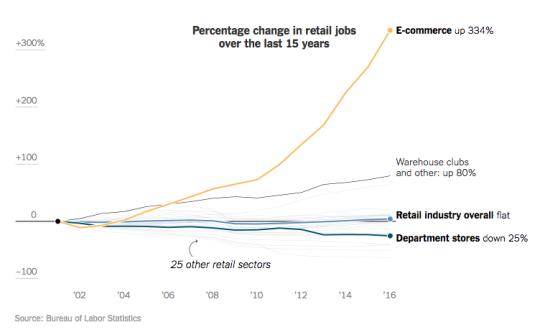
    But e-commerce related jobs are growing way faster than all other forms of retail employment. See above graph.

    That said, e-commerce jobs are still a small portion of overall retail employment. And the rise in e-commerce employment has not been enough to offset the losses in other areas, such as in departments stores.

    Over the last 15 years, e-commerce added 178,000 jobs and department stores lost 448,000 jobs. In this same time period, warehouse clubs added 841,000 jobs! I found it interesting to see department stores on the bottom and warehouse clubs on the top of the graph.

    image

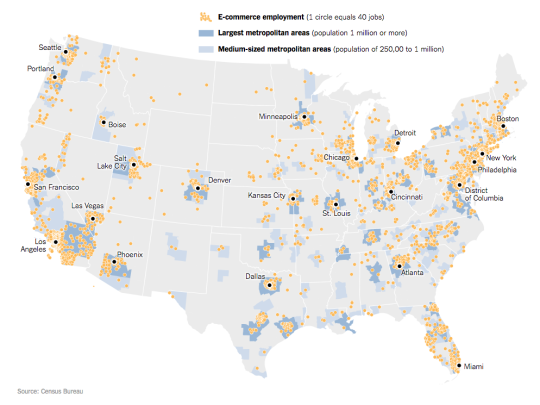
    Finally, e-commerce jobs appear to be concentrating in larger metros. See above map. Each mustard dot represents 40 e-commerce jobs. You’re selling more products with less human capital, and those people are clustering. This is a broader trend.

    According to the New York Times, counties and smaller cities (under 250,000 people) account for almost ¼ of overall retail employment. But when it comes to e-commerce firms the number drops to around 13%.

    Once again it would seem that technology and what we do online have an impact on our cities and towns. And that’s fascinating.

    All images from the New York Times

  • How did we miss this?

    I promise that this post won’t be all about laneways.

    This afternoon Erin Davis of Torontoist published a post called: Are Laneway Suites a Solution to Toronto’s Housing Crisis?

    There’s a quote in it from yours truly:

    Brandon Donnelly, a 34-year-old real estate developer, has submitted plans to the City to build a laneway home behind the house he owns in the St. Clair Avenue and Dufferin Street area. “Look, nobody is claiming that laneway housing is going to solve all of our affordable housing woes. But it will do two important things. One, it will unlock new ground-related housing, which is precisely the kind of housing that we’re no longer able to build at scale. And two, it will create additional rental housing,” says Donnelly.

    But I particularly like this one from Christopher Hume – urban affairs columnist at the Toronto Star:

    “But the City has all kinds of rules against it—‘You can’t do it for this reason, you can’t do it for that reason; oh no, we can’t have that!’ Why? Says who and for what reason?

    This morning my friend Alex Bozikovic also published a piece on Toronto’s new 1.75km of public space under the Gardiner Expressway called The Bentway. It’s currently under construction and will open this winter.

    The timing of his article is actually quite serendipitous because I was in the area last night and as I walked past the construction site I couldn’t help but think to myself: “This is going to be absolutely brilliant once it’s done. Complete game changer for the area.”

    My point with these two examples is that in both cases we are rethinking – or at least trying to rethink – neglected urban spaces. It’s about finding value where no additional value was thought to be found. And I love that.

    Conventional wisdom has told us that our laneways and the spaces under our elevated Gardiner Expressway are not spaces to be celebrated. They are utilitarian at best and they are to be completely ignored at worst.

    But when The Bentway opens this winter I have no doubt in my mind that it will prove conventional wisdom entirely wrong. Who wants to hang out under an elevated highway? Watch the entire city. 

    One day I believe that we will also look back on our laneways just as we look back at the The Bentway before it became The Bentway. We will ask ourselves: How did we overlook this for so long?

    Image: PUBLIC WORK via the Globe and Mail

  • Am I being too subtle?

    Billionaire Sam Zell has a (relatively) new book out called, Am I Being Too Subtle?: Straight Talk From a Business Rebel.

    I haven’t read it yet, but I’ve added it to my queue. I can, however, tell you that I always enjoyed listening to Zell speak candidly about business and real estate when I was in graduate school and he would come in. He was never one to mince his words.

    He’s making the rounds right now to promote this new book and he recently sat down with William D. Cohan of the New Yorker. Not surprisingly, the Chicago Tribute debacle formed a large part of the conversation – up until Zell got tired of talking about it.

    “That is the L.B.O. that drove this company into bankruptcy.” Zell said, of the Tribune experience, “I made a bet. I thought the bet was reasonable. I underwrote it appropriately. I was wrong.” He lost his entire investment.

    But this misstep did nothing to phase Zell’s contrarian approach to business and life:

    Zell attributes his wealth to a prescription articulated by any number of successful business people: zigging when everyone else is zagging. It’s a replicable formula, he says, and he has little patience for people who complain that it was somehow easier in the good old days, or that the moment for such opportunities has passed. (His earliest successes came from investing in real-estate assets that others shunned.)

    He refuses to listen when he’s told he can’t do something. “I spent my whole life listening to people explain to me that I don’t get it,” he says. “I look at the Forbes 400 list, and if I eliminate the people who inherited the money, everybody else went left when conventional wisdom said to go right. How did I do what I did? By not listening to anybody else.”

    It’s the Sam Zell way.

  • Laneway housing — right now feels different

    image

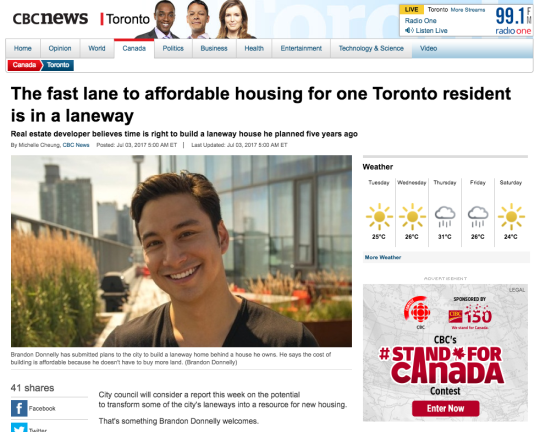
    The CBC published a piece this morning on my laneway house proposal. The subheadline: Real estate developer believes time is right to build a laneway house he planned five years ago

    It’s true. As many of you already know, this proposal has been in the works for a number of years. But right now feels different. I continue to be encouraged by all of the interest and support surrounding laneway housing in this city. 

    Thank you Michelle Cheung for covering this.

  • 616 Croft Ave., LLC, v. City of West Hollywood

    The Supreme Court of the United States may soon consider whether inclusionary zoning is in fact unconstitutional.

    A pending petition by the developer of an 11-unit condominium project in the City of West Hollywood is asking whether a $540,393.28 “affordable housing fee” – which is being imposed as a mandatory approval condition – is “subject to scrutiny under the unconstitutional conditions doctrine” set out in previous cases.

    The petition is supported by a collection of researchers and academics from Yale University, George Mason University, as well as many other institutions.

    More specifically, the question asks whether a “mandated permit condition” satisfies the “essential nexus” and “rough proportionality” tests established by the following decisions: Koontz v. St. Johns River Water Management District, 133 S. Ct. 2586 (2013); Dolan v. City of Tigard, 512 U.S. 374 (1994); and Nollan v. California Coastal Commission, 483 U.S. 825 (1987).

    To put it crudely, the nexus and proportionality tests essentially state that for an exaction to be constitutional, there needs to be a reasonable relationship between the ask and the adverse public impacts that can be directly attributable to the project in question.

    Here is an excerpt from the petition:

    Together, the nexus and proportionality tests hold that the government cannot condition approval of a land-use permit on a requirement that the owner dedicate private property to the public, unless the government can show that the dedication is necessary to mitigate adverse public impacts caused by the proposed development.

    In the case of 616 Croft Avenue, the argument is that this 11-unit condo project is not directly responsible for the lack of affordable housing in the city. In other words, the need for affordable housing exists independently of this project. So it fails the test.

    Another excerpt:

    Accordingly, the City
    provided no evidence of nexus and proportionality,
    admitting on the record that the in-lieu fee was not “intended to mitigate impacts caused by development.” Instead, the City explained that the fee was designed to meet “needs for affordable housing that exist independently of the Applicants’ residential
    development project.

    The petition also gets into the fact that, irrespective of this test, inclusionary zoning has not necessarily been shown to have a meaningful impact on affordable housing supply. And it may actually increase housing prices because of a reduction in overall supply and because the cost burden typically gets shifted over to the market rate units. More reading here.

    What do you think of this argument? It will be very interesting to see how this one plays out.

  • Canada 150(ish)

    image

    Today is Canada Day. And I love my country. (If you’re reading this via email subscription, then: Yesterday was Canada Day.)

    I recognize that not everyone who reads this blog is Canadian. In fact, 50% of my email subscribers and 36% of the users who read this blog on the web are actually from the United States. More Americans subscribe to this blog than Canadians.

    But today isn’t your average Canada Day. It’s the sesquicentennial anniversary of Canadian Confederation. Canadians all across the country and world are and will be celebrating. 

    The CN Tower will put on a pyrotechnics show this evening at 10:30pm and I’ll be watching. There’s even the world’s largest rubber ducky bobbing around in Lake Ontario. I’m missing the connection on this one, but a 6 storey rubber ducky is definitely worthy of an Instagram post or two. Perhaps we should have gone all out and staged a complete bathtub scene in Toronto’s inner harbor. That would have been fun.

    But as much as 150 years of Canada sounds and feels great, I’d like to talk about a different moniker today: Canada 150(ish). And I have two reasons for saying this.

    One the most effective ways to explain the difference between Canada and the United States is to talk about how we became independent.

    In the U.S. it was a “decisive declaration” leading to war. Americans fought for their independence and July 4, 1776 has become a clear temporal marker. They were dependent before and independent after.

    In Canada, our day of independence is less decisive. Instead of complete autonomy, it marks the beginning of a long and gradual process of becoming less and less British, one which arguably didn’t fully conclude until the Canada Act of 1982

    So might we call today Canada 35?

    One could also argue that this process isn’t fully complete. I don’t know about you, but our lingering connections to Britain – however benign they may be – actually weaken the Canadian story for me.

    The second reason why I’m throwing out Canada 150(ish) is because I want to acknowledge the fact that there are people in this country who feel excluded from the solidarity that “Canada 150″ is trying to instil. Here is an excerpt from a New Yorker essay by Molly Worthen that was published early this morning:

    Of course, the story of Confederation is largely a story of white men who mostly spoke English. This summer, the few Canadians who are eager to talk about history and reexamine the details of their constitution are those who feel excluded from the standard narrative of Canadian unity and progress: indigenous people and Francophone Québécois.

    Now that I’ve gotten this off my chest, I’m going to get on with celebrating Canada 150 and this incredible place of democracy and opportunity. And for all of the Americans who read this blog, happy 4th of July.

    Photo by Harry Sandhu on Unsplash

  • What land-use restrictions are doing to our cities

    I have Richard Florida’s recent book, The New Urban Crisis, sitting on my bedside table. I’m only about ¼ of the way through it, but I’m really enjoying it. I’ll write more once I’m done.

    What I instead want to talk about today is a recent (and related) article that Florida published in CityLab called: Did Land-Use Restrictions Save the Rust Belt? 

    In it, he leans on the research of two economists – Chang-Tai Hsieh of the University of Chicago and Enrico Moretti of the University of California at Berkeley – and makes 3 valuable points.

    They are:

    It is estimated that land-use restrictions (which limit development / supply) have reduced overall GDP in the U.S. by about 9% or approximately $1.5 trillion per year. It is also estimated that housing supply constraints alone lowered overall growth by more than half between 1964 and 2009.

    At the same time, these land-use restrictions may have benefited other regions – such as the Rust Belt – that would have otherwise lost more people and jobs to places like New York and San Francisco. The research found that without these land-use restrictions, employment growth between 1964 and 2009 would have been more than 1,000% higher in New York and almost 700% higher in San Francisco.

    The final takeaway is one that we’ve talked about before on this blog. One of the most effective things we can do to counteract geographic inequality is to build great transit; transit that connects both people and land to the most desirable areas of our city.

    And with that, Happy Canada Day weekend all.

    Photo by João Silas on Unsplash

  • Lease vs. Life

    image

    When I was in graduate school in the U.S., I remember it being a pain having to always sign a 1 year lease. I only wanted 8 months so that I could take off during the summers. Too bad Flip wasn’t around back then.

    Flip is a startup that I just discovered, which is positioning itself as the “easiest way to sublet or get out of your lease.” It’s all about reconciling the conflict between lease and life, which don’t always match up.

    The platform is free to listers. So you don’t get charged to post a lease or to flip a lease. Renters get charged a service fee equal to 5% of one month’s rent.

    It’s interesting to think about the surge in short-term rentals and platforms such as Flip that are effectively helping to reduce lease terms by way of streamlining the “flipping” process. 

    Are millennials ushering in a new era of mobility and transience?

    One feature that I think is neat and that I would like to point out is “Bounties.” The platform allows listers to attach a bounty ($) to any listing. Users are then able to grab a unique URL that can be shared around online. If someone takes over a lease via one of your links, you get paid the bounty. Smart.

    In case you’re curious – I certainly was – here’s a ranking of all 50 U.S. states according to how friendly they are to subletters. It also summarizes how to legally sublet. On the friendly side is New York and on the less friendly side is Wyoming.

    Photo by Dan Gold on Unsplash

  • 76 thumbs down

    A few weeks ago Seth Godin wrote a post on his blog called: What 99% looks like. He used the example of a Turkish vlogger who had posted an interview with him to YouTube that received the following view count, up votes and down votes:

    image

    The point he wanted to make was that many of us will instinctively focus on that one number: 76. We will say to ourselves that 76 people hated our video, our work, so much so that they felt compelled to give it a decisive thumbs down.

    His message was clear: “Ignore it. Shun the non-believers and ship your work.” 76 people out of 108,605 views is not even 1%. And 76 out of (10,827 + 76) interactions is still not even 1%. You could easily say that this video has a greater than 99% approval rating.

    I love this message, because there will always be naysayers, especially if you’re doing something interesting and unique. In fact, having naysayers is probably a good litmus test to make sure that you are indeed doing something interesting and unique.

    But here’s the thing. 

    The YouTube metrics above make for a rather transparent platform. You can see that the video received 108,605 views and that 10,827 + 76 people felt so strongly about it that they wanted to leave a mark by way of a thumbs up or thumbs down. But most importantly, you can see that way more liked the video than hated it.

    But what if it wasn’t clear that over 10,000 people were fans of your work? What if all you saw was how many people hated it? And what if those voices were amplified? That would be pretty discouraging, considering that many of us are already focusing on that number to begin with.

    I can think of many instances where the fog is thick and we don’t have full visibility. That’s where it gets even tougher, but more critical, to “shun the non-believers.” There may be people out there who truly love your work and what you’re trying to do. You just may not know it, yet.