Daily insights for city builders, delivered every morning at 6 AM ET. I’m Brandon Donnelly — a Toronto-based real estate developer and founder of Globizen. I’ve been writing here since 2013.

  • The past and the future on Armstrong Avenue

    I spent this evening driving around Toronto with an architect friend of mine looking for laneway houses. (Late summer sunsets have a wonderful way of extending the day.)

    I think most people would be surprised by how many of them are hidden away behind our streets. I think of laneways as a forgotten third layer behind our major avenues and smaller streets.

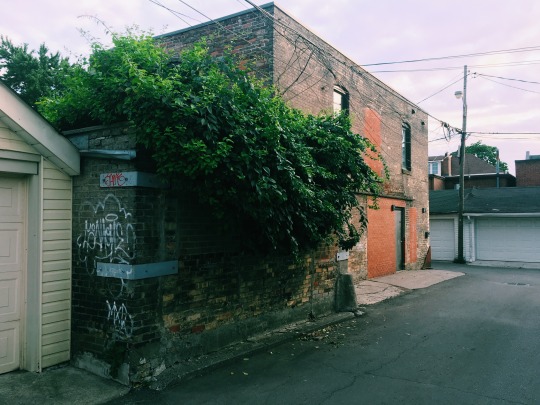
    One of my favorite laneway houses, pictured above, is Armstrong Avenue by Taylor_Smyth Architects. It’s a bit unusual in that it’s exceptionally large for a laneway house (2,200 square feet). But that’s because the building was originally built as a dairy (1912).

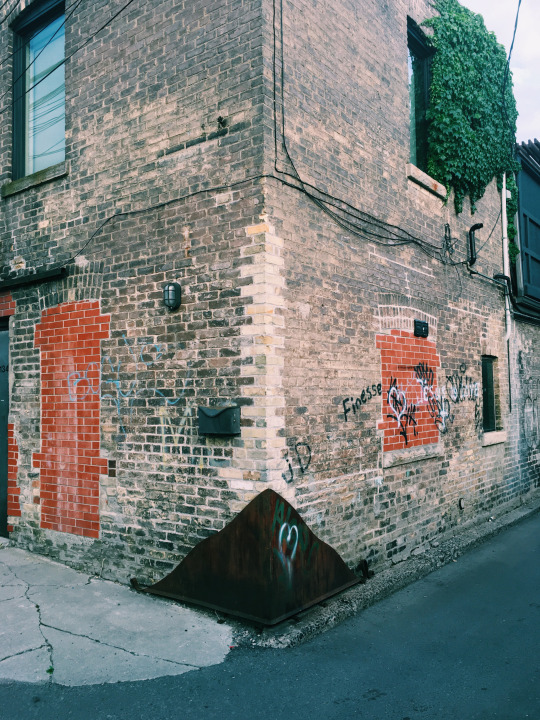
    What’s interesting about the house is that from the outside it looks rather nondescript. Okay, it looks raw and rundown. Here is a closer photo:

    But then inside, it looks like this. Modern. Clean. Polished. And light-filled.

    I’m not suggesting that this should or could become a repeatable model for laneway housing in Toronto. Again, it’s a unique circumstance. But I think contrast is an extraordinary poetic device. And in this case, it speaks to both the past and the future of this city.

  • How permissive zoning created Toronto’s King-Spadina district

    image

    Over the weekend, Marcus Gee of the Globe and Mail published a terrific article about Toronto’s King-Spadina district and how “condos conquered a rundown district of the city.” (This post will argue that condos were not the catalyst, but an outcome of other changes.)

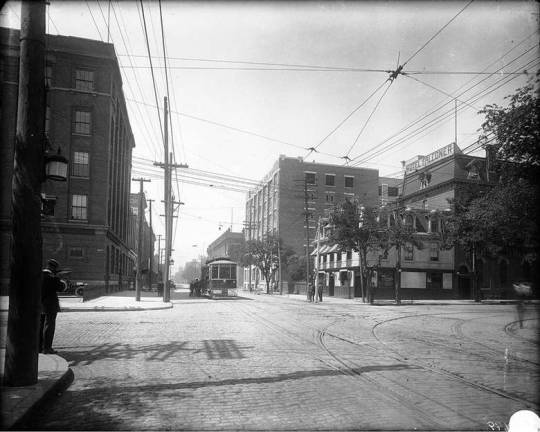
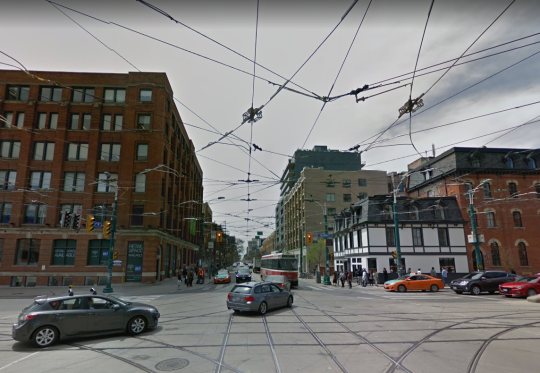
    The image at the top of this post (City of Toronto Archives) is the intersection of King Street and Spadina Avenue around the early 1900s. And here is roughly that same view from May 2016 (Google Streetview):
    image

    From this perspective, it may look like not much has changed. The buildings at the two corners are still there, although their uses have changed. The streetcars are still running, although we now have slightly newer machines. And there are overhead lines providing a canopy across the intersection.

    But as Gee points out, the reality is that in recent years King-Spadina has arguably seen more change and development than any other precinct in the city:

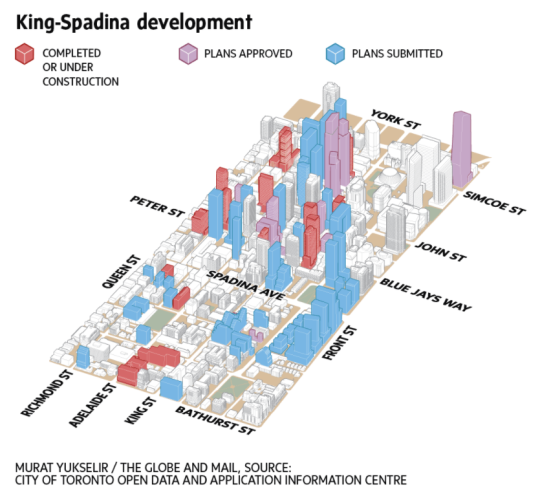
    No fewer than 99 projects have been built, approved or pitched since 2004. That’s one quarter of the total for the entire city and more than the count for two vast suburban districts – Scarborough and Etobicoke – combined. King-Spadina is overtaking even high-rise hubs such as Yonge and Eglinton in midtown Toronto and the Bay and Yonge corridors downtown.

    Below is a diagram showing the built form of that change.
    image

    But as we talk about this massive change, I would argue that this didn’t happen by accident. 

    Gee starts his piece by saying that “cities have an endless ability to evolve, to rebound, to reinvent and regenerate themselves, sometimes in ways that would astonish generations past.” I would add one word: Successful cities have an endless ability to evolve.

    King-Spadina has indeed reinvented itself many times. Prior to its current iteration, it served as a manufacturing district and as the center of Toronto’s garment industry. But from the 1970s through to the early 1990s, the area fell into decline as its manufacturing base left.

    The game changing moment happened in 1996 when “The Kings” – which includes the areas around both King-Spadina and King-Parliament – were redesignated as “Regeneration Areas.” The overarching goal was to deregulate away from single-use industrial zoning and allow the area’s buildings, both old and new, to take on almost any use.

    Now all of a sudden it was possible to have light industrial, commercial, entertainment, retail, residential, and live/work uses all mixed together. And with the bones already in place, the market responded. 

    In my view, it is these earlier changes that laid the groundwork for what has become one of the most exciting neighborhoods in the country.

    However, today some are worried about whether or not this is too much of a good thing. And I am sure that many would like to blame developers for piling up in this neighborhood. Why continue to build here when there’s lots of land elsewhere?

    King-Spadina is a perfect example of what Richard Florida would call “winner-take-all urbanism.” There are powerful clustering forces at play both globally and locally in our cities. And so there are real economic reasons for why King-Spadina has seen more development than Etobicoke and Scarborough combined.

    Permissive land use policies and the right building stock may have kickstarted things, but now economies of agglomeration have taken over. Retailers, restaurants, clubs, tech companies and people, among many others, are now fighting for space in this area for the same reason that Toronto’s garment industry once felt the need to cluster here. There are tangible benefits to doing so.

    What people are effectively asking today is at what point do we start to see diseconomies of agglomeration. This is an important question and one that needs to be actively managed. 

    Without getting into any of the details, I believe that the King Street Pilot Study – which puts transit first along the King corridor – is one very appropriate answer to this question. It is a direct response to diseconomies of agglomeration, in this case traffic congestion.

    But there are important corollaries to this question that are also worth considering: How do we now create more King-Spadinas and how do we create more broad-based and inclusive urbanism in the face of these powerful clustering forces? These are questions that go well beyond King-Spadina, but there are lessons to be learned from the successes seen on the west side of downtown Toronto.

    Images via The Globe and Mail and Google Street View

  • Video: Brooklyn Navy Yard

    image

    Monocle recently published a short 4 minute video tour of the Brooklyn Navy Yard. It covers a bit of the area’s history and the kind of businesses that are flocking to the area today.

    One of the reoccurring themes in the video is a feeling of stability. The local businesses feel secure in their space and some even believe that the area is somehow immune to gentrification.

    Monocle doesn’t allow embedded videos, so you’ll have to click here to watch.

  • How avocado toast became the poster child for Millennial self-indulgence

    I am a big fan of avocados, as I’m sure many of you are as well. But why the obsession these days? Consumption is very clearly up. Sure they’re healthy, but what else is driving their celebrity status?

    Here’s an excerpt from a recent New Yorker essay called, A Grand Unified Theory of Avocado Toast:

    Today, nine out of ten imported avocados in the U.S. are from Mexico.

    The change resulted from the North American Free Trade Agreement. Their effects on the consumer avocado market were profound: from the mid-nineties through 2014, the United States’ avocado consumption nearly quadrupled. Average consumption rose from less than two pounds per person per year to about seven. In the nineties, the United States was producing more than eighty per cent of the avocados that it ate. More recently, it has grown fewer than twenty per cent. The twenty-first-century explosion of avocado smoothies, avocado ice cream, avocado life, in other words, is not in your imagination. It reflects a foreign influx of the fruit, mostly made possible by NAFTA.

    If you also love avocados and you’re curious as to why avocado toast has become the poster child for Millennial self-indulgence, you may want to read the full article.

  • Crane capital of America

    When people like Richard Florida talk about today’s “superstar cities”, the usual suspects include London and New York for finance, the San Francisco Bay Area for tech, Milan for fashion and design, and so on.

    And you can certainly find the data to back up these claims. For instance, if you look at venture capital dollars invested, many of these same cities reappear near the top: San Francisco, San Jose, New York, etc.

    One city that doesn’t often appear on these sorts of lists, though, is Seattle. 

    However, clearly something special is taking place in the city. For the second year in a row, Seattle has been named the construction crane capital of America. No other American city comes close right now. (However, Toronto is still #1 in North America.)

    At the same time, if you think about all of the companies that have come out of Seattle over the years, you start to realize that maybe VC dollars invested isn’t enough to tell the entire entrepreneurial story.

    Venture capitalist Fred Wilson once said on his blog that if you look at dollars in and dollars out, Seattle outperforms – by a lot. And that’s very interesting to me. Is this simply the lasting legacy of Microsoft? Or are there other – transferable – lessons to be learned here?

  • Crazy girl down in Virginia Beach

    Last night I received an email from a 27 year old woman in Virginia Beach that really made my day. With her permission, I am sharing that email in full here on the blog, but redacting her identity. Here it is:

    Brandon,

    You don’t know me, but I just wanted to take a moment and say, thank you. I am a 27 year-old woman living and working in Virginia Beach, VA, with a Civil Engineering degree from Virginia Tech. Up until recently, I have been trying to “find myself” in my career with little success. I always had a feeling that I was “meant to do something” with my career. The problem was that I didn’t know what the hell I wanted to do. 

    Anyway, fast-forward to November 2016, and I decided to start applying to real estate development companies in the area. After all, it seemed like a pretty cool job. I began sending random emails to a few companies to see if they would hire me…. There wasn’t a real position open – I sort of just begged. Through all my random internet searches, I happened to find your blog one day… And to be honest, you have become a great inspiration to me.

    I began to love real estate development. Not just normal development, I want to make a difference. I began to feel excited and passionate about a science, a line of work, and an end vision and goal that several people share. I want to build these wonderful, competitive, beautiful, sustainable cities. I want to make our world better and more beautiful one place at a time. I was finally able to find myself through your work, so I thank you. You have helped me to commit to a career switch, be patient with my job hunt, and apply for an MBA program.

    Thank you for doing what inspires you because by doing it, you are also inspiring this crazy girl down in Virginia Beach! Keep it up.

    I wanted to share this email for two reasons.

    One, if you’re a firm in the Virginia Beach area, you should consider meeting her for a coffee. Send me an email and I’ll forward it along to her. It’s always challenging breaking into a new industry.

    And two, her email does a great job illustrating how important it is for people to feel fulfilled with their work. People want to make a difference. And some would argue that this desire is even more pronounced in the next generation coming up and entering the workforce.

    I feel lucky that I love what I do. And I know that many of my colleagues feel the same way. 

    Sometimes my friends in the development business will say to me that it’s hard not to become cynical and jaded over time. You start out wanting to change cities for the better and you think you’re doing the right thing, but then it feels like you’re getting punched in the gut every step of the way trying to do exactly that.

    That’s what life will do to you every now and then: It will punch you in the gut. If you want to accomplish great things, you have to take those. But it’s a hell of a lot easier to take them when you’re fulfilled by the work you do. 

    Trying to build better cities is pretty damn fulfilling. I am sure that many of you would agree, regardless of what side of the industry you happen to be on.

    Photo by Ravali Yan on Unsplash

  • Hive by Studio Gang

    image

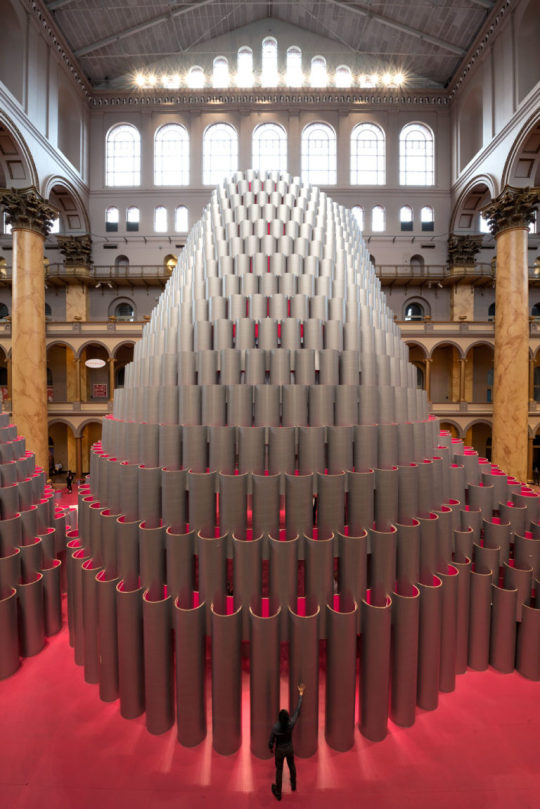
    As part of the National Building Museum’s Summer Block Party, Studio Gang created an installation in the Great Hall called Hive. See above picture. Note the human for scale. 

    Hive is an interactive series of spaces built exclusively out of lightweight and recyclable paper tubes – apparently 2,700 of them. The tubes have a polished silver exterior and bright magenta interior (love that part), and vary in size from several inches to over 10 feet. They are notched together to create a self-supporting structure.

    The installation is beautiful in its own right – especially against the museum’s 19th century interior – but the idea is that each “sound chamber” within the Hive has different acoustic properties. The small chambers create a more intimate setting. And the main chamber is more grand and public. Think group yoga class or concert.

    For more photos of Hive, click here. Below is also a time-lapse of the Hive’s construction. If you can’t see it, click here. (Don’t worry about turning on your sound.)

    [youtube https://www.youtube.com/watch?v=SvJV7m0JOF0?rel=0&w=560&h=315]

    Image: Tim Schenck

  • Reblog: The rationality paradox

    A few days ago, Seth Godin published a terrific blog post called the rationality paradox. It’s not very long (like most of his posts) and I like it a lot (particularly the bold part), and so I’m reblogging it in full here:

    If you see yourself as an engineer, a scientist, or even a person of logic, then it’s entirely possible that you work to make rational decisions, decisions that lead to the outcomes you seek.

    The paradox is that you might also believe that you do this all the time, and that others do it too.

    But a rational analysis shows that this is far from true. Almost every choice we make is subconscious. We’re glitch-ridden, superstitious creatures of habit. We are swayed by social forces that are almost always greater than our attraction to symbolic logic would indicate. We prioritize the urgent and most of the decisions we make don’t even feel like decisions. They’re mostly habits combined with a deep desire to go along with the people we identify with.

    Every time you assume that others will be swayed by your logical argument, you’ve most likely made a significant, irrational mistake.

    Your actions and your symbols and your tribe dwarf the words you use to make your argument.

  • Crypto Valley is emerging in this small Swiss canton

    There are 26 cantons in Switzerland. One of the smaller cantons is Zug. It has a population of around 122,000 people and an area of 239 square kilometers. The capital of the canton is the town of Zug, which itself has a population of about 29,256 (as of December 2015) and an area of 21.61 square kilometers. 

    To help put that into perspective, a single municipal ward in downtown Toronto (Ward 28 – Toronto Centre-Rosedale) had a population of over 66,000 people back in 2011.

    But as small as Zug may be, it is known as one of the most business friendly jurisdictions in the world. It has some of the lowest corporate taxes and the local revenue service prides itself on calling each taxpayer a “client” as opposed to a “debtor.” 

    As of 2010, the canton’s registry listed more than 29,000 companies, with more than 1,000 arriving and being started each year. There are about as many companies in the canton as there are people in the town of Zug.

    It’s a classic example of jurisdictional arbitrage and it’s one that Zug seems determined to keep. In July 2016, the town of Zug began accepting digital currencies, such as Bitcoin, as payment for city fees. 

    The impetus for doing so was to help advance Zug’s position as a global center for cryptocurrency innovation. There’s a very real government supported push to make Zug into “Crypto Valley.” And startups from around the world who are working in this space are starting to take notice. To me this feels like a natural extension given the canton’s existing strengths and reputation. (More reading here and here.)

    I’ve been to Zug maybe twice and, at first blush, it could easily pass for your average sleepy-yet-affluent Swiss town. But then you think about all of the money that flows through this place and you quickly understand why that modest, but very tasty, breakfast sandwich just cost you all of the CHF’s in your wallet. 

    Of course, if the entrepreneurs in Zug get their way, we won’t be carrying around wallets anymore. We’ll be paying with some sort of crypto varietal. And that would only strengthen this canton’s story: You don’t necessarily need to be big to be globally impactful – just put the right policies in the place. 

    Oh, and have a very high quality of life and an immensely beautiful natural setting. Those things help as well.

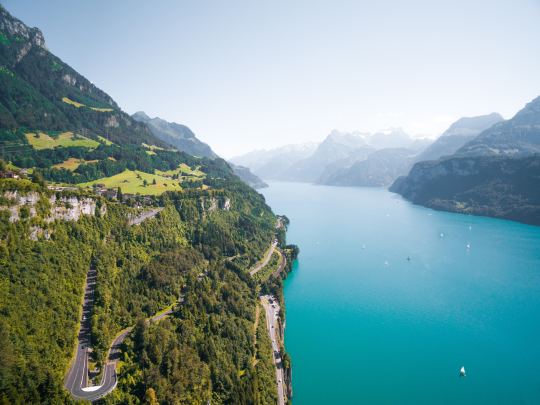
    Photo by Martin Sattler on Unsplash. The above photo is actually of Morschach in Switzerland, not of Zug. I couldn’t find a royalty free image of the latter. Please forgive me for the false advertising.

  • German investment fund buys 1111 Lincoln in Miami Beach for $283M

    The German investment fund Bayerische Versorgungskammer (BVK) has just closed on the Herzog & de Meuron-designed mixed-use parking garage / event space at 1111 Lincoln in Miami Beach

    They paid USD$283 million or $1,932 per square foot. It’s one of the biggest deals ever on Lincoln Road.

    The complex includes 94,488 square feet of office, 51,839 square feet of retail, and a 300 stall parking garage / event space (people get married in this garage). The sale also includes retail space at 1664-1664 Lenox Avenue, but excludes two new residential units according to The Real Deal. I’m assuming it is these two.

    The seller was developer Robert Wennett, who bought the site – existing office building + surface parking lot – in 2005 for $23.5 million. He then spent $65 million on the widely celebrated HdM garage and built himself a penthouse residence on top if it.

    I am very curious to know the cap rate. But it would also be interesting to try and figure out what sort of premium could attributed to the fact that this is a pretty famous complex designed by HdM.

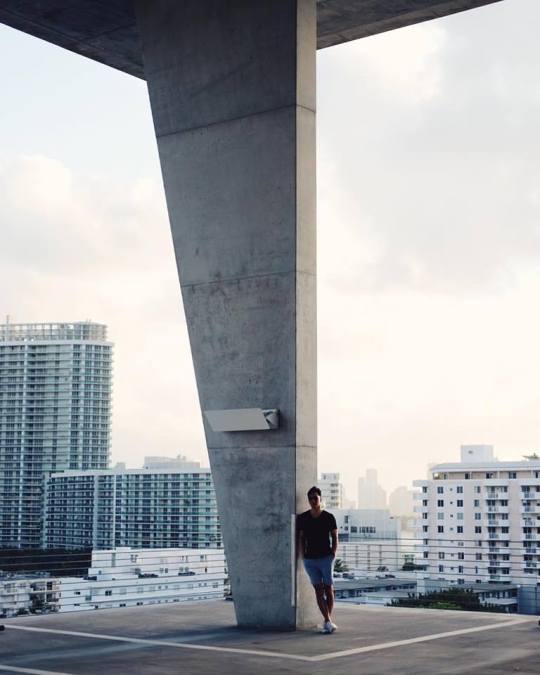
    The Wall Street Journal once wrote that several hundred people walk into this parking garage every single day just to look around. I have been one of those humans on many many occasions. See above photo.

    For more photos of 1111 Lincoln, click here.