Daily insights for city builders, delivered every morning at 6 AM ET. I’m Brandon Donnelly — a Toronto-based real estate developer and founder of Globizen. I’ve been writing here since 2013.

  • Utah creates new Condominium Construction Loan Program

    October 4, 2025 · View original


    The state of Utah is trying to build 35,000 starter homes over the next five years. Last year, $300 million was allocated to something known as the Utah Homes Investment Program (UHIP). The initial idea was that these funds would be provided as low-cost deposits to financial institutions so that they could, in turn, offer low-interest loans to homebuilders who committed to building single-family starter homes.

    But this didn’t go as planned. Apparently, the low-cost deposits weren’t low enough to compensate for the perceived lending risk. So Governor Cox asked if the funds could instead be directed to the Utah Housing Corporation. Enter the Condominium Construction Loan Program. The way this newly created program works is that UHC can now provide low-cost loans — up to 100% LTC — directly to developers.

    However, there are some stipulations:

    Warrantable projects: The projects must be warrantable to the Federal Home Loan Mortgage Corporation, meaning the property and the individual condominium units need to be eligible for conventional mortgage financing. – Owner-occupancy requirement: The individual condominium units must be sold to an owner-occupant, with a recorded deed restriction in place for a period of not less than five years. This is obviously to stop investors from buying and reselling. – Equity sharing: The equity appreciation on the condominium unit is shared between UHC and the first owner-occupant. The homeowner earns 75% of the equity appreciation (15% per full year of occupancy, through five years), with the balance going to UHC upon sale of the unit.

    So it’s a trade-off: buyers get access to new homes at below-market pricing (because the developer’s cost structure is reduced), and in exchange, they give up some of the potential upside. Will it work and help Utah achieve its starter home goal by 2030? I don’t know. But it’s clear recognition that if you want to deliver below-market housing, you need to provide subsidies.

  • Algorithms control our thoughts

    October 3, 2025 · View original


    This week has been a busy one, but I managed to get through this recent Prof G Markets interview with Mark Cuban while on the road and in between meetings. I like Mark Cuban. He comes across as likable and balanced. He’s also pretty good at making money.

    The conversation covers a lot of topics: AI, why AI could change the way we design housing, healthcare, the media landscape, social media algorithms, why it should be easier to be a public company, and what Cuban would do if he were president of the US, among others. If you’re interested in these topics, maybe have a listen.

    The discussion around social media algorithms struck a bit of a chord. At one point, Cuban makes the statement that this is one of the underlying challenges facing the US: whoever controls the algorithms controls our thoughts. He goes on to say that the social media algorithms know his kids better than he does.

    Algorithms also shape our cities. Everything these days is being reverse-engineered for the attention economy. Typically, this means promoting more extreme views, instead of measured ones, which can drive a further wedge between cyclists and motorists, existing communities and new developments, and so on.

    We know all this. But it’s scary to think about the influence it has on our behaviors.

  • Riz Dhanji on Toronto’s housing market

    October 2, 2025 · View original


    Riz Dhanji, who is the founder and president of RAD Marketing, is a long-time partner of ours. We are working together on One Delisle and on our waterfront project in the Niagara Benchlands. Riz has worked on some of Canada’s most high-profile development projects, has been through past cycles, and has even sold real estate to Elton John. That’s something.

    So today, I’m happy to share this recent Livabl podcast that he appeared on with host Matthew Slutsky.

    One theme that you’ll notice in the episode is the focus on end-user buyers. Talk to anyone in the condominium business and they’ll tell you that these are the few active buyers today. Investors are largely sitting on the sidelines. On the surface, this should be a healthy reset for the market — a refocusing on the actual customer. It’s also, in my opinion, a generational opportunity for buyers.

    But what I continue to find ironic is the number of end-users who also remain sidelined. For years, pundits loved to criticize Toronto’s new home market for being too geared toward investors. The argument was that it was a market based on speculation and that investors were crowding out real people from fulfilling their basic shelter needs. Developers were creating financial assets, not homes.

    Now the pundits have gotten exactly what they wanted: less speculation, less competition, and lower prices. So where, then, are all the end-users? Why are they not banging down the doors of sales galleries and saying, “Thank goodness — we’re no longer being crowded out?”

    Instead, what has happened is that the market has stalled out and new housing supply has largely shut off (the effects of which won’t be felt for a few more years).

    The question now is what will it look like once it returns. Who will be the buyers? Like every market, most people prefer to buy when everyone else is buying the same thing. So I suspect many end-users are waiting until there’s more activity (i.e. competition). But when that time comes, they won’t be the only buyers in the market.

  • The median price of existing homes in the US has just surpassed that of new homes

    October 1, 2025 · View original


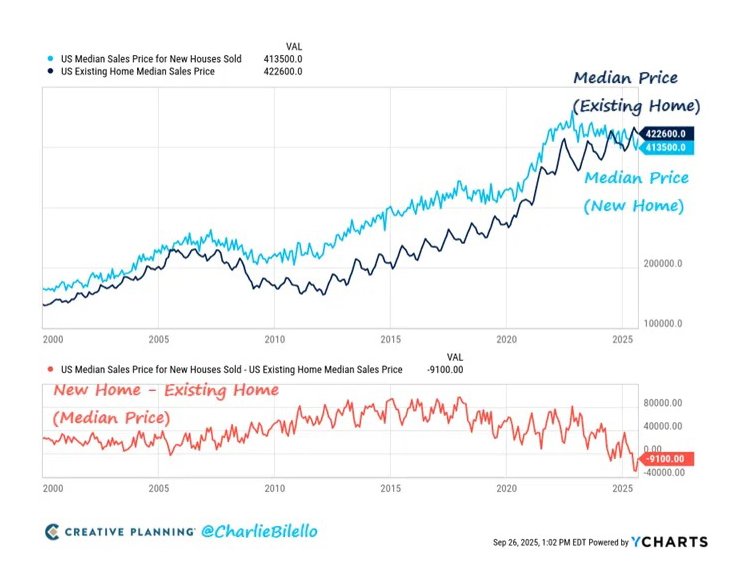
    Generally speaking, new homes tend to be priced higher than existing homes. This is, again generally, true because new homes are expensive to build, they’re new and shiny, and because oftentimes they’re pre-sold, meaning the purchase price reflects some future value.

    But interestingly enough, this relationship has just flipped in the US, for the first time in at least 25 years. Here’s the chart via Charlie Bilello:

    This is, of course, a national average, and every submarket and product type is naturally going to have its nuances. Still, this inversion is noteworthy for a handful of possible reasons.

    One, it points to softness in the new-home market. And indeed, homebuilder sentiment is down right now.

    Two, it may suggest that homebuilders are building smaller, more affordable homes, which would bring down the median price.

    And three, it’s an indication of the “lock-in effect” that is prevalent in the US (but that is far less of a factor in Canada, where mortgages typically renew every few years).

    For homeowners who are locked in at generationally low mortgage rates, there is a huge disincentive to sell. It would mean losing buying power. So why bother, unless you really have to?

    This reduces the supply of existing homes on the market.

  • How to create more cool-ass streets

    September 30, 2025 · View original


    Cities used to be adept at creating fine-grained, walkable, mixed-use streets. In fact, if you look at old photos, you’ll see it was the norm. But that has become increasingly difficult for a variety of reasons, ranging from parking and servicing requirements to overall suburbanization and chain retailers demanding certain spaces. Today, in many parts of the world, these kinds of streets are by far the exception rather than the rule.

    What hasn’t changed, however, is our appreciation for human-scaled spaces. This raises the question: How can we create more of them going forward? How might we make more Ossington Avenues? This is especially relevant as many cities look to intensify their existing neighborhoods. More housing is essential, but there are also broader city-building opportunities that can come along with it.

    The first thing to keep in mind is that developers will always have a bias toward what is most profitable and what has the least amount of risk. So if a residential apartment at grade is going to be more profitable than a cute coffee shop, developers will build the apartment. But markets and areas do change, and sometimes what didn’t make sense before makes sense today.

    Let’s, for example, return to our discussion of Ossington Avenue. At the intersection of Ossington and Halton, there is a stacked townhouse development that was built just prior to Ossington becoming the cool-ass street that it is today. One of the ways you can tell its vintage, I think, is that it has no retail fronting onto Ossington. Instead, it has townhouse balconies that are likely to remain there until the end of time. If it were built today, I bet you that the developer would have built ground-floor retail.

    But you can’t really blame the developer. At the time, it likely didn’t make economic sense to build retail. Few could have predicted Ossington would become what it is today. And it is this messiness and unpredictability that makes cities so great. But it’s also what makes top-down planning difficult. Nobody can predict the future, and nobody knows exactly what the market will want.

    As far as I know, a bunch of people didn’t sit down in a boardroom and outline how they were going to transform Ossington through top-down planning. It was local change agents who started doing things. And once they had found what the market wanted, it was the people in boardrooms who reacted with, “This is too successful; we better put in place a moratorium on bars and restaurants.”

    What made Ossington successful was that it had the right “bones” and the ability to be transformed. It allowed for bottom-up change. And if there’s one thing to take away from this post, it’s that. If we want a chance at creating more Ossingtons, we should be focused on (1) creating the right preconditions in new developments and in our land-use policies, and then (2) getting out of the way through fewer rules and more flexibility.

    A good land-use model to consider is that of Japan. By default, most zones are mixed-use and most low-rise residential zones allow “small shops and offices.” Because, why not? Of course, not every street can be an Ossington, and not every street can support fine-grained retail. But we won’t know exactly what’s possible unless we allow our street frontages to evolve along with our cities.

  • Globizen joins the Swimmable Cities alliance

    September 29, 2025 · View original


    It was a beautiful weekend in Toronto. Yesterday, I cycled another 50 km for Bike for Brain Health. So as far as I’m concerned, it’s still summer. And one of the themes for this summer — at least on this blog — is the urban swimming movement. Here’s a post I wrote saying that Toronto could use a (stronger) summer bathing culture. And here’s a post I wrote called The urban swimming renaissance.

    In that last post, I also mentioned that Globizen had applied to be a signatory to the Swimmable Cities alliance. Well, now it’s official. We were admitted in the last round and now join nearly 200 organizations, spanning 100 cities and towns in 34 countries. Other signatories include the City of Paris, the Great Lakes & St. Lawrence Cities Initiative, Sid Lee Architecture (Montréal), Gehl Studio (Copenhagen), and many others. (The full list can be found here.)

    As a city-building group focused on creating better places, it only made sense for Globizen to join this alliance. It’s clear that the urban swimming movement is gaining momentum around the world — and pretty soon, we believe it will be the norm. Cities that don’t adhere to these principles will be left behind.

    Logo: Swimmable Cities

  • You don’t need a car to live in NYC

    September 28, 2025 · View original


    Here’s further evidence that New York City is unlike any other city in the US. According to survey data from the US Census Bureau (via Bloomberg), New York is the only city in the US where the majority of households do not have a car, van, or truck. As of 2024, the figure was 56.7%.

    Also noteworthy is the fact that the next two cities on the list — Jersey City and Union City — are just across the Hudson River. So they are highly connected to New York both geographically and economically.

    The above chart also includes the median household income for each city. Income is a factor when it comes to car ownership, but I don’t think it’s the strongest predictor. Some of the highest zero-vehicle cities on this list also have some of the highest median incomes — places like DC, San Francisco, and Cambridge.

    The strongest predictor is built form. Once again, urban density, transit access, and a mix of uses are how you give people the option of not driving.

  • Now is the time for contrarianism, not conformity

    September 27, 2025 · View original


    Recently, a few people have asked me about whether now is a good time to buy and/or invest in real estate in Toronto. Now obviously this is a general question and a thoughtful answer depends on the asset class, your strategy, and a myriad of other possible factors, but one of the things I’ve noticed is that many people are trying to be incredibly precise in determining an answer to this question right now.

    They’ll talk about how much prices have come down, whether the Bank of Canada is going to lower interest rates again this fall (which seems probable), and then question whether it may be more optimal to buy in, say, 4-6 months versus now. It is, of course, always beneficial to be analytical, precise, and thoughtful about risk when evaluating major financial decisions, but I find it interesting just how perfect people are trying to be about timing.

    It’s interesting because when things were exuberant, the amount of worry over optimal conditions was clearly less. More people just believed in the market, believed in Toronto, and believed that immigrants would continue to move here at a high rate. It felt right. Greed ruled over fear. But as these market cycles go, the opposite is true today. Fear is the more dominant emotion. Many people are scared about making a bad decision, which is expected, but arguably ironic at the same time.

    It’s expected because it is harder to make what feels like a high-conviction bet when the market is moving in the opposite direction, things are uncertain, and there are few people to follow. But it’s ironic in that it’s significantly easier to find value today than 3-4 years ago. The best opportunities exist where other capital is not flowing, and a lot less capital is flowing into Toronto real estate these days.

    The one caution — and as a reminder, nothing in this post should be viewed as any sort of investment advice — is that just because an asset is cheaper than it was before, it doesn’t mean you’ve found great value. Many assets are cheap because they deserve to be cheap. Be mindful of this risk. The trick is finding high-quality undervalued assets that the market may one day recognize at their true value.

    In my view, it’s an unnecessary distraction to worry about whether market conditions might become incrementally more ideal in the future. One, because it’s pretty much impossible to time a market. And two, because down markets are a much more productive time to feel FOMO. So what might it mean in practice to not be a timer of markets?

    I like how Howard Marks once put it (though keep in mind he is not a real estate guy). He described it in the following way. On the upside, it means he doesn’t sell in expectation of a market decline. He might sell an asset because he thinks the investment case has deteriorated or because he’s found something better, but he doesn’t sell just because he thinks a crash is coming. He continues to play the long game.

    He also argues that selling at the bottom is easily worse than buying at the top of a market. The reason being that the former locks in your losses and takes you out of the game, whereas in the latter case, you can just wait until the market rebounds. The next top is usually higher than the last. (The lesson for highly-levered assets like real estate is to be careful with leverage.)

    On the downside, it means he doesn’t say, “it’s cheap today, but it’ll be cheaper in six months, so we’ll wait.” If it’s cheap, he buys. And if it gets cheaper, he buys more (assuming his thesis holds). That’s not possible if you’re just looking for a single home and aren’t able to dollar-cost-average across multiple assets, but it doesn’t change the fact that timing a market is essentially impossible and that a fearful market should be viewed as a feature, not as a bug that paralyzes decision making.

    As Marks has written, “in extreme times, the secret to making money lies in contrarianism, not conformity.”

  • Build Toronto advocates for congestion pricing

    September 26, 2025 · View original


    Back in the spring, I wrote about a platform called Build Canada. More recently, this same group launched their first “city project” called Build Toronto (which is not to be confused with the city corporation that ultimately became CreateTO). Similar to Build Canada, they publish regular memos and advocate for policies and projects that will help build Canada’s largest city.

    Their most recent memo is by the CEO of A2X, Jamie McDonald, and it covers a topic that we discuss a lot on this blog: congestion pricing. Jamie talks about the drag that congestion has on the region’s economy (upwards of $45 billion every year?), the numerous successes we can point to from around the world, and then lays out the following proposal:

    – Create a downtown congestion pricing zone – Introduce dynamic highway pricing across the GTA – Guarantee fairness and predictable exemptions – Invest in alternatives before launch

    This is the way. And it remains deeply disappointing that we don’t have the political leadership to move this forward. Instead, we sit in traffic. But after a decade of writing about it, I think I’ve said about all I can say about the virtues of congestion pricing. We absolutely know it works. Now we just need to spread the word and continue to apply pressure. I’m glad that groups like Build Toronto are helping to do exactly that.

  • Let’s make more Ossington Avenues

    September 25, 2025 · View original


    I was out for dinner last night on Ossington (here in Toronto). Afterwards, my business partner Rick and I walked the street for a bit. It was a beautiful evening. Every restaurant had their doors and windows open. All of the patios were full, many with the kind of awnings that I love from Paris. And in between these patios were endless options for beautiful window shopping. So during our walk, we couldn’t help but say to each other, “man, what an awesome street.”

    Our line of thinking then went here: How did this ~600-meter stretch of street between Queen and Dundas become one of the coolest retail streets in the city? As you might expect, it follows the typical urban trajectory. It was a seedy street with cheap(er) rents. Then the artists and creatives started moving in, along with OG dive bars like Sweaty Betty’s. And then the city implemented a brief moratorium on bars and restaurants because things were getting a bit too fun.

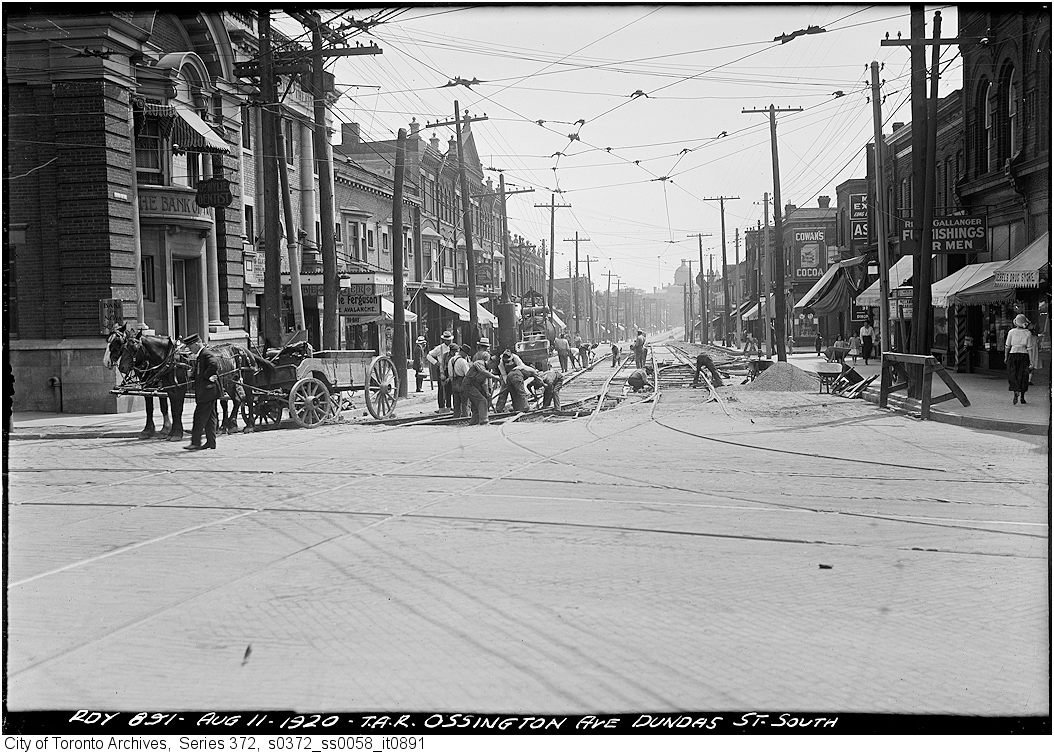
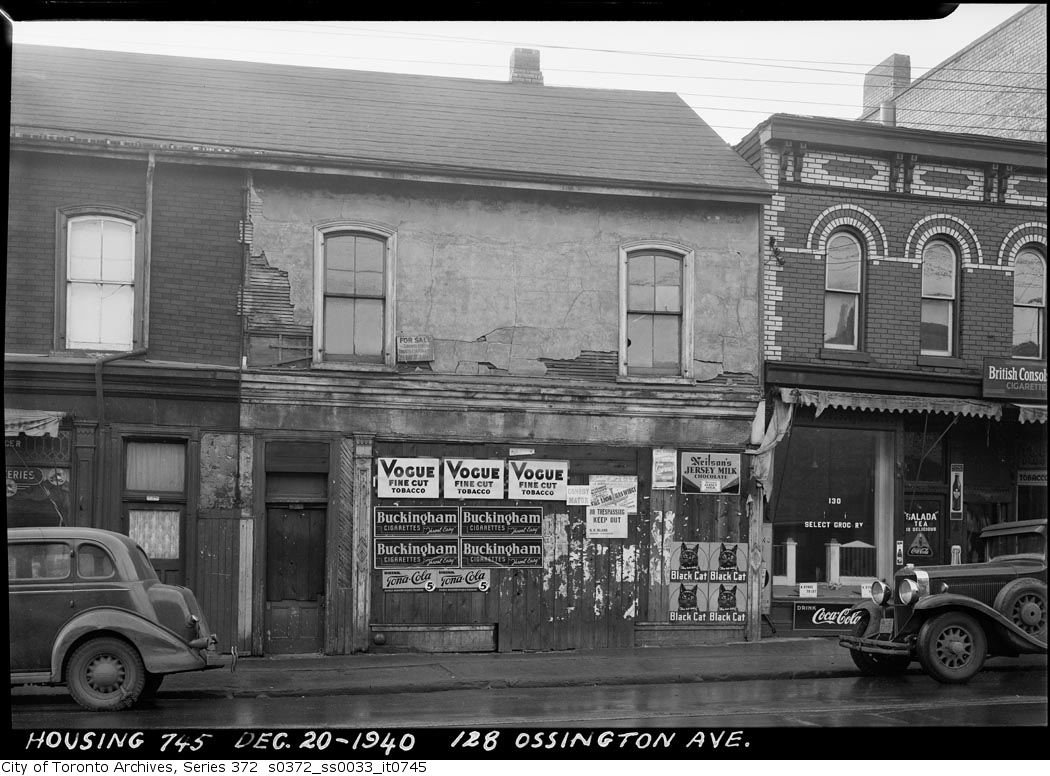
    I also think it’s fair to call Ossington’s rise as being a spillover from Queen Street West. As rents rose on Queen, Ossington became a natural outlet. It was in the right location, and it already had a commercially-oriented and fine-grained ground plane, meaning the buildings could be easily repurposed for galleries, bars, restaurants, and whatever else. This is also why the strip just dies north of Dundas — there are no more suitable buildings.

    To show you just how entrenched this built form was and is, here are a few archival photos from the 1920s and 1940s:

    Beyond this, there’s nothing particularly special about Ossington as a street. It has a 20-meter width, which is typical of most of Toronto’s central main streets, and it’s filled with a bunch of 2 to 3 storey buildings. So another thing it does is make you wonder: How many more Ossington Avenues could Toronto have if only we created the right preconditions for new businesses and ideas to flourish?

    Of course, not every street can be an Ossington. What I’m talking about is simply creating more walkable, mixed-use streets. That’s a lot harder to do when you don’t have the bones that Ossington had, and you have primarily large lots and/or residential uses. But that doesn’t mean it’s impossible. As Toronto works to intensify its major streets, it’s crucial that we also consider what the ground plane might one day want to become.

    More on this in future posts.