Daily insights for city builders, delivered every morning at 6 AM ET. I’m Brandon Donnelly — a Toronto-based real estate developer and founder of Globizen. I’ve been writing here since 2013.

  • Bottom-up budgeting

    January 14, 2026 · View original


    One of the ways that cities determine where they should spend money and invest is through something known as Participatory Budgeting. The birthplace of this approach is generally thought to be Porto Alegre in Brazil, which first adopted it in 1989. Since then, it has become a mainstream practice and spread to cities all around the world, including New York and Paris, both of which operate ambitious programs.

    In the case of Paris, they have committed 5% of their capital budget to be spent in this way. The way it generally works is simple: citizens get to propose ideas and then vote on which urban projects they think should be funded. Last year, Paris saw 2,079 ideas proposed, 261 projects put to a vote, 162,395 votes, and 104 projects selected. And since the program launched in 2014, over €768 million has been allocated.

    Some of these projects are very local and specific, such as “build a sports facility on this street,” while others are city-wide, like “make things cleaner, be better at sorting waste and recycling, and reduce noise.”

    While there’s lots of debate about the effectiveness of Participatory Budgeting, it does offer a number of benefits. Studies have shown that it can improve public trust in government institutions by making them more accountable. It can also help to educate residents on what things actually cost, making trade-offs more understandable. But most importantly, it can help to better allocate funds.

    After all, who better to decide what a neighborhood needs than the locals who live there every day? Just don’t ask about building new housing.

    Cover photo by Ness P. Colmart on Unsplash

  • Ontario proposes to pause Inclusionary Zoning policy in three municipalities

    January 13, 2026 · View original


    Oh boy, have we spoken a lot about inclusionary zoning over the years (see here, here, and the full list of 43 posts that I have tagged with “inclusionary zoning” here). Politicians tend to like this policy because they can present it as no-cost or “free” affordable housing. Few people have much sympathy for real estate developers, so it’s easy to just say, “Don’t worry, we’ll just get the developers to pay for it.”

    But the reality of inclusionary zoning is that you need a robust housing market that can absorb the additional cost burden of delivering affordable homes. There’s no such thing as a free lunch in economics, which is why when you read IZ reports and policy documents, you’ll typically find language to the effect that it only works in a strong economy and a strong housing market.

    These two descriptors do not generally apply in Ontario today, and so the province has just proposed an amendment that will pause the inclusionary zoning by-law. More specifically: developments with a complete application for a zoning by-law amendment, site plan approval, or a building permit on or before July 1, 2027, will not be subject to IZ in the cities of Toronto, Mississauga, and Kitchener.

    Why?

    Because IZ is deemed unviable under the current market conditions. In other words, there’s nobody to whom the cost of building affordable housing can be passed. If you’d like to comment on this proposal, you can do that here, and you have until January 19, 2026.

    Cover photo by Gleb Kozenko on Unsplash

  • It’s a long game

    Why early success does not predict exceptional performance as an adult

    January 12, 2026 · View original


    Conventional wisdom suggests that the way to get really good at something is to (1) start as early as possible learning the thing and (2) focus exclusively on the thing. This is relevant information for elite schools, sport academies, and other institutions because it leads to, “let’s find the best young talent and then further accelerate their skills through discipline-specific practice.”

    But recent research has found that this typically isn’t the case. By looking at more than 34,000 adult international top performers in different domains ranging from classical music composers to Olympic champions, researchers found the following three major features associated with human development (quoted verbatim from here):

    1. Early exceptional performers and later exceptional performers within a domain are rarely the same individuals but are largely discrete populations over time. For example, world top-10 youth chess players and later world top-10 adult chess players are nearly 90% different individuals across time. Top secondary students and later top university students are also nearly 90% different people. Likewise, international-level youth athletes and later international-level adult athletes are nearly 90% different individuals. 2. Most top achievers (Nobel laureates and world-class musicians, athletes, and chess players) demonstrated lower performance than many peers during their early years. Across the highest adult performance levels, peak performance is negatively correlated with early performance. 3. The pattern of predictors that distinguishes among the highest levels of adult performance is different from the pattern of predictors of early performance. Higher early performance in a domain is associated with larger amounts of discipline-specific practice, smaller amounts of multidisciplinary practice, and faster early discipline-specific performance progress. By contrast, across high levels of adult performance, world-class performance in a domain is associated with smaller amounts of discipline-specific practice, larger amounts of early multidisciplinary practice, and more gradual early discipline-specific performance progress. These predictor effects are closely correlated with one another, suggesting a robust pattern.

    In other words, it’s a long game:

    The most successful and highest-performing adults seem to start off as well-rounded kids.

    Cover photo by Patrick Tomasso on Unsplash

  • Stocks just overtook homes as the main source of US household wealth

    The same isn’t true in Canada.

    January 11, 2026 · View original


    My dad sent me an article from Canoe Financial over the weekend that included the chart below. What it shows is that corporate equities and mutual fund shares now make up a greater percentage of household wealth in the US than residential real estate for only the second time since 1990.

    From a macro perspective, and when you consider the popularity of index funds, this means that American households probably have a lot of their wealth concentrated in high-growth tech stocks. And since these stocks are being driven higher largely due to the promise of AI, there’s perhaps a concentration risk for US households.

    The other thing this chart made me wonder about was what it would look like for Canadian households.

    According to these net worth indicators released by Statistics Canada in October 2025, real estate as a share of total household assets was sitting at 41.8%. Financial assets as a share of total assets were at 53.4%, but this includes life insurance and pensions, which are not included in the US chart.

    If we remove this line item, we’re left with “other financial assets” at 37.8%. However, this account also includes cash deposits, bonds, foreign investments, and other receivables, which I also don’t think are carried in the US chart. So net-net, Canadian household wealth is composed of real estate at 41.8% and corporate equities at some number below 37.8%.

    Real estate is the larger net worth account for Canadian households. Whether this is good or bad is a topic for another post, but there’s certainly an argument to be made that Canadians are over-indexing on real estate at the expense of investing in new ideas and businesses.

    Cover photo by Daniela Araya on Unsplash

  • Blurring the line between grade and below

    January 10, 2026 · View original


    I’m writing this post from the concourse level of Place Ville Marie Esplanade in Montréal (also known as Galerie PVM) while I wait for my next meeting. Like the PATH in Toronto, the space I’m in is part of an underground network of restaurants, shops, and circulation spaces that runs through downtown Montréal.

    But what makes the space I’m in right now particularly noteworthy is that I’m sitting beneath an enormous glass roof supported by 18 glass beams measuring 15 meters long and 0.9 meters tall. So, while I am below grade, I have a clear view of The Ring, Mont-Royal, and the street life happening above me.

    Underground “malls” like Toronto’s PATH and Montréal’s RÉSO were a somewhat obvious urban solution to inclement weather. But they are often criticized for sucking life underground and making the streets at grade feel dead.

    When I’ve toured my American friends through Toronto’s CBD in the past, I’ve heard comments like, “How come you have no retail downtown? It feels dead.” And then I have to cheekily say, “Oh, well, we actually have tons of it, we just decided to hide it all underground so it’s harder to find and confusing to navigate.”

    The way you start to counteract these negatives — lack of street life and challenging wayfinding — is to do what Sid Lee Architecture did masterfully here at Place Ville Marie. To the extent possible, you make grade and below grade feel like one space.

  • Toronto to Montréal by train

    January 9, 2026 · View original


    Yesterday morning, I took the train from Toronto to Montréal. I’m here for one night for a few meetings. I love trains. You can show up right before departure, the seats are more spacious, and they go downtown to downtown. Plus, there’s something romantic to me about whizzing through the landscape. But currently, this trip takes just over 5 hours once you factor in the above stops (see cover photo). That’s too long in this day and age, so Canada is, as I understand it, working on a new high-speed rail solution called Alto.

    The first phase will connect Ottawa to Montréal (construction is expected to start in 2029), and a subsequent phase will connect Ottawa to Toronto. The top speed will be around 300 km/h, which I’m guessing will result in an effective speed closer to 200 km/h when you factor in stops and any speed limits required near urban centers. With this, the goal is to bring the journey from Toronto to Montréal down to around 3 hours.

    One thing to keep in mind is that Ottawa does not lie on the fastest route between Toronto and Montréal; it adds about 70 km. But it’s of course necessary. In theory, an express route with no stops running TGV or Shinkansen-like trains could bring the journey time down closer to 2 hours. But that’s not what is being planned from what I have read. Regardless, 3 hours is still a big deal and a meaningful improvement. It makes the trip faster than flying, and certainly faster than driving.

    Could current drive times ultimately change with autonomous vehicles? Maybe, but it’s unlikely to be by this much. I hate long road trips and the same would be true even if a robot were driving me. So I look forward to one day — in my 50s? — doing this journey in 3 hours. If we could get it down to 2 hours and change, that much better. That’s a trip worth taking for a night out or just to stock up on bagels.

  • The 4 Toronto projects the Globe and Mail is watching in 2026

    January 8, 2026 · View original


    Dave Leblanc (“The Architourist”) just published this article in the Globe and Mail talking about the four Toronto building projects that he’ll be watching in 2026. And number one on his list is none other than One Delisle (though maybe it’s intended to be in no particular order):

    > Announced back in 2017, this 16-sided, 47-storey, circular tower was penned by Jeanne Gang, an award-winning Chicago-based architect and educator. Interestingly, while Ms. Gang holds the record of “tallest building in the world designed by a woman,” the 101-floor/363 metres-high St. Regis Chicago (hotel and residences), she is better known as a socially responsible designer sensitive to the pedestrian realm and for her love of biophilic design, which connects end-users to nature. > > When I interviewed Ms. Gang back in 2021, I asked if One Delisle had been inspired by a pine cone or an artichoke. “Both an artichoke and a pine cone – and a sunflower for that matter – there’s a spiralling organization of the seeds, the petals,” she said. “It’s nature solving a packing problem.” > > With the people-packing (occupancy) set for this year or next, I visited the site last week. And, unlike some projects, it holds true to Ms. Gang’s original sketch. And the way the base is organized to project west onto Delisle Avenue means Janet Rosenberg & Studio’s landscaping will make a real impact.

    Dave is right to point out the lag between sales and shovels. All four of the projects on his list were (zoning) approved, designed, sold, and financed during a very different real estate market. And so it is that market that is right now bestowing this level of architecture on Toronto.

    2026 is going to be an exciting year for One Delisle. The tower will be topped out shortly, with the curtain wall cladding following closely behind. And drywall is already going up in the suites on the lower floors. This is the year where things really come together. I can’t wait.

  • Now you can bet on real estate without actually buying it

    January 7, 2026 · View original


    Prediction markets have become a big deal, presumably because a lot of people like betting. But functionally and economically, prediction markets are also supposed to be about information discovery. If you get enough people researching, analyzing, and thinking about something, eventually the “wisdom of the crowds” should prevail and something resembling the truth should, in theory, emerge. The stereotypical use for a prediction market (also referred to as an event market) is a binary bet. Will this happen? Yes or no.

    But now, you can also bet on real estate prices:

    > Parcl, the real-time housing data and onchain real estate platform, and Polymarket, the world’s largest prediction market, today announced a partnership to bring Parcl’s daily housing price indices to a new suite of real estate prediction markets on Polymarket. > > The partnership will introduce housing-focused markets that settle against Parcl’s published price indices, giving traders and analysts an objective, data-driven reference point for forecasting where home prices are headed. Polymarket will list and operate the markets; Parcl will provide independent index data and settlement reference values designed for transparent verification. > > Housing is the largest asset class in the world, but it’s still hard to express a clean view on price direction without taking on property-level complexity, leverage, or long timelines. By combining Parcl’s daily indices with Polymarket’s event-market structure, the partnership offers a simpler way to trade housing outcomes, with clear settlement rules and public, auditable resolution data.

    Here’s a specific example: What will the median home value in Miami be on February 1?

    Right now, the market seems to believe it will be greater than $1.1 million. This is fascinating. Among many other things, it gives us a clear and real-time sense of market sentiment. But as Matt Levine wrote in Money Stuff, it also gives homeowners the ability to hedge and diversify their housing market risk. If you live in a cold, high-tax place and you’re super envious of everyone moving to Miami, you could, of course, just sell your house and move there too. But if you don’t want to do that and you still want to participate in its growth, now you can just bet on its home prices using this derivatives market.

    Cover photo by Cody Board on Unsplash

  • Sometimes architecture is irrelevant

    January 6, 2026 · View original


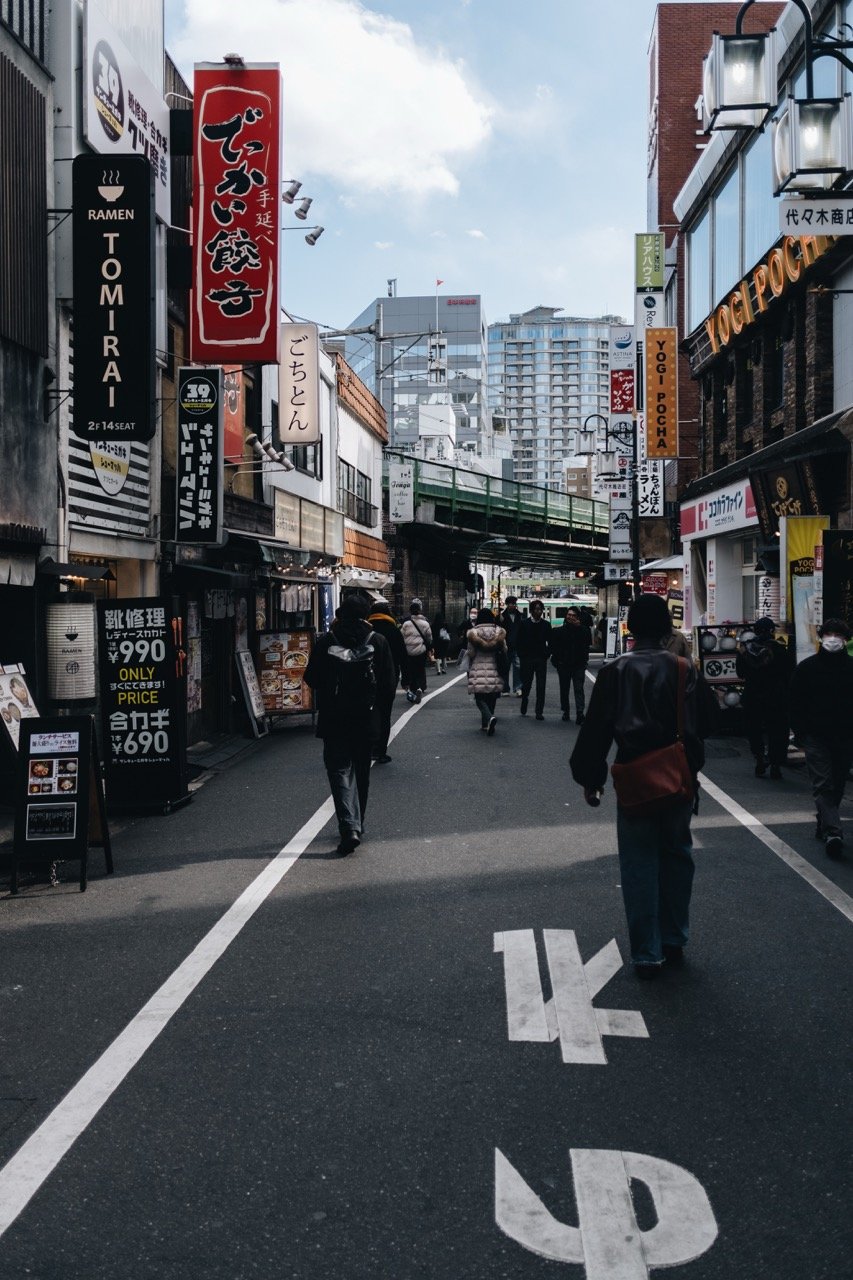
    Tokyo is a city of contrasts. It is both hyper-modern and steeped in tradition. It is known for art, architecture, design, and fashion, yet it’s also a city that — through its built form — makes the argument that architecture is irrelevant.

    While the city certainly has countless examples of remarkable architecture, the vast majority of its buildings are arguably just that — buildings. They are a nondescript part of the urban fabric that give back through their siting, scale, rhythm, and mix of uses rather than their raw architectural qualities. Sometimes you may not even be able to see the building past all the signage.

    If you were looking for a city to support the argument that urbanism matters more than architecture, I think Tokyo would be a good place to start.

    What Tokyo does so successfully is ground-up urbanism (as opposed to top-down master planning). Flexible permissions, mixed-use zones by default, and an orientation around rail have allowed Tokyo to organically evolve into one of the most livable global cities on the planet.

    In fact, I think you’d be hard-pressed to find any city of this magnitude that is simultaneously this livable. Which makes me wonder: Are we spending too much time worrying about architecture?

    It is common for big cities to have design review processes. These typically consist of a panel of experts who evaluate new development proposals based on their architectural and urban design qualities. The comments that come back might suggest that a long facade be visually “broken up,” or that additional stepbacks be introduced in order to mitigate the impact on the street and improve sky views. It’s a process that can be lengthy.

    But what Tokyo tells us is that, while architecture matters a great deal, it may not be the most important thing to focus on from a city-building standpoint. What matters more is the space and relationship between these buildings, the uses and permissions granted to their occupants, and the overall relationship to transit infrastructure. Here, urbanism is more critical than architecture.

    If you buy this argument, then design review panels aren’t actually our most pressing priority. Instead, what we should have is a kind of urbanism review panel. But rather than react to new developments, its job would be to go out and proactively identify and fix bad urbanism: this street is too narrow, this street is too wide, OMG what were we thinking here, and so on.

    Then, when a new development proposal comes along, this panel would get out of the way and let the market decide what it wants to be. It would trust that it had done its job and laid the right preconditions for good urbanism to emerge.

    Sounds weird and unsettling, doesn’t it? Except, we might be pleasantly surprised by what it would lead to.

    Cover photo by Fred Nassar on Unsplash

  • How 300,000 commuters built a retail destination

    Why retail at Toronto’s Union Station was inevitable

    January 5, 2026 · View original


    Good morning, and welcome back to work and school.

    I remember a moment very early on in my development career when I was sitting in a boardroom with dozens of “gray hairs” and the topic of Toronto’s Union Station revitalization came up. Specifically, the proposed plan to dig out a new basement and add significant retail throughout the station. This was before construction had started in 2010 and it was considered a rather novel move.

    At the time, Union Station was essentially a transit hub with a few ancillary retail offerings like Jugo Juice and Cinnabon (for the good smells). My comment was along the lines of “Finally, more retail, what a great idea,” but everyone looked at me like I had three heads. The consensus in the room was, “It’ll never work, Brandon.” And what was implied was that I just didn’t have enough real estate experience to get that.

    But what I didn’t understand was their reaction. Union Station is the busiest mobility hub in the country. Hundreds of thousands of people pass through it each day. Today, I think the number is somewhere around 300,000 people. This is like the entire population of Markham or Vaughan passing through one building every single day. It’s hard to imagine a better anchor than rail. Surely, if you put retail in front of this foot traffic, you’ll be able to monetize it!

    Fast forward to today.

    Over the weekend, Bianca and I took the subway to a Raptors game. As we walked through the concourse, the first thing I said to her was, “I really love what they have done here. Union finally feels like a station fit for a global city like Toronto.” It feels grand, there are global retailers like Uniqlo, Shake Shack, Arabica, and many others, and the wayfinding seems to only be getting better. The pathway to Scotiabank Arena felt deliberate — finally.

    I have no firsthand experience with the revitalization program or the leasing at Union Station. So I couldn’t tell you quantitatively how the stores and restaurants are performing. I also recognize that construction was massively delayed and ran over budget. But anecdotally, I can say that you do have to wait a long time for a burger from Shake Shack, even late at night. The place is always busy.

    Union Station seems well on its way to being a commercial success, and it seems to be establishing itself not only as a mixed-use rail hub, but as a destination in downtown Toronto. If any of you have firsthand experience, please drop a comment below.

    Cover photo from Toronto Union