One of the reasons why "new small-scale retail, service, and office uses" are now permitted in low-rise neighborhoods of Toronto -- and why many are on to talking about these uses in our laneways -- is because it's a way to serve the "needs of residents" and "reduce local automobile trips". But what are these needs exactly? And if you had to choose only one, what would it be?
Let me provide some further background.
According to this mapping, 94% of Parisians live within a 5-minute walk of a bakery. And according to this mapping, 94% of people in Mexico City live within a 5-minute walk of a taqueria. So in other words, these two cities seem to have the kind of "small-scale retail, service, and office uses" that satisfy at least some of the needs of their residents.
People in Paris need bread. And people in Mexico City need tacos. But what do people in Toronto need? I'm not sure we have a perfectly parallel thing.
One of the reasons why "new small-scale retail, service, and office uses" are now permitted in low-rise neighborhoods of Toronto -- and why many are on to talking about these uses in our laneways -- is because it's a way to serve the "needs of residents" and "reduce local automobile trips". But what are these needs exactly? And if you had to choose only one, what would it be?
Let me provide some further background.
According to this mapping, 94% of Parisians live within a 5-minute walk of a bakery. And according to this mapping, 94% of people in Mexico City live within a 5-minute walk of a taqueria. So in other words, these two cities seem to have the kind of "small-scale retail, service, and office uses" that satisfy at least some of the needs of their residents.
People in Paris need bread. And people in Mexico City need tacos. But what do people in Toronto need? I'm not sure we have a perfectly parallel thing.
, the top-selling grocery item last year across both the US and Canada was -- bananas. One and four carts typically contain them, and apparently this number has remained fairly consistent.
So maybe this should be our small-scale retail and walkability test metric: What % of the population lives within a 5-minute walk of fresh bananas? (I'm open to other food suggestions here.)
Up until last year, non-residential uses within Toronto's low-rise neighborhoods were typically legal non-confirming uses. Meaning, the use wasn't technically allowed, but if it had been there for a long and continuous time, we would let it slide and say it's legal.
Then we decided that small-scale retail, service, and office uses might be kind of good in our neighborhoods. Especially if they empower people to perform their daily necessities without a car. So we agreed to allow these sorts of uses provided they don't annoy too many people.
But what about in Toronto's laneways? Can and should they go there, too?
But we need to get out of the way and we need small and affordable spaces. Which is why it's hard to imagine a more ideal place than in our laneways, especially considering that there's a long history of these spaces being used for exactly this. (Read this recent article by John Lorinc.)
Fortunately, this idea continues to gain positive momentum, thanks to people like the late Michelle Senayah (co-founder of the Laneway Project) and Blair Scorgie (a partner at Sajecki Planning). So in my mind, it's only a matter of time before we start getting out of the way.
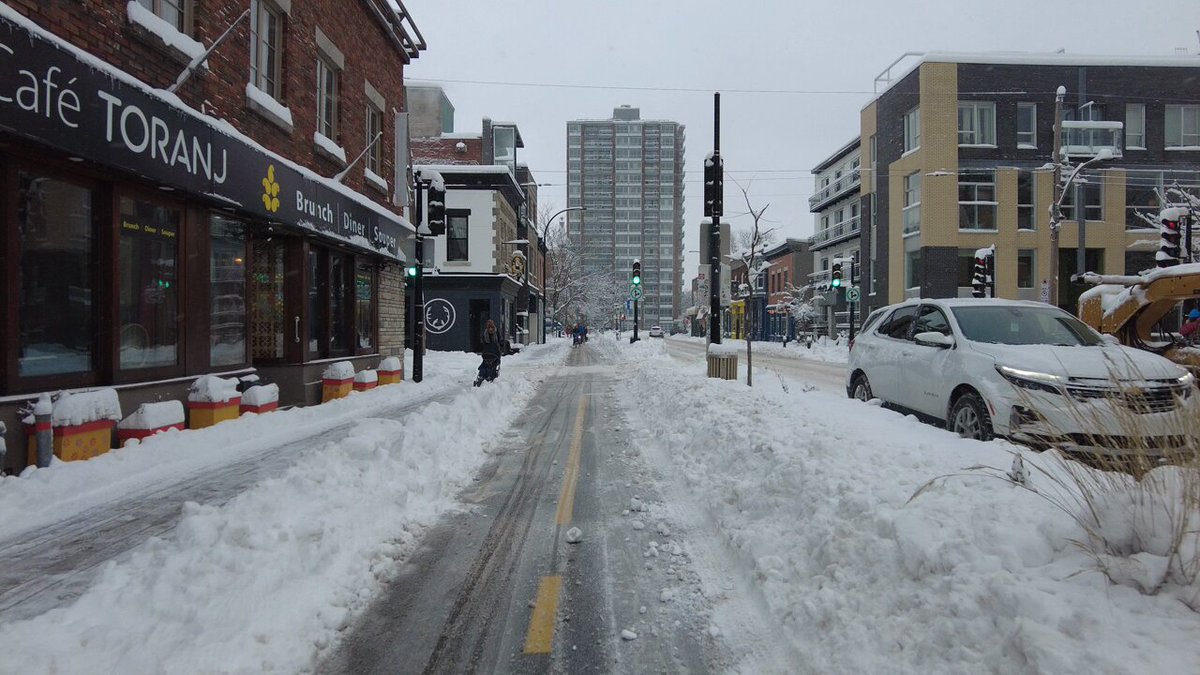
Interesting how people project based on wherever they're from. No one could come to central Montreal in the winter and not see lots of cyclists. Not the same volumes as summer but it's still common and visible.
, the top-selling grocery item last year across both the US and Canada was -- bananas. One and four carts typically contain them, and apparently this number has remained fairly consistent.
So maybe this should be our small-scale retail and walkability test metric: What % of the population lives within a 5-minute walk of fresh bananas? (I'm open to other food suggestions here.)
Up until last year, non-residential uses within Toronto's low-rise neighborhoods were typically legal non-confirming uses. Meaning, the use wasn't technically allowed, but if it had been there for a long and continuous time, we would let it slide and say it's legal.
Then we decided that small-scale retail, service, and office uses might be kind of good in our neighborhoods. Especially if they empower people to perform their daily necessities without a car. So we agreed to allow these sorts of uses provided they don't annoy too many people.
But what about in Toronto's laneways? Can and should they go there, too?
But we need to get out of the way and we need small and affordable spaces. Which is why it's hard to imagine a more ideal place than in our laneways, especially considering that there's a long history of these spaces being used for exactly this. (Read this recent article by John Lorinc.)
Fortunately, this idea continues to gain positive momentum, thanks to people like the late Michelle Senayah (co-founder of the Laneway Project) and Blair Scorgie (a partner at Sajecki Planning). So in my mind, it's only a matter of time before we start getting out of the way.
Interesting how people project based on wherever they're from. No one could come to central Montreal in the winter and not see lots of cyclists. Not the same volumes as summer but it's still common and visible.
What's remarkable is the number of people who, at least from these tweets, continue to cycle in the winter. In fact, in the above video, there looks to be more bikes on the road than cars. Plowed lanes certainly help!
According to the city of Montréal, about 80% of the network is maintained for year-round use (717 km of its 900 km network). But I'm sure that there are a lot of people who still can't imagine anyone wanting to cycle in these conditions. So what is the actual winter usage?
Thankfully, Montréal has bike counters. 55 of them to be exact. And all of the data can be viewed, here. The busiest location is Saint Denis and Rue des Carrières. This falls within their Réseau Express Vélo (REV) network, which is a series of protected lanes intended to do what the name suggests.
The daily average for this counter is currently 4,403 riders, but the summer peak looks to be closer to 10,000. And this year, it has seen close to 1.5 million rides in total. This is a significant number. I mean, imagine 1.5 million more car trips on the road.
Looking at yesterday's data, the daily count was 1,292. If you very crudely divide this by my 10,000 summer peak estimate, you get to around 13%. And this happens to line up with what seems to be the city's generally accepted winter cycling retention ratio.
Not surprisingly, fewer people want to cycle in the winter. But the number is not nothing. If you multiple 1,292 cycling trips by 120 days (roughly December to March), that's still over 150,000 trips (I know, I didn't account for weekends). On top of this, the city's winter cycling retention rate appears to be increasing.
So just because you may not want to cycle to work in the winter, it doesn't necessarily mean that others feel the same way.
What's remarkable is the number of people who, at least from these tweets, continue to cycle in the winter. In fact, in the above video, there looks to be more bikes on the road than cars. Plowed lanes certainly help!
According to the city of Montréal, about 80% of the network is maintained for year-round use (717 km of its 900 km network). But I'm sure that there are a lot of people who still can't imagine anyone wanting to cycle in these conditions. So what is the actual winter usage?
Thankfully, Montréal has bike counters. 55 of them to be exact. And all of the data can be viewed, here. The busiest location is Saint Denis and Rue des Carrières. This falls within their Réseau Express Vélo (REV) network, which is a series of protected lanes intended to do what the name suggests.
The daily average for this counter is currently 4,403 riders, but the summer peak looks to be closer to 10,000. And this year, it has seen close to 1.5 million rides in total. This is a significant number. I mean, imagine 1.5 million more car trips on the road.
Looking at yesterday's data, the daily count was 1,292. If you very crudely divide this by my 10,000 summer peak estimate, you get to around 13%. And this happens to line up with what seems to be the city's generally accepted winter cycling retention ratio.
Not surprisingly, fewer people want to cycle in the winter. But the number is not nothing. If you multiple 1,292 cycling trips by 120 days (roughly December to March), that's still over 150,000 trips (I know, I didn't account for weekends). On top of this, the city's winter cycling retention rate appears to be increasing.
So just because you may not want to cycle to work in the winter, it doesn't necessarily mean that others feel the same way.