Daily insights for city builders, delivered every morning at 6 AM ET. I’m Brandon Donnelly — a Toronto-based real estate developer and founder of Globizen. I’ve been writing here since 2013.
This September 25, 2019, the Bronx Museum of the Arts will be opening up a new exhibition called, Henry Chalfant: Art vs. Transit, 1977-1987. Henry is a renowned photographer who is most known for his work on graffiti, breakdance, and overall street culture. This exhibition is about all of this, but there’s a particular focus on the subway car art that was once ubiquitous in New York City.
There’s also a Kickstarter campaign if you’d like to support this exhibition. What struck me as I watched the campaign video, was that the “urban street culture” of this era doesn’t seem to exist in quite the same way today (or maybe I’m missing it). In the video, Henry talks about things like the birth of hip hop, which he documented outside, on the street.
We shouldn’t forget that New York was also a scary place at this time. Removing the subway art that Henry fastidiously documented was one of the ways in which the city is thought to have broken its patterns of crime. But at the same time, there’s something really special about new ideas forming out in the public realm.
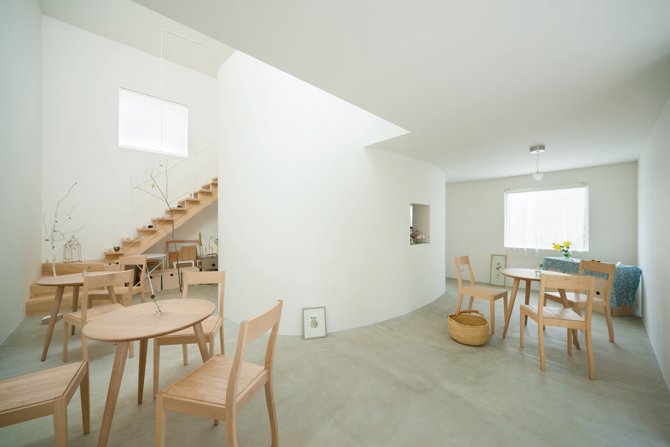
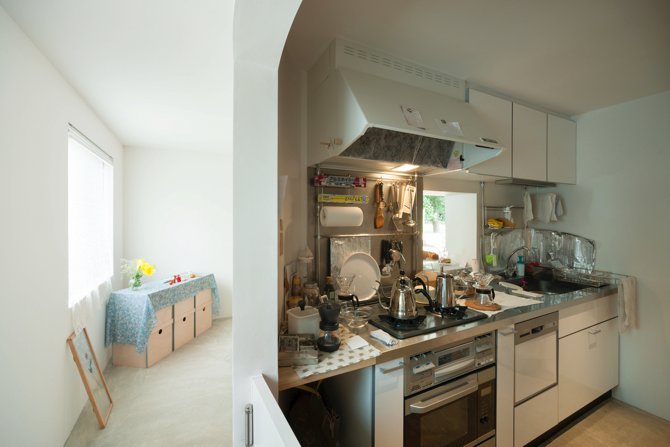
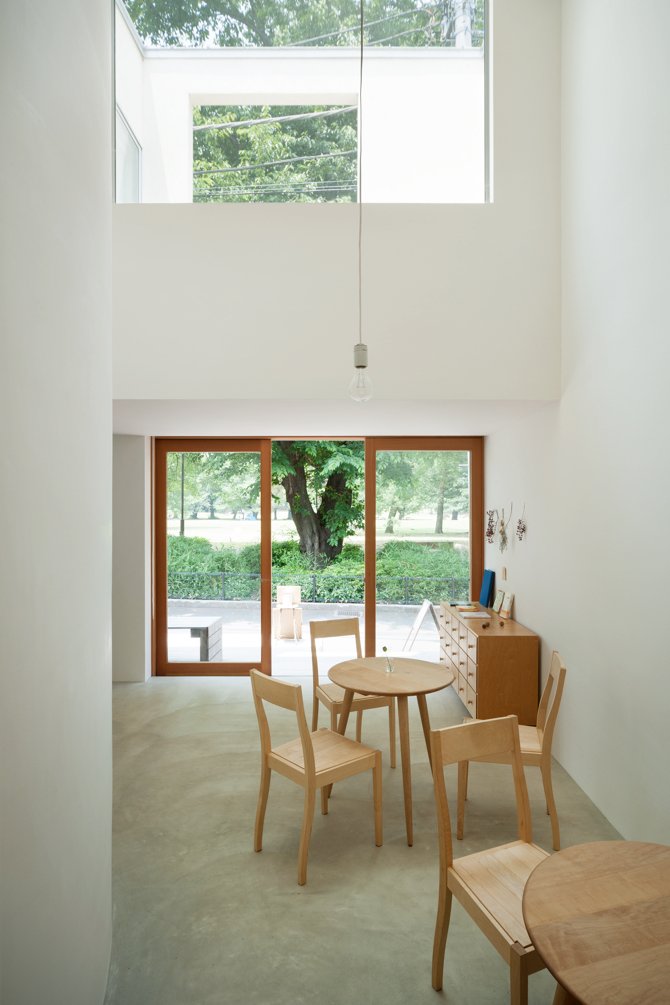
Few are able to do “small houses” quite like the Japanese. Below is the Flat House in Tokyo by Yoshinori Sakano Architects. Completed in 2011, it was designed for a young couple in their twenties who wanted to build a home that was like a “small art museum.” Looking at these photos, I bet many of you will be surprised to know that the site area is only 100.10m2. The building footprint is only 49.00m2. And the total floor area is 79.36m2. This is the kind and scale of housing that is now permissible on many of Toronto’s laneways. And here, in Tokyo, you can see that it is serving as a family home. (The working kitchen is quite a contrast with the rest of the house.)
Randy Shaw is the Editor of Beyond Chron, Director of San Francisco’s Tenderloin Housing Clinic, and author of, Generation Priced Out: Who Gets to Live in New Urban America.
In his recent piece in Beyond Chron, he makes the argument that, from San Francisco to New York, homeowners who oppose new multi-unit housing are in fact the ones driving gentrification.
He admits that there are some exceptions and cites San Francisco’s SOMA neighborhood as a place that became upscale because of new development. (I think it’s more nuanced than that.)
But the key point is that there countless examples of neighborhoods changing their socioeconomic position without the presence of new development. (There’s investment, but at a smaller or individual scale.)
Here’s an excerpt from Shaw’s article:
Banning apartments from single family home neighborhoods limits new residents to those who can afford to purchase a home. Banning new multi-unit construction also artificially reduces supply, driving up home prices for existing owners.
That’s how most San Francisco neighborhoods, and those in other high-housing cost cities, gentrified. It happened with little or no multi-unit construction. Yet homeowners have adeptly shifted blame for the gentrification of urban neighborhoods from their own land use policies to builders—even when no building has occurred.
But in the end, do these details even matter? What we have here are competing self-interests. Developers, obviously, want to build. And many people benefit when this does happen. But others don’t see it that way.
Richard Florida is currently running a four-part CityLab series on the economic performance of America’s cities. What makes this study somewhat unique is that it looks at cities proper, rather than at their larger metro areas. In some cases there may not be that much of a difference. But in other cases, the performance of the city proper could be very different from that of the broader area.
Here are the fastest and slowest growing cities from 2012 to 2017:
Here are the fastest and slowing growing job markets:
And here is the growth in share of adults with a graduate degree:
It’s interesting to see Seattle at the top of the population growth list. It is not a sprawling sunbelt city. It is an expensive tech hub. And it is also interesting to see Miami’s strong employment and education growth. Years ago, Paul Graham wrote an essay arguing that tech hubs have two prerequisites: capital and nerds. He went on to argue that Miami has lots of the former, but not much of the latter. Maybe that’s changing.
Parasitic architecture sounds like a bad thing because of the connotations, but you could make an argument that it is, in fact, the exact opposite. It is a way to better leverage existing structures and reclaim under-utilized urban spaces. Perhaps additive architecture would be a more appropriate name.
Here’s one example. WARchitect recently completed this “skyscape apartment” on top of an existing 5 storey apartment building in Bangkok. It’s about 1,600 square feet. And the entire space is organized according to the structural grid of the apartment building below.
Many/most structural systems have excess capacity because of a built in factor of safety. So for a small addition like this, I’m guessing that they probably just loaded up the existing column grid. It also looks like there were already stairs leading up to the roof of the building.
Years ago I looked at doing an addition on top of an existing apartment building here in Toronto and it ended up being a lot more complex than I may be making it out to be in this post. Mind you, we were looking at adding on a few floors, which triggered all sorts of issues.
But now that Toronto is allowing accessory dwelling units along its laneways, is it time that we also look at the rooftops of our existing buildings?
Generally speaking, architects are the only people I know who like Brutalist architecture. In fact, architect, professor and author Witold Rybczynski once proposed the following litmus test to determine whether a building is indeed an example of Brutalism: “If people don’t hate it, it can’t be Brutalist.”
But as I have argued before, sometimes architectural styles take a bit of time to settle in and become fully appreciated. Consider how improbable it would seem to demolish a beautiful old Victorian home today. And yet Toronto, and countless other cities, did this on many occasions. Regent Park, Toronto was once Cabbagetown South.
Brutalism also took on different sensibilities around the world.
I love this recent piece in T (NY Times Style Magazine) by Michael Snyder called, “The Unexpectedly Tropical History of Brutalism.” In it he uses the term “Equatorial Brutalism” (a new one for me) and discusses the “surprising apotheosis” of Brutalism in equatorial countries (and in particular Brazil). It is a good follow-up to my recent post on Oscar Niemeyer’s work.
So here’s an excerpt from Michael’s article. If you don’t already like Brutalism, maybe it’ll get you a little bit closer.
What these buildings shared, beyond an aesthetic — though they shared that, too, with their radical porousness, their blunt geometric forms and their extensive use of raw concrete — was a commitment to architecture as an instigator of progress. But in the tropics, Brutalism reached an unexpected apotheosis: Infiltrated by lush plants and softened by humidity, buildings that looked cold and imposing against London’s constant drizzle or Boston’s icy slush were transformed into fecund, vital spaces. Concrete surfaces bloomed green with moss. The panels of glass necessary for sealing rooms against the northern chill either disappeared or receded from view, encouraging cross-ventilation while also protecting interior spaces from direct sun. The openness and transparency that the Smithsons had pronounced became a practical reality in these humid environments, both theoretically and literally: Built from inexpensive, readily available materials, equatorial Brutalism was as accessible and functional as it was symbolically potent, resulting in buildings that would define new societies growing around them like vines. Here, Brutalism wasn’t only an architecture that shaped the future or confronted the past — it was an architecture of freedom.
This recent Economist article makes the argument that, despite the recent (and sometimes annoying) proliferation of electric scooters across Europe, we probably shouldn’t be that grouchy about them. And that’s, “because the rise of the electric scooter is part of a broader and welcome phenomenon: the gradual retreat of the car from the European city.” By way of one example, by next year, Paris will have grown its bike lane network by 50% in five years.
The article ends with the point that, while this may seem like a “revolution,” it’s actually a “reversion.” European cities such as Paris and Antwerp (examples from the article) were both built before the advent of the car and were never really designed for it, although Haussmann’s wide avenues certainly helped. All of this gets back to a point I tried to make over the weekend with this post about driving and parking, and the relevance of urban form.
Reversion is a lot easier than a revolution. And for most North American cities, a revolution is what’s needed if we are in fact serious about a post-car future.
Today’s Seth Godin post on innovation, guts, and generosity is Seth Godin at his best. One of the reasons why I like it is that I keep thinking that “innovative” has become too much of a buzzword. It’s similar to walking around and telling everybody you’re a cool person. If you have to explain it to everyone, then you’re probably not cool. At the same time, I also find his generosity angle to be a clever one. Here is Seth’s post in its entirety (short and sweet, as usual):
Innovation is guts plus generosity
Guts, because it might not work.
And generosity, because guts without seeking to make things better is merely hustle.
The innovator shows up with something she knows might not work (pause for a second, and contrast that with everyone else, who has been trained to show up with a proven, verified, approved, deniable answer that will get them an A on the test).
If failure is not an option, then, most of the time, neither is success.
It’s pretty common for someone to claim that they’re innovative when actually, all they are is popular, profitable or successful. Nothing wrong with that. But it’s not innovative.
Allow generosity to take the lead and you’ll probably discover that it’s easier to find the guts.
Inc. Magazine just did a profile on Opendoor, which is a company that we have, of course, talked a lot about on this blog and that I continue to follow closely.
It’s interesting to read about some of the challenges that they’ve been having as a result of their frictionless open houses. Since all you need is a smartphone, the company has been having the ongoing problem of people camping out in their listed homes. Sometimes for weeks. They’ve been working to address this by restricting the hours (6AM to 9PM) and by installing motion detectors. I am sure they will figure it out.
The company is also having to be careful in terms of how it positions itself alongside realtors. There are many livelihoods at stake here. Here’s an excerpt from the article:
During interviews, Wu has chosen his words carefully when discussing Opendoor’s potential to replace Realtors. “The reality with Realtors today,” he said on stage at the Startup Grind Global Conference in Silicon Valley in February, “is their role is shifting from project management–especially in our ecosystem, where we’re automating a lot of the processes–to advisement.”
Fred Wilson (venture capitalist) has argued many times before on his blog that business model innovation is far more disruptive than technical innovation. I think it’s valuable to keep that in mind in the context of this discussion.
Opendoor continues to charge a commission fee (sometimes a higher one than is typical), but it also makes money on the flipping of homes and it has plans to vertically integrate other aspects of the real estate business.
Urbanation released its Q2-2019 condo market results for the Greater Toronto Area this week. It was a robust quarter, following a slower Q1. Here are a few highlights:
– 8,902 condo units were sold across the GTA in Q2-2019. This is the second highest Q2 level on record after Q2-2017 (11,413 sales).
– The average price for all remaining (unsold) inventory in the GTA hit $1,000 psf for the first time ever, representing a 9% year-over-year increase.
– The region saw increased activity in the outskirts, including Hamilton, as a result of purchasers/investors looking for value buys.
– Only 6 projects launched for pre-sale in the former/old City of Toronto (the core). The average opening price was $1,284 psf.
– Average pricing for remaining units in the core is now $1,291 psf. This is the new standard for centrally located housing.