Daily insights for city builders, delivered every morning at 6 AM ET. I’m Brandon Donnelly — a Toronto-based real estate developer and founder of Globizen. I’ve been writing here since 2013.

Category: Uncategorized

  • Amazon’s new supercenter strategy

    January 27, 2026 · View original


    This month, Amazon announced that it will be opening a new 230,000 sf big box store in the suburbs of Chicago. Half of the store will be consumer-facing, where customers can browse aisles for groceries, household items, and general merchandise, and the other half will serve as a kind of micro-fulfillment center.

    Supposedly, the municipality applied a restriction to the lands requiring it to be a consumer-facing store; it can’t just be for fulfillment. But it seems that some kinds are allowed.

    My understanding is that the “fulfillment” component of the project will allow customers to order (on kiosks throughout the store) certain items “from the back” and have them delivered to the front of the store for checkout. Importantly, it also decouples inventory management and optimizes the back-of-house for online grocery.

    This is a big store; bigger than even a Walmart Supercenter. It also sits on a 35-acre site, which means the lot coverage is only around 15%. However, there’s also a large stormwater management pond and room for additional pad buildings based on this site plan:

    A store this massive is a fascinating signal because it’s a clear admission from Amazon that it needs to get its brick-and-mortar strategy right if it wants to compete in grocery. Even after its Whole Foods acquisition, it’s only about 3% of the US grocery market, whereas Walmart is sitting at over 20%.

    Ten years ago, it did not feel like this would be where we would end up. Retail as a real estate asset class was out of favor. Brick-and-mortar retail seemed destined to be disrupted by e-commerce and drone delivery. But retail evolved and grocery proved to be a unique facet of retail. At least so far.

    Cover photo by Brittani Burns on Unsplash

  • Creating successful places from scratch isn’t easy

    January 26, 2026 · View original


    Creating anything from scratch is more difficult than working from an established base. This is absolutely true when it comes to starting new neighborhoods and communities. What do you build first? What will be the anchors? And how do you balance hard and soft infrastructure to make it an attractive place before a critical mass is achieved?

    I was thinking about this over the weekend while walking around Whistler Village, so I tweeted this out. If you’ve been before, you know it’s packed with people all throughout the day. I would characterize it as a successful place.

    But the responses I got on Twitter were along the lines of: “Are you joking? It’s a fake utopia. It may be busy, but staff are forced to live on the outskirts of the village in dorms.”

    These comments are not entirely wrong. Resort villages are typically a kind of Disneyland. Attainable workforce housing is a major challenge for resorts, and it’s typical to make the building of it a precondition to development. You can’t run a resort without staff.

    But none of this changes the fact that it is still very difficult to create successful places from scratch. There are lots of ski resorts that don’t have the energy of Whistler, and lots of new planned communities that don’t have the foot traffic of older neighborhoods. The Canary District in Toronto comes to mind as a place that is still settling in. That is how you know it’s challenging.

    Creating successful places from scratch requires the right strategy, careful design and programming, patience, and probably the ability to subsidize the right tenants to seed activity early on. It’s also helpful if you can avoid going broke before the neighborhood comes alive.

    Cover photo by Peter Robbins on Unsplash

  • I’m in Whistler to do huge deals

    January 25, 2026 · View original


    I arrived in BC yesterday for ICSC Whistler. This is my first time here for this conference. I came around this time several years ago for a Slate investor day, but I never participated in ICSC activities per se. So, I’ve come to realize that I don’t really know the proper protocols. I’m an ICSC newbie. Most people I know don’t attend the actual conference. My loose understanding is that you wear Patagonia, ski and snowboard all day, après at Longhorn, and then real estate deals and capital get thrown at you from all angles. I’ll try this and see what happens.

    If you’re around, drop me a text or email me at brandon.donnelly@globizen.com.

  • Why even “luxury” housing improves overall affordability

    January 24, 2026 · View original


    One of the common criticisms of new housing is that it’s designed for rich people and that it does nothing to help the housing situation of average citizens. The YIMBY response to this is, “Well, yes, it does actually, because supply eases overall housing pressures and because of the filtering effect.” This is the process whereby housing becomes gradually more affordable and available to people as new housing is built and vacancies are created. But most people don’t like this explanation. It feels slow and indirect.

    Here’s something that might help.

    In this recent study, researchers looked at the downstream effects of a new condominium tower in Honolulu called The Central Ala Moana. Completed in 2021, the building contains 512 units, of which 60% are income-restricted (310 units) and 40% are market-rate (202 units). It was developed under a state affordable-housing program that gave the developer height and density bonuses, plus fee waivers totalling about $13 million in exchange for delivering income-restricted units. (In my opinion, this is directionally preferable to unfunded inclusionary zoning mandates.)

    Using address-history microdata, the researchers tracked who moved into the new condominium tower, and constructed detailed vacancy chains across multiple rounds of moves. Here’s what they discovered:

    > Among documented vacancies, the 202 market-rate units produced 87 downstream vacancies (0.43 vacancies per initial unit), while the 310 income-restricted units produced 90 (0.29 vacancies per unit). Thus, market-rate units are more likely to generate a downstream vacancy. The main mechanism is new household formation: movers into income-restricted units are more likely to be a newly formed household, leaving family or roommates at the prior address and thus preventing a vacancy from being created.

    In absolute numbers, they found that the completion of the building induced more than 500 local vacancies in the three years after construction, by setting off a chain of moves. Importantly, the researchers also found that the homes being vacated were, on average, about 40% less expensive than those in The Central. So even though a new building may be more expensive than the existing housing stock (which is generally the case or else the development wouldn’t happen), it does generate benefits.

    It eases overall housing supply constraints and expands affordability in the local housing market.

    Cover photo by Michael Olsen on Unsplash

  • Segmenting cities and real estate

    January 23, 2026 · View original


    Towards the end of last year, Meta released SAM 3, which stands for the third version of its Segment Anything Model. The way it generally works is that it allows you to detect, edit, and experiment with things in images and videos. For example, if you were looking at a video of a street, you could ask it to find all the scooters (which I did below), count the number of pedestrians wearing black pants, blur all the license plates on the cars, and so on.

    This is immediately useful for a company like Meta because it allows for object-level modifications across its content creation platforms. So if you took a video of someone dancing and you desperately wanted to give them a bobblehead, SAM 3, I’m told, would allow you to quickly do that. Other AI models, such as Gemini, can also segment, but supposedly the SAM models are better and more precise at this specific task.

    Beyond bobblehead videos, the potential of this model seems enormous for real estate, cities, and, of course, many other things. Using the above image as an example, you can quickly imagine SAM 3 being used to count and track modal splits across a city, and then make planning decisions based on real-time data.

    People are also using it for real estate purposes. Pair the model with satellite images, and you can ask it to tell you how many houses have a pool, which houses recently had their roof replaced (and have solar panels), how many cars are parked on a street, how many cars are parked at Canadian Tire, and the average building lot coverage in an area.

    You could also use it to swap out finishes in a real estate listing (including in videos), and get material/area takeoffs ahead of a construction project. I don’t know for sure, but I would also imagine that this model would make a great building condition inspector. Come to think of it, I’d love a SAM 3 that could walk our construction sites and document every little detail!

    Of course, a lot of these use cases are already being tackled. But the models are getting that much better. And that will lead to even more innovation.

    Cover photo by Above Horizon on Unsplash

  • The luxury of walking

    January 22, 2026 · View original


    Engaging in physical activity is unequivocally associated with improved health outcomes. But are certain physical activities better than others? And what might the implications be for how we design our cities?

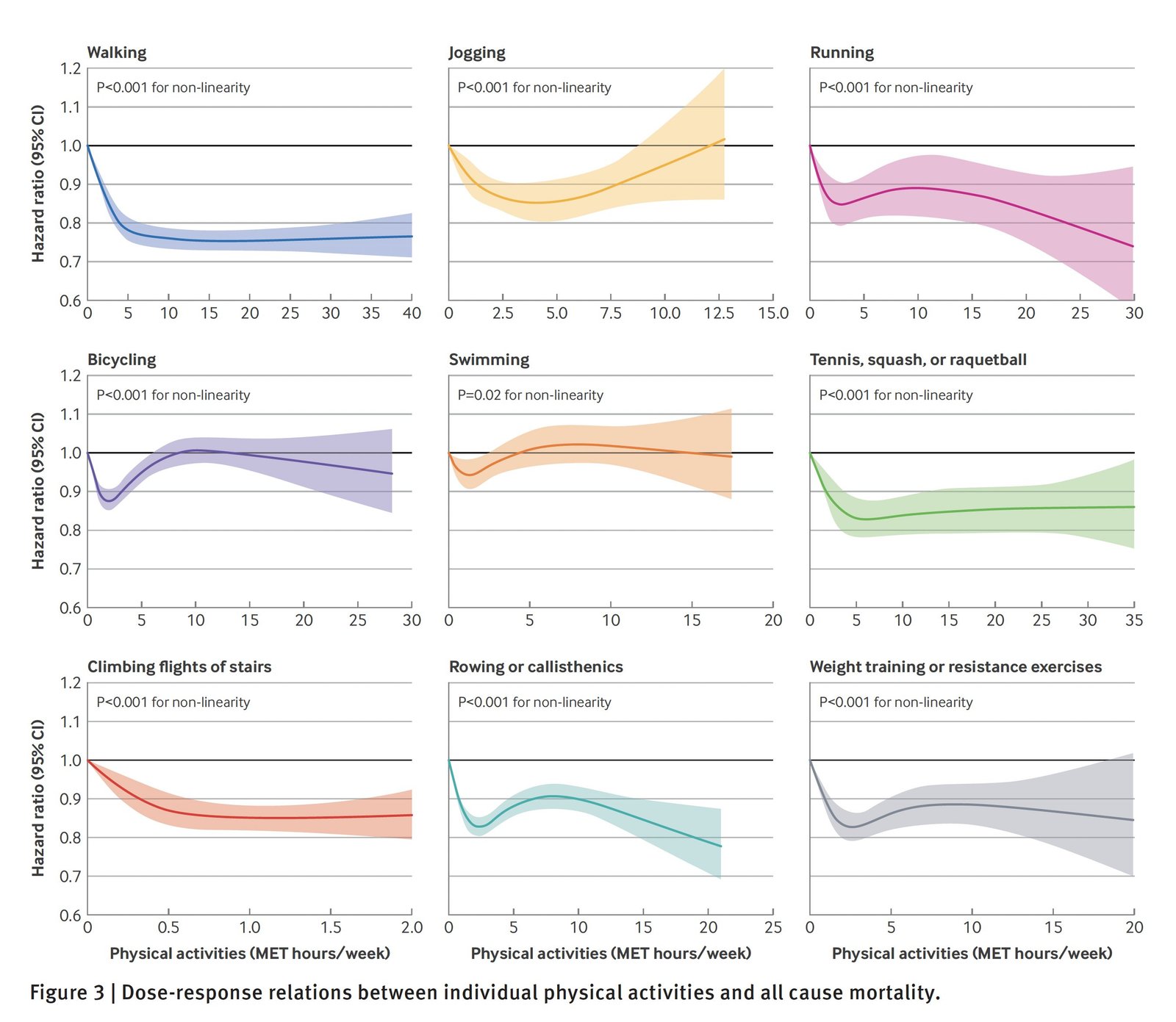
    Here is a brand new study that examined the relationship between specific types of physical activity and the risk of death, using two large cohort studies with more than 30 years of self-reported data.

    The study included information on walking, jogging, running, cycling (including stationary machines), lap swimming, tennis, climbing flights of stairs, rowing, and weight training.

    It’s important to note that this is an observational study using self-reported data. There are limitations to this. One question mark is around intensity. When someone reports swimming for an hour, it could be vigorous or casual. And the researchers note that long, low-intensity physical activities could bias the observed associations toward the null.

    With this caveat out of the way, here’s what they found:

    Their two key findings were that (1) most physical activities lower mortality rates in a non-linear way when you do more of them, and (2) mixing different physical activities is associated with lower mortality, independent of total activity levels. Variety is good.

    Interestingly enough, the most effective activity at lowering overall mortality is the simplest one: walking. It was found to reduce all-cause mortality by about 17%. This is the difference, or maximum observed benefit, between the highest walking group and a sedentary baseline.

    Once again, the data clearly shows that walkable cities can help produce meaningfully better health outcomes. So, if, like me, you subscribe to the philosophy that there’s no greater luxury in life than our health, well, then there’s perhaps no greater luxury than living in a walkable city.

    Cover photo by Alain ROUILLER on Unsplash

  • Negotiating leverage is everything

    January 21, 2026 · View original


    Back in the fall of 2006, almost twenty years ago, Sam Zell’s Equity Office Properties Trust announced that it had entered into a definitive agreement to be acquired by Blackstone Real Estate Partners, in a transaction valued at approximately US$36 billion. This was a massive deal at the time, so much so that Sam Zell would later come to the University of Pennsylvania, where I was in grad school at the time, to talk to real estate students about how smart he was.

    The transaction closed in 2007 and, in hindsight, it looked like he had timed the peak of the real estate market perfectly. But in all fairness, when asked about his clairvoyant timing, his response was that he had no idea (probably with a strong expletive somewhere in the middle). His honest answer was that Blackstone simply offered him a price for the portfolio that was greater than their own internal valuation, and so he accepted it.

    Another question that he was asked went something like this: “Blackstone is likely going to break up the portfolio, sell off the assets individually or in chunks, and make boatloads of money. Why didn’t you just do that?” Despite the peak-market timing, this statement ended up being true. Blackstone generated something like a $7 billion profit on the deal.

    But Sam’s response was that he couldn’t. He cited an esoteric IRS rule that stipulates that once a REIT decides to sell all of its assets and formalizes a liquidation plan, it has a 24-month window to do so, or else get hit with additional corporate taxes. Regardless of the specific IRS section, his reasoning was simple: you never want to be a seller when buyers know you need to sell by a certain time.

    This is, of course, intuitively true. Negative leverage is bad in negotiations. In other words, it is highly unlikely that Sam could have generated the same $7 billion profit. I mean, as far as I can tell, Blackstone didn’t sell the last office building from the portfolio until 2018, over a decade later.

    I was reminded of this principle when reading Prime Minister Carney’s speech to the World Economic Forum this week. (This entire post was the best real estate segue I could come up with.) If you haven’t read or heard it yet, I would strongly encourage you to do so. Leverage is crucial in negotiations, and it’s best to do everything you can to manufacture it.

    Cover photo by Kyle Fritz on Unsplash

  • Alex Honnold is about to free solo Taipei 101

    January 20, 2026 · View original


    My palms are sweating as I write this post, because even the thought of someone free soloing a skyscraper makes me clammy. (Free solo means climbing with no ropes.) But that’s what climber Alex Honnold is scheduled to do live, on Netflix, on January 23, 2026, at 8 PM ET.

    He will be climbing Taipei 101, which is over 500 meters tall, one of the tallest buildings in the world, and formerly the world’s tallest. Dubai’s Burj Khalifa stole this superlative in 2009 when it was completed.

    My palms continue to sweat, but Alex is of the opinion that, as far as enormous towers go, this one is relatively safe for free soloing:

    > Honnold said the shape of the building makes it safer to climb because there are balconies every eight floors. “You could actually fall in tons of places and not actually die, which makes it safer than a lot of rock climbing objectives,” he said.

    I can see the logic.

    The architecture of Taipei 101 consists of inverted trapezoids that are stacked on top of each other. Each is 8 storeys tall and they angle outward as you move up, creating a roof condition or terrace on top of each module.

    Eight is an important number in Chinese culture because of a homophone in Mandarin; the number sounds like “to prosper” or “to make a fortune.” So that’s why the modules are the height that they are.

    It is now also dawning on me that the nested modules of One Delisle are 8 storeys tall. That’s good! This was never talked about during the design phase, but now that I’m aware of it, I’m going to pretend it was deliberate.

    I guess this also means that One Delisle would be a relatively safe building to free solo climb. Please, nobody try this.

    Good luck, Alex.

    Cover photo by Timo Volz on Unsplash

  • Who says buildings need stepbacks?

    January 19, 2026 · View original


    > Tweet: Who says buildings need stepbacks? https://t.co/PXlIf8o6Rv

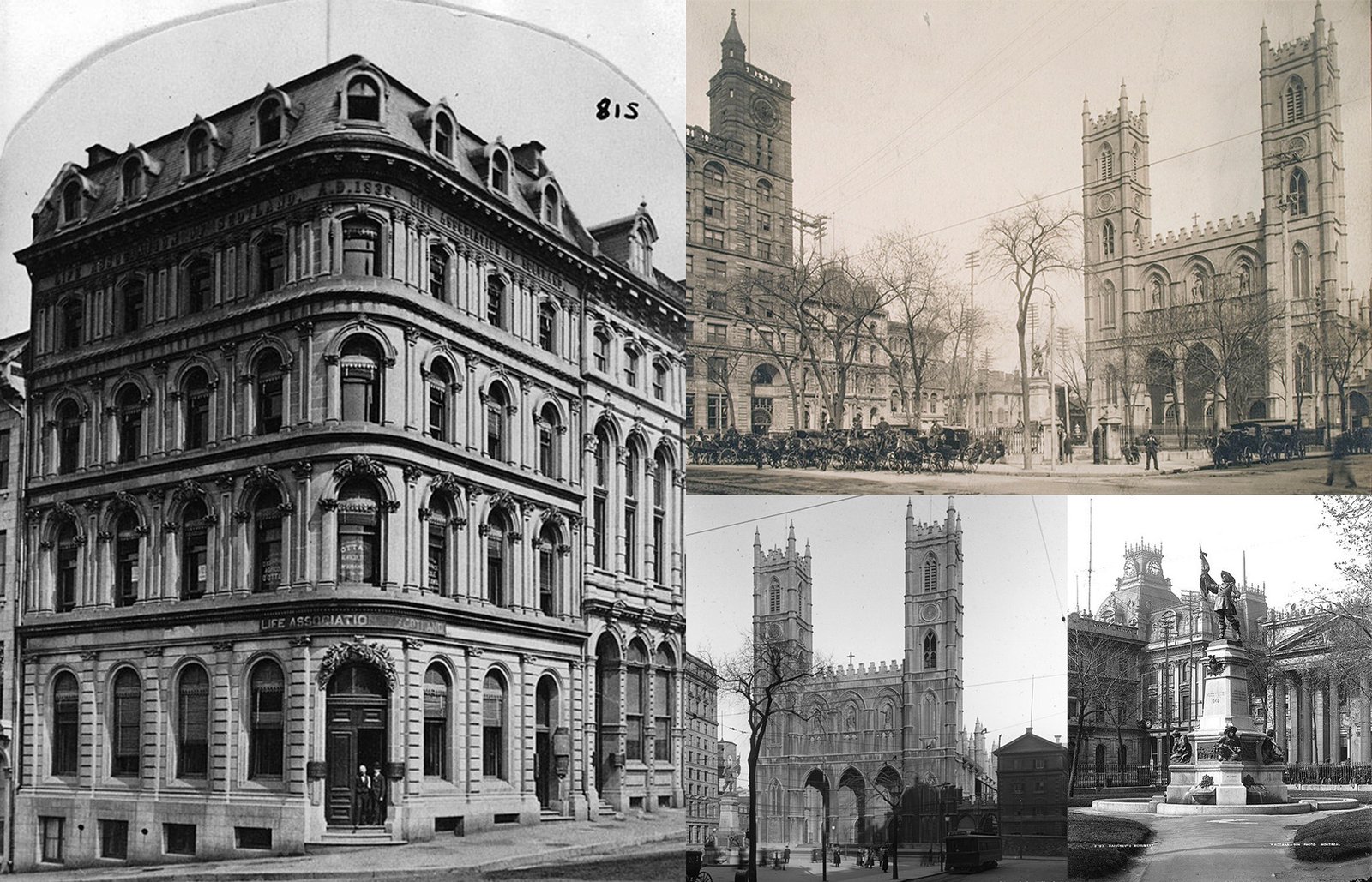
    I recently tweeted a photo of 701 Côte de la Place-d’Armes in Montréal and asked: Who says buildings need stepbacks?

    The response was exactly as I expected. Modern planning, as you know, is obsessed with setbacks, stepbacks, angular planes, shadow studies, skyviews, and lots of other things that inform the overall massing of new buildings. But then you point out a building like 701 Côte de la Place-d’Armes — which is not set back from the street and does not have any stepbacks above — and lots of people seem to love it.

    In fact, I specifically chose to share this building because it’s exactly the kind of architecture and urban design that conveys the feeling of grandeur I get when I’m in Montréal. I also chose it because it’s taller than six storeys, which is the height that Toronto is hoping to one day deliver along its major streets at scale.

    But here’s a question: If this stepback-less building is so great, why are stepbacks so in-demand?

    Firstly, I should point out that when the building was completed in 1870, it only had five floors. The top floor was an attic storey and had a mansard roof reminiscent of Haussmannian Second Empire architecture.

    Then in 1909, the attic floor was removed, and three new floors were added (a net increase of two floors). If you look closely above the fourth floor, you’ll see a slightly different architectural expression, but one that remains harmonious with the original design of the building.

    This approach breaks many of the rules for how modern planning thinks about heritage buildings. Today, it is likely that someone would have asked for a stepback above the existing building, with a completely new expression above it. Admittedly, this can produce desirable results. But it’s not what was decided in 1909, and the result is a very handsome building.

    This gets us back to our original question: Why do we insist on stepbacks, but still like architecture like this one so much? I think there are at least two answers at play here.

    The first has to do with architecture and design. If you were to pluck random people off the street and ask them about their architectural tastes, I would bet you that more people would prefer something Neoclassical or Beaux-Arts over something modern. And if people actually like the architecture, then I think they become more comfortable with scale, or perceived scale.

    The second answer has to do with the fact that one way to look at stepbacks is as a defensive architectural tool. They have become a tool we use when someone doesn’t actually want a building to be built. We use them to try and soften the massing by hiding as much of it as possible.

    The problem with this approach is that it also means we’re not playing offence. And if you want urban grandeur, I think you need to play offence. You need to be confident and decisive about what you’re trying to do. And I think this is part of the reason why so many people seem to like 701 Côte de la Place-d’Armes. It is all of these things, and it’s not in their backyard.

    Cover photo by Macy Nguyen on Unsplash; historic photo from Hôtel Place d’Armes

  • Thoughts on the new Deer Valley Four Seasons

    Spoiler: It’s not for me

    January 18, 2026 · View original


    New York-based Extell Development is currently under construction on a Four Seasons Resort and Private Residences in the new Deer Valley East Village in Utah. When I was there in December, Bianca and I went by to check out the overall progress in the village, and the crew was in the midst of laying the decking for the ground floor. ODA designed the architecture, interiors, and landscaping.

    The residential offering consists of Private Residences and Hotel Residences. The former are located in an owner-exclusive building and the latter are in the hotel building, where the units can be put into the Four Seasons Rental Program. I’m not sure if this is indicative of their overall inventory, but the remaining Hotel Residences are meaningfully larger than the Private Residences.
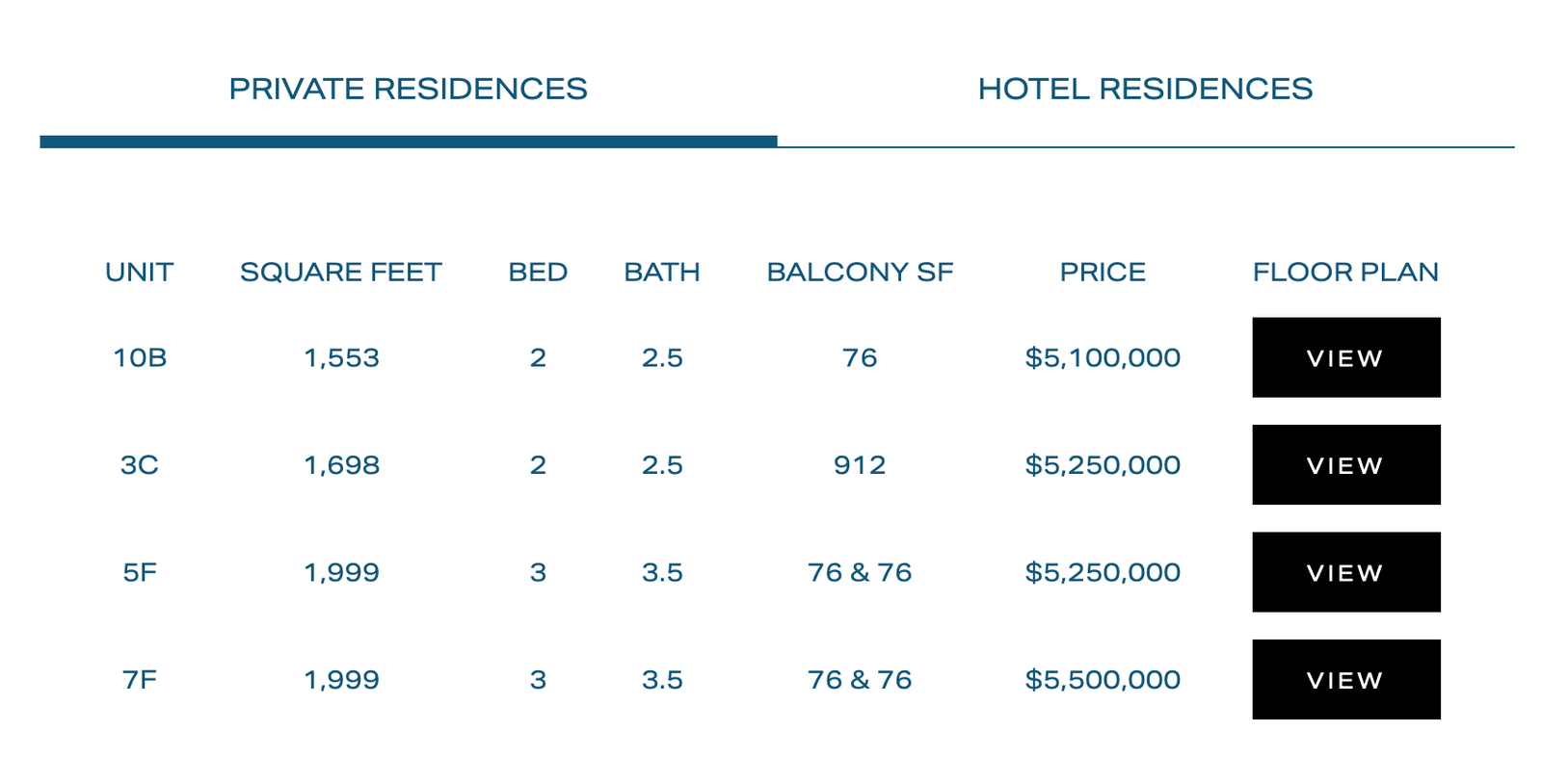
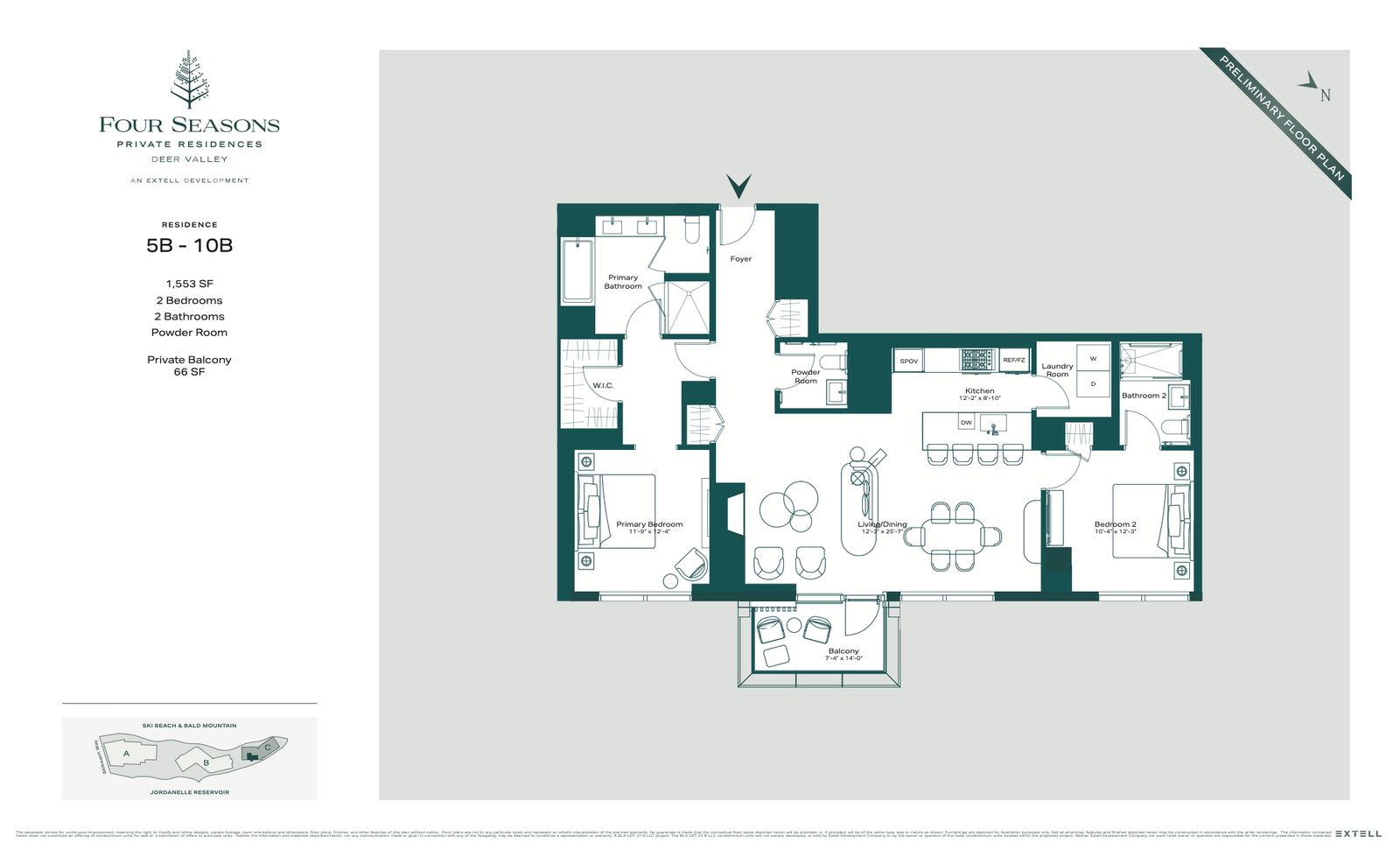
    Based on current availability, the smallest remaining Private Residence (1,553 sf) is going for US$3,283 psf.
    As a Park City booster, I think this additional village is exciting. There are now two large interconnected resorts and four distinct villages lining the Wasatch Back: Park City Mountain Resort, Park City Canyons Village, Deer Valley, and the Deer Valley East Village. Visit Utah would say that there’s also a third resort in Woodward Park City (which happens to be adjacent to Parkview Mountain House).

    But as a real estate developer and snowboarder, I do wonder about two things.

    First, Deer Valley East Village is located in an area on the Wasatch Back that receives noticeably less snow compared to other areas because of its lower elevation and broad east exposure. If I refer back to Jim Steenburgh’s book, Secrets of the Greatest Snow on Earth, the average annual snowfall at the base of the Jordanelle Gondola (located just north of the East Village) is probably less than 150 inches. This compares to 350+ inches at higher elevations in Park City and 500+ inches in the Cottonwood Canyons.

    Because of this, the East Village has obviously invested heavily in snowmaking equipment. But artificial snow is not the same as natural snow. The higher elevations will be just fine, but the lower elevations will likely see marginal conditions. So why build a new village here? And was and is this a consideration for buyers at this new Four Seasons? Or are the luxury amenities and après events the real deciding factors? I’m not their target demographic, but from my perspective, this is reason enough not to buy here.

    On the topic of the target buyer, my second question is about Deer Valley’s “no snowboarding” rule (which is another reason why I’m not their target demographic). There are only 3 resorts in the United States that ban snowboarding. One of them is Deer Valley, and the other two are Alta (Utah) and Mad River Glen (Vermont). This seems to be a wildly popular rule among resort guests, and I support Deer Valley’s decision to weed out “riff-raff” like me. Deer Valley is also known for capping daily lift tickets to keep the crowds down, so they don’t seem to be hurting for patrons.

    But according to recent data from Snowsports Industries America (SIA), the rough participation split in the US between skiers and snowboarders is somewhere around 60-70% and 30-40%, respectively. There are also many instances where families have a mix of skiers and snowboarders. If you’re the Four Seasons at Deer Valley, this segment of the market is excluded. Oh well. The rich snowboarders have Park City, The Colony at Canyons Village, Powder Mountain, Aspen, and many other locations.

    My assumption is that the ban on snowboarders is an unapologetic feature of Deer Valley and developments like the Four Seasons. It creates an air of exclusivity and differentiation. Some data also suggests that snowboarders tend to be a more ethnically diverse group compared to skiers (SIA reports show that among female snowboarders, 25% are Hispanic, and among males, 13% are Black — the highest diversity rates in winter sports), so one could argue that it’s not just about the type of device used to get down the mountain. And, it seems to be working.

    In July 2025, the Extell announced that they had closed a $600 million construction loan for the project from JVP Management and that 60% of the hotel residences were already sold. This is believed to be the largest construction loan on record for a hotel and residential condominium project in Utah.

    At the same time, I’m also certain that the Four Seasons lost sales to certain buyers, perhaps a wealthy Boomer or Gen Xer with kids or grandkids who snowboard. Extrapolating this demographic trend, it is also believed that Millennials represent the first generation in the US with near-parity between skiers and snowboarders. So what will this mean for luxury real estate as these Millennials become the dominant buyer segment? My prediction is that the real estate market will respond.

    Would you buy at the Deer Valley Four Seasons? Or have you already?

    Cover photo: Deer Valley Four Seasons