
Daily insights for city builders, delivered every morning at 6 AM ET. I’m Brandon Donnelly — a Toronto-based real estate developer and founder of Globizen. I’ve been writing here since 2013.

Category: Tech

  • Paris may have the busiest bike route in the world

    In my opinion, we need far better urban data if we’re actually going to make evidence-based decisions. Thankfully, there are lots of great companies that are focused on this space. One of them is Eco-Counter, which makes devices to count pedestrians and cyclists, among other things. This is an important job, because as Peter Drucker used to say, “you can’t manage what you don’t measure.”

    Let’s look at their bike counters. According to their global map, they have 464 of them installed around the world. Montreal has 58 of them, which we’ve spoken about before, and is an impressive install base. And Toronto looks to have only one, which is located on Bloor Street on the north side of High Park.

    The busiest route/counter in Montreal is at St-Denis Street and Rue des Carriéres. So far this year — up to November 17, 2024 — this counter has seen an average of just under 5,000 trips per day and a year-to-date total of 1,600,468 trips. Both of these metrics are notably up compared to 2023 when I last looked at the data.

    The busiest route in Eco-Counter’s entire network is on Boulevard de Sébastopol in Paris (an important main roadway, not a side street). It has seen an average of 13,667 trips per day and a year-to-date total of 4,386,996 trips. Not surprisingly, the Paris counter exhibits less seasonality. People still cycle in the winter in Montreal, but it’s less than in the warmer months.

    Finally, our lone Toronto counter adjacent to High Park has seen an average of 1,186 trips per day and a year-to-date total of 380,813 trips. Not quite Paris or Montreal (the latter of which has a colder climate), but I would argue that this really isn’t an indicative location for Toronto given how underdeveloped the area is. Plus, you need to see each route as part of a network.

    If you look at Montreal’s top 5 bike counters, all of them have a year-to-date total that exceeds 1 million trips. This is important information if you’re trying to make mobility decisions and these are significant figures. Imagine if these millions of people got off their bikes and instead decided to take transit or drive a car. That would change things.

    Photo by Celine Ylmz on Unsplash
  • Venice to Venice

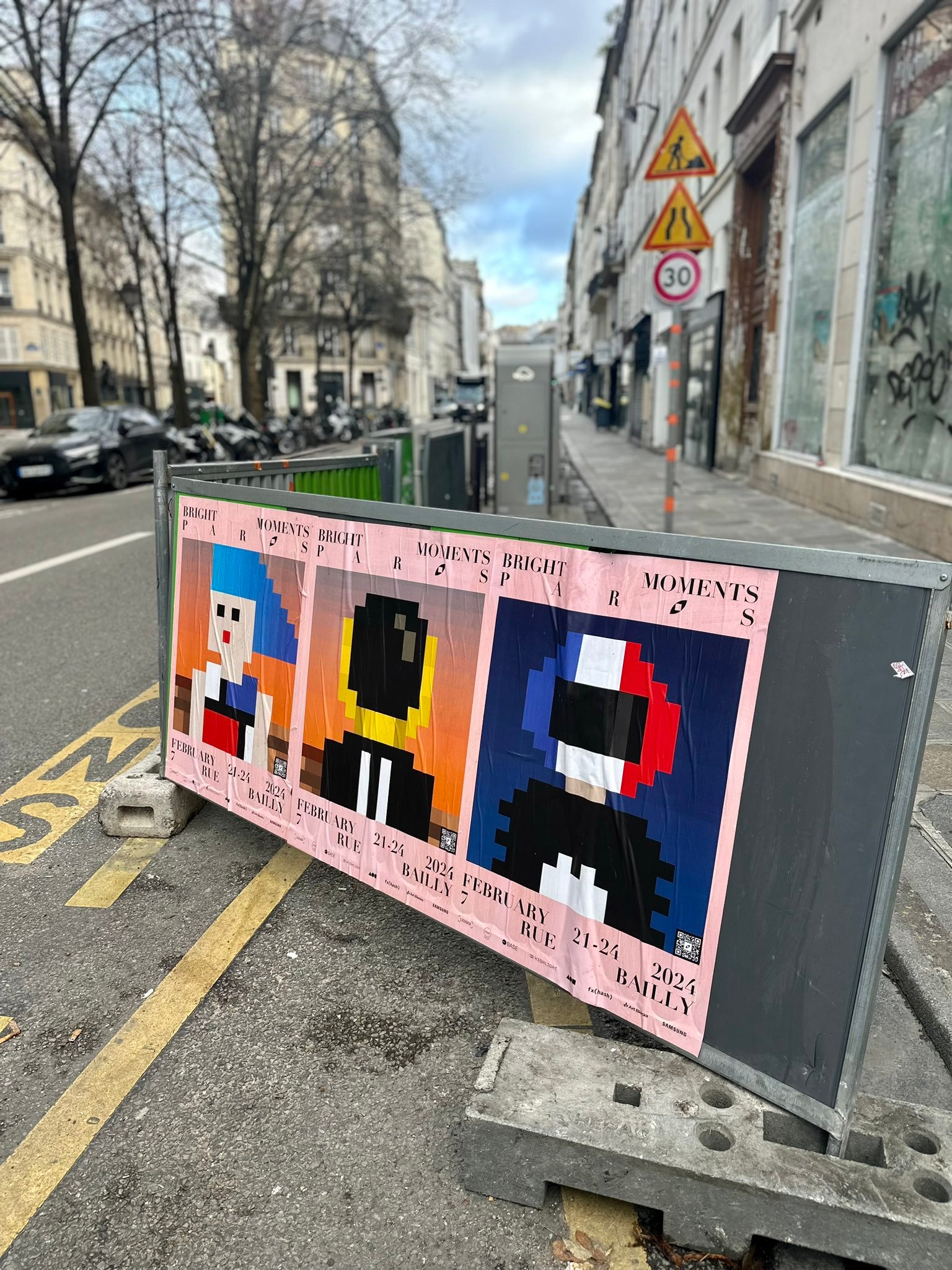
    Crypto Citizens are a collection of 10,000 NFTs that were minted between 2021 and 2024, starting first in Venice, California and ending in Venice, Italy. Each of their 10 locations has a sub-collection of 1,000 pieces and I am the owner of CryptoParisian #112, because, well, Paris was the next best city for me after they egregiously skipped over Toronto.

    This is one of the most ambitious projects in the NFT art community and, now that they’ve completed their world tour, they’ve just released a documentary called Venice to Venice. It is currently being screened in private venues around the world, but eventually there will be a world premiere at a film festival. This is when I presume they will land in Toronto!

    If you’d like to watch the trailer and/or mint it, click here.

    Photo: Seth Goldstein

  • Boom: Bubbles and the End of Stagnation

    So Stripe, the payment-processing company, also has a book publishing division. It’s called Stripe Press, and its objective is to publish ideas that support overall business progress. Their latest book is called Boom: Bubbles and the End of Stagnation, and I must say that the website is pretty neat.

    Here’s what the actual book is about though:

    From the Moon landing to the dawning of the atomic age, the decades prior to the 1970s were characterized by the routine invention of transformative technologies at breakneck speed. By comparison, ours is an age of stagnation; of slowing median wage growth, rising inequality, and decelerated scientific discovery. In Boom, Byrne Hobart and Tobias Huber take an inductive approach to this problem. They track some of the most significant breakthroughs of the past 100 years—from the Manhattan Project and the Apollo program to Moore’s law and Bitcoin—and reverse-engineer how transformative progress arises from the same dynamics that govern financial bubbles, bringing together small groups with a unified vision, vast funding, and surprisingly poor accountability. Bubbles, they conclude, aren’t all bad—in fact, they create the ideal conditions for transformative innovation. Integrating insights from economics, philosophy, and history, Boom provides a blueprint for accelerating innovation and a path to unleash a new era of global prosperity.

    If you’re interested, it comes out on November 19, 2024.

  • Audio is the poor person’s augmented reality

    I have long been interested in the work of entrepreneur Dennis Crowley. He is perhaps best known as the co-founder of Foursquare, which popularized location “check-ins.” But he’s created a bunch of other stuff too. The common theme is that his products exist at the intersection of tech and cities (the physical world), which is probably why I’ve been so interested over the years.

    Check-ins, for example, allowed you to say to all your friends, “hey everyone, I’m at this bar.” It was a way of checking if anyone you knew was there too, or close by, and also a way of inviting your friends to come join you if they were so inclined.

    This was extremely popular for a period of time, but then kind of fizzled out, and Foursquare was forced to pivot and try a bunch of other things. And in the end, this “problem” of augmenting the physical world with our social graph (and other information) never really got solved. I mean, this is broadly the promise of augmented reality.

    Thankfully, Dennis has a new company (Hopscotch Labs) and a new tech/city product called Beebop (which is currently in private beta). Here’s how it works (excerpt from this Crazy Stupid Tech interview):

    It’s an iPhone app. There’s not much to do in the app, there aren’t a lot of buttons to press. Once it’s installed and you set the permissions, every time you put on your headphones — your AirPods or any other headphones, it doesn’t matter—it chimes and says, “Beebop’s been activated.” (Beebop is the first project from the company, Hopscotch Labs.)

    Then as you walk around the city, it will tell you things about certain places. Eventually, if I walk by a place where my friend was, it tells me that Alex was here two days ago. If I walk by a place and someone’s inside, it tells me that Max is inside that place. A lot of it is still under development. Eventually, people leave a comment at a place. Imagine Twitter. It is as if you leave a tweet and you stick it in the ground. When you walk over it, you hear it.

    So like before, it’s about experiencing cities:

    It’s been a long time since I built something. What’s different now? AI is what’s different. You know what’s different? Everyone’s on their phones all the time. Back in my day, we made stuff for the streets. You would use your phone, you’d put it away, and stuff would happen. Where are the people making that stuff anymore? All we make is stuff that makes you look at the screen. Let’s make stuff that gets you out in the world, where you’re not glued to the devices. You’re out there doing stuff. Big companies out there aren’t going to make stuff like this.

    The key idea here is that augmented reality doesn’t have to just be visual. Visual also requires somebody to figure out a cool set of glasses that people will actually wear out in public. Who knows when this happens, though I do think it will eventually.

    So what Dennis is doing is making something that works today — with audio. This has been called the poor person’s augmented reality, but I think that’s selling it short. This is really clever. And once again, it’s fundamentally connected to how people live in and interact with our cities.

  • Mass transit with on-demand service

    Here’s what we know:

    In the mid-20th century, the US made a pivotal choice that shaped its cities, economy and lifestyle. It chose highways and cars over public transit. At the time, this seemed like the future: the freedom of the open road, the allure of suburban living, and the booming post-second world war economy all converged to push America towards a car-centric culture.

    The Federal-Aid Highway Act of 1956 cemented this vision, unleashing a highway system that encouraged suburban sprawl, fuelled the automotive industry and sidelined public transit. Rail systems were seen as relics of a slow, industrial-era technology ill-suited to America’s postwar aspirations. The car was king. 

    But this congested system is breaking. In 1950 about 30 per cent of the world’s population lived in cities. By 2030 this is expected to reach 60 per cent. Infrastructure cannot keep up with this growth. An increase in cars further reduces street capacity.

    What we don’t have a clear consensus on, though, is the path forward. Is it more highways? More public transit? More bike lanes? Or will autonomous vehicles finally arrive and bail us out? The answer will depend on who you ask.

    In this recent opinion piece, venture capitalist Vinod Khosla makes the case for something else: personal rapid transit systems (or PRT). Conveniently, he also happens to be an investor in one — a company called Glydways.

    The promise is an on-demand mass transit system that offers the convenience of a personal car, but with the capacities and price points of public transit. And it is based on small autonomous vehicles riding in their own dedicated lanes.

    Each lane only needs to be 1.5 meters wide, which is less than the 2.3 meters that the Dutch see as the ideal width of a one-way bike lane. And with this, the company claims that it can reach capacities of up to 10,800 people per hour.

    To further put this into perspective, the standard width of a two-way parking drive aisle here in Toronto is 6 meters. So this would mean that each drive aisle could, in theory, have 4 lanes dedicated to these “Glydcars.” That’s how narrow they are.

    Here’s a video of them in operation:

    This, of course, isn’t an entirely new idea. You might remember that Masdar City in Abu Dhabi claims to have opened the world’s first PRT system in 2010 — a 1.4 km line with only two stations. That said, Glydways has already been awarded three projects in the US. So for fun, I think I’ll keep an eye on them.

  • We need far better urban data

    The divisive debate over bikes lanes in Toronto continues to remind me that we need far better urban data. People and politicians keep touting “evidence-based decisions,” but what exactly is that evidence? The high-level figure being thrown around by the anti-cycling side is that only something like 1% of residents use bike lanes. So obviously it only makes sense to focus on the 99% and not give up any space to this small minority group.

    But this is highly aggregated data. It also doesn’t speak to any of the externalities associated with introducing new bike infrastructure. Looking at 2021 Census data, the number of cyclists was actually around 5% for the old City of Toronto and in some areas it was between 15-20%. However, it’s absolutely critical to note that this is only the people who selected cycling as their “primary mode of commuting” when submitting their responses to the last census.

    Meaning, it excludes people who maybe only cycle 1-2 days a week, or who ride for leisure and/or for exercise, or who ride to their French class in the evenings (like me). I would also assume that these numbers have generally grown since 2021 given the overall investments that have been made in biking infrastructure. So overall, this is weak data. It’s a few years old. And it excludes many types of users. We need to get more granular.

    Like, it’s great to see local business owners speaking out about the benefits that they have seen as a result of the Bloor bike lanes, but in the end, this is also anecdotal. We need real-time data, precise modal splits, the throughput of every major street, and much more. Then maybe we’ll be able to better optimize around the fact that we are a city divided by built form and by politics. That’s the thing about evidence-based decisions, they tend to get stronger with accurate evidence.

  • Crypto is really hard to explain, but things are happening

    I was at a dinner recently where the topic of crypto came up. Only two of us at the table were full-on believers, and the rest were generally sceptics. So naturally, the two of us started talking about why we think crypto is important. But in moments like this, it always becomes immediately clear that crypto is really hard to explain in a succinct and compelling way. Like, I don’t know how to do it. Thankfully, venture firm a16z just released their latest State of Crypto report, and so here are a handful of interesting takeaways.

    The number of crypto addresses continues to grow. Currently it’s at an all-time high of approximately 220 million, which roughly mirrors the adoption curve of the internet back in the 90s (log scale). It is, however, important to note that one crypto address does not necessarily correspond to one human being. For example, I have many different crypto addresses. So if you dig a little deeper, you’ll see that their net estimate is somewhere between 30-60 million real human beings transacting using crypto every month. This is the estimated active user base and it continues to grow.

    The number of mobile crypto wallet users is also growing rapidly outside of the US, namely in countries like Nigeria, India, and Argentina. This is the result of a number of factors: population growth, mobile phone adoption, government support, inflation, and many others. I mean, since 2010, the Argentine Peso has lost basically 99% of its value against the USD. So of course you’d rather put your money somewhere else, such as in stablecoins.

    Stablecoins are cryptocurrencies that have their value pegged to something else, such as a fiat currency. Today, they are one of the most popular crypto products and virtually all of them (more than 99%) are pegged to the USD dollar. This is viewed by some as an opportunity to strengthen the dominance of the US dollar at a time when it’s waning (see above). But more importantly, stablecoins already serve two important functions in the market: one, it’s as stable as the US dollar; and two, the cost of sending a stablecoin anywhere in the world is now basically free. Say goodbye to bank wire transfers.

    It’s worth reiterating that a16z is a venture capital firm that is heavily invested in the crypto space. And so reports like this are naturally a form of marketing and a form of lobbying. Still, there’s a lot of great information in here that you can use to form your own opinions about the sector. It may not be succinct, but if you take the time, I think you’ll find it compelling.

  • I’d actually like a Tesla bicycle

    I watched Tesla’s We, Robot event last night. As many of you know, Elon and his team showcased a Cybercab, Robovan, and a humanoid robot that dances funny, all of which will be available in the market for purchase at some unknowable date in the future. What was obvious is that Elon himself has no clear idea of when this will be.

    What I will say, though, is that the designs look cool. The Cybercab looks like a Porsche and a Cybertruck had a love child, and the Robovan looks like an Art Deco rendition of what the future is supposed to be like. I first wondered why they’d create a robotaxi with only two seats. But thinking about it now, most Uber rides probably only have 1-2 passengers.

    Despite these pretty designs, the overwhelming reaction to the event seems to be one of disappointment. We’ve heard what was said before. Public transportation is bad (I disagree). Autonomy will free up your time and remove unnecessary parking spaces from our cities (allowing for more public space). And soon you’ll be able to put your under-utilized car to work and earn extra cash.

    Cool, but when?

    Waymo and Uber are not, as far as I know, hosting similarly flashy events. But as far as I can tell, they’re making meaningful progress in advancing toward full autonomy. As of June of this year, Waymo had already logged over 22 million rider-only miles. And in September, they announced a partnership that would bring AVs to Austin and Atlanta by way of the Uber app.

    At this point in the hype cycle, I don’t think anyone is interested in hearing promises about what the future of autonomy will be like, especially without any firm dates. They want to know: Are we there yet? So I think it’s no surprise that people, including investors, weren’t all that pumped up by the event.

    On a more important note, Tesla had bicycles with brightly illuminated wheels circulating around their event set (at Warner Bros.) to presumably demonstrate that their Cybercabs can successfully navigate around moving objects (when brightly illuminated). If you missed them, look at the 29 second mark in the below video:

    I can’t be the only one who thought: “What are those? Now, that’s what I want!” So I’ve asked Elon when they’ll be available and when I can buy one. I’ll keep you all posted on his response.

  • Canada’s proptech landscape

    The morning I attended the release of Venturon’s 2024 Sustainable Proptech Report. What’s great is that it includes a list of all the (known) companies that are active in this space in Canada. It also summarizes venture funding by region. Interesting to see Alberta punching above its weight and coming in second behind Ontario. It has roughly half the population of Quebec.

    As part of the event, the following companies also gave short presentations:

    • Panergy — they make a prefabricated insulated wall system
    • Darabase — they are creating an advertising ecosystem around augmented reality; one that will allow building owners to monetize in a new digital world
    • Axe Buildings — they make simple, prefabricated homes; they are optimizing for speed and price, not quality
    • QEA Tech — they use drones with thermal cameras to tell you where your building envelope is leaking and wasting energy

    I don’t know anything about these companies other than what I heard this morning, but all are working on important problems. Darabase is perhaps the most future oriented in that it appears to rely on AR / spatial computing becoming a thing. I believe this will happen, and so I found it particularly interesting.

    The 2024 report is available online, here.

  • An Ethereum story

    We’ve spoken about Vitalik Buterin before.

    He is the inventor of the Ethereum blockchain, and its most prominent figure. He also happens to have grown up in Toronto. He went to the University of Waterloo. So when I wrote this post back in 2021, I asked: Why the hell is nobody talking about this? Why are we not celebrating the fact that our great city helped birth one of the most important technologies of our time? You couldn’t ask for a better economic development story. Well, I guess the answer is twofold. Crypto isn’t mainstream. Even back in 2021 when things were frothy it wasn’t. And, we’re awful at promoting and driving a global brand for our city. Both of these things need to change. So if you’re interested in learning more about Vitalik and Ethereum, you should check out this new movie (trailer) called Vitalik: An Ethereum Story. To watch it, go to ethereumfilm.xyz and mint the NFT for $20. You’ll then be able to stream it. I haven’t done this yet, but I’ll be doing it very soon. All of the proceeds from the NFT sales will go toward getting a more mainstream distribution deal.

    So by watching, you’re helping.

    Update: I watched it. It’s great.