Daily insights for city builders, delivered every morning at 6 AM ET. I’m Brandon Donnelly — a Toronto-based real estate developer and founder of Globizen. I’ve been writing here since 2013.

Category: Tech

  • Uber and Waymo announce exclusive partnership in Austin and Atlanta

    Waymo and Uber just announced a partnership that will bring Waymo’s autonomous vehicles to the Uber app in Austin and Atlanta. Notably, this is an exclusive partnership, meaning the only way you’ll be able to summon a Waymo vehicle in these cities will be through Uber.

    The people who follow this space closely, people like Reilly Brennan of Trucks (VC) and Harry Campbell (The Rideshare Guy), think this is a really big deal for a number of reasons.

    One, it signals a bifurcation in the industry where there will be companies, like Waymo, that supply autonomous vehicles, and companies, like Uber, that operate them and manage the overall ride hailing marketplace. As part of this deal, Uber is going to handle all of the maintenance and cleaning of the vehicles. This split is similar to the airline industry.

    Two, it suggests, and this is Harry’s argument, that Waymo needs Uber more than Uber needs Waymo. One of the reasons for this is that a 100% AV fleet is simply too expensive to operate if you’re solving for peak demand loads. Because during off-peak times, you then need to pay for downtime.

    Uber, on the other hand, doesn’t pay for downtime with its human drivers. Most of its drivers are part-time and only plug in when they want to or when the surge pricing becomes too attractive to pass up. So they’re the perfect compliment to an AV fleet. Harry argues that this is part of Uber’s competitive moat.

    And three, it signals that AVs are really starting to arrive, if not already here. The hype cycle certainly hit its trough of disillusionment and everyone switched to thinking that AVs weren’t going to happen for many years, if not decades. But now it’s happening. City by city.
  • I finally tried Apple Vision Pro

    I know I’m late to the party on this, but I finally tried Apple Vision Pro this weekend. I was in the Apple Store at the Toronto Eaton Center getting the battery replaced in my phone, so I decided to do a demo. And let me tell you — I was totally blown away. I messaged everyone I knew (after I got my phone back) and told them that they need to try it.

    To be clear, though, very few people right now want to actually buy this computing device. Initially, Apple was thinking that it would sell upwards of 800,000 units this year. But now it expects to sell somewhere closer to 400,000. Maybe. The device is too expensive, too bulky, and the use cases just aren’t there for someone to feel they need to buy it.

    I also found that, when I was looking at the world around me, I could tell I was looking at a video. It wasn’t exactly perfect. (Vision Pro creates a mixed-reality experience by recording the world around you and then playing it back to you.) But that’s okay. The hardware will get better. The price will come down. And the developer community will build a bunch of killer apps that nobody has even thought of yet.

    None of this changes the fact that the device is still an astonishing technical achievement. The eye tracking works perfectly. All of my hand gestures were flawlessly picked up. And the overall experience was entirely immersive — from 3D videos (recorded on regular iPhones) to a butterfly landing on my hand and a velociraptor flaring its nostrils right in front of me.

    What was most impactful to me is that I could easily imagine a future where all of this works. Is this a more exciting way to watch sports? Yes. I sat courtside and Lebron dunked in my face. Is this a better way to watch movies on a plane? By far. Will this be used to help build buildings and coordinate design & engineering disciplines? Yes, absolutely, among many other things.

    It is also easy to imagine how spatial computing is likely to dovetail with other innovations such as AI and blockchains. Mixed-reality or extended reality blurs the line between physical and digital. And in my mind, AI becomes the way in which we will want to interact with this new computing world. (It’s not easy to type on a virtual keyboard.)

    At the same time, digital artifacts will come to be viewed much differently when they’re all blended in. An NFT sitting in a cold wallet is going to feel a lot different than an NFT hanging in a fully immersive 3D gallery that is viewed by millions of people. This strengthens the case for blockchains, and the ownership of digital objects, products, and services.

    Maybe this is really far into the future. I don’t know. But regardless, if you haven’t already, I would encourage you to book a demo at your local Apple Store. However cool and great you think it will be, it will be better. I’m not suggesting you should buy one, but I am suggesting that you need to try it out and see a glimpse into the future.

    And if any of you are working on Apple Vision Pro software that is somehow connected to the design and construction industry, I would love to hear from you and learn more about what you’re up to. I have complete conviction that this will form the future of our industry. The best place to reach out is here.

  • Autonomous vehicles are already safer than human-driven ones

    Waymo has started releasing statistics for its autonomous vehicles. Here’s the link.

    There are a number of important considerations when comparing human-driven and autonomous vehicles. For instance, the two have different definitions of a crash. AV operators have to report any kind of physical contact (property damage, injury, or fatality). Human-driven cars, on the other hand, don’t typically report accidents unless it was bad enough to necessitate a police report. So there are nuances to keep in mind.

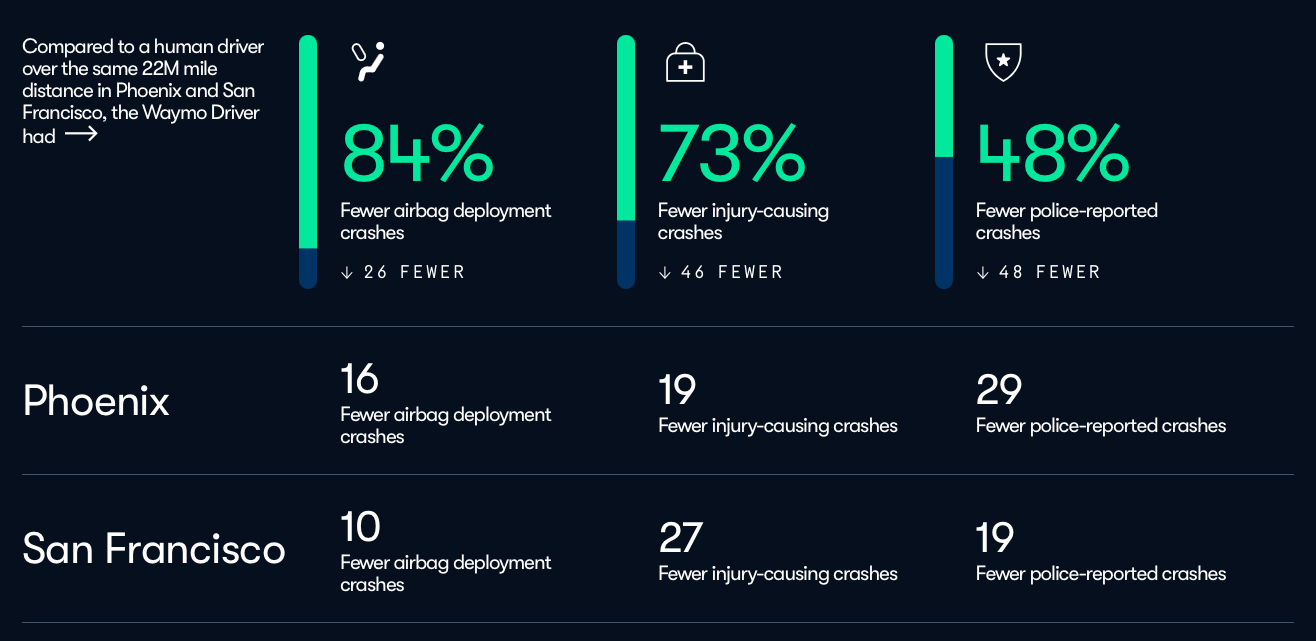
    That said, there is an argument to be made that AVs are already safer than human-driven ones. Through to June 2024, Waymo had already logged over 22 million rider-only miles. And here is what it is now reporting in terms of airbag deployments, injury-causing crashes, and police-reported crashes:

    All of them are lower than their respective benchmark crash rates.

  • Barcelona’s short-term rental ban

    Our growing desire — and ability — to live, work, and/or play in other places is, in my opinion, a powerful macro trend. We spoke about that here, here, and here. And one of the things that has obviously empowered this trend is the growth of short-term rentals.

    But right now, the winds are not in favor of this model.

    In September 2023, nearly a year ago, New York City enacted one of the strictest short-term rental laws to date, requiring hosts to be physically present while a dwelling is being rented. Yeah, that eliminates the majority of use cases.

    Then in June of this year, Barcelona mayor Jaume Collboni announced a complete ban of short-term rentals starting November 2028. This is expected to return some 10,000 apartments to the long-term housing market.

    Regardless of whether it will be effective, it is obvious why this is being done: housing unaffordability and too many annoying tourists. (We are flying to Barcelona next week and will endeavor to not be annoying.)

    But at the end of the day, this is not going to extinguish our underlying desire to live, work, and play around the world. So I think these restrictions will create new opportunities to service this demand. It also strengthens the bull case for the tried-and-true formula of purpose-built hotels.

  • Apple’s next best thing is on the road

    I hate driving (specifically in the city), but I am fascinated by the next generation of Apple’s CarPlay, which I recently wrote about, here.

    One of the reasons why I’m fascinated is because so much of our built environment is built around the car. And since the built environment tends to be very sticky, I think one can safely assume that — for better or for worse, it’s actually worse — we’re going to need a lot of cars for the foreseeable future.

    According to Apple, 98% of new cars in the US come with CarPlay already installed. So, all cars. And the obvious reason for this is that many or most people want it. According to this survey, about 1/3 of new car buyers say that they wouldn’t buy a new car if it didn’t have Apple CarPlay or Android Auto.

    Apple believes this number is much higher at 79% of US buyers. I don’t know what the right number is, but I do believe the number is substantial and probably closer to Apple’s than the 1/3 figure. I certainly wouldn’t buy a new car without CarPlay.

    The result is a suboptimal situation for carmakers. Apple is still going to do whatever it takes to make carmakers want to use CarPlay. My recent post was largely about the design efforts that they have undertaken. But in the end, I’m not sure the auto industry has much of a choice.

    There’s likely no way they’re going to be able to compete with Apple (and Alphabet) from a software perspective and, in the end, consumers are going to want whatever pairs perfectly with their existing phone, since that’s where their entire life already lives.

    No wonder Apple killed their car project. They can just use everyone else’s cars. Even if this is a departure from their typical approach of controlling both the hardware and software.

  • The next generation of CarPlay

    Apple had plans to make an electric car. Then, earlier this year, it cancelled that project. Now, the plan seems to be to just get Apple CarPlay into everyone else’s cars.

    This is obviously smart, because it expands the Apple ecosystem, but it also means that they have to make it so that automakers want them in their cars.

    And since car companies have their own brands to manage, you end up with a somewhat unique scenario where Apple doesn’t own and control both the hardware and software, and it needs to be flexible in order to scale.

    This is if they want to control all of this:

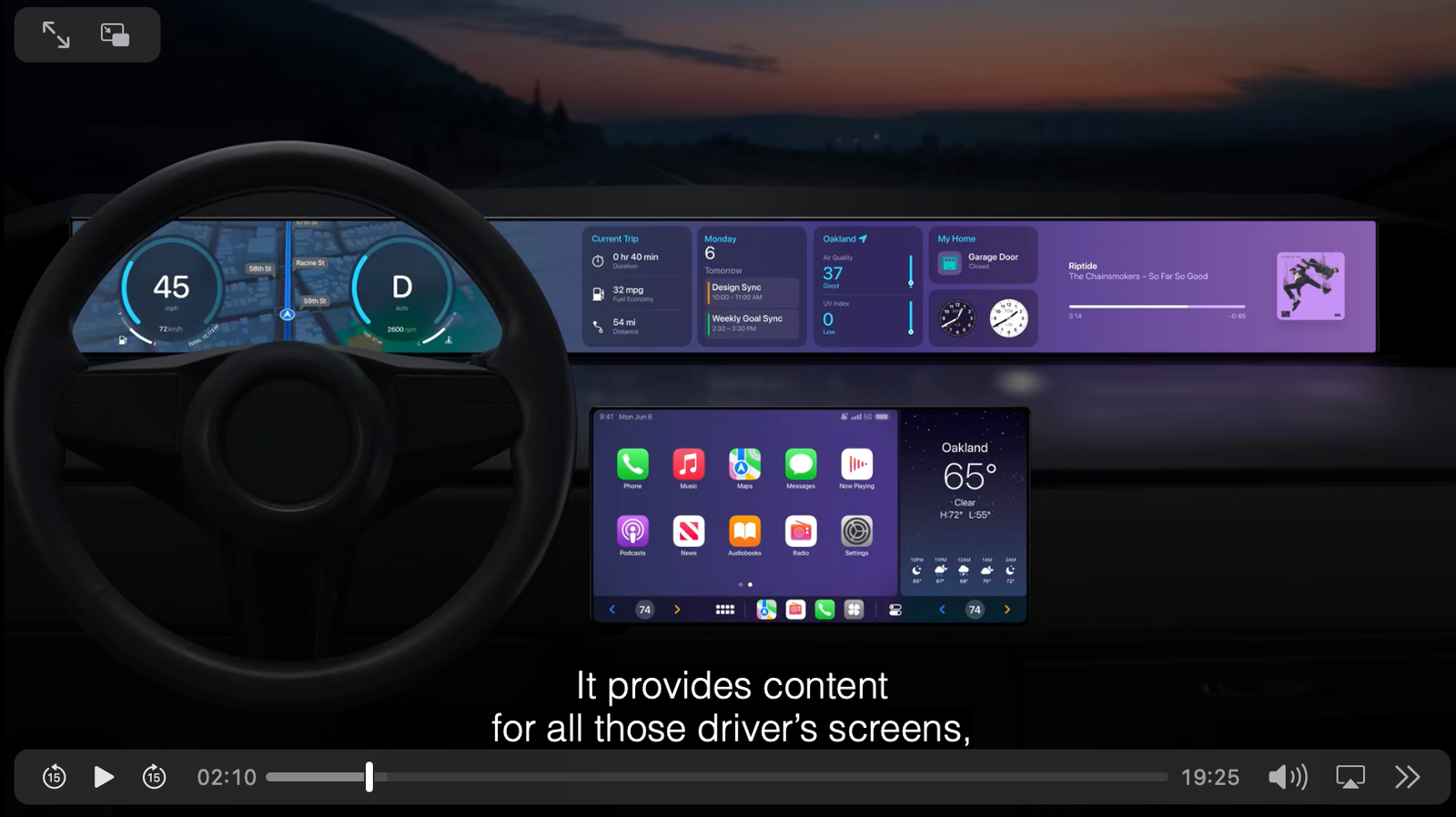
    The solution: A special co-branded experience that is going to allow car makers to heavily customize the appearance of CarPlay such that it reads as their own brand. This is how the next generation of the software will work and I think it’s a fascinating balancing act.

    Here’s another screenshot:

    If you’re also interested in this sort of thing, here’s a video explaining the new CarPlay’s design system. It’s primarily aimed at automakers and system developers, but you’ll also like it if you’re a designer.

  • Be your own bitch

    I just joined Warpcast. You can find my profile, here.

    At first glance, Warpcast is going to look a lot like X. But instead of tweets, you cast. There are also various topic channels, similar to how Reddit works. But the most important difference is that Warpcast is a client for the Farcaster protocol, which is a social network built on Ethereum. This means that it is a decentralized social network.

    You won’t see of any this if you decide to sign up. All of the esoteric crypto things are hidden in the background. But it’s there. And it ultimately means that, as a user, you get to own your online identity and whatever content and following you create. Meaning, you can take it with you if you decide you no longer want to use Warpcast and instead want to access the network through another client.

    It also means that software developers now have a real incentive to build things on top of the protocol, because unlike with a centralized service like X, they can be confident that they won’t get the rug pulled out from underneath them. And herein lies the feature that will ultimately lead to an enormous amount of new ideas and innovation.

    In real estate terms, you can think of developing on top of a centralized service like building within a theme park owned by a single company. The theme park might want you to build on their land, right now, but if at some point it no longer suits their business needs, they can always change the game on you.

    On the other hand, building in a city on land you own outright is a lot like developing on top of a decentralized service. Sure, you need roads and municipal infrastructure to service your land (think of these like the above protocol), but you generally don’t need to worry that the city might wake up one day and remove all of this important infrastructure. It’s a given. And that’s a fundamental difference, even if the buildings might look the same in the end.

    Venture capitalist Fred Wilson once explained it in this way, “don’t be a Google bitch, don’t be a Facebook bitch, and don’t be a Twitter bitch. Be your own bitch.” What he meant by this is that if you build on someone else’s land, then you’re opening yourself up to being their bitch. What you want to be is your own bitch. And similar to how our cities work, this is the potential of decentralized services.

    As I write this post, I currently have 6 followers on Warpcast. If you’d like to be number 7, you can follow me here.

  • Amazon moves away from “Just Walk Out” technology at its grocery stores

    Back in 2018, Amazon opened its first cashier-less grocery store. The technology — which it later branded as “Just Walk Out” — was intended to allow customers to do exactly that. All you had to do was put items into your cart and walk out of the store. And then, through the magic of sophisticated computer vision, machine learning, and lots of sensors, you would be billed and sent a receipt.

    However, this month the company announced that it will be moving away from this technology, and instead focusing on its Dash Carts (more on this shortly). It turns out that the technology wasn’t nearly automated enough.

    Last year, The Information reported that “Just Walk Out” was relying on at least 1,000 off-site workers in India to constantly review video footage and figure out who had bought what. This is why it apparently took so long to receive a bill sometimes; humans far away were working to figure out if that was a persimmon in your hand, or a tomato.

    I’m not an expert on this space, but I’m guessing it is not (yet) feasible to do what Uniqlo and other retailers now do with their supply chains and checkouts. So this was the workaround. Whatever the case, Amazon has now said that it will be focusing on its Dash Carts, which are kind of like roaming checkout counters. They come with screens and scales for weighing things.

    Obviously the ideal solution is to not have to do or scan anything. But being able to avoid check-out lines still feels like meaningful progress. I just wonder if these smart carts will encourage or discourage spending. Because now everyone will have a live receipt in front of them. That might discourage spending unless you can offset it with rewards and/or other incentives.

  • Work, untethered

    On Monday morning, I flew on Delta from Salt Lake City to Toronto, which in this direction takes just over 3 hours. And it was my first time ever experiencing reasonably reliable wi-fi on a flight. Maybe this is already common for the people who fly in the front of planes, but for me, I’ve never had the wi-fi work so well.

    Usually it goes like this: I try and connect, everything is painfully slow, and so I get frustrated and move on. But this time around, I was able to check all of my emails, download fairly large PDFs, mark them up on my iPad, and write yesterday’s blog post. It was pretty great, and it allowed me to land in Toronto with far less anxiety around my work backlog.

    But it also got me thinking about what this means for travel and work. If you’re a regular reader of this blog, you’ll know that I greatly prefer working in an office with my team. I think proximity matters.

    At the same time, I recognize that technology is empowering new kinds of remote work, that we are all becoming more globally connected, and that, in the future, most of us are likely to travel more, rather than less. This will be for both work and for fun.

    While solid in-flight wi-fi may not seem like that big of a deal, in my mind it’s a game changer. People will become more mobile if they can sit on flights and actually be productive (and maybe Apple Vision Pro helps with this). It is another step in what feels like an ongoing untethering of work.

  • You have to try

    Now that some of the dust has settled around Apple Vision Pro, it is clear that nobody really knows if it is going to work. (Though, it’s too expensive and it’s too heavy are missing the bigger picture.) It sounds like it delivered what it said it was going to deliver as a product, and the potential is there for a “spatial computing” future. But who knows for sure. Here’s an excerpt from an essay that Benedict Evans recently published called, “A month of the Vision Pro“:

    Second, taking one step further back again, even if my doubts are all wrong, we won’t know any of this for years, and right now this is all still in the experimental category. Apple sells more watches in a typical quarter than Meta has active Quest users. Even the iPhone took years to start selling. It’s possible than in five years this will have started to work, and it’s possible than in five years we’ll have concluded that this [AR/Apple Vision Pro] is a niche, and we’ll have to wait for glasses, contact lenses or neural implants.

    But ultimately, this is okay. You have to try, because:

    Thank you to Lucas Manuel for sending me the above quote.