Daily insights for city builders, delivered every morning at 6 AM ET. I’m Brandon Donnelly — a Toronto-based real estate developer and founder of Globizen. I’ve been writing here since 2013.

Category: Vancouver

  • We need pipelines to build a post-oil Canada

    November 18, 2025 · View original


    I’m not sure that oil is Canada’s only economic hard power, but it has to be our largest:

    > “To effectively use oil, Canada’s only economic hard power, Carney needs to get not just one, but two pipelines built,” said Adam Waterous, chief executive of Calgary’s Waterous Energy Fund, a major oil sands investor.

    It’s hard to imagine a more strategically important investment for Canada. Right now, virtually all of Canada’s oil exports go to the US. That gives us zero leverage. We are price takers! To correct this, we need to diversify our customer base. And the only way we do that is by building pipelines to our coastlines and then selling to the rest of the world.

    But beyond shoring up our economy, I’d argue that this is also the way we accelerate decarbonization. Here’s the plan: We get rich, and then reinvest the profits into renewable energy, the world’s largest sovereign wealth fund, and critical nation-building infrastructure like housing, transport, and education.

    Oil and gas profits won’t last forever. This is about building for that future.

    Cover photo by Chris Liverani on Unsplash

  • The market for three-bedroom apartments isn’t what you think

    November 2, 2025 · View original


    Erica Alini of The Globe and Mail just published this article called, “The era of the shoebox condo is over.” You should read it, and not just because I’m quoted in it. One thing that I appreciate about the article is that it gets into some of the development economics underlying new projects.

    The high-level math provided by Bryn Davidson of Lanefab (Vancouver) once again shows that land is the residual claimant in a pro forma and that the price developers can feasibly pay needs to be greater than the status-quo value. It’s exactly what I was getting at in this recent post about the Impossible Toronto publication.

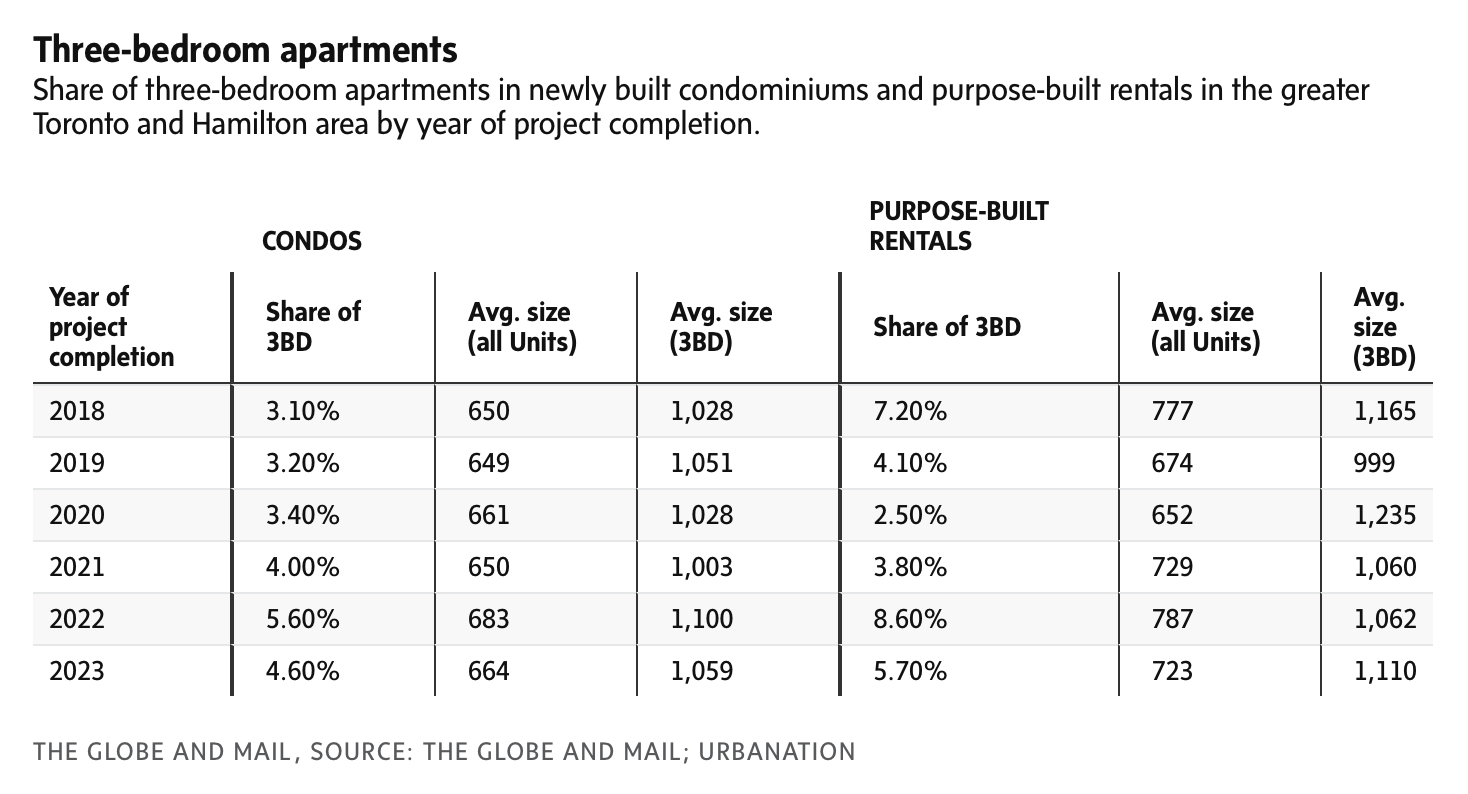
    The other thing I’d like to highlight is the following chart showing the share of three-bedroom apartments in newly built condominiums and purpose-built rentals in the city:

    What’s interesting about this six-year period of completions is that there isn’t a meaningful difference between condominiums and rentals. Average unit sizes as a whole tend to be slightly larger in rental projects, but in terms of the share of three-bedroom suites and the average size of those three-bedrooms, the differences aren’t meaningful.

    This suggests that it’s less about investors “distorting” the market (see pundits talking about the condo market), and more about the fact that the demand isn’t there. And the reason the demand isn’t there is because these types of homes are expensive. If you can afford $5,000 per month in rent, you generally have some options.

    Table from the Globe and Mail; cover photo by Lotus Design N Print on Unsplash

  • Winning and losing at the same time

    October 16, 2025 · View original


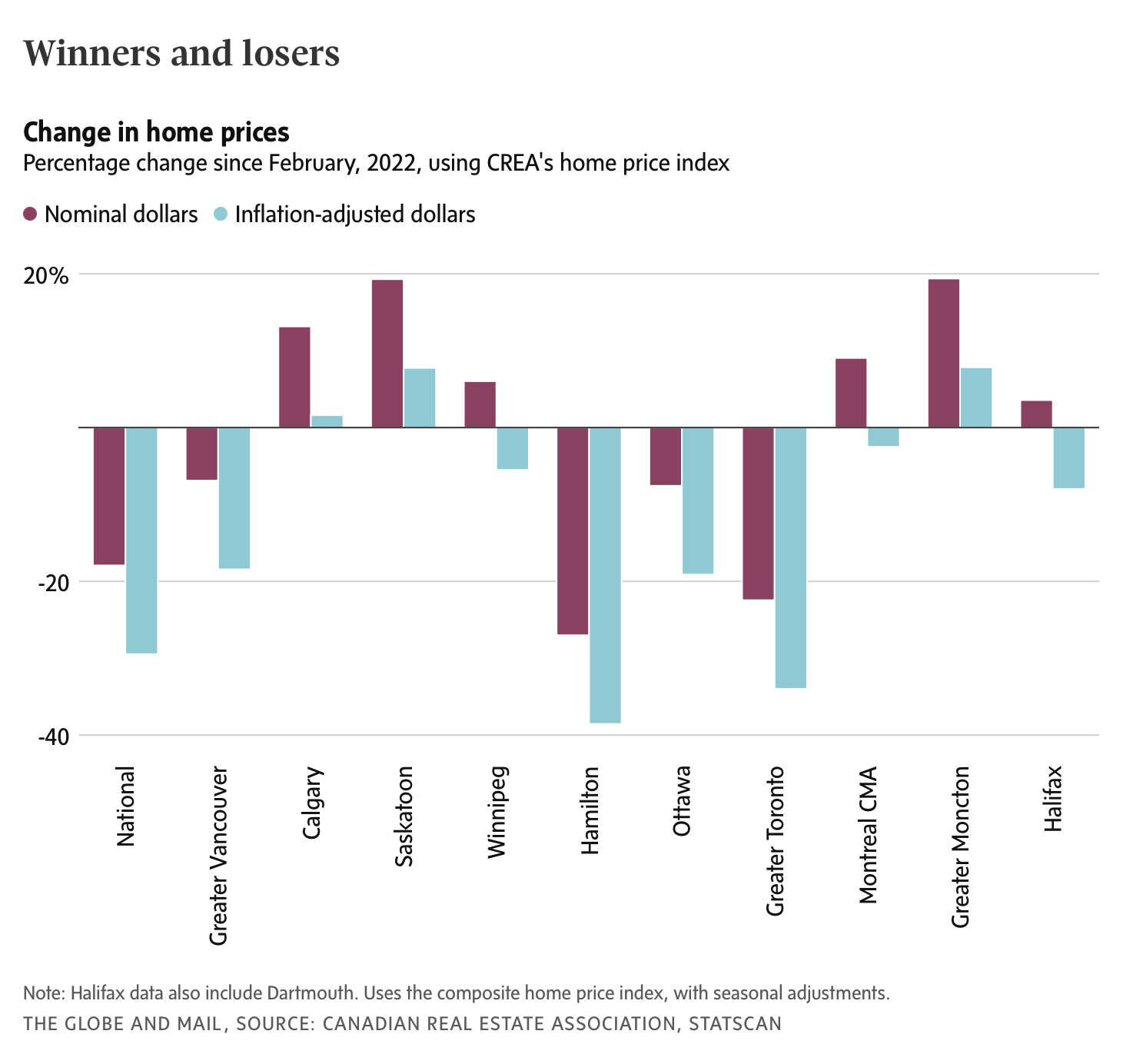
    The Globe and Mail just published this article about Canada’s real estate markets. It’s behind a paywall, but if you’re able to access it, you’ll find 10 housing charts. The first is called “Winners and losers,” and what it shows is the percentage change in CREA’s home price index since February 2022 — which, in hindsight, was the top of the market. (I don’t know what the end date is for this data, though.)

    The first thing you’ll see is that, very broadly, there’s Southern Ontario and Greater Vancouver, and then the rest of Canada. Prices have fallen materially in Canada’s most expensive markets, whereas in cities like Calgary, Saskatoon, and Moncton, nominal home prices are up by double-digit percentages. There isn’t just one Canadian market.

    The other thing I found interesting is the title “Winners and losers,” because it reminded me of the great paradox of modern housing policy. And by this I mean: which cities are winning and which are losing? If you already own a home, then winning is positive price appreciation. But if you don’t already own a home and you’d like to in the future, well then, falling home prices is winning — they’ve just become more affordable.

    Not surprisingly, it’s hard solving for two opposing kinds of winning.

  • When should foreigners be allowed to buy homes?

    August 1, 2025 · View original


    Given how nice it is outside right now, some of you may be forgetting that Canada does have winter. And it is largely because of winter that we are the biggest foreign buyer of homes in the state of Florida (and the US as a whole for that matter). In 2024, Canadians bought over $2.4 billion worth of homes in Florida. And between April 2023 and March 2024, it is estimated that Canadians accounted for nearly 25% of all foreign home sales in the state (this is according to the National Association of Realtors).

    Because of this strong demand, I would imagine that many and perhaps even most Canadians would tell you that being allowed to buy a home in the US — or elsewhere in the world — is a nice freedom to have. (Although demand is waning because of the strong US dollar and because of the current geopolitical climate.)

    If we flipped this around and asked Canadians whether foreigners should be allowed to buy homes in Canada, I suspect that we might get a different leaning. And that’s why there is the Prohibition on the Purchase of Residential Property by Non-Canadians Act (which is currently set to expire on January 1, 2027). This was and likely still is the politically popular thing to have in place.

    Now, it could be the case that these two groups are mutually exclusive. In other words, the people who own homes outside of Canada (a small minority) do not overlap with the people who support a ban on foreign buyers (the majority). And so when looked at in aggregate, the majority of Canadians do in fact want this ban. That said, I would not be surprised if Canadians buy more homes abroad than foreigners buy homes in Canada, which would make our current policies, at the very least, mildly hypocritical.

    Whatever the case may be, it is in the news this week that some of the largest builders in British Columbia have just sent a letter to our governments arguing that the foreign buyer ban and BC’s foreign buyer tax need to be reconsidered — or modified to something that resembles Australia’s model. (Australia restricts foreign ownership to newly constructed homes and pre-sales. Foreigners can’t buy resales.) The letter was signed by 25 companies including developers like Amacon, Beedie, Strand Development, and Westbank.

    At the very least, I think there’s a strong argument to be made that pre-construction and new home sales should be exempt from the ban. Most people probably don’t appreciate that developers rely on pre-sales to finance the construction of new homes. It is significantly more challenging for end users to buy in this same way given how long projects take. We can certainly have a conversation about whether this is the optimal financing approach, but it is the way things work today.

    So my view is this: If foreign capital wants to finance new housing and help increase our overall housing supply, that’s a good thing. Let’s take their money and use it to build lots more homes for Canadians. With this approach, foreigners won’t be competing for our existing housing stock and, over the longer term, it is likely that most of these pre-sales will end up as new rental supply or as a resale home for Canadians.

    The alternative is building fewer new homes, waiting until there’s a worse housing shortage, and then turning the industry back on to deliver new homes in 5-7 years.

    Cover photo by Denys Kostyuchenko on Unsplash

  • Canada should be celebrating Vancouver’s new Terminal 2 port

    July 14, 2025 · View original


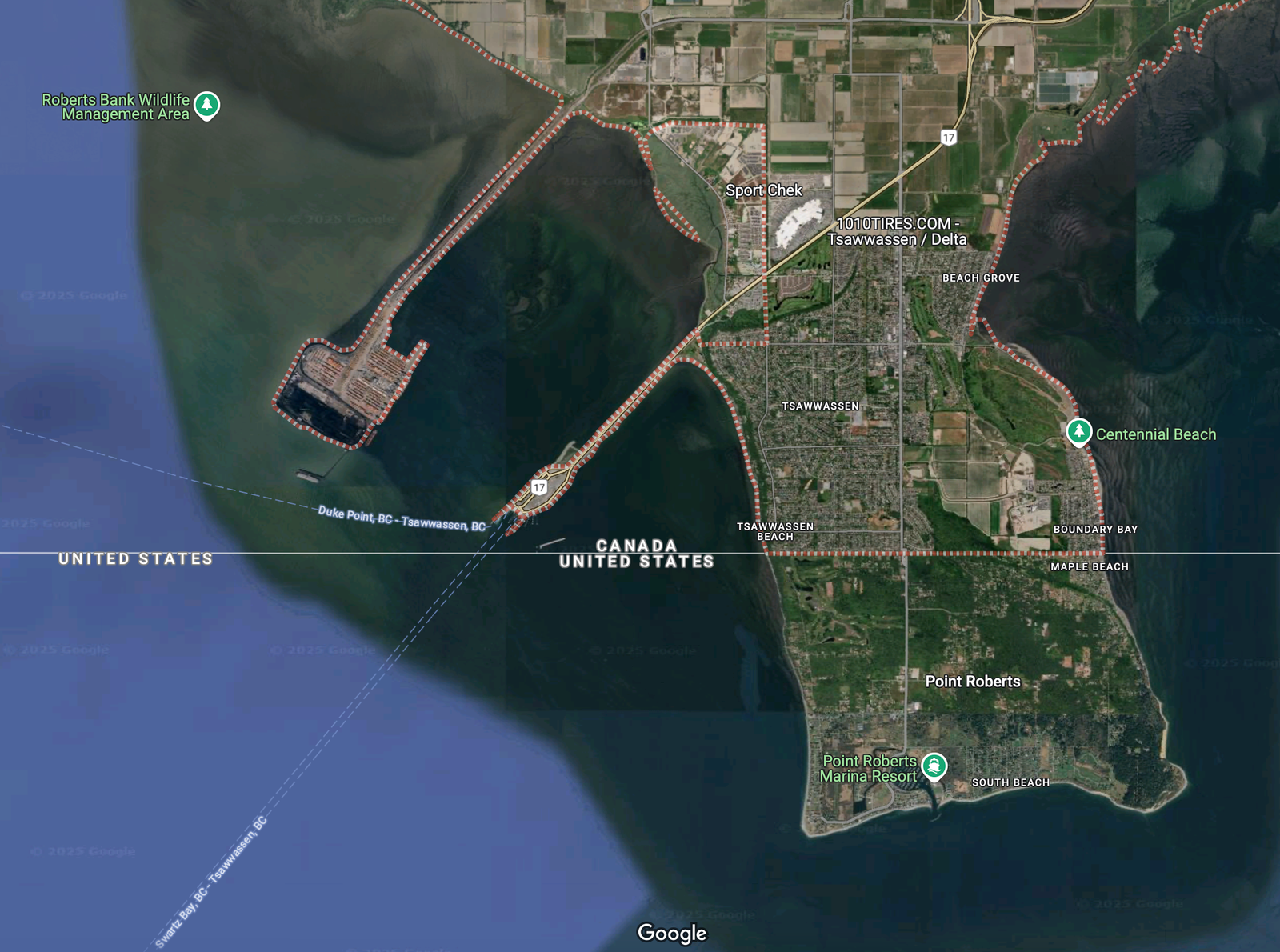
    Last week, the Vancouver Fraser Port Authority kicked off procurement for the new Roberts Bank Terminal 2 project by issuing a request for qualification (RFQ). Bidders now have until September 25, 2025 to submit their qualifications with the hopes of eventually being selected to deliver this “nation-building project” in the Lower Mainland of BC.

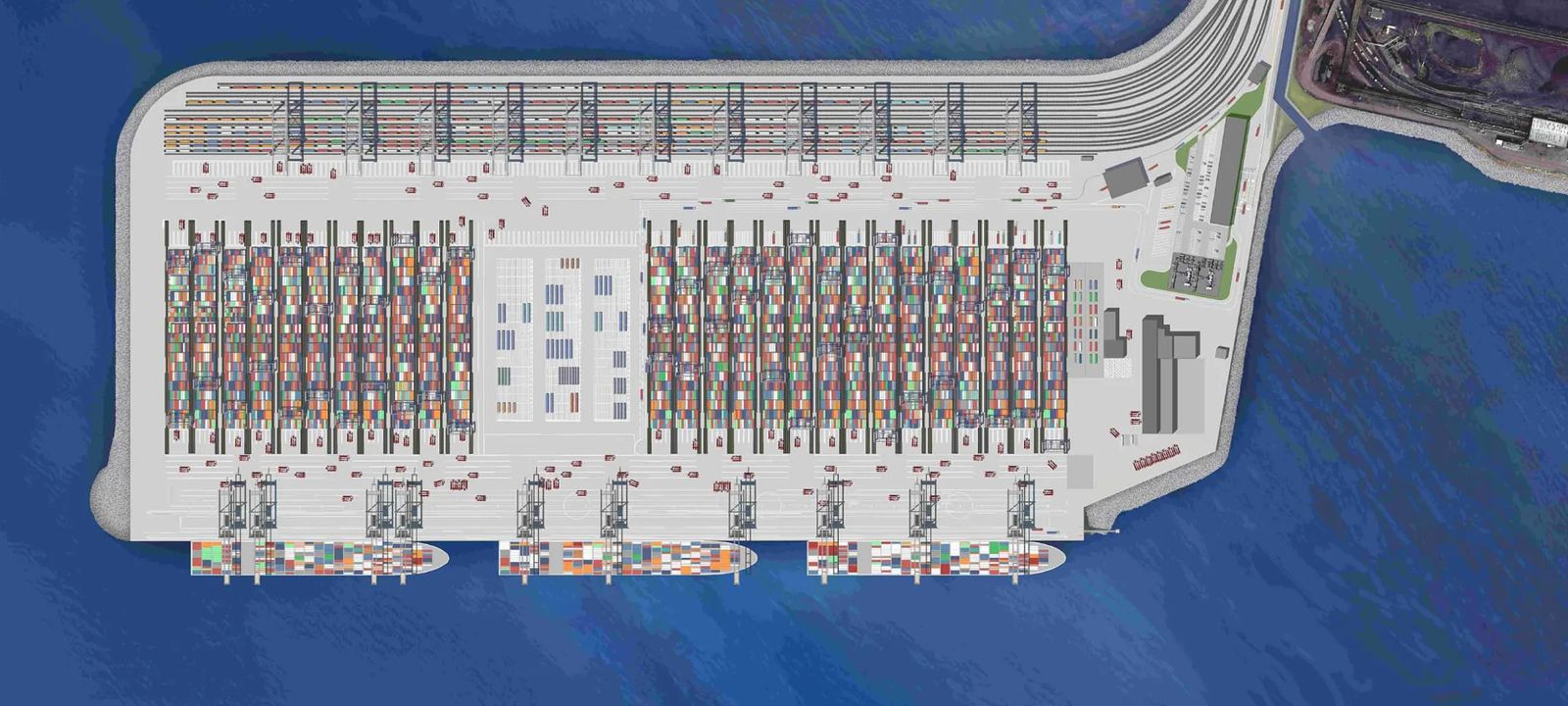
    The contract will include the delivery of an approximately 100-hectare marine landmass (~247 acres), 35-hectare widened causeway, 1,300-meter wharf structure and berth pocket, and expanded tug basin. And when complete by the mid-2030s, the new terminal is expected to create more than 17,000 well-paying long-term jobs, unlock $100 billion in new trade capacity, and contribute somewhere around $3 billion in annual GDP.

    Here’s a rendering of the new marine landmass:

    The Port of Vancouver is the largest port in Canada by tonnage and TEUs (twenty-foot equivalent units). It’s also one of the largest in North America. This expansion is expected to increase its capacity by up to 50%, which could have it leap ahead of several major US ports by the time it’s complete in the mid-30s. That could place it among the top 4 container ports in North America.

    It would be hard to overstate the importance of this project for Canada. The economic center of gravity for the world is steadily moving toward East Asia. In the 1980s, if you were to map and drop a pin at this economic center — according to GDP — it would have landed in the North Atlantic (between the US and Europe). By 2030, this economic center is projected to be near the border of India and China.

    Already, China is Canada’s second largest trading partner (after the US). And over 60% of the container trade flowing through Vancouver is transpacific. More specifically, it is trade with China, Japan, South Korea, Vietnam, and India. If we don’t expand our port capacity and if we allow our container supply chain to become bottlenecked, well then these containers will simply shift south to the US West Coast. It’s that simple.

    Though this project was approved by the federal and provincial governments in 2023, it has faced stiff opposition from local community groups and environmentalists. This is partly why it took approximately 10 years. The Federal Environmental Assessment process began in 2013. And it wasn’t until April 2023 that the feds granted approval with a list of 370 legally binding environmental conditions.

    What this means is that by the time this project is (hopefully) complete in the mid-30s, it will have taken at least two decades! And perhaps even longer knowing how construction works. This is far too long, which is obviously why we are working to make changes to how we, as a country, green light important nation-building projects. There’s no question that this is one of them, and so today I think it’s important to celebrate this milestone.

    It’s time to build, Canada. And as fast as possible.

  • Toward smaller condominium apartments

    Statistics Canada recently published some data (from 2022) looking at investors in the condominium apartment market. Here is what they believe to be the share of condominium apartments used as investment properties in Ontario’s 10 largest census metropolitan areas:

    It’s worth noting that this is after excluding condominium buildings where every single suite is owned by a single investor. This is/was most prevalent in London, and it’s the result of there being property tax benefits to registering a condominium (individual unit assessments), even though for all intents and purposes it’s a rental building (building in its entirety assessed).

    The article goes on to rightly suggest that the prevalence of investors, and the way that condominiums are financed, could be leading to the construction of more buildings with smaller suites. Here’s the proportion of new condominium apartments under 600 square feet by period of construction:

    The unsurprising takeaway is that condominium suites have gotten smaller. In the 1990s, the average condominium apartment built in the Toronto CMA was 947 square feet. This is compared to 640 square feet after 2016. And the same thing happened in Vancouver, which went from an average of 912 square feet to 790 square feet.

    Investor preferences certainly have something to do with this. But what the article doesn’t specifically mention is that this phenomenon is also a direct response to rising build costs: making suites smaller was how the market tried to maintain some level of affordability. Put differently, imagine how expensive new condominiums would be if the average size was still 947 square feet.

    But there are obviously limits to this. I was with one of our architects the other week and he made an interesting comment to me. He said, “Brandon, before when build costs used to go up and things got less affordable for consumers, we could just make the suites smaller to offset the impacts. But I don’t see how we can go any smaller now. We’ve reached the limit.”

    This is one of the reasons why I think this downturn is going to ultimately be a good thing for Canada’s housing markets. It’s a reset. It’s forcing everyone out of complacency and, hopefully, it means that when the next cycle begins we’ll be starting from a better foundation.

  • Vancouver’s social housing initiative

    Vancouver just put forward a bold proposal to encourage more social, or non-market housing, across the city. As drafted, new social housing projects up to 6 storeys would be permitted as-of-right in “villages” and social housing between 15-18 storeys would be permitted as-of-right in “neighborhood centers.” This is a big deal. I mean, look at the above map. Between these two area designations, big chunks of the city would receive these new permissions. For more information on the proposal, check out this short video.

  • What rules should we be breaking?

    Here is another great video from About Here talking about how breaking certain rules could make for better apartment buildings.

    The basis for the video is a design competition put on by Urbanarium, called Decoding Density, which asked participants to propose creative solutions for “six-story plus apartment forms in Metro Vancouver.”

    More specifically, the competition asked: How might Vancouver intensify its single-family neighborhoods with small-scale wood-frame apartments?

    The About Here video covers some of the common themes from the submissions and, not surprisingly, the first is single-stair buildings. Requiring only a single point of egress can really unlock small sites.

    Some of the other ideas are, perhaps, a bit more adventurous; but these are valuable exercises. Many rules are dumb. So it’s important that we continually question them and search for better ways.

  • This slash that

    Maison Kitsuné is a French-Japanese lifestyle brand that was founded in 2002 as both a record label and a fashion house. Apparently, the founders — Gildas Loaëc and Masaya Kuroki — started out by DJ’ing in order to promote their brand and clothes.

    In 2005, they released a full ready-to-wear collection and, according to Wikipedia, fashion has come to represent about 90% of the company’s revenue (2020 figure).

    In 2013, Kitsuné opened their first coffee shop in Tokyo. And since then, they have expanded around the world, opening cafes in Paris, Vancouver, Shanghai, and many other cities. As of today, I think they have 35 around the world.

    Their latest venture is something a bit new though. It’s called Desa Kitsuné, it’s located in Canggu, Bali, and it’s their first ever clothing shop/restaurant/club. It also comes with a pool and the idea is that you can do lots of different things here: shop, lounge during the day, and/or party at night.

    I always find it interesting when different ideas and approaches are combined. And that’s what Kitsuné continues to do. They also plan to do more of it. According to Monocle, the company wants to reach 100 cafes/restaurants around the world in the next 5 years.

    So keep an eye out for more foxes in your city.

  • Adding missing middle housing in Vancouver

    The City of Vancouver recently published this video talking about missing middle housing. For those of you who are following this trend (and reading this blog), there won’t be a lot that is new in the video (although Uytae Lee is great). But I’m sharing it here, anyway, for three reasons. One, it’s an example of Toronto being ahead of Vancouver, which wasn’t the case with laneway housing. Vancouver started allowing these first. Two, it is further evidence that this shift toward intensifying low-rise residential neighbourhoods is really happening — and gaining momentum — all across North America. And three, the City of Vancouver is about to bring forward new multiplex housing policies. So now is a good time to get involved and say things.