Daily insights for city builders, delivered every morning at 6 AM ET. I’m Brandon Donnelly — a Toronto-based real estate developer and founder of Globizen. I’ve been writing here since 2013.

Category: Places

  • Hudson Yards opens in New York

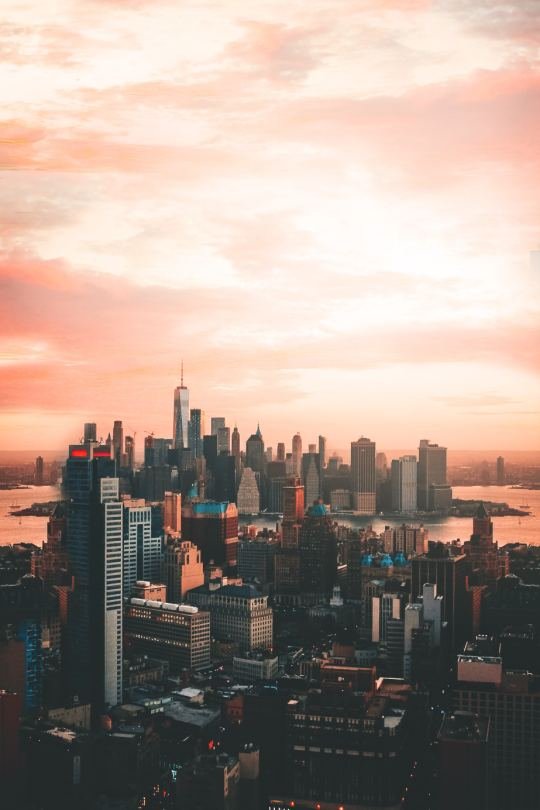
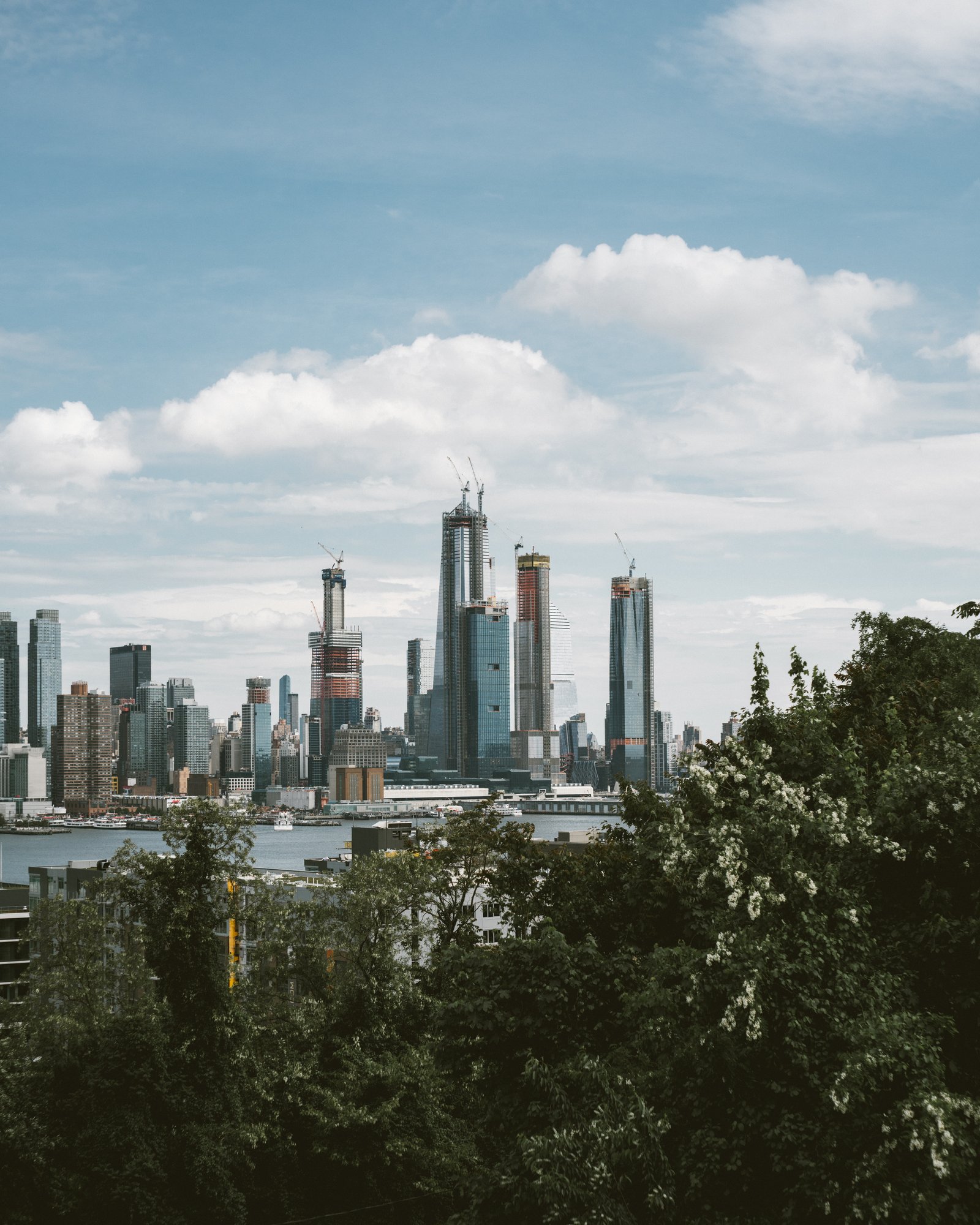
    Hudson Yards officially opened today on the west side of Manhattan. More specifically, the eastern half of Hudson Yards opened. There’s a second phase to come on the western yards. And the highly anticipated observation deck at 30 Hudson Yards — the highest outdoor observation deck in the Western Hemisphere — is also not quite ready. It is expected to open in early 2020.

    Considered the largest mixed-use private real estate project in American history by square footage, Hudson Yards has been in the works for many decades and was previously part of New York’s (failed) bid for the 2012 Olympic Games. Dan Doctoroff, who is now the CEO of Sidewalk Labs, led the bid under the Bloomberg administration.

    So today is a bit of a big deal.

    To commemorate the opening, the architecture critic for the New York Times, Michael Kimmelman, published this searing, but highly visual, piece about the project. I think it is fairly safe to assume that he isn’t a huge fan (he doesn’t seem to love developers either).

    Here’s an excerpt talking about Thomas Heatherwick’s Vessel:

    Purportedly inspired by ancient Indian stepwells (it’s about as much like them as Skull Mountain at Six Flags Great Adventure is like Chichen Itza) the object — I hesitate to call this a sculpture — is a 150-foot-high, $200 million, latticed, waste-basket-shaped stairway to nowhere, sheathed in a gaudy, copper-cladded steel.

    It preens along the critical axis between the High Line and the newish No. 7 subway station at Hudson Yards, hoping to drum up Instagram views and foot traffic for the mall, casting egregious shadows over what passes for public open space, ruinously manspreading beside the Shed, the most novel work of architecture on site, and the only building the private developers didn’t build.

    If any of you have formulated your own opinions about Hudson Yards, I would love to hear from you in the comments below. I’m looking forward to exploring the neighborhood in person sometime soon. If you’re interested in learning more about the project, Curbed also just published, The ultimate guide to Hudson Yards.

    Photo by Sandy Ching on Unsplash

  • New York’s “pied-à-terre tax” explained

    New York is close to implementing new “pied-à-terre tax.” If the bill passes, which the New York Times believes is likely, cities of a million or more people will be able to levy an additional property tax on non-primary residence homes worth $5 million or more. The additional tax would be based on the following sliding scale:

    So let’s say for argument sake that you own a pied-à-terre in New York City worth approximately $238 million. Based on the above, your additional tax would be $370,000 + [4% x ($238 million – ~$25 million)]. That’s almost $8.9 million. Most of the revenue from this tax is expected to come from this upper (and open-ended) valuation bracket.

    New York City estimates that the tax could bring in about $650 million annually. The state in turn believes it could then raise $9 billion in bonds. And the intent is that these additional funds could be used to fund things like transit and housing. I am curious how elastic the demand is for trophy real estate in New York.

    Another thing I noticed while reading up on this bill is that the New York State Senate has made it pretty easy to voice your opinion on proposed legislation. On the sidebar of every bill making its way through the system is a box that looks like this:

    This is probably the clearest engagement tool I have ever seen on a government website. Do you think something like this could work for new housing?

  • New York City’s $35 billion nightlife economy

    image

    The Mayor’s Office of Media and Entertainment in New York City recently commissioned this report on the city’s nightlife economy. The study was completed by Econsult Solutions, the North Highland Company, and Urbane Development. (Full disclosure: I was a teaching assistant for the President of Econsult while at Penn.)

    Here’s what they found:

    The total economic impact of this industry is the sum of its direct, indirect, and induced economic impacts, as well as the ancillary spending impacts that are adjacent to nightlife activity. In 2016 (the most recent year where standardized datasets were available), the nightlife industry supported 299,000 jobs with $13.1 billion in employee compensation and $35.1 billion in economic output. This economic impact also yielded $697 million in tax revenue for New York City.

    They also found that, between 2011 and 2016, the nightlife industry has outpaced the city’s overall economy. Nightlife establishments grew by a 2% annual growth rate. Jobs in the nightlife industry grew by a 5% annual growth rate. And nightlife wages have been rising by 8% annually – about double the average for the city.

    I am a firm believer in the value of the nighttime economy. So I’m happy to see more people paying attention to it as of late. For the full report, click here.

    Photo by Markus Spiske on Unsplash

  • Project Profile: Golf Exécutif Montréal Clubhouse

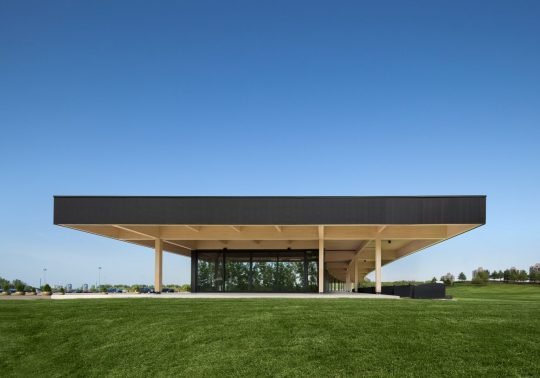
    I’m not a very good golfer (probably because I don’t golf), but this clubhouse in Montréal has me wanting to try my hand at the driving range again. Designed by Architecture49, the clubhouse itself is 855 square meters, but the roof area is around 1,800 square meters – so more than double as a result of the overhangs that protect golfers from poor weather. Black zinc panels and pale wood get me every time.

    Images: Dezeen

  • Vancouver revisits laneway house program

    Vancouver is light years ahead of Toronto when it comes to laneway housing/suites. And by light years I mean that their Laneway House (LWH) Program is about a decade old now.

    Last month the City of Vancouver published this staff report which outlined recommendations for improving the program. It includes simplifying the regulations, reducing processing timelines, and improving livability in LWHs.

    This aligns with their Housing Vancouver Strategy (2018-2027), which has set a target of 4,000 new LWHs over the coming ten years. That may not seem like a lot and certainly it won’t solve everything, but I reckon that 4,000 is better than 0.

    The city also estimates that approximately 50% of these new LWHs will be two and three bedroom homes, which makes them a viable housing solution for families who want to remain in the city. (Related post: Where are all the kids?)

    There’s a lot of good stuff in the staff report if you’re so inclined, but I’ll leave you with a few facts about the current LWH program in Vancouver. 90% of LWHs are built along with a new house. And 45% of all new houses, so almost half, are now built with a LWH.

    Only 10% of LWHs are single storey, which certainly helps to support the above percentage of two and three bedroom homes. And in both 2016 and 2017 over 500 building permits for LWHs were issued each year.

    So 4,000 LWHs over the next decade may actually be a fairly conservative estimate. Thank you to Michael Geller for sending me this staff report.

    Photo by Spencer Watson on Unsplash

  • How New York City became boring

    image

    On the cover of the July 2018 issue of Harper’s Magazine is a picture of New York City – with Rafael Viñoly’s 432 Park Avenue as the focal point – and the title: Death of a Great American City. New York and the Urban Crisis of Affluence.

    The long-form article is by Kevin Baker and it is an account of how New York City has transformed itself over the past few decades from a place of culture and character (and of cockroaches and discarded crack vials) into a place for the ultra-wealthy to buy ultra-luxury real estate that may or may not sit empty for more often than it is occupied.

    “As New York enters the third decade of the twenty-first century, it is in imminent danger of becoming something it has never been before: unremarkable. It is approaching a state where it is no longer a significant cultural entity but the world’s largest gated community, with a few cupcake shops here and there. For the first time in its history, New York is, well, boring.”

    This narrative and/or phenomenon is of course not unique to New York City, though it is surely more pronounced when you are one of, if not the, preeminent global city. In fact, I was sent this article by a reader who was wondering about the possible parallels here in Toronto. Thank you Natasha.

    The desire, which is how Baker ends his article, is that New York City should be a city of “workers and eccentrics” as well as “visionaries and billionaires.” It should be a place for “street photographers” and “hedge fund operators.” That sounds like a pretty cool place to me.

    But we all know how challenging this has proven to be for cities.

    Photo by Dean Rose on Unsplash

  • New York City’s retail vacancy problem

    The New York Post has some interesting articles, here and here, on the growing retail vacancy problem in NYC. (Thank you Michael for the link in the comments this week.)

    The vacancy rate on Amsterdam Avenue in the Upper West Side is said to be around 27% and it is said to be around 20% on a stretch of Broadway in Soho. It has become such a problem that Mayor Bill de Blasio wants to implement some sort of retail vacancy tax:

    “I am very interested in fighting for a vacancy fee or a vacancy tax that would penalize landlords who leave their storefronts vacant for long periods of time in neighborhoods because they are looking for some top-dollar rent but they blight neighborhoods by doing it,” he said on WNYC. “That is something we could get done through Albany.”

    But this is based on the assumption that greedy landlords are simply holding out for exorbitant rents. It doesn’t consider the fact that, maybe, there is simply too much retail space:

    Only a few grasp the true scope of the problem. Vornado Realty Trust titan Steven Roth said we can only cure the national plague through “the closing and evaporation” of up to 30 percent of the weakest space — which would take five years.

    All of this, of course, has me thinking about the future of ground floor main street retail. What are your thoughts?

  • Vancouver’s Empty Homes Tax

    In an effort to curb the much talked-about and much debated empty home situation in Vancouver (supposedly the number is ~20k vacant homes), the city, as many of you know, implemented an Empty Homes Tax.

    To enforce this, the City of Vancouver now requires that every year, every owner of residential property must file a status declaration. If you don’t file this by the deadline, the property is automatically deemed vacant and the tax (1% of assessed taxable value) and a penalty ($250) are applied.

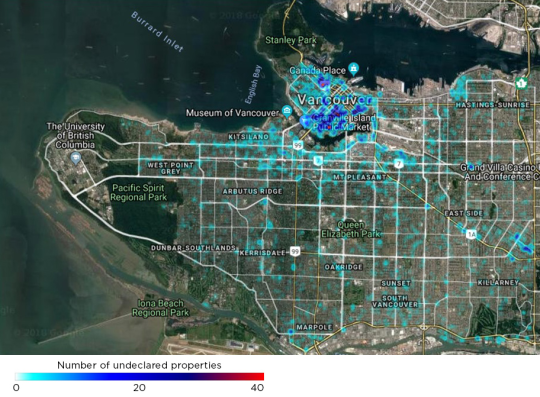
    Last month, 11 days before the 2017 deadline, the city published the below heat map showing the concentration of Vancouver property owners who hadn’t yet made their declaration. There were just under 4,000 undeclared properties.

    image

    But as Jens von Bergmann points out on his blog, Mountain Doodles (great data-driven blog), this was really just a map of where people live. Because if you also create a map of residential properties subject to the tax, which he did, it looks pretty similar to above.

  • Paris syndrome (in China)

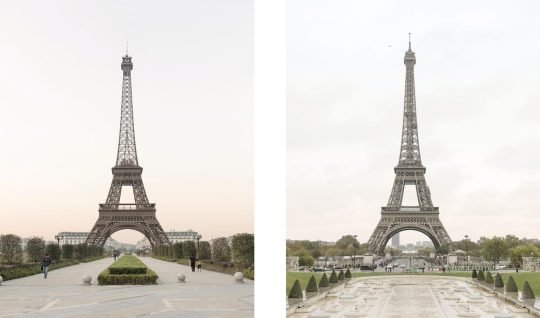
    French photographer and graphic designer François Prost has a new photo series out that I thought I would share with you today. It’s called “Paris Syndrome” and I discovered it via CityLab.

    What the series does is visually compare Paris to a housing estate in Hangzhou, China called Tianducheng, which was designed to be a replica of Paris. Tianducheng even has its own Eiffel Tower, though this Chinese version is only 108m tall and the French original is 324m.  

    image

    Still, in many of François’ photos, you may find it difficult to distinguish between the two (provided you ignore the Chinese people and the Chinese signs). The neighborhood was initially a ghost town, but apparently it’s now starting to fill up.

    The reason I mention this photo series is because it reminded me of the day that I spent in Macau last week. I’m not much for gambling – and Macau is firmly the gambling capital of the world with revenues that greatly exceed Las Vegas – but I was curious to see it.

    Similar to Hong Kong, Macau is a Chinese Special Administrative Region with a lot of autonomy. But from 1557 to 1999 it was under Portuguese administration. And so historically it has been home to this very unique Eurasian culture spanning everything from food to language. 

    I say “historically” because the Macanese and their Patuá language – which is supposedly a blend of Portuguese, Cantonese and Malay – seem to be on the brink of extinction. 

    Today it’s all about the casinos. And the demand is firmly coming from mainland China. In 2016, 90% of Macau’s 31 million tourists came from there.

    I fully appreciate the demand drivers, but I struggle to understand the allure of replicating and bastardizing attractions from other places. Macau also has an Eiffel Tower, as well as a Venetian (like Las Vegas). You can go for gondola rides in its canals.

    The more interesting part for me was the historic center of Macau with its Portuguese paving on the sidewalks. But maybe that’s just me.

    Image: François Prost

  • New York is the only US city with an urban core growing faster than the suburbs

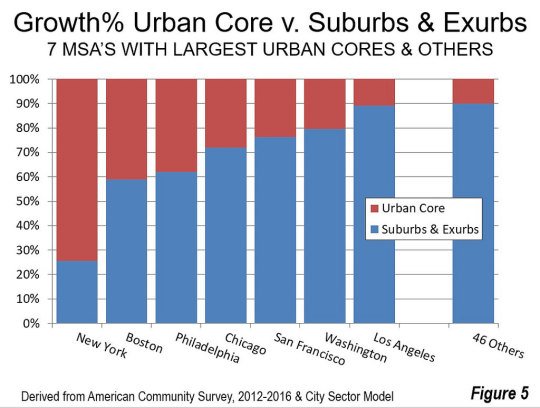
    The latest data from the American Community Survey (2012 to 2016) has placed the suburban and exurban share of the US population (53 major metropolitan areas) at 85.5%. Back in 2000 this number was thought to be around 83.5%.

    Since 2010, automobile oriented suburbs and exurbs have also accounted for 90.5% of population growth. The US – and Canada would be no different – is by and large a suburban nation. And the data suggests this isn’t about to change.

    The one exception is the New York metro area. From 2012 to 2016, 74% of its growth happened in the urban core. No other major metropolitan area in the US comes close to this sort of urbanity. Below is a chart from New Geography that shows you how NYC compares.

    All of the data for this post was also taken from New Geography.