Daily insights for city builders, delivered every morning at 6 AM ET. I’m Brandon Donnelly — a Toronto-based real estate developer and founder of Globizen. I’ve been writing here since 2013.

Category: Planning

  • Using maps on a bike

    I have started using Apple Maps when I cycle. I’ve been using Apple instead Google because it automatically pairs with my watch and tells me (through vibrations) when I need to turn somewhere, but I’m not here to argue that one is better at navigating than the other.

    What’s great about using either Apple or Google Maps is that it will take you on routes that have bike lanes or, at the very least, routes that have less vehicular traffic.

    Toronto’s cycling network is far from complete. But I have been impressed by how far I can go on dedicated lanes and by how many lanes/trails exist that I didn’t know about. Here is the city’s 2024 map showing only dedicated bikeways:

    It is not fun riding a bike when you have to fight with city traffic. And so this is a great way to try and avoid that, and not think too much about which routes you should be taking. It’s also a great way to test the completeness of your city’s biking network.

    I’m glad that Toronto is becoming a much better place to ride a bike.

  • Montréal is making yet another case for pedestrian-only streets

    There are parts of Toronto that are pedestrian only. There’s the Distillery District, some small laneways in Yorkville, the Toronto Islands (though this is a bit of a unique situation), and various other pockets around the city.

    There are also streets that we temporarily open up to only pedestrians, such as Market Street and King Street, and areas, such as Kensington Market, that we have been rigorously considering pedestrianizing for as long as I can remember.

    What is clear is that pedestrian-only streets are controversial. Motorists fear that it will make driving in the city even more inconvenient. And businesses fear that it will limit their customer base.

    While it is true that not all streets can and should be pedestrianized, there are countless examples of streets and areas that appear to be thriving because of it.

    Take, for example, Montréal.

    Since 2021, the city has been pedestrianizing a stretch of 30 blocks along Mont-Royal Avenue during the summer months. And according to Mayor Valérie Plante, the commercial vacancy rate for the street has dropped from 14.5% in 2018 to 5.6% in 2023:

    Maybe you don’t want to infer causality here, but at the very least, it seems to suggest that the street isn’t dying and bereft of human activity. This year, pedestrianization is also planned to be extended further into the fall.

    This won’t necessarily be the outcome for all streets, but I do agree with this recent Globe and Mail article that, oftentimes, the reasons for not pedestrianizing are “a question of philosophy, not geography.” Because there’s lots of research and data to support doing this.

    If any of you are business owners along Mont-Royal, I’d love to hear about your experiences and how you think, for better or for worse, it has changed the area. Leave a comment below or drop me a line.

  • Manhattan’s sticky street

    Street networks tend to be pretty sticky. Meaning, they tend not to change very much, or at all, over time. We have spoken about this before, over the years.

    A good example of this is Broadway in Manhattan. Broadway is a world-famous street. And it’s perhaps no coincidence that it’s also the only street that runs the full length of Manhattan and breaks across the city’s regular street grid.

    The exact reasons for this are somewhat nuanced. And for a more fulsome backstory, I recommend you watch Daniel Steiner’s recent video on the topic (embedded above).

    It is alleged that Broadway started out as the Wickquasgeck trail. Meaning it pre-dates the arrival of Europeans to the island. But regardless, we know that it came before New York’s famed Commissioners’ Plan of 1811, which is the plan that gave the city its grid.

    So it would appear that, sometimes, even the most rational of plans can be no match for something even stronger: a street that already exists.

  • Community open house for Project Bench

    This afternoon, the team, including the Town of Lincoln, hosted a community open house for Project Bench. This is our upcoming development project in the Niagara Benchlands.

    This was a follow-up to the pre-application community meeting that we held last November, and it is a precursor to the statutory public meeting that will be held in two weeks on July 8th at 6 PM.

    If any of you would like to attend, this upcoming meeting will be held in the Council Chambers of the Town of Lincoln at 4800 South Service Road in Beamsville, Ontario.

    Overall, the team feels that today went very well. We’re looking forward to continuing the dialogue with the community and further refining our development application.

    Community meetings are a critical part of the development process and, over the years, I have come to learn the following:

    • Open houses, like the one that was held today, are a good format for encouraging dialogue. The typical setup includes presentation boards, representatives walking the floor, and some sort of mechanism for people to provide feedback (post-it notes on a site plan can work well).
    • Part of why this is a good format (compared to a straight presentation followed by a Q&A) is that it humanizes the team and it gives the community an opportunity to ask all of their questions. A lot of concerns can be addressed through clear explanations.
    • The most common concerns are usually (1) height, (2) density, and (3) traffic. There are obviously others, but this is a good high-level list.
    • Many/most people tend to conflate height and density. But as we have talked about many times before on this blog, they are not one and the same. Density tends to be harder to grasp, which is why you’ll often hear people criticize tall buildings, but not cities like Paris and Barcelona, despite being two of the densest cities in the world.
    • A developer’s job is to be creative. You have to manage a myriad of competing interests and then thread the needle as best you can. Community meetings are about listening, learning, and then trying to figure out where the needle might go.
    • The objective should be to make as many people as possible excited about the development. In other words, do great work.

    What else would you add to this list?

  • Don’t serve coffee

    For the last few weeks, a small corner store/cafe at 42 Dewson Street has been in the news here in Toronto. It has been in the news because, despite the fact that Toronto is actively working to allow more uses like these in residential neighborhoods, it is my understanding that it currently remains a legal non-conforming use. Meaning, it’s allowed to operate only because it’s been there for a long time.

    The specific fight right now, though, is around whether this corner store is allowed to serve people coffee. It can sell groceries and stuff, but can it serve coffee? (Also, self-serve coffee is apparently an entirely different thing and acceptable behavior.) The store owner thinks the answer is yes. But then somebody called in an anonymous tip and the city came knocking:

    CityNews reached out to the City of Toronto for a response. They said “the building at 42 Dewson St. is in a Residential Zone, and a non-residential/commercial use is not permitted. Any change of use from a Retail Grocery/Variety Store is not permitted; and that includes store staff preparing food or drinks (or coffees) for sale to patrons. A change of use, requires zoning relief from the Committee of Adjustment.”

    Okay, so serving coffee to people is potentially problematic. But why? Here are three possible reasons that immediately come to mind:

    • Somebody else in the neighborhood is serving coffee and they’re ruthlessly trying to eliminate all competition.
    • Serving coffee encourages people to linger and lingering people make more noise relative to people who don’t linger.
    • The neighborhood is filled with pedants who like to read zoning by-laws in their spare time and they just can’t stand seeing such a blatant disregard for refreshment rules.

    There are, of course, other possible reasons. And according to Twitter/Reddit, the real reason is that the property is owned by a rich developer and the neighborhood is, for a variety of reasons, pissed off at said rich developer. I don’t know that this is true, but maybe it is. Because fighting over served versus self-served coffee seems like an insane thing to argue about.

    If you happen to agree, Dan Seljak has a petition you can sign, here.

    Photo: CityNews

  • Infinity and beyond

    Earlier this week, Oklahoma City Council approved plans for the 1,907-foot-tall Legends Tower. If built according to these plans, it would become the 5th tallest building in the world and the tallest building in the Western Hemisphere.

    Currently, the tallest building in the US is One World Trade Center at 1,776 feet (581 meters). This is a symbolic height meant to reference the date of the Declaration of Independence.

    To be even more specific, though, the Legends Tower wasn’t approved at 1,907 feet. As I understand it, it was approved with with an unlimited height. Meaning, if the developers wanted to go even taller in the future, they could.

    This is sort of unique. Usually when a new by-law/ordinance is passed, it includes a maximum height in feet/meters. In this case, I guess they’ll just use an infinity symbol and call it a day.

    Here are some quotes from Dezeen:

    “AO is delighted that the Oklahoma City Council has approved the development team’s request for unlimited height for the Boardwalk at Bricktown,” said AO.

    “We are grateful that the City Council has embraced the vision of Matteson Capital and the entire design team to transform the city into a global destination.”

    The obvious question is “will this get built?” And I don’t know the answer to that. But I do think that infinity is just as symbolic as 1,776 feet.

  • Does above-grade parking kill street life?

    Here’s an unproven hypothesis that you can all challenge me on: many or most people only care about the environment while it is convenient to do so. Said oppositely, once it becomes inconvenient to care about the environment, we tend to start prioritizing other objectives.

    The example I have in my mind right now is parking. Now, to be clear, cars are not the best mobility solution for the environment. But let’s assume for a minute that you need parking and you have only two available options: below-grade parking or above-grade parking.

    The former is worse for the environment. If you were to look at the embodied carbon in below-grade parking versus above-grade parking, it would be higher. So from an environmental perspective, you want above-grade parking.

    It also makes for more flexible spaces. It’s hard to convert below-grade parking to much else. Again, this strengthens the environmental case, because now you’re building something that can be repurposed in the future.

    However, unless you’re forced to only build above-grade parking (as is the case in Miami), many/most cities tend to shun it. The most common objectives are (1) that it’s unsightly, and therefore needs to be wrapped with occupiable spaces, and (2) that it kills street life.

    What this suggests is that (1) and (2) are seen as being more important than the environment. And I think this is noteworthy in its own right. But here’s the other thing: this is arguably a false dichotomy. I mean, does above-grade parking necessarily kill street life?

    The above two street view images are from 1111 Lincoln Road in Miami Beach. It’s a parking structure and area of the city that I have visited many times. And I have to say, the street life seems fine to me. What do you think?

  • Dangerous by design

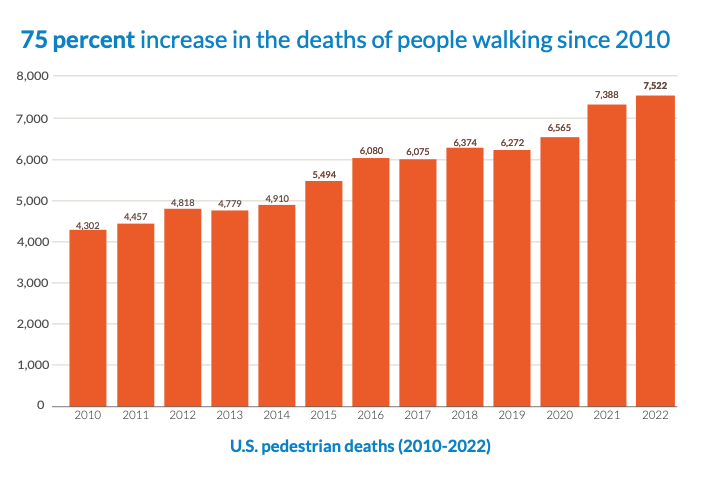
    This is a shocking report from Smart Growth America on traffic fatalities in the US. Since 2010, the number of pedestrians struck and killed has increased by almost 75%. As of 2022, this number sat at just over 7,500 fatalities per year:

    Here are also the top 20 most deadly metro areas:

    Not surprisingly, these hot spots tend to be in the south, as opposed to in older northern cities. And that’s because these tend to be car-oriented places. As the name of the report suggests, they are “dangerous by design.” If you optimize for cars, it means you’re making trade-offs in other places.

    Charts: Smart Growth America

  • Building new cities

    On this blog, we often talk about city building in the context of doing things to help improve a city — whether that be a development project, a new public art mural, or an interesting local business. These interventions help to build a city. But even more specifically, the term has, for many, come to mean building up a city in a positive way.

    But there is another way to think about city building. You can think of it in terms of building actual new cities. We’ve spoken about some of these before, namely this one in California and this odd one in Saudi Arabia. But apparently it is becoming more common. According to The Economist, the world is now building more new cities than it has in the last 80 or so years:

    Egypt’s “New Administrative Capital” is part of a rush of city-building. Firms and governments are planning more settlements than at any time in the post-war period, with many already under construction. Ninety-one cities have been announced in the past decade, with 15 in the past year alone. In addition to its new capital in the north, Egypt is building five other cities, with plans for dozens more. India is considering eight urban hubs. Outside Baghdad, Iraq, workers have just broken ground on the first of five settlements.

    In some cases, it is being done as a solution to urban congestion. If this city is too expensive and unaffordable, just create a new one. This appears to be part of the idea with the above city outside of San Francisco. Of course, new cities can also be created for ideological reasons, or for political purposes, which was the case with Brazil’s capital city, Brasilia.

    Here, the idea was to move the federal capital away from the country’s populated southeast region to a more geographically neutral location in the middle of the country. It also turns out that seeding a new city with government institutions is a good way to get one of these started. Existing cities do, after all, benefit from network effects.

    History points to characteristics shared by successful projects. State institutions can help anchor cities, as Brasília (in Brazil) and Chandigarh (in India) showed in the 20th century. Although both have had problems, people in Brazil and India are voting with their feet. Brasília’s population is growing at 1.2% a year, more than double the national average. Chandigarh, a state capital, is now India’s fourth-richest region on a per-person basis.

    But putting money, ego, and ideology aside, when does it actually make sense to start a new city in lieu of just expanding (or addressing the problems in) the one(s) you’ve already got? Population size can’t be the only factor in determining whether a city is “full”, because Tokyo seems to do just fine as the largest metropolitan area in the world.

    If it hasn’t already been done, I think this would make for an interesting research project. Until then, there’s this (paywalled) Economist article.

  • Please sire, may I give you free land?

    This is an aerial photo of the construction site at One Delisle:

    Currently, we are on hold and waiting to pour a number of columns on the ground floor because the city has not yet issued our above-grade building permit. And the reason the city has not issued our above-grade building permit is because we have not yet conveyed our parkland dedication land to the city. Frustratingly though, we have been ready to convey this land for over a year! We simply need the city to allow us to give them this free land. To date, we have meticulously documented at least 3-pages of follow-ups and back-and-forth emails as we try our best to do this.

    I’ve been doing this long enough that this isn’t surprising or unusual. But it remains deeply maddening. Younger people on the team can’t believe that this is par for the course. On top of this, the city continues to charge interest on the fees that are payable upon issuance of the first above-grade building permit. The result is an insane dynamic where the city can delay things as long as it wants and then charge us, and all other developers, interest on its own delays! I mean, is it any wonder that housing keeps getting more expensive in this city?

    During the last mayoral election, some candidates were quick to promise that, if elected, the city itself would start building affordable housing. This, I’m sure, sounded good to most. Toronto needs more affordable homes. But for all of us involved in the building of buildings, it was frankly impossible to imagine. If the city takes this long to accept free land from developers, how could it possibly build anything?