Daily insights for city builders, delivered every morning at 6 AM ET. I’m Brandon Donnelly — a Toronto-based real estate developer and founder of Globizen. I’ve been writing here since 2013.
A few weeks ago, Equitable Bank launched a new construction financing product for laneway homes and garden suites in Canada. Here is the announcement. This is generally good news. When we completed Mackay Laneway House back in 2021, the banks hadn’t yet gotten their head around this housing type. I remember RBC getting tripped up on the fact that there were two detached dwellings on the same residential lot.
That said, there are some important conditions around this new mortgage product:
“The Laneway House Mortgage is offered on properties that are free and clear, or in combination with new or existing mortgages where Equitable Bank holds, or will hold, the first position.”
In other words, they want no debt on the property or they want sufficient equity in the property — but Equitable Bank needs to hold the mortgage. I suspect that most of the people who have built laneway and garden suites have done so by leveraging the equity in their main house; so I’m not sure how “innovative” this product will end being in practice. You’ll also need to switch to Equitable Bank if you have your mortgage with another lender.
Still, if you’re looking to build one of these homes — and I continue to believe that they make a ton of sense both financially and from a city-building standpoint — it wouldn’t hurt to see what Equitable Bank can offer.
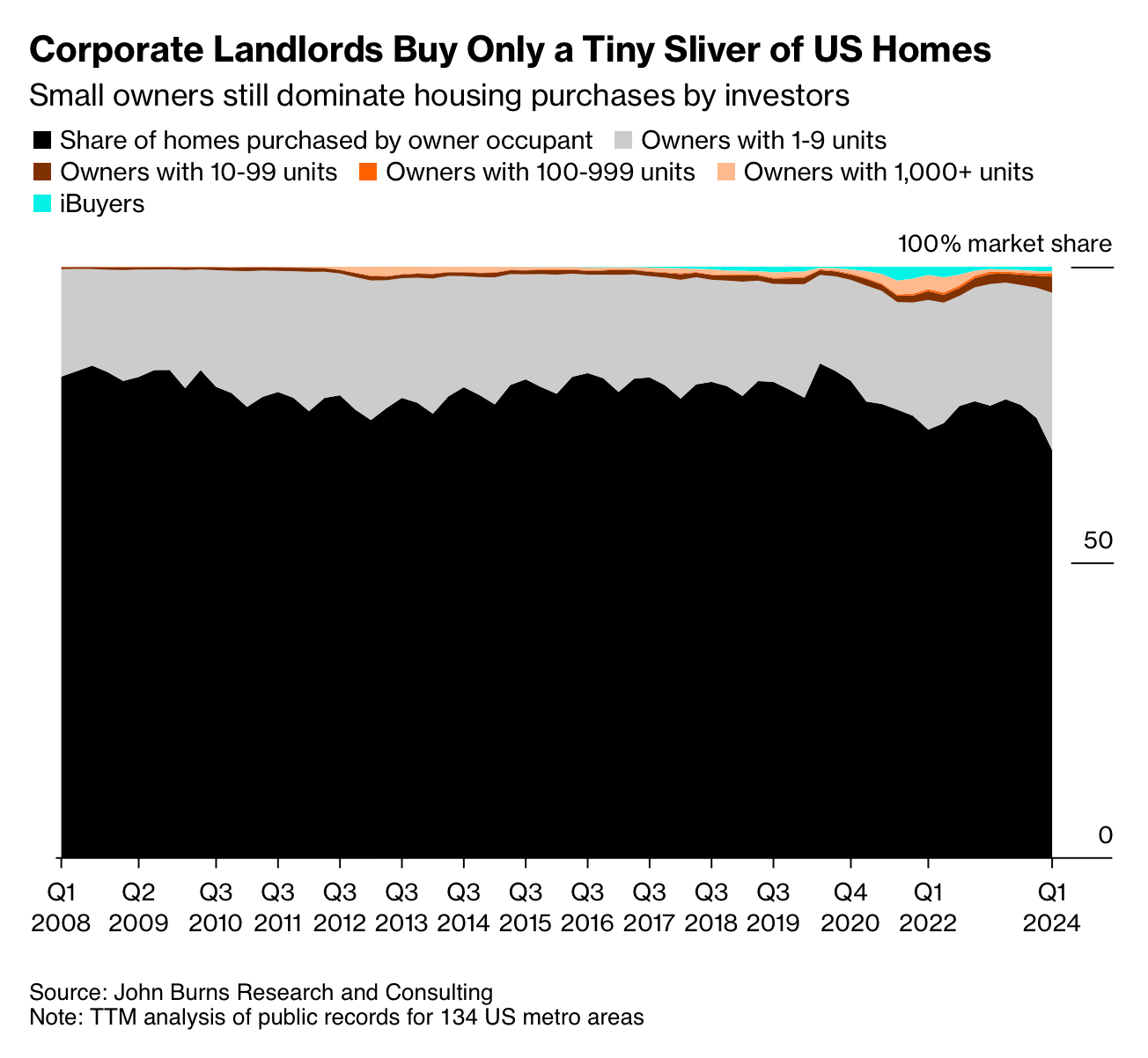
Here is a chart from a recent Bloomberg article summarizing who owns single-family houses in the US.
As of Q1-2024, about 69% were owner-occupied, about 26.6% were owned by small landlords (1-9 homes), and the rest were owned by what many are now calling “corporate landlords.”
The point of this graph was to show that, despite getting a lot of political attention, corporate landlords still own very little. Let’s call it sub 4%, excluding iBuying companies like OpenDoor. So how much of a problem is this, really?
Smaller landlords control much more of the US market. And at the end of the day, a house owned by a small landlord versus a corporate landlord doesn’t change the supply-demand balance of a market. It still represents an available home.
The first and more important problem to solve is overall housing supply. Because that does change the supply-demand balance of a market. And once again, there’s no shortage of data to support the finding that increased supply tends to moderate rental growth.
For the record, I also dislike using the term home to refer to single-family houses. Home is not a housing type. It is simply a place where people live permanently. So whenever I see a title like “US homes,” I get confused, because I don’t actually know what they’re referring to.
If you read the article, it would appear they’re only talking about single-family houses. But implying that these are the only kind of home feels to me like an anachronism.
The GTA condo market is in a state of economic lockdown. The math doesn’t make economic sense from both the demand side (investors) and the supply side (developers), leaving the market at a standstill.
The above excerpt is from a recent CIBC Capital Markets article by Benjamin Tal (CIBC) and Shawn Hildebrant (Urbanation). And what it ultimately means is that the supply of new condominiums in the GTA is falling and will continue to fall for the foreseeable future. Below are two charts, from the same article, that show that.
Because of this, I actually think that, if you need or want a place to live, right now is a near ideal time to buy a condominium, especially if it’s from developer inventory (in an already completed project) or it’s a resale. Of course, most people won’t want to do this because they’d rather buy when most other people in the market want to buy. This is how markets tend to go.
It has been a while since the GTA has gone through one of these real estate cycles, but it is typical: developers are prone to both over-building and under-building. It simply takes too long to build a building, and so it is natural for there to be moments when supply and demand don’t exactly line up.
Pre-selling condominiums is — in theory only — supposed to protect against too much overbuilding. But as we have spoken about many times before, it can be challenging for end users to buy a new home so far in advance. And so the new condominium market has come to rely on investors who want to buy early and then either sell later or rent later.
According to the above article (and MLS data), the share of newly completed condominiums used as rentals reached a peak of 34% in 2023. So a third of new condos. My gut tells me that the actual number is much higher. Many rentals never reach MLS. Overall, I think it’s very safe to assume that the majority of new condominiums are owned by investors.
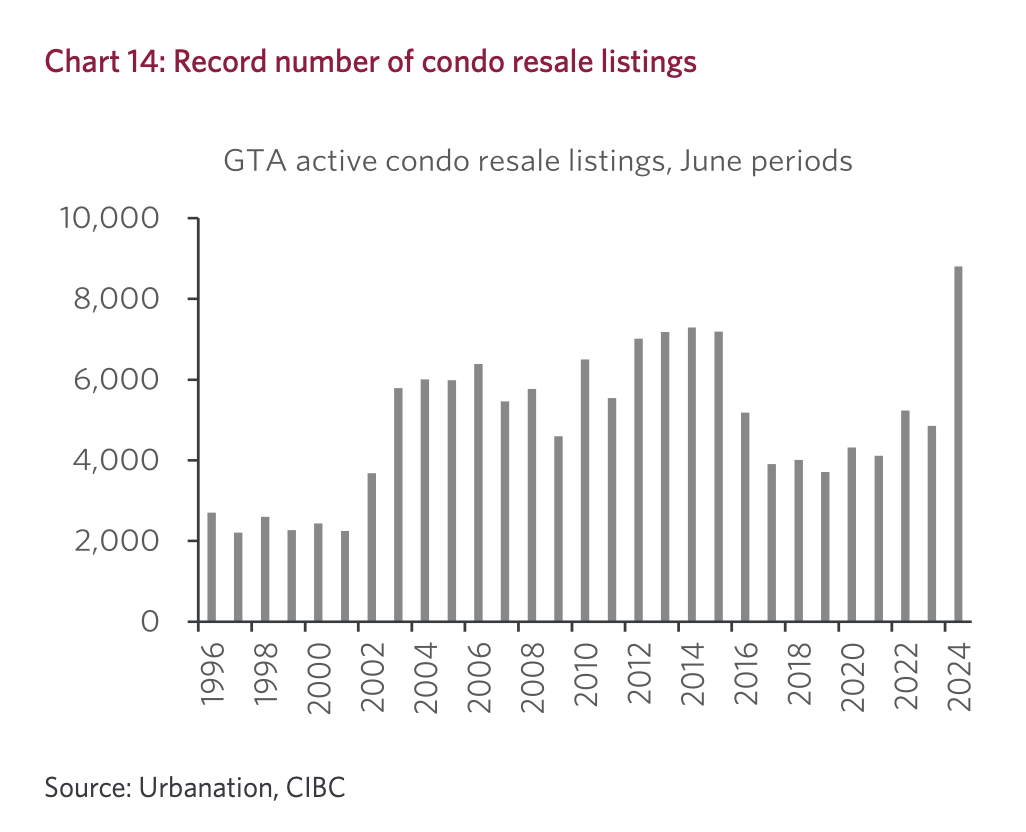
But right now, fewer investors want to own condominiums, which is why the number of resale listings has spiked this year:
This is, again, why I think right now is an excellent time to buy a condo. You know, be greedy when others… Regardless, this inventory will need to get absorbed and that will ultimately happen. Some of it will go to end users and some of it will go to investors who can make sense of the rental math and/or want to take a long view on Toronto. But if more goes to the former, we will be losing a lot of new rental housing.
At the same time, while all of this is going on, construction starts are likely going to remain depressed (chart 3 above). It’s impossible to know how long this lasts, but at some point we will reach a moment in the cycle where we are under-building new housing. Maybe we’re already there. Development simply can’t turn on fast enough when demand spikes. There will almost always be a lag.
So, since the majority of new condominiums have been serving as new rental housing, there’s a strong case to be made that at some point we will run into a potentially severe shortage of rentals. Condo investors are sometimes vilified in the media, but we will soon find out what happens when you take a big chunk of them out of the housing market.
Urbanation just released its Q2-2024 condominium market survey for the Greater Toronto & Hamilton Area (GTHA), and we should probably talk about some of the data:
The new condominium market reported 1,688 sales in the quarter. Outside of Q2-2020 (the pandemic), this is the lowest in the past 20 years. Note: This number is self-reported by developers.
Of the 3,625 homes launched for pre-sale during the quarter, only about 17% got absorbed/sold. That’s about ~616 homes, which isn’t very much when you spread it out across the region’s projects.
Unsold inventory increased to 25,893 homes. Urbanation equates this to 34 months of supply, versus a more “balanced level” of 10-12 months. This number breaks down to 15,157 homes in pre-construction projects, 9,788 homes in projects under construction, and 948 homes in recently completed buildings.
This is higher than Urbanation’s 20-year average, but the way I see it is that the ~15k homes in pre-construction projects could very quickly evaporate. If those projects don’t get to construction (and most probably won’t in the short term), then that inventory will disappear from the market. On the other hand, the ~11k homes under construction or recently completed is a hard number. These homes exist, or will soon exist, and they’ll need to get absorbed at some point.
There are also going to be homes that are currently sold, but where buyers ultimately say “yeah, I’m not going to be able to close.” So there will be some non-zero percentage of homes that will need to be reabsorbed. I don’t know what this percentage will be, but if it’s something like 5%, that’s not nothing. (See below for the number of condominiums under construction right now.)
Not surprisingly, average asking prices for unsold homes only declined about 2.6% over the past year. Prices have remained markably sticky. And this is how you know that development happens on the margin. Because developers are infinitely better off selling homes and starting construction, compared to holding lots of unsold inventory and starting construction, whenever. The fact that developers aren’t dropping prices to sell more homes demonstrates that they can’t. They’re hitting the floor of financial feasibility.
Finally, last quarter saw 727 new condominium homes start construction. In theory, this could have been a single tall building, though that probably wasn’t the case. As new starts fall, the number of condominiums under construction will naturally also fall. The current number is 87,508 homes, which is almost 19,000 less than a year ago. I expect this number to keep coming down.
I’ve been thinking more about yesterday’s post and what it might mean for cities, and I’d like to add some additional thoughts. The report that I linked to looks at what the fiscal implications of WFH have been on a number of US cities (at least so far). That is the chart that I shared summarizing New York City’s “agglomeration losses.”
But along with this, there is an important assumption that we have not yet reached a new equilibrium. In other words, we are still in a period of adjustment, which feels right, especially if you talk to anyone in the commercial real estate industry. And that means that there are alternative and largely unknowable scenarios for the future.
In the report, they study the following three:
Doom loop prevails (current state where city finances get worse)
Recovery (cities regain their pre-pandemic levels of agglomeration economies)
Virtuous boom loop arises
Obviously the objective with their recommendations is to help cities achieve this last one. This is the scenario where cities regain prosperity because firms are able to simultaneously increase their concentration of high-value in-person workers (who benefit from agglomeration economies) and shift all the other stuff to WFH (which allows firms to save money and drive efficiencies).
More specifically, this scenario assumes that agglomeration economies start to grow again; that wages increase because of it; and that firms, overall, become 10% more productive. It also assumes that office real estate values recover to pre-pandemic levels.
The future is, of course, notoriously difficult to predict. But I am optimistic that the best and most desirable cities will figure out how to create a new virtuous boom loop. History has shown us that cities are remarkably resilient.
However, implicit to this discussion seems to be the creation of two classes of workers: workers who are expected to show up in-person and do innovative things with their colleagues, and workers who are encouraged to stay at home and do the tasks that do not benefit from co-location. Of course, lots of people do both of these things. But for the purposes of this post, let’s just compare and contrast these two.
Importantly, these two types of workers are expected to have different wage outcomes (in the above report). For WFH workers, wages are initially modeled to fall because of the loss in agglomeration-related productivity. But interestingly enough, before this wage decline happens, WFH workers are unambiguously better off — they have the same salary and none of the direct costs of going into the office.
On the other hand, in-person workers are modeled to have their wages increase because of the gains in agglomeration-related productivity. The authors of the report have calibrated their models so that these two types of workers eventually become equally well off, once you adjust for changes in wages and things like the direct costs of commuting. But what would this really mean in practice?
To oversimplify, we’re talking about two different types of workers:
An in-person worker who is expected to have higher wages, be more productive, and live closer to a city center because of their need to be physically present
A WFH worker who is expected to have lower wages, be less productive, and live further out (or in a different city) in order to equalize their lower earnings by way of less expensive real estate
If this is how our labor markets evolve, then it strikes me that there could be far-reaching socio-economic implications. What I worry about is further segregation within our cities. The above scenario means doubling down on the role of big cities as centers for innovation and agglomeration economies. But in doing this, how do we ensure that we don’t exclude everyone else?
Once again, I suspect that a good place to start would be lowering the cost of new housing and increasing the pace of production.
It was not my intention to make this building code week on the blog, but for some reason that has happened. So let’s continue. Here is an interesting guest essay — about elevators — written by Stephen Smith for the New York Times.
Stephen is the founder and executive director of a Brooklyn-based non-profit called the Center for Building in North America. And what they do is conduct research on building codes, specifically in the United States and Canada, and then advocate for reforms.
Here’s what he thinks about elevators (taken from the above essay):
Elevators in North America have become over-engineered, bespoke, handcrafted and expensive pieces of equipment that are unaffordable in all the places where they are most needed. Special interests here have run wild with an outdated, inefficient, overregulated system. Accessibility rules miss the forest for the trees. Our broken immigration system cannot supply the labor that the construction industry desperately needs. Regulators distrust global best practices and our construction rules are so heavily oriented toward single-family housing that we’ve forgotten the basics of how a city should work.
Here’s how the US compares to a few European countries:
Nobody is marveling at American elevators anymore. With around one million of them, the United States is tied for total installed devices with Italy and Spain. (Spain has one-seventh our population, 6 percent of our gross domestic product and fewer than half as many apartments.) Switzerland and New York City have roughly the same population, but the lower-rise alpine country has three times as many single-family houses as Gotham — and twice as many passenger elevators.
And here’s a set of cost comparisons:
Behind the dearth of elevators in the country that birthed the skyscraper are eye-watering costs. A basic four-stop elevator costs about $158,000 in New York City, compared with about $36,000 in Switzerland. A six-stop model will set you back more than three times as much in Pennsylvania as in Belgium. Maintenance, repairs and inspections all cost more in America, too.
If you’re interested in this topic, I would encourage you to give the full article a read. It’s highly relevant to our ongoing discussions around missing middle housing. If cities, like Toronto, hope to build a lot more apartment buildings (especially smaller-scale ones), they are going to need affordable and plentiful elevator options.
Conrad Speckert got in touch with me following yesterday’s post (about single-stair buildings) and he was kind enough to let me know that, this Thursday, Toronto Planning and Housing Committee will be considering this single exit stair item.
Included in the agenda item is a building code report that was done because City Council wanted to know if it were feasible to design multi-residential buildings up to four storeys that wouldn’t be detrimental to human health.
Now that the report is done, one of the recommendations being put forward this week is for Toronto to create a guideline that would help people prepare alternative solution proposals under the Ontario Building Code.
Alternative solutions provide greater design flexibility. We almost always have them come up on our projects. In essence, they are a way of saying, “yeah, I know this design doesn’t precisely meet the code, but it still satisfies its intent, and it works, so please approve it.”
In this particular instance, the idea is to create a public-facing guideline so that more people will be able to figure out how to build 4-storey buildings with a single means of egress. Again, the current maximum is 2 storeys.
Four storeys isn’t quite six storeys. But we’re getting there. And it has become increasingly obvious that it is now just a question of when, not if. At some point, we won’t be calling this an alternative solution proposal. It will just be — the way.
Point access blocks, which are also known as single-stair buildings, are getting a lot more attention here in Canada. And B.C. looks like it might be one of the first provinces to relax its building code. Here’s an excerpt from a recent Globe and Mail article:
Canada’s building code, which provinces have generally gone along with, has required two staircases per apartment building since 1941. But B.C.’s Ministry of Housing last week published a research report outlining the optimal conditions for single staircases.
“We are definitely moving forward with this,” said Ravi Kahlon, the Housing Minister, who hopes to introduce the legislation allowing the change in the fall.
Mr. Kahlon said that the option of “single-egress” buildings, as they’re also called, will be confined to areas where there is professional fire services (as opposed to rural-style volunteer departments) and good water supply, as is the case in Seattle. That city has allowed single-stair buildings since 1974.
In this case, the proposed change is expected to be limited to six storey buildings that have no more than four apartments per floor. That still feels fairly limiting, but it’s at least a step in the right direction.
I have been spending some time looking at the feasibility of small six-storey apartments (here in Toronto), and I can tell you that it’s not easy to make the math work. You need to optimize, everything. Minor assumption changes can really blow up the model.
I don’t think that this change will magically fix that. But it’s still meaningful progress. And if we keep chipping away at this housing problem, we might actually get there.
Here’s an interesting, though not shocking, chart from a recent Globe and Mail article talking about “Canada’s dysfunctional housing market.” What is noteworthy is that Toronto is dead last when it comes to the number of new 3+ bedroom homes built between 2016 and 2011.
Peterborough, for example, is a census metropolitan area with somewhere around 130,000 people. And yet, based on this data, it is building more family-sized homes than Toronto.
Why this is not surprising is that the vast majority of new homes now built in Toronto are high-density and built out of reinforced concrete. This means that they are relatively expensive on a per square foot basis.
In fact, you could argue that mid-rise housing — the exact high-density type that is supposed to be most attractive to families — is the most expensive to build. What this means is that if you’re building a 3+ bedroom home in this way, it’s not going to be affordable to most.
It also means that people are going to go shopping elsewhere: Ottawa, York, Simcoe, Durham, and so on. The expected market outcome is decentralization. But in my mind, this raises an important question: Is this what people really want?
This is a great debate. And many will argue that grade-related suburban housing is exactly what people want. What we are seeing is a result of raw consumer preference.
However, the costs are so skewed in favor of low-rise housing, that I think it’s hard to say with absolute certainty the degree in which this is true. What if higher-density 3+ bedroom homes were the cheaper option? My bet is that we would see a lot more centralization.
The development charge rate for a 2+ bedroom apartment in the City of Toronto is currently $80,690 per unit (effective June 6, 2024). As development charges work, this is supposed to pay for the growth-related impacts of adding a 2+ bedroom apartment in the city.
However, the above chart suggests that there are also impacts to not building that 2 or 3 bedroom apartment in an already developed area next to existing infrastructure. It means the home goes somewhere else (further away) or doesn’t get built at all.
According to this report (2023) from the Centre for Cities, the UK has a backlog of about 4.3 million homes. This is in comparison to other Western European countries for the period from 1955 to 2015.
Said differently, these 4.3 million homes are effectively missing from the UK’s national housing market because it failed to build and deliver at the same rate as some other rich countries.
The report also argues that this housing shortage started not at the end of the post-war period, but at the beginning of it in the 1940s.
Increase housing supply where new homes are needed. More homes are built in Wakefield than Oxford. Building in places with fewer jobs won’t fix prosperous cities’ housing crises.
Planning reform to introduce a new flexible zoning system that would allow builders to build if they follow the rules, while maintaining special protections for National Parks, Conservation Areas etc.
Zoning of land in walkable distances around train stations in the green belt for suburban living and with protected green space, which would provide 1.8 to 2.1 million homes.
Increase the use of permitted development rights to cut the red tape that makes it hard to build upward extensions or infill developments.
Stop subsidising home ownership. Despite Right to Buy, home ownership as a share of private housing has fallen in every city since 1981. The Government should stop subsidising ownership, tax housing wealth increases by abolishing the Capital Gains Tax exemption for primary residences and treat owning and renting equally.
None of these proposed solutions should come as a surprise. We know that housing follows money/jobs. And we know that if we want more of it, we need to remove the barriers to building it, especially around higher-order transit.