Daily insights for city builders, delivered every morning at 6 AM ET. I’m Brandon Donnelly — a Toronto-based real estate developer and founder of Globizen. I’ve been writing here since 2013.
I had lunch today with a friend (from school) who runs a multifamily development company in South Florida. His business is very similar to the apartment strategy that we are now working on in Toronto, in that he builds a repeatable apartment product (garden style apartments). In fact, he was telling me that he now has a dedicated design & QA/QC team within the company. Their job is to focus on continuous optimization and on reducing construction inefficiencies.
This is the way!
But each market is obviously unique. His rents are in the US$3 – 3.25 psf range (call it ~C$4.15 – 4.50 psf), whereas in Toronto you need something closer to C$5 psf to have a feasible project. Our yields are also lower on average. It’s hard work to get to an untrended yield-to-cost of 5% here. But for him, he can’t raise capital with anything less than 6.5%, which represents a development spread of at least 150 bps over where multifamily cap rates are today in his market (~5%).
Statistics Canada recently published some data (from 2022) looking at investors in the condominium apartment market. Here is what they believe to be the share of condominium apartments used as investment properties in Ontario’s 10 largest census metropolitan areas:
It’s worth noting that this is afterexcluding condominium buildings where every single suite is owned by a single investor. This is/was most prevalent in London, and it’s the result of there being property tax benefits to registering a condominium (individual unit assessments), even though for all intents and purposes it’s a rental building (building in its entirety assessed).
The article goes on to rightly suggest that the prevalence of investors, and the way that condominiums are financed, could be leading to the construction of more buildings with smaller suites. Here’s the proportion of new condominium apartments under 600 square feet by period of construction:
The unsurprising takeaway is that condominium suites have gotten smaller. In the 1990s, the average condominium apartment built in the Toronto CMA was 947 square feet. This is compared to 640 square feet after 2016. And the same thing happened in Vancouver, which went from an average of 912 square feet to 790 square feet.
Investor preferences certainly have something to do with this. But what the article doesn’t specifically mention is that this phenomenon is also a direct response to rising build costs: making suites smaller was how the market tried to maintain some level of affordability. Put differently, imagine how expensive new condominiums would be if the average size was still 947 square feet.
But there are obviously limits to this. I was with one of our architects the other week and he made an interesting comment to me. He said, “Brandon, before when build costs used to go up and things got less affordable for consumers, we could just make the suites smaller to offset the impacts. But I don’t see how we can go any smaller now. We’ve reached the limit.”
This is one of the reasons why I think this downturn is going to ultimately be a good thing for Canada’s housing markets. It’s a reset. It’s forcing everyone out of complacency and, hopefully, it means that when the next cycle begins we’ll be starting from a better foundation.
Today, I’m excited to share that I’ll be attending the second annual Elevate event this December as an industry ambassador. This means I get to ride alongside industry celebrities like Norm Li. (He better be DJ’ing.)
Put on by Zonda, in partnership with Livabl and ARCHITECT Magazine, the event is focused exclusively on “the art of high-rise luxury living.” Everything from the overall state of the housing market to how to sell branded residences.
I wasn’t able to attend last year, but I heard from a number of industry friends that it was very well done, which is why I agreed to participate this year. That now means I have a discount code you can all use if you’d like to attend — BRANDONVIP30.
For those of you who like art and culture things, the event also happens to fall right after Art Basel. This was done on purpose, and so now you have at least two good reasons to be in Miami Beach in December.
A branded residence is, as the name suggests, a residential building with a known branded attached to it. Historically, these have tended to be hotel brands. But it really just needs to be any brand that people know, care about, and will pay a premium for. So it could also be a fashion brand, a car brand, or whatever else.
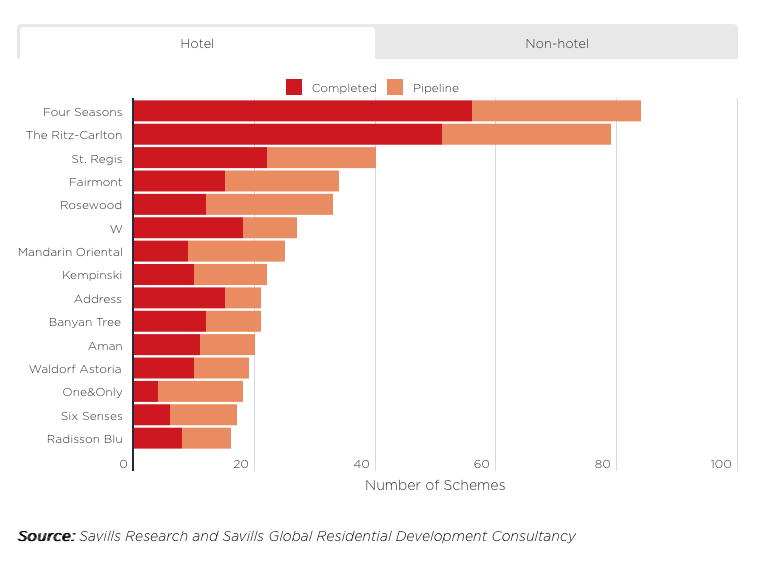
This is a growing segment of the residential market. According to UK-based Savills, there were only 15 or so of these “schemes” in the 1990s (the UK uses scheme in lieu of project, which always sounds conniving to me), but by the end of this decade they expect the pipeline of branded residences to exceed over 1,200.
I would also argue that projects designed by celebrated architects and/or designers are a form of branded residence. And this is not being captured in Savills’ number above.
Whatever your definition, today, the branded residence capital of the world seems to be Dubai, which feels right. And the biggest brands, by what appears to be a long shot, are Four Seasons and Ritz-Carlton (hotel side), and YOO and Trump (non-hotel side). Here are the full rankings from Savills:
This is an interesting part of the real estate business for a few reasons. One, it makes sense. A New Balance shoe that gets co-branded with Aimé Leon Dore unlocks additional value for both sides. ALD has a brand that certain people care about. So, of course the same would be true of real estate paired with the right brand.
Two, it’s a growing market, and I think this is aided by the fact that development is an intensely local business — so it can be hard to grow a globally-significant brand on your own. Sometimes you just need to borrow someone else’s.
And three, it’s usually a less risky approach to getting your name on buildings. Branded residences typically operate on a licensing model, which means developers pay for the right to use the brand. The brand may also capture some of the upside in the form of a percentage of sales. That’s less risky than putting up your own money.
Vancouver just put forward a bold proposal to encourage more social, or non-market housing, across the city. As drafted, new social housing projects up to 6 storeys would be permitted as-of-right in “villages” and social housing between 15-18 storeys would be permitted as-of-right in “neighborhood centers.” This is a big deal. I mean, look at the above map. Between these two area designations, big chunks of the city would receive these new permissions. For more information on the proposal, check out this short video.
Toronto has been making great progress when it comes to allowing more housing in its low-rise neighborhoods. We now allow laneway suites, garden suites, multiplexes, and soon we’ll allow 6-storey apartments. But interestingly enough, there is one small part of the city that is looking to regress. This past summer, council asked planning staff to bring forward a zoning by-law amendment to remove garden suite permissions for some of the properties backing onto Craven Road, near Danforth and Coxwell.
Here’s a community consultation flyer that went out to residents and that shows the affected properties:
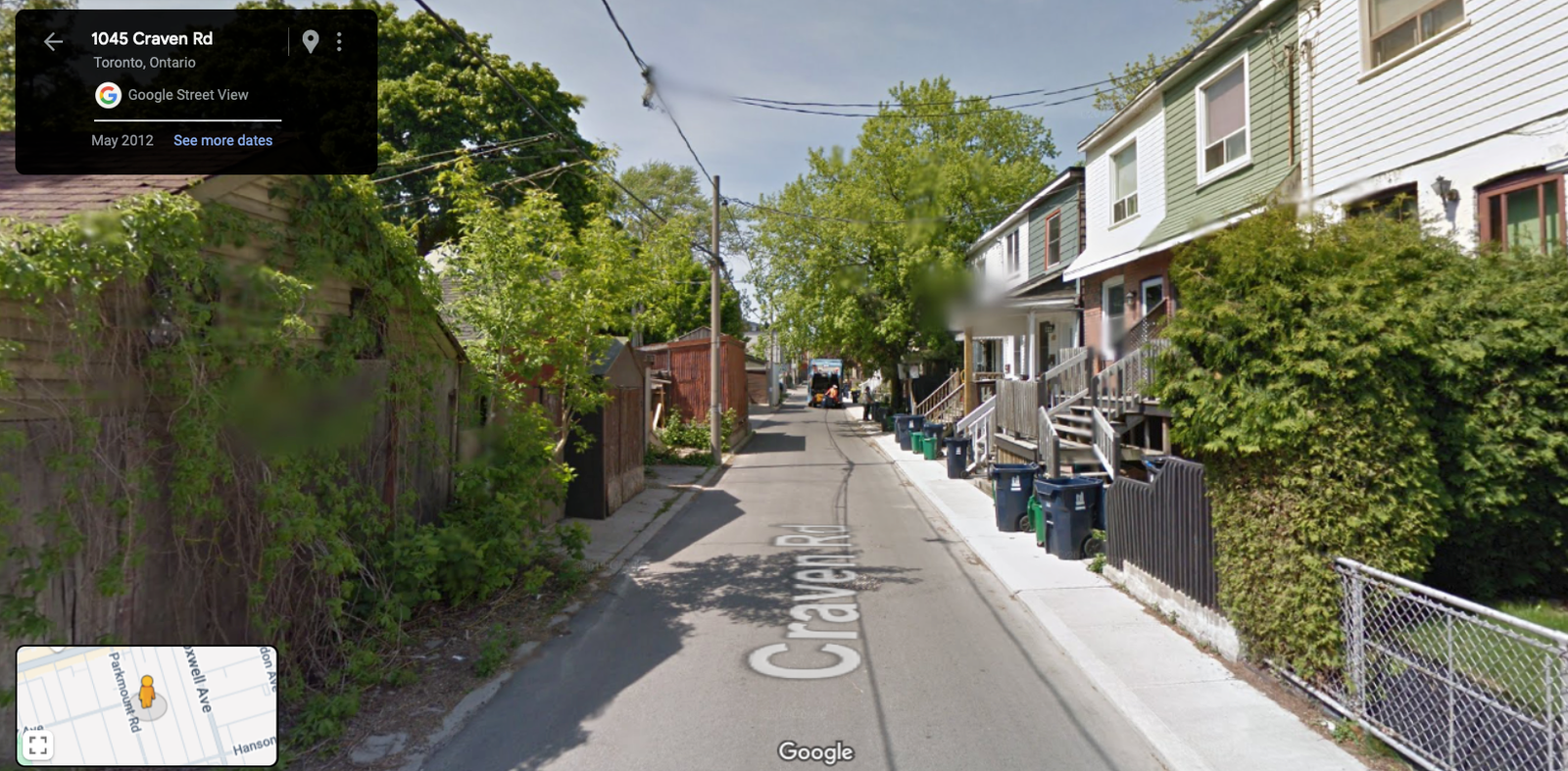
We’ve spoken about Craven Road before. It’s a relatively odd street with a unique history. Its most obvious characteristic is that it’s a kind of single-sided street. For the most part, there are homes on the east side of the street, but no homes on the west side. On the non-home side there is typically a garage, or the longest municipally-owned fence in the city. Here’s some of the backstory on Craven Road’s infamous fence (which occurs on a stretch further south), and below is what the study area in question looks like today:
So why remove the garden suite permissions here? The answer is to block housing. The people who live on Craven Road like it the way it is and don’t want anyone to build new housing on the other side of the street. What’s interesting about this is that it roughly mirrors what happened over a century ago. We couldn’t figure out how to broker a deal between two adjacent streets and so we just said “screw it, let’s build a really really long fence and call it a day.”
Today we’re saying, “yeah, we really need more housing in the city, but I dunno, somebody might get upset here.” There is nothing sacrosanct about the old garages, or the fence, that line the west side of Craven. It is a street, proximate to a major subway station, that is missing homes on one entire side. It’s low hanging fruit for infill housing. In fact, there’s an easy argument to be made that garden suites aren’t nearly enough density for a location like this. We should be encouraging a lot more.
But this is just my opinion. If you’d like to share yours, the City of Toronto is hosting a community meeting this week on September 19, 2024 from 7 – 830 PM. To participate, register here.
Here is a recent chart from Mike Moffat showing how much development charges have increased in the City of Toronto from 2009 to today:
We’ve, of course, seen this before. Back in 2020, I shared an article that developer Urban Capital published where they did a cost comparison between a project they had done in 2005 and a project they were doing in 2020. What they uncovered was that development charges alone had increased by 3,244%! The most of any line item in their pro forma.
Development charges over the last real estate cycle have been an insidious problem. Meaning, the industry knew they were crazy high, and we were all trying to be vocal about it, but let’s face it — the general public doesn’t have a lot of sympathy for developers complaining about high fees. They are also largely hidden from purchasers and renters. The charges just get lumped in.
If our industry could figure out how to be more transparent and separate out these charges, much like a sales tax, I think it would go a long way to showing consumers what they’re actually paying when it comes to new housing. And then maybe something positive would happen. Because this is a major reason why new housing has gotten so expensive in this region.
Can you imagine if property taxes had increased by 3,244% over the last 15 years? I can’t. Because no one would have ever allowed that to happen.
For better and for worse, the current market is going to serve as a rude awakening for municipalities. We’ve reached the breaking point. The housing market is, as we’ve talked about, in a “state of economic lockdown.” And when people don’t buy new homes, it means developers no longer have the money to pay development charges.
Traffic congestion and a lack of affordable housing are two clearly defined problems facing most, if not all, major cities. We know they exist. We call them crises. And yet, we can’t seem to implement effective solutions, even though we know what they are. Why is that? In her new book, On The Housing Crisis: Land, Development, Democracy, Jerusalem Demsas makes the argument that it is a failure of local democracy. There is a disconnect between what we say we want to happen and what we are actually doing. This resonates with me. In my mind, it’s looking upstream at what is bottlenecking us from making the decisions that will produce better outcomes for our cities. So after reading this conversation with her about the new book, I decided to buy a copy.
The Project Bench team spent the last several weeks capturing photos and videos of Canada’s largest wine region — the Niagara Benchlands (link is to the official tourism website). And today I’m excited to share that we’ve launched our own new placemaking website called On the Bench.
The purpose of the site is to help celebrate the region. There’s also some very preliminary information about Project Bench. In our humble opinion, we don’t feel that the Benchlands region receives the attention that it clearly deserves. More people are familiar with Niagara-on-the-Lake and Niagara Falls, especially globally.
The Bench is a distinct area, with its own unique character and with more — and arguably better — wineries. This v1 website is the start of us working to demonstrate this. So if you’re a local business or community member that would like to collaborate with us on this overall initiative, we’d love to hear from you.
To join the Bench community and be first to learn more about Project Bench, email subscribe at the bottom of the page, and follow us on Instagram and X.