
Daily insights for city builders, delivered every morning at 6 AM ET. I’m Brandon Donnelly — a Toronto-based real estate developer and founder of Globizen. I’ve been writing here since 2013.

Category: Housing

  • The 12 best design districts around the world

    Architectural Digest has just published the perfect article for gratuitous self-promotion. It is a list of “the 12 best design districts around the world”, and it includes The Junction, here in Toronto:

    Located in a tree-lined historic area of the city, The Junction gets its name for its past as the heart of the Canadian Pacific Railway. Mix with locals on the main drag of Dundas West at boutiques including the minimalist homeware store Mjolk and modern stationery shop Take Note. A short 20-minute walk from this charming retail center, the Museum of Contemporary Art is worthy of a stop in too. (Current exhibitions include a site-specific commission by artist Sarah Badr and Seeing the Invisible, an augmented reality experience in the museum’s Jerusalem Botanical Gardens.) Then take a tipple at The Junction Brewery, which serves local craft beers within an Art Deco building that offers a glimpse of the neighborhood’s rich history.

    Early on in high school, I used to come downtown to primarily do two things: skateboard and walk Queen Street. This was the street. It was weird and artsy and we loved it. And so we would start at University Ave and walk west for as long as the street was interesting.

    For a period of time, it felt like things kind of fell off after Spadina Ave. So we would often stop there. But then west of Spadina started getting cool and interesting too.

    Years later in 2004, the Drake Hotel would open up on what felt like a far off location on Queen Street. And then seemingly overnight, all of Queen Street was cool. Parkdale had a taco place with absurdly long lines and loud hip-hop music, and cool started moving up Ossington Ave, presumably because Queen had run out of space.

    Of course, neighborhoods have cycles. Before it was the Drake Hotel, it was Small’s Hotel. And when it opened in 1890, it was located in one of the wealthiest areas of Toronto. Then the area became a lot less wealthy, and eventually the hotel became a flophouse, before once again becoming cool again. These are the cycles.

    There is no doubt that Queen Street remains one of the greatest streets in Toronto. But in my mind, 2018 was a turning point. This is when when the Museum of Contemporary Art (MOCA) left Queen and moved to the Junction Triangle (or the Lower Junction, or just the Junction, depending on what you prefer to call it).

    This to me didn’t signal that Queen had in any way peaked. Far from it. But I think it did solidify the Junction as one of Toronto’s next cool and artsy neighborhoods. And now here we are with Architectural Digest calling it one of the best in the world.

    It would be hard for me to be more biased. But I’m a big fan of the Junction. And I am really looking forward to erecting our placemaking art later this year. It is one of the things that our team is most proud of, and we proposed it simply because we thought it would be cool and interesting. That’s important.

  • Single-exit housing in Paris

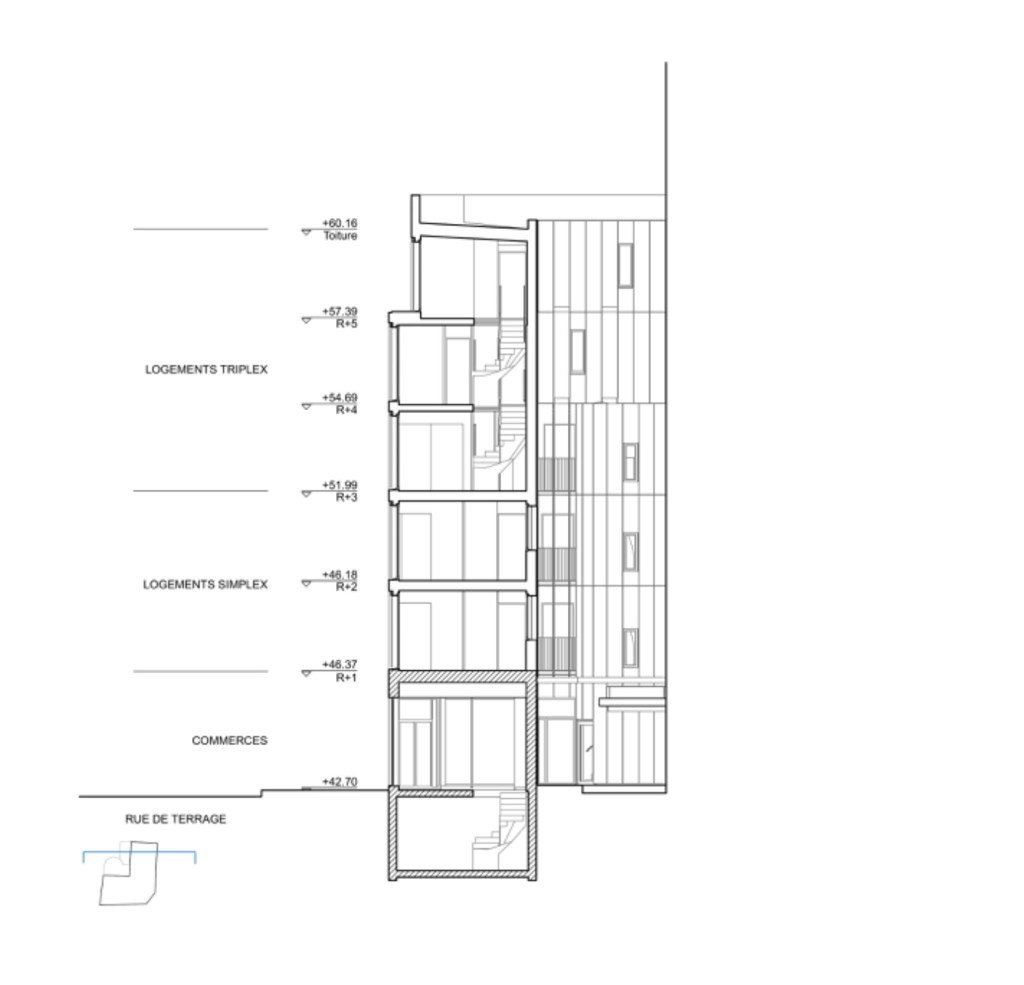
    Lloyd Alter of Treehugger recently wrote about this infill housing project in Paris. Designed by Mobile Architectural Office (MAO), it is a 6-storey building with 6 residential suites (two of which are 3-storey triplex suites) and 1 ground floor non-residential space.

    Building section:

    But here’s where things get really remarkable: the area of this corner site is less than 100 m2 (~1,000 sf), the construction budget was €940,000 (excluding VAT), and almost the entire structure was built out of cross-laminated timber. So overall, this is an incredibly sustainable build: it uses land and services efficiently and it uses low-carbon materials.

    At this point, you should now be wondering, “why can’t we just do this everywhere?” And this would be the right question.

    Lloyd correctly points out in his article that one of the things that makes this building feasible is that it only has one exit stair (as well as no elevator). Typically you need two means of egress, which can serve as a real barrier to smaller builds like this one here.

    But in this case, and this is part of the argument, the building is small enough that, should a fire or emergency happen, occupants could be rescued through their windows. So technically there are still two ways of getting out.

    In this year’s predictions, I mentioned that we would see “supportive building code changes”, which would help to encourage more infill housing. Exiting is one of the changes I had in mind when I wrote the post. So here’s hoping that policy makers are reading this blog, looking to projects like this one in Paris, and recognizing the benefits.

    Talking about exit stairs may not be as exciting and seemingly impactful as something like a foreign buyer ban, but I promise you that removing the many barriers to building this scale of housing would ultimately bring more benefit to our cities.

    P.S. This project is also social rental housing.

    Image: MAO

  • No more foreign buyers

    Here’s the thing about housing:

    The delegates insisted on one hand that “housing is for living not speculation”, but on the other, emphasised the critical importance of real estate to China’s economic growth.

    In other words, things are complicated. We want housing to be affordable to more people, but at the same time, we recognize that housing appreciation is kind of useful for overall economic growth. So we’re a bit conflicted. And that may be why we tend to take contradictory actions.

    Broadly speaking, the current playbook in Canada seems to be as follows: heavily tax new housing, force those who can afford new market-rate housing to subsidize those who can’t, and then tax/ban foreign buyers.

    Canada’s new foreign buyer ban came into effect on January 1 of this year. And for the next 2 years, it prohibits companies and people who are not Canadian citizens or permanent residents from acquiring non-recreational, residential property in Canada. (What is the definition of non-recreational?)

    While this may sound good to some — finally, more homes for Canadians — we’re talking about a relatively small portion of the market, which is likely why there’s also little evidence that any of our foreign buyer taxes have been all that effective.

    It’s really hard to imagine this one working much better. But it certainly sounds like something.

  • What happened in 2022 and how I did on my predictions

    It has become tradition around here that at the end of each year I write down my predictions for the following one. And in 2022, I did that here. The overarching point of writing something like this down publicly is not necessarily to be right (because you can do that through obvious predictions). The point is to dedicate time to thinking (which is oftentimes hard to do throughout the year), to search for non-obvious things, and to generally be okay with being wrong. So I plan to do this again in the coming weeks for 2023.

    But first, let’s see how I did with my 2022 predictions:

    1. COVID: I argued that 2022 would be the year that the pandemic becomes endemic and it reaches a point where it no longer factors into decision making in the same way that it has since 2020. Some of you may disagree whether this is a good thing, but I would still say that this happened, at least in this part of the world. I started the year in lockdown here in Toronto and I ended the year having taken multiple overseas trips where testing was no longer required. (Right)
    2. Return to office: I was kind of close. I thought that the majority of people would be back in their offices by September. I didn’t say that hybrid/flex work was going to disappear, but that we would see a great return. That did happen, according to my super scientific Jimmy the Greek Reopening Index. But if you look at the latest swipe card data for the 10 largest US cities, average occupancy is hovering just below 50%, which is not a majority. (Wrong)
    3. Recreational/fringe housing: I felt very strongly that we would see a pullback in residential real estate this year, specifically recreational properties and properties in tertiary markets. This 100% happened, but I’ll be honest in that I was not thinking about the interest rate hikes that we saw. I just saw it as a pandemic bubble. I also thought that apartment rents would do very well and surpass pre-pandemic levels. This happened in many markets. (Right)
    4. Return of travel: Yup. (Right, but maybe too obvious?)
    5. Intensification of single-family home neighborhoods: This continued to be an important topic in 2022. Did we see some a tipping point-like moment, like I had predicted? I think it depends on the market, but here in Toronto we did see things like Bill 23, as well as additional efforts on the part of Mayor John Tory. (Right)
    6. Autonomous vehicles: Progress was made this year. You can now hail an autonomous taxi in places like San Francisco. But I also thought that this would be a fantastic year for Uber as the world reopened, and that they’d finally become profitable. As of Q3 of this year, that had not happened. (Wrong)
    7. Public transit and micromobility: I got the public transit ridership piece correct. I assumed that ridership levels would remain depressed. Perhaps an obvious one. But I also figured that e-scooters would be one of the main beneficiaries. While it is true that e-scooters remain very popular, particularly with French people, we did see ridership decline in the US, as the availability of cheap capital waned. (Mostly right)
    8. NFTs and augmented reality: There’s a lot happening in this digital world and I continue to be incredibly bullish. But we are certainly in a “crypto winter.” I also thought that Apple would announce something big related to augmented reality this year, but supposedly that has been pushed to next year. (Wrong)
    9. Climate change and carbon prices: I thought that the price of carbon on the EU’s Emissions Trading System would surge this year. It did not. Right now it’s looking like it’ll end up being fairly flat for the year. Of course, I also had no idea that Russia would do terrible terrible things to Ukraine, which has had dramatic impact on energy markets. (Wrong)
    10. More crypto (Ethereum, Bitcoin, and Solana): Well, I got this last one really wrong. ETH is down ~70% over the last year relative to the US dollar. I was not predicting a “crypto winter.” And I did not know that Sam Bankman-Fried was operating a weird cult-like ponzi scheme out of a penthouse in the Bahamas. None of this changes my views on crypto, but I was still wrong in 2022. (Wrong)

    Looks like I’m somewhere around 5/10.

    Stay tuned for my predictions for 2023. In the meantime, if any of you have predictions of your own, I would love to hear from you in the comment section below or on Twitter.

  • Upsizing in Hong Kong

    It is well known that Hong Kong has some of the most unaffordable housing in the world and that one response to this has been to build increasingly smaller homes — some with the moniker of “nano apartments.”

    But then earlier this year Beijing decided that these nano apartments are actually too small for people, and so a new rule was created requiring homes in Hong Kong to be no smaller than 280 square feet.

    At the same time, interest rates obviously went up, the price cap on homes that can be bought by a first-time buyer with just 10% down was increased, and people have continued to leave Hong Kong for places that are, I’m guessing, more open and less Chinese.

    The unsurprising result is that home prices are now down some 14% for the year, according to Bloomberg. But the other interesting thing about all of this is that buyers are now shifting toward larger homes:

    Developers were only able to sell 48% of the studio apartments available in the first 11 months this year, while the rate for one-bedroom and two-bedroom apartments stood at 53% and 67% respectively, according to Midland Realty.

    Even with the interest rate hikes that we have seen, what seems to be happening is that people are starting to take advantage of this softer market to buy something bigger. Hong Kong is still Hong Kong, meaning grab whatever space you can find when you can.

  • Two somewhat useless housing polls

    I tweeted two polls today. The first one is mostly useless:

    It asked whether developers should build more 3-bedroom apartments/condominiums. And not surprisingly, the vast majority of people voted yes. Of course, the problem with this poll is that it says nothing about the overall affordability of these larger suites. (We’ve talked about this many times before on the blog.)

    So it is akin to asking: Should Mercedes put this concept car into production and make it widely available? My answer would obviously be yes. It’s a sweet car. I would like one. But I also don’t like spending money on depreciating “assets”, so in the end I probably wouldn’t buy it. That said, if you’re in the market for a sweet 3-bedroom condominium, I could sell you one right now.

    The second poll is this one here:

    My overly simplistic view of taxes is that it is generally good practice to tax the things you want less of — you know, things like cigarettes and pollution — and reduce taxes on the things you want more of — you know, things like housing and income.

    The irony of this poll is that the vast majority of people voted for road tolls as the way to increase municipal funding. But in practice, this is not what we do at all! We heavily tax new housing and we are extremely reticent to even accurately price the usage of roads and highways.

    Here in Toronto, I guess we kind of tried a few times, but in the end it never passes. Part of the problem, I think, is visibility. New home taxes are easy to hide from consumers. It is also easy to just vilify big bad developers. Road prices, on the other hand, are highly visible and they hit you repeatedly.

    Perhaps what we ought to do is become more transparent about the charges that are levied on all new housing. I bet most people would be surprised.

  • Basketball and housing and football, oh my

    Three quick and unrelated things for today’s post:

    1.

    A handful of years ago, before the pandemic, Bullpen Consulting, Slate Asset Management, and AD HOC STUDIO started a somewhat irregular basketball meetup for Toronto’s development industry called City Builder Ball. It, of course, fell off the rails during the pandemic, but as of this month we are officially back at it! We played over the weekend and I can’t tell you how much fun it was to run around a gym for an hour and play basketball very poorly — so much fun. The next meetup will be in January and if you’d like to join, drop Ben Myers of Bullpen an email to get on the mailing list. It is open to all.

    2.

    A few months ago I wrote about a passion project that I am working on with a friend, called Unlyst. The idea is to see if there is a way to leverage the “wisdom of crowds” to determine the current market value of housing. And the way it works is that we feature a home on the website, people (or the crowd) get 14 days to input what they think it’s worth, and then we come up with something we are calling an “unlysted value.” There’s a lot of evidence of this sort of thing working exceptionally well for other markets, so we’re very curious to see if it can work for housing. If you’re interested in contributing your home and/or just seeing how it works, check out unlyst.com.

    3.

    World Cup Finals. What a game! A huge congratulations to Argentina and, of course, Messi. I should, however, come clean and say that I know virtually nothing about football, I don’t know why the field is so big, and that my overall impression of the game used to be mostly consistent with this Simpsons’ take (albeit with more sensationalized flopping by men with faux hawks). But since Canada qualified this year, I felt it was my duty to watch — at least some bits and until we got eliminated. And since the finals are the finals, and since I have an open crush on France, I figured this would also be a good game to watch. Turns out I was right. And now, I am fairly certain that it has turned me into a true fan — or at the very least a “I could watch a finals game every 4 years” kind of fan. Who knew that soccer, I mean football, could be so thrilling?

    Photo by Florian Wehde on Unsplash

  • What does Toronto want to be?

    “On some level, we’re [Toronto] still trying to be a Victorian city.” —Peter Clewes

    It is not an exaggeration to say that Peter Clewes, of architects-Alliance, is one of the most important architects working in Toronto today. Over the last two decades, Toronto has built a lot of new condominiums and Peter’s firm has been behind many of them.

    I mean, I currently live in a building designed by architects-Alliance. My mom lives in a building designed by architects-Alliance. And the first condominium I ever lived in around 2005 or so, was naturally also designed by architects-Alliance.

    Peter’s work is everywhere. And it has been instrumental in helping to define this new Toronto. But what is this new Toronto? It’s hard to say really.

    Toronto may have built a lot of new things and added a lot of new people over the last two decades, but it has done so almost begrudgingly and without the confidence to say, “we are building this way because this is the kind of global city we want to become.”

    I think Peter gets a lot right in this excellent interview with Azure about Toronto, condominiums, and city building. Despite everything that has changed, on some level, we are still trying to be a Victorian city.

    Of course, we are no longer that city. It’s long gone. Time to think much bigger.

    Photo by Dillon Kydd on Unsplash

  • [Project Profile] High Street Apartments, Thornbury

    It is an overwhelmingly positive thing for cities when you can somehow figure out how to turn a site like this (which looks to have been a single-family home):

    Into 13 homes and new ground-floor retail that looks like this (non-Google street view images can be found here):

    This particular example is at 752 High Street in Thornbury, which is an inner suburb of Melbourne. Designed by Gardiner Architects, the build has 4 floors of residential, a 5th floor rooftop amenity, and a single elevator with a single wraparound staircase. It was also constructed out of cross-laminated timber.

    For more about that process, here’s a short video:

    If you watch the video, you’ll hear the architect talk about how his firm had been working on this project for about 8 or 9 years. I have no idea the backstory and I’m not about to speculate, but clearly 8-9 years is far too long for only 13 new homes. And the reality is that we often don’t make it easy to build this kind of infill housing.

    Broadly speaking, if you’re trying to encourage this scale of housing, I think at a minimum you want to look at 3 things: (1) the planning permissions need to be flexible and as-of-right, (2) you need to look at the local building codes to see if there are any obstacles in place that don’t necessarily make sense for this typology, and (3) you want to look at the impact fees being levied.

    It’s hard not to imagine our cities being better off having more apartments like High Street.

  • What AI thinks about missing middle housing

    I don’t know if any of you have had a chance to play with ChatGPT yet, but it is pretty incredible. Here is something that my friend David Fitzpatrick, who is a planner, tweeted out:

    https://twitter.com/_DavidFitz/status/1600886386734682112?s=20&t=nxrqQJM8AQ6unugSs7eP9w

    There is really no way of telling that AI produced this. It sounds natural and, in this particular case, it also feels like it understands that this is an ongoing debate: “the by-law may not provide enough flexibility to allow for…”

    It’s a good thing I don’t write for a living.