
Generally speaking, new homes tend to be priced higher than existing homes. This is, again generally, true because new homes are expensive to build, they're new and shiny, and because oftentimes they're pre-sold, meaning the purchase price reflects some future value.
But interestingly enough, this relationship has just flipped in the US, for the first time in at least 25 years. Here's the chart via Charlie Bilello:

This is, of course, a national average, and every submarket and product type is naturally going to have its nuances. Still, this inversion is noteworthy for a handful of possible reasons.
One, it points to softness in the new-home market. And indeed, homebuilder sentiment is down right now.
Two, it may suggest that homebuilders are building smaller, more affordable homes, which would bring down the median price.
And three, it's an indication of the "lock-in effect" that is prevalent in the US (but that is far less of a factor in Canada, where mortgages typically renew every few years).
For homeowners who are locked in at generationally low mortgage rates, there is a huge disincentive to sell. It would mean losing buying power. So why bother, unless you really have to?
This reduces the supply of existing homes on the market.
Recently, a few people have asked me about whether now is a good time to buy and/or invest in real estate in Toronto. Now obviously this is a general question and a thoughtful answer depends on the asset class, your strategy, and a myriad of other possible factors, but one of the things I've noticed is that many people are trying to be incredibly precise in determining an answer to this question right now.
They'll talk about how much prices have come down, whether the Bank of Canada is going to lower interest rates again this fall (which seems probable), and then question whether it may be more optimal to buy in, say, 4-6 months versus now. It is, of course, always beneficial to be analytical, precise, and thoughtful about risk when evaluating major financial decisions, but I find it interesting just how perfect people are trying to be about timing.
It's interesting because when things were exuberant, the amount of worry over optimal conditions was clearly less. More people just believed in the market, believed in Toronto, and believed that immigrants would continue to move here at a high rate. It felt right. Greed ruled over fear. But as these market cycles go, the opposite is true today. Fear is the more dominant emotion. Many people are scared about making a bad decision, which is expected, but arguably ironic at the same time.
It's expected because it is harder to make what feels like a high-conviction bet when the market is moving in the opposite direction, things are uncertain, and there are few people to follow. But it's ironic in that it's significantly easier to find value today than 3-4 years ago. The best opportunities exist where other capital is not flowing, and a lot less capital is flowing into Toronto real estate these days.
The one caution — and as a reminder, nothing in this post should be viewed as any sort of investment advice — is that just because an asset is cheaper than it was before, it doesn't mean you've found great value. Many assets are cheap because they deserve to be cheap. Be mindful of this risk. The trick is finding high-quality undervalued assets that the market may one day recognize at their true value.
In my view, it's an unnecessary distraction to worry about whether market conditions might become incrementally more ideal in the future. One, because it's pretty much impossible to time a market. And two, because down markets are a much more productive time to feel FOMO. So what might it mean in practice to not be a timer of markets?
I like how Howard Marks once put it (though keep in mind he is not a real estate guy). He described it in the following way. On the upside, it means he doesn't sell in expectation of a market decline. He might sell an asset because he thinks the investment case has deteriorated or because he's found something better, but he doesn't sell just because he thinks a crash is coming. He continues to play the long game.
He also argues that selling at the bottom is easily worse than buying at the top of a market. The reason being that the former locks in your losses and takes you out of the game, whereas in the latter case, you can just wait until the market rebounds. The next top is usually higher than the last. (The lesson for highly-levered assets like real estate is to be careful with leverage.)
On the downside, it means he doesn't say, "it's cheap today, but it'll be cheaper in six months, so we'll wait." If it's cheap, he buys. And if it gets cheaper, he buys more (assuming his thesis holds). That's not possible if you're just looking for a single home and aren't able to dollar-cost-average across multiple assets, but it doesn't change the fact that timing a market is essentially impossible and that a fearful market should be viewed as a feature, not as a bug that paralyzes decision making.
As Marks has written, "in extreme times, the secret to making money lies in contrarianism, not conformity."

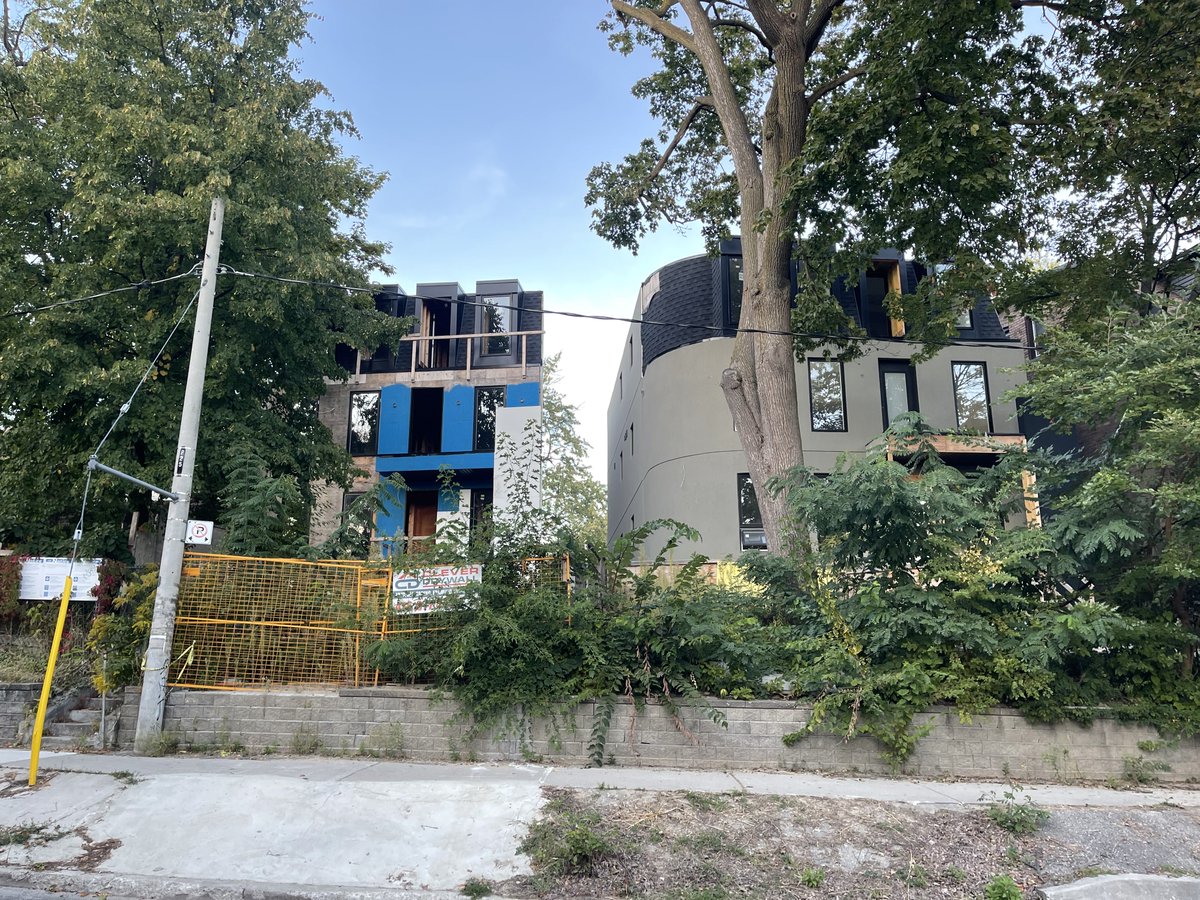
Bianca and I went for a walk around the Junction over the weekend, as we like to do, and I was pleasantly surprised to find a number of "multiplexes" under construction. That is, small infill rental projects with four or five homes, sometimes including a laneway house at the back. (Sorry, no sixplexes were spotted just yet.) It immediately made me think, "Wow, it's happening! Toronto is intensifying its neighborhoods."
For those of you who haven't been following closely, many of Toronto's neighborhoods have been bleeding population over the past few decades. It's only where we've allowed larger-scale new developments that we've really seen populations increase. That's what has precipitated our current push to expand housing options in our low-rise neighborhoods. And already, you can find evidence that it's starting to work.
That said, it's worth mentioning a few things. Some of the planning notice signs that I stumbled upon dated back to 2022, and some were current. This raises at least two lines of questions. One, why is a small project that went to the Committee of Adjustment in 2022 still under construction? Was it because of planning delays, or something else? And two, why are today's projects still having to go to the CofA? Are we still not there yet in terms of the planning policies?

I don't know the precise answers to these questions, but I do know that planning staff actively monitor which variances are requested and ultimately approved. If the same variance continues to show up, then it's a clear indication that it should just become policy, and not be something that needs to be sought. This should give some comfort that we should only get better at facilitating this scale of housing.