Daily insights for city builders, delivered every morning at 6 AM ET. I’m Brandon Donnelly — a Toronto-based real estate developer and founder of Globizen. I’ve been writing here since 2013.

Category: Development

  • Money and beauty

    I’ve told versions of this story before, but I was reminded of it again today.

    When I was in grad school studying both architecture and real estate, I used to walk back and forth across campus and jump between two very different kinds of academic experiences. On the one side of campus, it was taboo to talk about money. And on the other end, the only important thing to talk about was money. (I am exaggerating in both cases, but I think only slightly.)

    Given that I was studying and genuinely interested in both, this always felt like a weird false dichotomy. I mean, why not care about, you know, multiple things? But that’s generally not the way it was. Talking about money tainted the purity of design. And talking about things like design and beauty felt out of place and less serious in a room where cap rates were being debated and serious financial models were being honed.

    This is not to say that nobody was thinking across disciplines. I was in a joint program, after all. I can also remember attending a lunch & learn where a student asked a seasoned real estate executive what he should study in addition to finance. The response he got was something along the lines of, “the furthest thing from finance. Study something that will give you a different perspective on real estate.”

    I remember this really resonating with me — probably because I was searching for breadcrumbs to make me feel like less of an outsider at Wharton. Still, this came across as a unique perspective at the time.

    Knowing how money stuff works is absolutely fundamental. (We need to teach more of it in schools to young people.) And as a developer, it all starts with managing risk, executing (i.e. doing what we said we would do), and being an honest steward of other people’s money. Don’t do this, and you likely won’t be a developer for very long.

    But then, what else? What unique insights can we bring to the assumptions that feed a finely honed model? Fast forward to today and this is now the basis for how the Globizen team aims to look at real estate opportunities. We want to cover all ends of campus. And that means we are more than okay talking about unserious things like design and beauty.

  • Stubborn flexibility

    I’ve been having more coffee meetings over the last few weeks. And one of the things they are doing — besides making me jittery — is reminding me that at least two things happen during bear markets:

    1. Conviction gets tested.
    2. People get really creative.

    Let’s start with number one. It’s easy to have conviction in something when it’s obviously working and lots of other people are doing it. But what about when that is no longer the case?

    Take the example of Amazon. In this 2018 post by Fred Wilson, he reminds us that at the peak of the internet bubble in 1999, Amazing was trading at around $90 per share. Two years later it was somewhere around $6 per share. And it was not until 2007 that Amazon would start trading above its peak again.

    In hindsight, holding on was very obviously the right thing to do. But to do that from 1999 to 2007, you would have needed patience. And to have patience, you would have needed a high degree of conviction in Amazon as a company and in the internet as the harbinger of an important societal shift. That wouldn’t have been easy — just like many things today are not easy.

    At the same time, bear markets force people to get really creative — we’re now onto thing number two. In this case, it’s not a question of patience. It’s, “the thing I was doing before no longer works and I don’t know if/when it will work again, so I’m going to get creative and try something new.” Bear markets give you this wonderful opportunity because the opportunity cost of not doing the status quo disappears (or greatly reduces).

    On some level, though, these are two contradictory things: are we sticking to our guns or are we trying something new? But in my mind, you want both. This is not about saying, “lots of people used to want to buy cryptocurrencies and condominiums, but now a lot of people don’t, so I’m going to move onto the next hot thing.” It’s something more calculated than this.

    To return to Amazon, I think it’s akin to Jeff Bezos’ old mantra that you want to be stubborn on vision, but flexible on the details. Right now, lots of people are being forced to be flexible. But the vision part is what you still need conviction around. Otherwise, how will you get to where you want to go?

  • What rules should we be breaking?

    Here is another great video from About Here talking about how breaking certain rules could make for better apartment buildings.

    The basis for the video is a design competition put on by Urbanarium, called Decoding Density, which asked participants to propose creative solutions for “six-story plus apartment forms in Metro Vancouver.”

    More specifically, the competition asked: How might Vancouver intensify its single-family neighborhoods with small-scale wood-frame apartments?

    The About Here video covers some of the common themes from the submissions and, not surprisingly, the first is single-stair buildings. Requiring only a single point of egress can really unlock small sites.

    Some of the other ideas are, perhaps, a bit more adventurous; but these are valuable exercises. Many rules are dumb. So it’s important that we continually question them and search for better ways.

  • Remember unfunded inclusionary zoning?

    Over the weekend, we spoke about how the “GTA condo market is in a state of economic lockdown.” What this generally means is that the math isn’t making sense to build new condominiums. And so the market is necessarily pausing.

    We spoke about what this will likely mean for supply in the coming years, but I think it’s also interesting to talk about this in the context of something else: unfunded inclusionary zoning.

    As a reminder, inclusionary zoning is, in its most basic form, a requirement to build a certain amount of affordable housing as part of new housing developments. And what I mean by “unfunded” is that there are no subsidies or other incentives being provided to the project.

    This means that the cost of providing this housing — and there is an additional cost — needs to be shouldered by the project, which ultimately means the market-rate units need to pay for it.

    Which is why if you look at most policy studies, you’ll often find recognition that, because of this economic reality, IZ tends to work better in areas where home prices/rents are higher. And again, that’s because the market-rate homes need to shoulder the cost.

    We have questioned, many times, on this blog, whether this is the right approach to delivering affordable housing, but I think this question becomes even more critical in our current market environment.

    If the entire market is, for the most part, in a state of economic lockdown, should we really be layering on additional costs and making it broadly more difficult to build any sort of new housing? It seems counterintuitive.

    For more on this topic, check out this recent Sightline article by Dan Bertolet.

  • Over-building and then under-building: Is Toronto headed for a severe shortage of new rental housing?

    As we know — because here’s the data — this is the current state of affairs:

    The GTA condo market is in a state of economic lockdown. The math doesn’t make economic sense from both the demand side (investors) and the supply side (developers), leaving the market at a standstill.

    The above excerpt is from a recent CIBC Capital Markets article by Benjamin Tal (CIBC) and Shawn Hildebrant (Urbanation). And what it ultimately means is that the supply of new condominiums in the GTA is falling and will continue to fall for the foreseeable future. Below are two charts, from the same article, that show that.

    Because of this, I actually think that, if you need or want a place to live, right now is a near ideal time to buy a condominium, especially if it’s from developer inventory (in an already completed project) or it’s a resale. Of course, most people won’t want to do this because they’d rather buy when most other people in the market want to buy. This is how markets tend to go.

    It has been a while since the GTA has gone through one of these real estate cycles, but it is typical: developers are prone to both over-building and under-building. It simply takes too long to build a building, and so it is natural for there to be moments when supply and demand don’t exactly line up.

    Pre-selling condominiums is — in theory only — supposed to protect against too much overbuilding. But as we have spoken about many times before, it can be challenging for end users to buy a new home so far in advance. And so the new condominium market has come to rely on investors who want to buy early and then either sell later or rent later.

    According to the above article (and MLS data), the share of newly completed condominiums used as rentals reached a peak of 34% in 2023. So a third of new condos. My gut tells me that the actual number is much higher. Many rentals never reach MLS. Overall, I think it’s very safe to assume that the majority of new condominiums are owned by investors.

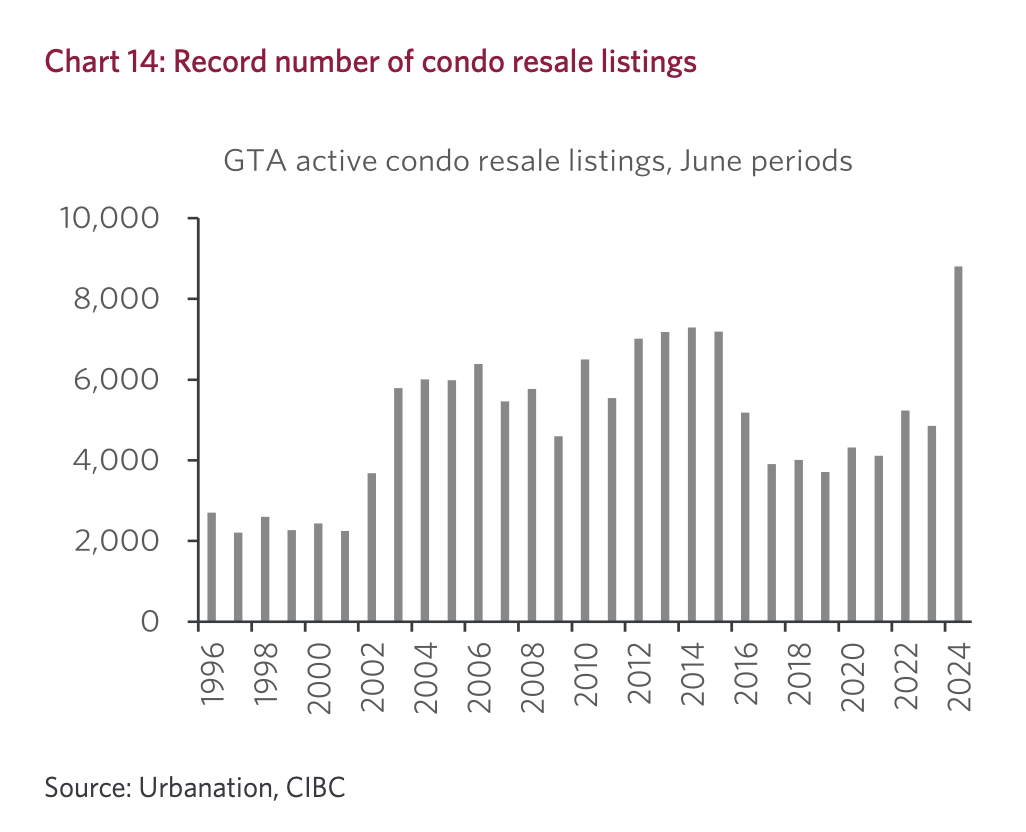
    But right now, fewer investors want to own condominiums, which is why the number of resale listings has spiked this year:

    This is, again, why I think right now is an excellent time to buy a condo. You know, be greedy when others… Regardless, this inventory will need to get absorbed and that will ultimately happen. Some of it will go to end users and some of it will go to investors who can make sense of the rental math and/or want to take a long view on Toronto. But if more goes to the former, we will be losing a lot of new rental housing.

    At the same time, while all of this is going on, construction starts are likely going to remain depressed (chart 3 above). It’s impossible to know how long this lasts, but at some point we will reach a moment in the cycle where we are under-building new housing. Maybe we’re already there. Development simply can’t turn on fast enough when demand spikes. There will almost always be a lag.

    So, since the majority of new condominiums have been serving as new rental housing, there’s a strong case to be made that at some point we will run into a potentially severe shortage of rentals. Condo investors are sometimes vilified in the media, but we will soon find out what happens when you take a big chunk of them out of the housing market.

  • Lisbon House Mafia

    This past Monday, I got together with David Wex (of Urban Capital) and Rick Sole (my business partner) for a night of DJ’ing electronic music. We called it our inaugural developer rave session and it was a ton of fun. I (mostly) had no idea what I was doing. Rick and David were great. And together, we played to a sold out crowd that consisted of two of our wives.

    David was also kind enough to host us at his bar Lisbon Hotel (it’s closed on Mondays). Which is why when I posted some of the above photos on X, Affan Imran asked if we are calling ourselves the Lisbon House Mafia. I thought that was pretty good. And since I’m still in search of a proper DJ name, that’s the title of today’s post.

    Maybe when we do this again, we’ll open it up to more than 2 people. Maybe.

  • Ontario should have more solar energy

    I have a very close friend (Peter Vogel) who is in the solar business. He runs business development for a company called Otter Energy. And by volume, I believe they are the largest in Ontario. Since 2009, they have installed over 350,000 panels.

    So when Peter and I hang out, I get the benefit of learning about solar. And he is great at reminding me that installing panels on the roof of buildings in Ontario makes a ton of sense from both an environmental and financial standpoint.

    Generally speaking, the amount of benefit you will see depends on the building’s ratio of roof area to overall building area. Low-rise buildings with a lot of roof area (think industrial assets), are absolute no brainers. But it can also work very well on many other asset classes, including mid-rise multi-family.

    Here are some high-level figures that he recently walked me through:

    • As a rule of thumb, solar in Ontario typically generates between 12-14 kWh’s per year per square foot of roof area (usable flat roof).
    • The average payback period for an install is usually somewhere between 4.5 to 7 years.
    • However, on income producing properties, the permanent decrease in operating expenses and the corresponding increase in net operating income (NOI) will increase your asset value on day one.
    • Consider spending $100k on solar panels to increase your NOI — through lower electricity costs — by $10k. If you were to then capitalize this increase in NOI by 5%, it would mean your asset value has right away increased by $200k. If the cap rate for this asset is even lower, say 4%, the increase goes up to $250k.
    • These multiples can get even better with larger installs. Here are some numbers from a real-world 100,000 sf commercial building in Ontario. In this case, the solar system cost about $800k (net) and resulted in annual operating cost savings of about $140k. This means, that at a 5% cap rate, the owner spent $800k to increase the value of their asset by $2.8 million on day one.
    • Of course, in addition to all of this, you get long-term energy cost certainty. That’s worth something too.

    The business case is compelling. So I think more building owners should be looking at solar. We are certainly looking at it from a development perspective. If you’re interested in learning more, feel free to reach out to my friend. There are a lot of details that help strengthen the case for solar, including depreciation allowances and tax credits.

  • On-street residential parking is too cheap

    The minimum size of a parking space in Toronto is 2.6 m wide x 5.6 m long. (It can change based on other factors, but this is all you need to know for today’s post.) This works out to 14.56 square meters or ~157 square feet in area for a typical spot.

    Building a parking space of this size in an underground or structured parking garage is very expensive. I have seen the former cost over $200k per space once you include everything else that goes along with building below-grade parking.

    However, this opinion piece reminded me that if you’d like to rent an equivalent area on the streets of Toronto, you can do that for a lot less. If it’s your first vehicle permit and you have no on-site parking where you live, the 2024 cost is $22.19 (plus HST) per month.

    That works out to a monthly land rent of approximately $0.14 per square foot.

  • 1,688 new condominiums were sold last quarter in the Toronto region

    Urbanation just released its Q2-2024 condominium market survey for the Greater Toronto & Hamilton Area (GTHA), and we should probably talk about some of the data:

    • The new condominium market reported 1,688 sales in the quarter. Outside of Q2-2020 (the pandemic), this is the lowest in the past 20 years. Note: This number is self-reported by developers.
    • Of the 3,625 homes launched for pre-sale during the quarter, only about 17% got absorbed/sold. That’s about ~616 homes, which isn’t very much when you spread it out across the region’s projects.
    • Unsold inventory increased to 25,893 homes. Urbanation equates this to 34 months of supply, versus a more “balanced level” of 10-12 months. This number breaks down to 15,157 homes in pre-construction projects, 9,788 homes in projects under construction, and 948 homes in recently completed buildings.
    • This is higher than Urbanation’s 20-year average, but the way I see it is that the ~15k homes in pre-construction projects could very quickly evaporate. If those projects don’t get to construction (and most probably won’t in the short term), then that inventory will disappear from the market. On the other hand, the ~11k homes under construction or recently completed is a hard number. These homes exist, or will soon exist, and they’ll need to get absorbed at some point.
    • There are also going to be homes that are currently sold, but where buyers ultimately say “yeah, I’m not going to be able to close.” So there will be some non-zero percentage of homes that will need to be reabsorbed. I don’t know what this percentage will be, but if it’s something like 5%, that’s not nothing. (See below for the number of condominiums under construction right now.)
    • Not surprisingly, average asking prices for unsold homes only declined about 2.6% over the past year. Prices have remained markably sticky. And this is how you know that development happens on the margin. Because developers are infinitely better off selling homes and starting construction, compared to holding lots of unsold inventory and starting construction, whenever. The fact that developers aren’t dropping prices to sell more homes demonstrates that they can’t. They’re hitting the floor of financial feasibility.
    • Finally, last quarter saw 727 new condominium homes start construction. In theory, this could have been a single tall building, though that probably wasn’t the case. As new starts fall, the number of condominiums under construction will naturally also fall. The current number is 87,508 homes, which is almost 19,000 less than a year ago. I expect this number to keep coming down.
  • What’s best for the project?

    Development is tough. Among a long list of other things, it requires making a lot, and I mean a lot, of decisions. Oftentimes you won’t have all the information. And sometimes they will be uncomfortable ones to make. But you need to decide on something. It is, arguably, almost always the case that any decision is better than no decision.

    In situations like these, I often like to think back to something that my first boss in development used to drill into me. She would simply ask: What’s best for the project? Now, this is not to say that you should ever do bad things simply for the betterment of a project. That is clearly the wrong thing to do. What I am instead saying is that it can be helpful to keep this guiding light in mind.

    Developers have a fiduciary duty to their investors and partners. But they also have a responsibility to the people who will ultimately occupy the spaces that they’re building and to the communities that they’re building in. And at the highest level, all of these groups should be aligned in wanting the best possible project.

    So if you’re ever struggling with a development decision or you just need a goal reminder, try asking yourself this basic question. It may not work or apply in all scenarios, but I have found it to be helpful in situations where I’m wrestling with something and I need to take emotion out of the equation. What’s best for the project? That’s what it’s all about.