Daily insights for city builders, delivered every morning at 6 AM ET. I’m Brandon Donnelly — a Toronto-based real estate developer and founder of Globizen. I’ve been writing here since 2013.

Category: Development

  • What we value the most

    One natural response to yesterday’s post about (housing) affordability vs. beauty is to think that I put forward a false dichotomy. Why can’t we have both? Why does it need to be a zero-sum game? Surely there’s a middle ground. Our cities should be both inclusive and beautiful. And of course, I don’t disagree.

    What I was trying to do with the post was force a thought exercise. There are lots of things that we do as city builders which serve to increase the cost/price of housing. Going to a design review panel adds time/cost. Deciding to use that really nice material from Europe adds cost (and maybe time). And even adding a simple building stepback adds time/cost.

    So in doing these things, we are in effect deciding that these are more important that just building cheaper and lowering the resulting rents/sales prices. We can certainly debate the right balance and how much should be spent on things like design and/or sustainability, but it doesn’t change the fact that, for better or for worse, we are saying, “it is important that we spend the money on this particular item.”

    Now, there is also a common counter argument that none of this really matters, because developers will always price new housing at whatever the market will bear (i.e. the maximum possible price). But as I have tried to argue many times before on this blog, this is not always true. Pushing prices too far increases risk and slows absorption.

    It also ignores the fact that in any given city there are going to be sites that are infeasible to develop with new housing. That is, when you look at all the costs and, yes, what the market will bear, the numbers just don’t work. And so what can happen when you reduce development costs is that you now unlock more sites for new housing, increasing overall supply.

    None of this is to say that our cities shouldn’t be beautiful or that we shouldn’t strive for creative design solutions. This is exactly what we should be doing! Instead, this post (and yesterday’s) is simply a reminder that time and things do cost money, and that the decisions we make are rarely benign. In fact, they usually speak to what we value the most.

  • Affordable vs. beautiful

    If you had to pick one, would you say that it’s more important for new housing to be affordable or to be beautiful? Many of you are probably thinking that it should be both. And while it is true that good and thoughtful design doesn’t always need to be more expensive, nice things do often cost money. And sometimes, doing as little as humanly possible costs even more money.

    Let’s consider two development scenarios. In scenario A, the developer has well-oiled machine that delivers relatively affordable, but identical rental housing all across the country. The buildings are functional and there’s virtually no vacancy, but the architecture is undoubtedly bland and it certainly doesn’t respond to its local context. Standardization and efficiency trumps all, including aesthetics.

    In scenario B, the developer is similarly building new rental housing, but she instead invests heavily in custom designs. Each building is unique. And each building goes through a “design review panel”, after which extensive changes are made in order to ensure that the design is truly beautiful and that it responds to its local context. As a result, there is a real price premium to these homes.

    These are perhaps extreme examples. Usually, the goal is some sort of balance between affordability and beauty. But I do think it speaks to some of the tensions that our industry faces. So if you had to choose one, which one would it be? What kind of new homes do our cities really need more of? And if your answer is scenario B, does it change after a certain premium?

  • Multiple on land cost

    Following yesterday’s post about the most expensive home in Brooklyn’s Dumbo, Jed Bryne of Oak City CRE fame shot me a note asking about the typical land multiple that developers need in Canada in order to make a project feasible. In other words, if your land cost is $X, what multiple on this would your top line number need to be in order to have a project? And he mentioned that in North Carolina, he often sees multiples in the range of 3-5x the land acquisition cost.

    My initial response was that we don’t typically look at this metric. Many years ago, the rough rule of thumb for new condominiums here in Toronto used to be 10x the land price per buildable square foot. So if you were buying development land at $100 per buildable square foot (calculated as land price divided by the total gross floor area of the project), then you likely needed to sell your condominiums for somewhere around $1,000 per square foot.

    On some level this can be a useful metric, because it allows you to quickly tell if a parcel of land is too expensive. And in some situations, it might allow you to compare sites/markets. If you have two different markets and land at the same $X price pbsf, but one requires a 10x multiple to be feasible and the other a 5x multiple, then it tells you something about the cost structures of these two markets. Construction costs probably won’t vary all that much (assuming similar builds), but project timelines, development charges, and many other things sure can.

    But again, this isn’t a number that we typically care a great deal about.

    There are a lot of variables in a pro forma and the “required” multiple can change overnight. Maybe it’s 10x today, but then development charges go up by 49% and now you need an even higher multiple in order to make the project feasible. So for us, the salient land number is the price per buildable square foot. What is the price per pound of development density? And the way you determine if you have a reasonable number is by doing a residual land value calculation.

  • The most expensive home in Brooklyn’s Dumbo neighborhood

    The most expensive home in Brooklyn’s Dumbo neighborhood is currently under contract and is expected to close in the next few months (at least according to the WSJ). It is a 4,270 square-foot penthouse, with a 500 square-foot terrace, that occupies the full top floor of Olympia Dumbo.

    The asking price / contract price is $17.5 million, which works out to be about USD 4,098 per square foot (or CAD 5,486 per square foot based on the exchange rate right now). Based on this price per pound, an equivalent 600 square foot suite would cost you about CAD $3.3 million.

    The land was purchased in 2018 for about $98 million. I don’t know what the total GFA of the building is, but it does have 76 residences, so that works out to about USD 1,289,473 per suite (or CAD 1,726,624 per suite), for the land cost alone.

    This should give you an indication of what the end suite pricing would need to be to make this development feasible, and likely also speaks to its average suite size. New York City tends to build much bigger suites. Certainly compared to here in Toronto.

    Also, notice that I didn’t say unit?

  • The 12 best design districts around the world

    Architectural Digest has just published the perfect article for gratuitous self-promotion. It is a list of “the 12 best design districts around the world”, and it includes The Junction, here in Toronto:

    Located in a tree-lined historic area of the city, The Junction gets its name for its past as the heart of the Canadian Pacific Railway. Mix with locals on the main drag of Dundas West at boutiques including the minimalist homeware store Mjolk and modern stationery shop Take Note. A short 20-minute walk from this charming retail center, the Museum of Contemporary Art is worthy of a stop in too. (Current exhibitions include a site-specific commission by artist Sarah Badr and Seeing the Invisible, an augmented reality experience in the museum’s Jerusalem Botanical Gardens.) Then take a tipple at The Junction Brewery, which serves local craft beers within an Art Deco building that offers a glimpse of the neighborhood’s rich history.

    Early on in high school, I used to come downtown to primarily do two things: skateboard and walk Queen Street. This was the street. It was weird and artsy and we loved it. And so we would start at University Ave and walk west for as long as the street was interesting.

    For a period of time, it felt like things kind of fell off after Spadina Ave. So we would often stop there. But then west of Spadina started getting cool and interesting too.

    Years later in 2004, the Drake Hotel would open up on what felt like a far off location on Queen Street. And then seemingly overnight, all of Queen Street was cool. Parkdale had a taco place with absurdly long lines and loud hip-hop music, and cool started moving up Ossington Ave, presumably because Queen had run out of space.

    Of course, neighborhoods have cycles. Before it was the Drake Hotel, it was Small’s Hotel. And when it opened in 1890, it was located in one of the wealthiest areas of Toronto. Then the area became a lot less wealthy, and eventually the hotel became a flophouse, before once again becoming cool again. These are the cycles.

    There is no doubt that Queen Street remains one of the greatest streets in Toronto. But in my mind, 2018 was a turning point. This is when when the Museum of Contemporary Art (MOCA) left Queen and moved to the Junction Triangle (or the Lower Junction, or just the Junction, depending on what you prefer to call it).

    This to me didn’t signal that Queen had in any way peaked. Far from it. But I think it did solidify the Junction as one of Toronto’s next cool and artsy neighborhoods. And now here we are with Architectural Digest calling it one of the best in the world.

    It would be hard for me to be more biased. But I’m a big fan of the Junction. And I am really looking forward to erecting our placemaking art later this year. It is one of the things that our team is most proud of, and we proposed it simply because we thought it would be cool and interesting. That’s important.

  • 2 storeys not 12

    I came across this poster — related to this development application — over the weekend:

    And I think it raises a number of important questions:

    • Is 2 storeys appropriate for next to a subway station and next to an existing mid-rise building?
    • Is a mid-rise building truly unprecedented in this context? See below.
    • Are mid-rise homes inappropriate for “residential streets?”
    • How does building height factor into flood plain concerns? Wouldn’t lot coverage be more relevant?
    • And when does a mid-rise become a “high-rise?”

    For more context, here’s the proposal and its immediate surroundings:

    I fully appreciate that there’s little incentive to support new development in a place where you already live — even if you happen to live in a similarly-scaled building across the street. And I am sure that I’ll receive a number of emails following this post.

    But optimizing the use of land around our existing transit stations is one of the best things we can do as city builders.

    Update: I have redacted the contact information on the above poster.

  • Single-exit housing in Paris

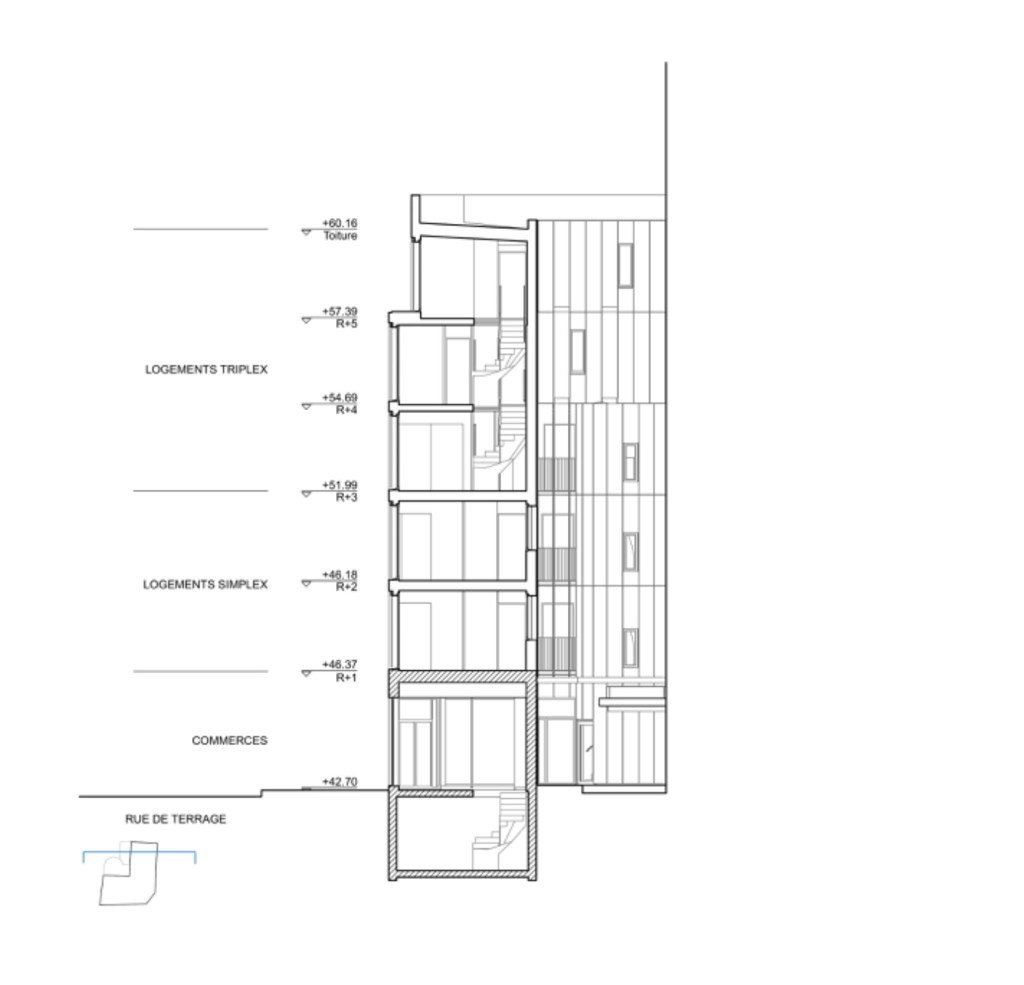
    Lloyd Alter of Treehugger recently wrote about this infill housing project in Paris. Designed by Mobile Architectural Office (MAO), it is a 6-storey building with 6 residential suites (two of which are 3-storey triplex suites) and 1 ground floor non-residential space.

    Building section:

    But here’s where things get really remarkable: the area of this corner site is less than 100 m2 (~1,000 sf), the construction budget was €940,000 (excluding VAT), and almost the entire structure was built out of cross-laminated timber. So overall, this is an incredibly sustainable build: it uses land and services efficiently and it uses low-carbon materials.

    At this point, you should now be wondering, “why can’t we just do this everywhere?” And this would be the right question.

    Lloyd correctly points out in his article that one of the things that makes this building feasible is that it only has one exit stair (as well as no elevator). Typically you need two means of egress, which can serve as a real barrier to smaller builds like this one here.

    But in this case, and this is part of the argument, the building is small enough that, should a fire or emergency happen, occupants could be rescued through their windows. So technically there are still two ways of getting out.

    In this year’s predictions, I mentioned that we would see “supportive building code changes”, which would help to encourage more infill housing. Exiting is one of the changes I had in mind when I wrote the post. So here’s hoping that policy makers are reading this blog, looking to projects like this one in Paris, and recognizing the benefits.

    Talking about exit stairs may not be as exciting and seemingly impactful as something like a foreign buyer ban, but I promise you that removing the many barriers to building this scale of housing would ultimately bring more benefit to our cities.

    P.S. This project is also social rental housing.

    Image: MAO

  • What could happen in 2023

    The central bank tightening and interest rate hikes that we saw last year will come to an end in the first quarter of 2023 as inflation gets under control. This will ultimately lead to a recession but my sense is that it will be more mild than severe. For this reason, I don’t think anyone should expect ultra-low rates to return in the short-term.

    Much of the real estate sector went on pause in the second half of 2022. But ultimately this reset to a more balanced market is going to be necessarily painful for some. And I think we will see that pain play out in the first half of the year. This will obviously be bad for some, but it will create opportunities for others.

    Construction costs tempered in the second half of 2022 and started to show some evidence of price softening. I think we will see more of this in 2023, which will be healthy for the market. Cost management over the last few years has been a meat grinder for the development industry.

    Pre-construction condominium sales for well-located projects will return in a more fulsome way by the spring. This will be driven by buyers now having clarity around where interest rates will be hanging out in the short-term and, in the case of Canada’s largest cities, by record-high immigration levels.

    For the tertiary/fringe housing markets that saw big run ups in pricing during the pandemic, I unfortunately think it will take many years for prices to fully rebound. The price increases we saw in these submarkets were of course a result of low rates, but it was also driven by a view on urban decentralization that in my view did not actually materialize.

    The desire to add more housing to single-family neighborhoods will continue to pick up steam across North America. How exactly this plays out will be market specific, but in Toronto I expect to see new planning policies put in place, as well as supportive building code changes.

    Public transit ridership will remain below pre-pandemic levels throughout 2023. This will continue to exacerbate public finances.

    Autonomous taxis will grow rapidly this year. Companies, such as Cruise, will expand into a number of new US markets and, at some point during the year, I will take my very first ride in an autonomous vehicle.

    2023 will be a big year for augmented reality and “phygital” goods. Last year I thought Apple would release a new product in this space. That didn’t happen, but it will this year. At the same time, we will see more companies releasing products that blur the lines between our online and offline worlds (hence “phygital”). This will include NFTs and other crypto-related things that will start to operate more seamlessly in the background of consumer-facing products/services.

    I continue to be bullish on Ethereum and I think it will overtake Bitcoin in terms of market cap in the next 2-3 years. But I was very wrong about Solana last year. And now I am struggling with its value proposition. Today, layer 2 chains such as Polygon feel more likely to win out. Broadly speaking, I suspect 2023 will be a positive year for crypto, but not a record-setting one.

    In summary, I think we are going to see more pain at the beginning of 2023, but that on the other side of it will be healthier and more balanced markets. This means that we can look forward to the end of the year feeling much better than it does right now. All of this said, please keep in mind that I’m often wrong and that nothing in this post should be construed as actual advice.

    Happy 2023, friends. I’m excited to get going.

  • What happened in 2022 and how I did on my predictions

    It has become tradition around here that at the end of each year I write down my predictions for the following one. And in 2022, I did that here. The overarching point of writing something like this down publicly is not necessarily to be right (because you can do that through obvious predictions). The point is to dedicate time to thinking (which is oftentimes hard to do throughout the year), to search for non-obvious things, and to generally be okay with being wrong. So I plan to do this again in the coming weeks for 2023.

    But first, let’s see how I did with my 2022 predictions:

    1. COVID: I argued that 2022 would be the year that the pandemic becomes endemic and it reaches a point where it no longer factors into decision making in the same way that it has since 2020. Some of you may disagree whether this is a good thing, but I would still say that this happened, at least in this part of the world. I started the year in lockdown here in Toronto and I ended the year having taken multiple overseas trips where testing was no longer required. (Right)
    2. Return to office: I was kind of close. I thought that the majority of people would be back in their offices by September. I didn’t say that hybrid/flex work was going to disappear, but that we would see a great return. That did happen, according to my super scientific Jimmy the Greek Reopening Index. But if you look at the latest swipe card data for the 10 largest US cities, average occupancy is hovering just below 50%, which is not a majority. (Wrong)
    3. Recreational/fringe housing: I felt very strongly that we would see a pullback in residential real estate this year, specifically recreational properties and properties in tertiary markets. This 100% happened, but I’ll be honest in that I was not thinking about the interest rate hikes that we saw. I just saw it as a pandemic bubble. I also thought that apartment rents would do very well and surpass pre-pandemic levels. This happened in many markets. (Right)
    4. Return of travel: Yup. (Right, but maybe too obvious?)
    5. Intensification of single-family home neighborhoods: This continued to be an important topic in 2022. Did we see some a tipping point-like moment, like I had predicted? I think it depends on the market, but here in Toronto we did see things like Bill 23, as well as additional efforts on the part of Mayor John Tory. (Right)
    6. Autonomous vehicles: Progress was made this year. You can now hail an autonomous taxi in places like San Francisco. But I also thought that this would be a fantastic year for Uber as the world reopened, and that they’d finally become profitable. As of Q3 of this year, that had not happened. (Wrong)
    7. Public transit and micromobility: I got the public transit ridership piece correct. I assumed that ridership levels would remain depressed. Perhaps an obvious one. But I also figured that e-scooters would be one of the main beneficiaries. While it is true that e-scooters remain very popular, particularly with French people, we did see ridership decline in the US, as the availability of cheap capital waned. (Mostly right)
    8. NFTs and augmented reality: There’s a lot happening in this digital world and I continue to be incredibly bullish. But we are certainly in a “crypto winter.” I also thought that Apple would announce something big related to augmented reality this year, but supposedly that has been pushed to next year. (Wrong)
    9. Climate change and carbon prices: I thought that the price of carbon on the EU’s Emissions Trading System would surge this year. It did not. Right now it’s looking like it’ll end up being fairly flat for the year. Of course, I also had no idea that Russia would do terrible terrible things to Ukraine, which has had dramatic impact on energy markets. (Wrong)
    10. More crypto (Ethereum, Bitcoin, and Solana): Well, I got this last one really wrong. ETH is down ~70% over the last year relative to the US dollar. I was not predicting a “crypto winter.” And I did not know that Sam Bankman-Fried was operating a weird cult-like ponzi scheme out of a penthouse in the Bahamas. None of this changes my views on crypto, but I was still wrong in 2022. (Wrong)

    Looks like I’m somewhere around 5/10.

    Stay tuned for my predictions for 2023. In the meantime, if any of you have predictions of your own, I would love to hear from you in the comment section below or on Twitter.

  • Upsizing in Hong Kong

    It is well known that Hong Kong has some of the most unaffordable housing in the world and that one response to this has been to build increasingly smaller homes — some with the moniker of “nano apartments.”

    But then earlier this year Beijing decided that these nano apartments are actually too small for people, and so a new rule was created requiring homes in Hong Kong to be no smaller than 280 square feet.

    At the same time, interest rates obviously went up, the price cap on homes that can be bought by a first-time buyer with just 10% down was increased, and people have continued to leave Hong Kong for places that are, I’m guessing, more open and less Chinese.

    The unsurprising result is that home prices are now down some 14% for the year, according to Bloomberg. But the other interesting thing about all of this is that buyers are now shifting toward larger homes:

    Developers were only able to sell 48% of the studio apartments available in the first 11 months this year, while the rate for one-bedroom and two-bedroom apartments stood at 53% and 67% respectively, according to Midland Realty.

    Even with the interest rate hikes that we have seen, what seems to be happening is that people are starting to take advantage of this softer market to buy something bigger. Hong Kong is still Hong Kong, meaning grab whatever space you can find when you can.