
Canada must become a global superpower
The silver lining to the US starting a trade war with Canada and regularly threatening annexation is that it has forced this country out of complacency. Indeed, I'm hard pressed to remember a time, at least in my lifetime, when patriotism and nationalism has united so much of Canada. According to a recent survey by Angus Reid, the percentage of Canadians expressing a "deep emotional attachment" to the country jumped from 49% in December 2024 to 59% in February 2025. And as further evidence of...

The bank robbery capital of the world
Between 1985 and 1995, Los Angeles' retail bank branches were robbed some 17,106 times. In 1992, which was the the city's worst year for robberies, the number was 2,641. This roughly translated into about one bank robbery every 45 minutes of each banking day. All of this, according to this CrimeReads piece by Peter Houlahan, gave Los Angeles the dubious title of "The Bank Robbery Capital of the World" during this time period. So what caused this? Well according to Peter it was facil...
The story behind those pixelated video game mosaics in Paris
If you've ever been to Paris, you've probably noticed the small pixelated art pieces that are scattered all around the city on buildings and various other hard surfaces. Or maybe you haven't seen or noticed them in Paris, but you've seen similarly pixelated mosaics in one of the other 79 cities around the world where they can be found. Or maybe you have no idea what I'm talking about right now. Huh? Here's an example from Bolivia (click here if you can't see...

Canada must become a global superpower
The silver lining to the US starting a trade war with Canada and regularly threatening annexation is that it has forced this country out of complacency. Indeed, I'm hard pressed to remember a time, at least in my lifetime, when patriotism and nationalism has united so much of Canada. According to a recent survey by Angus Reid, the percentage of Canadians expressing a "deep emotional attachment" to the country jumped from 49% in December 2024 to 59% in February 2025. And as further evidence of...

The bank robbery capital of the world
Between 1985 and 1995, Los Angeles' retail bank branches were robbed some 17,106 times. In 1992, which was the the city's worst year for robberies, the number was 2,641. This roughly translated into about one bank robbery every 45 minutes of each banking day. All of this, according to this CrimeReads piece by Peter Houlahan, gave Los Angeles the dubious title of "The Bank Robbery Capital of the World" during this time period. So what caused this? Well according to Peter it was facil...
The story behind those pixelated video game mosaics in Paris
If you've ever been to Paris, you've probably noticed the small pixelated art pieces that are scattered all around the city on buildings and various other hard surfaces. Or maybe you haven't seen or noticed them in Paris, but you've seen similarly pixelated mosaics in one of the other 79 cities around the world where they can be found. Or maybe you have no idea what I'm talking about right now. Huh? Here's an example from Bolivia (click here if you can't see...
Share Dialog
Share Dialog


Most of us have heard of the so-called "Blue Zones." These are the parts of the world where there is an exceptionally high number of centenarians — people over the age of 100. We've talked about this topic before, covering the importance of things like diet, community, and constant moderate physical activity. But I would like to reiterate just how impactful our physical environments can be on our overall well-being.
The island of Sardinia is one of the world's Blue Zones. But it's not actually the entire island of Sardinia; it's a specific inner mountain region that is the Blue Zone. And in this region, at least two things are fascinating: First, the men have some of the longest average life expectancies in the world and second, the men live just as long as the women do. This is unique. Ordinarily, women outlive men. But not here.
The data overwhelmingly suggests that this outcome is the result of topography and employment. Because it is a mountainous region, the built environment is filled with steep inclines and staircases everywhere you go. The result is that even walking down the street to go to church or the grocery store results in organic moderate physical activity.
At the same time, the men in this region have historically worked as shepherds. This meant that work also involved walking up and down hills all day. Again, more organic moderate physical activity. Because of this, research has found very significant correlations between longevity and pastoralism, the average slope of the territory, and the average daily distance required to reach work. The steeper the better.
There's little mystery here. We know that more activity is better for us than less. The challenge is that we can't all live in bucolic mountain towns and chase sheep around all day. Modern society demands a lot of sitting and typing and vibe coding. We also have a market economy that is constantly looking for ways to make our lives more convenient so that we're able to do even more sitting around.
We try to compensate for this with gyms and other fixes (“Urban Cycles” cover image by Marcellus Hall):
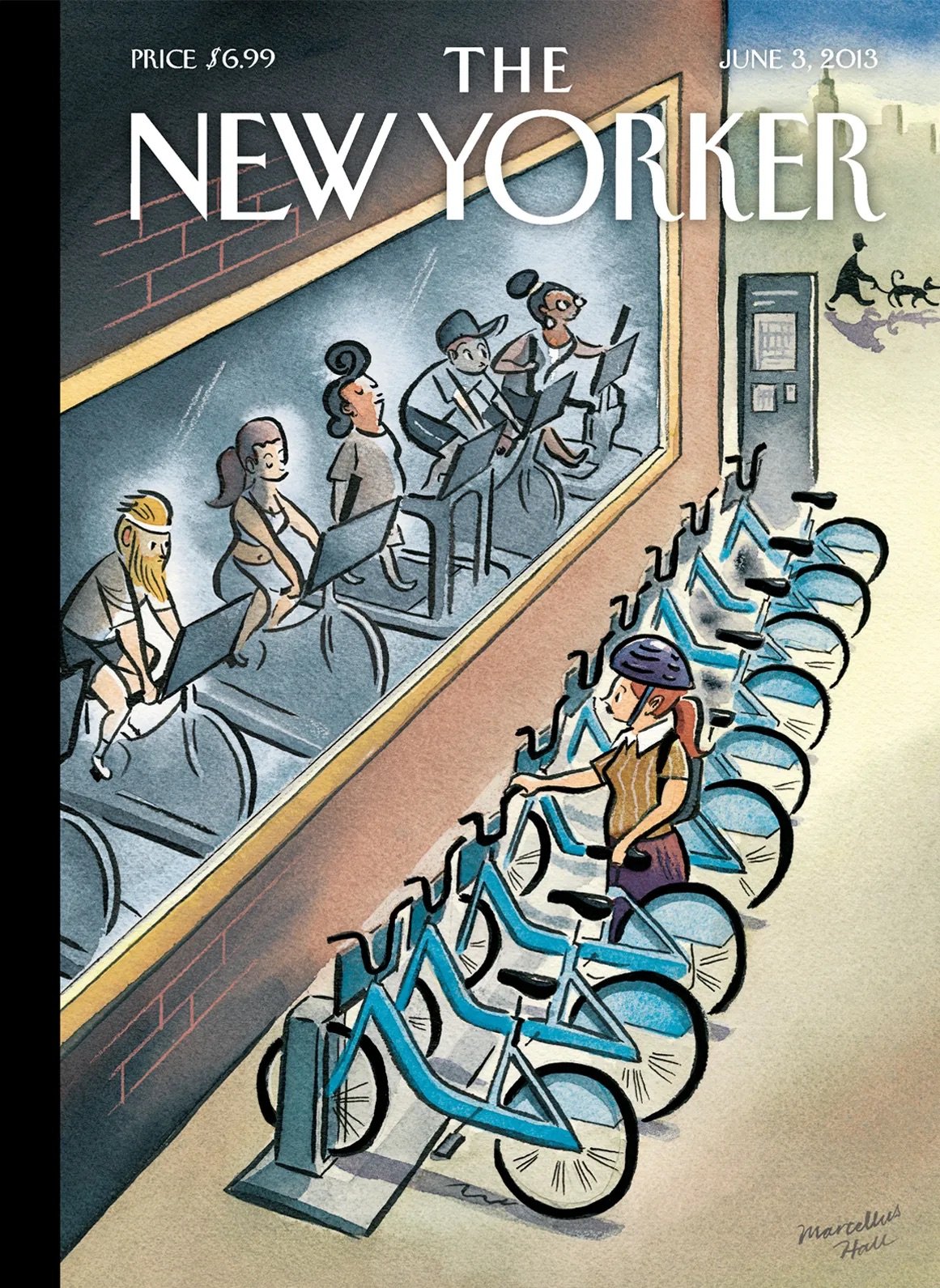
But the better and more fundamental solution is organic moderate physical activity. Meaning, moderate physical activity that we don't have to actively seek out, and that is organically embedded throughout our everyday lives. It's best when it's a lifestyle. And this is one of the reasons why I view cities where walking and cycling are ingrained as a great luxury. All else being equal, these places are destined for better health outcomes.
If I look up my Apple Health data for 2025, there are very clear spikes in steps whenever I'm traveling. This makes sense. It's because I like going to places where I can walk around all day and be physically active. I can only sit on a beach for so long. But it's also ironic that modern life dictates that I have to go on vacation in order to be more active. That's not how Blue Zones work.
There is no greater luxury than our health. Without it, nothing else matters. And so I think it behooves us to make it a fundamental component of city building.
Cover photo by Valentina Uribe Posada on Unsplash
Most of us have heard of the so-called "Blue Zones." These are the parts of the world where there is an exceptionally high number of centenarians — people over the age of 100. We've talked about this topic before, covering the importance of things like diet, community, and constant moderate physical activity. But I would like to reiterate just how impactful our physical environments can be on our overall well-being.
The island of Sardinia is one of the world's Blue Zones. But it's not actually the entire island of Sardinia; it's a specific inner mountain region that is the Blue Zone. And in this region, at least two things are fascinating: First, the men have some of the longest average life expectancies in the world and second, the men live just as long as the women do. This is unique. Ordinarily, women outlive men. But not here.
The data overwhelmingly suggests that this outcome is the result of topography and employment. Because it is a mountainous region, the built environment is filled with steep inclines and staircases everywhere you go. The result is that even walking down the street to go to church or the grocery store results in organic moderate physical activity.
At the same time, the men in this region have historically worked as shepherds. This meant that work also involved walking up and down hills all day. Again, more organic moderate physical activity. Because of this, research has found very significant correlations between longevity and pastoralism, the average slope of the territory, and the average daily distance required to reach work. The steeper the better.
There's little mystery here. We know that more activity is better for us than less. The challenge is that we can't all live in bucolic mountain towns and chase sheep around all day. Modern society demands a lot of sitting and typing and vibe coding. We also have a market economy that is constantly looking for ways to make our lives more convenient so that we're able to do even more sitting around.
We try to compensate for this with gyms and other fixes (“Urban Cycles” cover image by Marcellus Hall):

But the better and more fundamental solution is organic moderate physical activity. Meaning, moderate physical activity that we don't have to actively seek out, and that is organically embedded throughout our everyday lives. It's best when it's a lifestyle. And this is one of the reasons why I view cities where walking and cycling are ingrained as a great luxury. All else being equal, these places are destined for better health outcomes.
If I look up my Apple Health data for 2025, there are very clear spikes in steps whenever I'm traveling. This makes sense. It's because I like going to places where I can walk around all day and be physically active. I can only sit on a beach for so long. But it's also ironic that modern life dictates that I have to go on vacation in order to be more active. That's not how Blue Zones work.
There is no greater luxury than our health. Without it, nothing else matters. And so I think it behooves us to make it a fundamental component of city building.
Cover photo by Valentina Uribe Posada on Unsplash
1 comment
Nice article 👍