Daily insights for city builders, delivered every morning at 6 AM ET. I’m Brandon Donnelly — a Toronto-based real estate developer and founder of Globizen. I’ve been writing here since 2013.

Month: January 2026

  • Landfilling Toronto’s Parliament Slip

    January 31, 2026 · View original


    Toronto’s East Bayfront has changed dramatically over the last twenty years. Remember when we used to complain that the waterfront was under-utilized?

    Here’s what it looked like circa 2005 (photo via Waterfront Toronto):

    And here’s what it looks like today:

    The waterfront has, in my opinion, become one of the nicest neighbourhoods in the city. I’m bullish on this part of Toronto. But it’s not done yet.

    One key piece of infrastructure that was just completed is the landfilling of a part of the Parliament Slip.

    If you go back to the previous aerial photo, you’ll see that the water’s edge now runs parallel to Queens Quay East in this section.

    This was an important piece of city-building work because it will allow Queens Quay to continue eastward to Cherry Street, establishing a new city grid that can be used for transit and future development in the area.

    If you’d like to see what it takes to landfill part of Lake Ontario, below is a time-lapse video, also from Waterfront Toronto.

    YouTube video

    If you can’t see it embedded in the post, click here.


    Cover photo from Waterfront Toronto

  • Can London really build 180,000 homes on its roofs?

    January 30, 2026 · View original


    As a general rule, building a new building is easier than trying to do surgery on an existing one, because you never know exactly what you’re going to find when you start the latter. But there are instances where surgery is necessary.

    According to Bloomberg, developers in London are becoming increasingly interested in the airspace above existing buildings, and it supposedly started because of some policy changes:

    > In 2020, then housing minister Robert Jenrick introduced reforms that relaxed rules to add airspace builds above existing buildings. Owners can now construct additional residential stories to either expand their own dwelling or to create new units altogether without going through full planning permissions, which are often a long and costly process. This was part of a broader set of reforms to boost housing supply, and the current Labour government has not shelved these changes.

    Here’s an example site listed for £150,000:

    > The site currently comprises the roof and airspace above a 3-storey mixed-use residential-led block (Block B) within The Glassworks Development. > > The existing development was constructed in 2017 and comprises 23 residential apartments plus ground floor commercial space, all of which are sold off on long leases.

    I had an old boss who was very interested in this idea. For him, it was “free” land and a way to further extract value from an existing real estate portfolio. Of course, it’s also a way to build new homes in already built-up cities. Some industry people think that London could accommodate up to 180,000 new homes using this strategy.

    But these are not simple builds. Can the existing structure and foundations support additional levels? How do you modify the existing elevator(s) while the building below remains occupied? How do you do the mechanical tie-ins without impacting the suite(s) below?

    All of this makes me wonder how feasible it will be for London to build 180,000 new homes in this way. If it can, that would be a great accomplishment, and one that other cities should aim to emulate. But regardless, I’d love to get under the hood of one of these projects.


    Cover photo by Travis Fish on Unsplash

  • Signage tells you more than just where to go

    January 29, 2026 · View original


    We arrived in Revelstoke, BC, yesterday afternoon. The last time I was here was in 2015, and already I can tell that a lot has changed since then. I’m sure I’ll have more to say on this over the next few days, but one of the first things that stood out to me was the city’s signage.

    In 2020, Revelstoke City Council approved a $3.2 million, multi-phase wayfinding plan designed by Cygnus Design Group. So, what I have been seeing are the first completed phases.

    Wayfinding signage serves (at least) two critical functions. The first, and most obvious one, is that it tells people where they are and how to get to where they likely want to go. The sign in the cover photo of this post is what you see right before you enter downtown.

    The second function of wayfinding signage is to send other signals. It communicates to visitors that things are well-managed, that the place is hospitable, and, most importantly, that the place attracts visitors from around the world. It conveys importance.

    Before I had even reached downtown, the signage made me think to myself, “Wow, Revelstoke has grown a lot since I last visited!” That’s the power of good communication, and it’s a vital part of placemaking.


    Cover photo from Cygnus

  • 15th annual

    Plus, Extell and Hilton announce new Waldorf Astoria in Park City

    January 28, 2026 · View original


    Whistler is out, the Interior of BC is in. Huge real estate deals are out, powder chasing is in. If you’re a long-time reader of this blog, you’ll know that I do a ski and snowboard trip with a group of friends each year around this time.

    Our last three trips were to Park City (where it snowed so much we lost power); Trois Vallées (which also served as my bachelor party and which involved equal parts snowboarding and dancing on tables); and Hokkaido (where it looked like Toronto looks right now).

    This year — for annual number fifteen — we’re headed to Revelstoke and Kicking Horse in the Selkirk and Purcell Mountains.

    On some trips we like to combine an urban trip with the mountains, so that we can also gawk at architecture and urbanism. That’s what we did in Japan last year. But this year’s trip is not about that. It’s about unadulterated time in the mountains.

    It has been a weird season for snow. The west coast has been too warm with not enough of it, and the east coast has been too cold with unusual amounts of it. I have no idea what’s in store for us this week, but here’s to hoping it looks like the cover photo of this post.


    In some related real estate news, Extell Development Company and Hilton just announced that they’ll be opening a Waldorf Astoria Resort and Residences in the new Deer Valley East Village.

    It’s going to have 132 hotel keys and 105 one- to six-bedroom branded residences ranging from 1,099 to 5,155 square feet. Of the 105 branded residences, 56 will be “hotel residences” located above the hotel, and the remaining 49 residences will be in a more exclusive standalone residential building.

    Architecture for the project is by KPF and the interiors are by AvroKO.

    If you missed my recent post about the East Village and the new Four Seasons that is also currently under construction, click here.


    Cover photo by Zach Wear on Unsplash

  • Amazon’s new supercenter strategy

    January 27, 2026 · View original


    This month, Amazon announced that it will be opening a new 230,000 sf big box store in the suburbs of Chicago. Half of the store will be consumer-facing, where customers can browse aisles for groceries, household items, and general merchandise, and the other half will serve as a kind of micro-fulfillment center.

    Supposedly, the municipality applied a restriction to the lands requiring it to be a consumer-facing store; it can’t just be for fulfillment. But it seems that some kinds are allowed.

    My understanding is that the “fulfillment” component of the project will allow customers to order (on kiosks throughout the store) certain items “from the back” and have them delivered to the front of the store for checkout. Importantly, it also decouples inventory management and optimizes the back-of-house for online grocery.

    This is a big store; bigger than even a Walmart Supercenter. It also sits on a 35-acre site, which means the lot coverage is only around 15%. However, there’s also a large stormwater management pond and room for additional pad buildings based on this site plan:

    A store this massive is a fascinating signal because it’s a clear admission from Amazon that it needs to get its brick-and-mortar strategy right if it wants to compete in grocery. Even after its Whole Foods acquisition, it’s only about 3% of the US grocery market, whereas Walmart is sitting at over 20%.

    Ten years ago, it did not feel like this would be where we would end up. Retail as a real estate asset class was out of favor. Brick-and-mortar retail seemed destined to be disrupted by e-commerce and drone delivery. But retail evolved and grocery proved to be a unique facet of retail. At least so far.

    Cover photo by Brittani Burns on Unsplash

  • Creating successful places from scratch isn’t easy

    January 26, 2026 · View original


    Creating anything from scratch is more difficult than working from an established base. This is absolutely true when it comes to starting new neighborhoods and communities. What do you build first? What will be the anchors? And how do you balance hard and soft infrastructure to make it an attractive place before a critical mass is achieved?

    I was thinking about this over the weekend while walking around Whistler Village, so I tweeted this out. If you’ve been before, you know it’s packed with people all throughout the day. I would characterize it as a successful place.

    But the responses I got on Twitter were along the lines of: “Are you joking? It’s a fake utopia. It may be busy, but staff are forced to live on the outskirts of the village in dorms.”

    These comments are not entirely wrong. Resort villages are typically a kind of Disneyland. Attainable workforce housing is a major challenge for resorts, and it’s typical to make the building of it a precondition to development. You can’t run a resort without staff.

    But none of this changes the fact that it is still very difficult to create successful places from scratch. There are lots of ski resorts that don’t have the energy of Whistler, and lots of new planned communities that don’t have the foot traffic of older neighborhoods. The Canary District in Toronto comes to mind as a place that is still settling in. That is how you know it’s challenging.

    Creating successful places from scratch requires the right strategy, careful design and programming, patience, and probably the ability to subsidize the right tenants to seed activity early on. It’s also helpful if you can avoid going broke before the neighborhood comes alive.

    Cover photo by Peter Robbins on Unsplash

  • I’m in Whistler to do huge deals

    January 25, 2026 · View original


    I arrived in BC yesterday for ICSC Whistler. This is my first time here for this conference. I came around this time several years ago for a Slate investor day, but I never participated in ICSC activities per se. So, I’ve come to realize that I don’t really know the proper protocols. I’m an ICSC newbie. Most people I know don’t attend the actual conference. My loose understanding is that you wear Patagonia, ski and snowboard all day, après at Longhorn, and then real estate deals and capital get thrown at you from all angles. I’ll try this and see what happens.

    If you’re around, drop me a text or email me at brandon.donnelly@globizen.com.

  • Why even “luxury” housing improves overall affordability

    January 24, 2026 · View original


    One of the common criticisms of new housing is that it’s designed for rich people and that it does nothing to help the housing situation of average citizens. The YIMBY response to this is, “Well, yes, it does actually, because supply eases overall housing pressures and because of the filtering effect.” This is the process whereby housing becomes gradually more affordable and available to people as new housing is built and vacancies are created. But most people don’t like this explanation. It feels slow and indirect.

    Here’s something that might help.

    In this recent study, researchers looked at the downstream effects of a new condominium tower in Honolulu called The Central Ala Moana. Completed in 2021, the building contains 512 units, of which 60% are income-restricted (310 units) and 40% are market-rate (202 units). It was developed under a state affordable-housing program that gave the developer height and density bonuses, plus fee waivers totalling about $13 million in exchange for delivering income-restricted units. (In my opinion, this is directionally preferable to unfunded inclusionary zoning mandates.)

    Using address-history microdata, the researchers tracked who moved into the new condominium tower, and constructed detailed vacancy chains across multiple rounds of moves. Here’s what they discovered:

    > Among documented vacancies, the 202 market-rate units produced 87 downstream vacancies (0.43 vacancies per initial unit), while the 310 income-restricted units produced 90 (0.29 vacancies per unit). Thus, market-rate units are more likely to generate a downstream vacancy. The main mechanism is new household formation: movers into income-restricted units are more likely to be a newly formed household, leaving family or roommates at the prior address and thus preventing a vacancy from being created.

    In absolute numbers, they found that the completion of the building induced more than 500 local vacancies in the three years after construction, by setting off a chain of moves. Importantly, the researchers also found that the homes being vacated were, on average, about 40% less expensive than those in The Central. So even though a new building may be more expensive than the existing housing stock (which is generally the case or else the development wouldn’t happen), it does generate benefits.

    It eases overall housing supply constraints and expands affordability in the local housing market.

    Cover photo by Michael Olsen on Unsplash

  • Segmenting cities and real estate

    January 23, 2026 · View original


    Towards the end of last year, Meta released SAM 3, which stands for the third version of its Segment Anything Model. The way it generally works is that it allows you to detect, edit, and experiment with things in images and videos. For example, if you were looking at a video of a street, you could ask it to find all the scooters (which I did below), count the number of pedestrians wearing black pants, blur all the license plates on the cars, and so on.

    This is immediately useful for a company like Meta because it allows for object-level modifications across its content creation platforms. So if you took a video of someone dancing and you desperately wanted to give them a bobblehead, SAM 3, I’m told, would allow you to quickly do that. Other AI models, such as Gemini, can also segment, but supposedly the SAM models are better and more precise at this specific task.

    Beyond bobblehead videos, the potential of this model seems enormous for real estate, cities, and, of course, many other things. Using the above image as an example, you can quickly imagine SAM 3 being used to count and track modal splits across a city, and then make planning decisions based on real-time data.

    People are also using it for real estate purposes. Pair the model with satellite images, and you can ask it to tell you how many houses have a pool, which houses recently had their roof replaced (and have solar panels), how many cars are parked on a street, how many cars are parked at Canadian Tire, and the average building lot coverage in an area.

    You could also use it to swap out finishes in a real estate listing (including in videos), and get material/area takeoffs ahead of a construction project. I don’t know for sure, but I would also imagine that this model would make a great building condition inspector. Come to think of it, I’d love a SAM 3 that could walk our construction sites and document every little detail!

    Of course, a lot of these use cases are already being tackled. But the models are getting that much better. And that will lead to even more innovation.

    Cover photo by Above Horizon on Unsplash

  • The luxury of walking

    January 22, 2026 · View original


    Engaging in physical activity is unequivocally associated with improved health outcomes. But are certain physical activities better than others? And what might the implications be for how we design our cities?

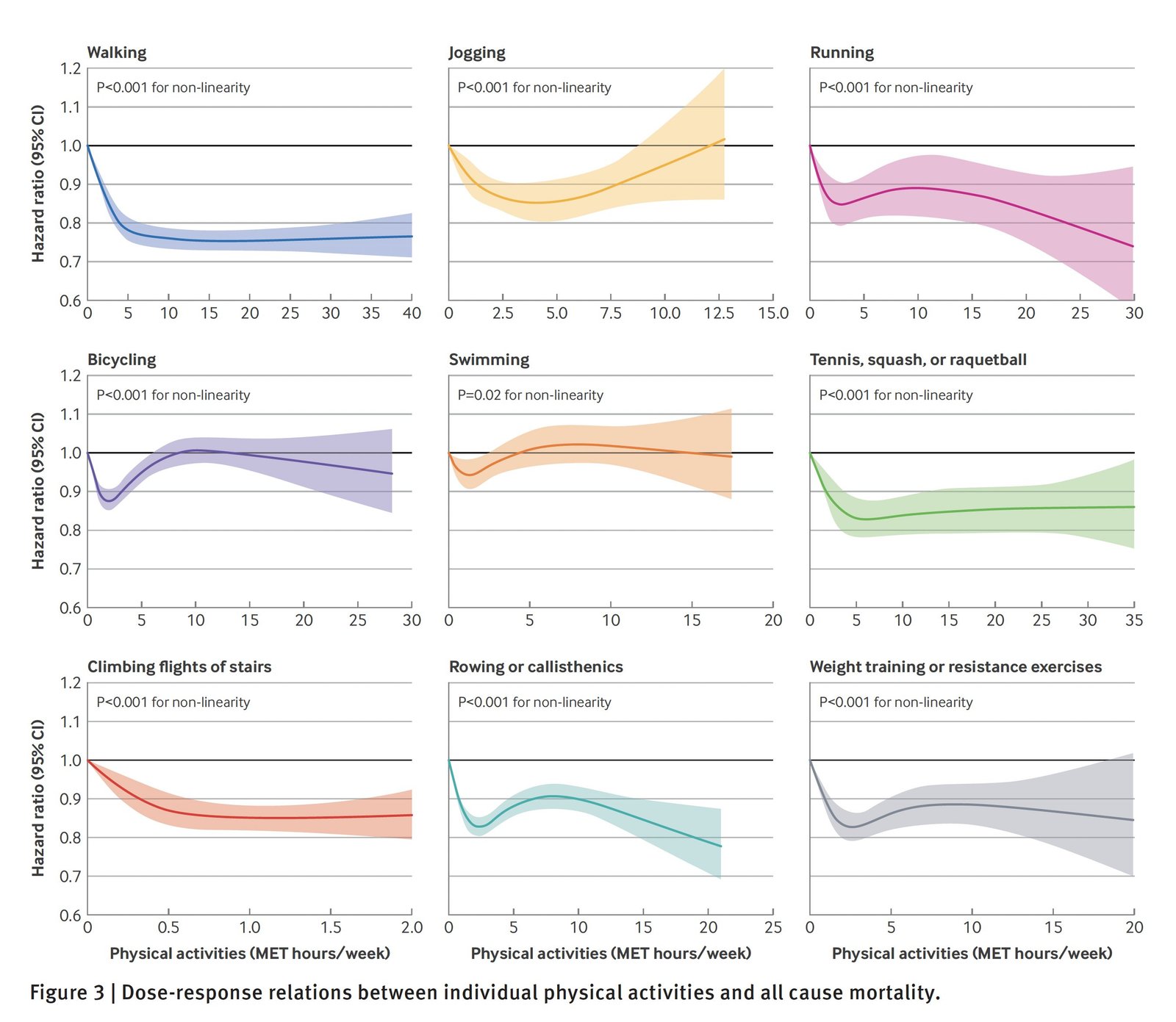
    Here is a brand new study that examined the relationship between specific types of physical activity and the risk of death, using two large cohort studies with more than 30 years of self-reported data.

    The study included information on walking, jogging, running, cycling (including stationary machines), lap swimming, tennis, climbing flights of stairs, rowing, and weight training.

    It’s important to note that this is an observational study using self-reported data. There are limitations to this. One question mark is around intensity. When someone reports swimming for an hour, it could be vigorous or casual. And the researchers note that long, low-intensity physical activities could bias the observed associations toward the null.

    With this caveat out of the way, here’s what they found:

    Their two key findings were that (1) most physical activities lower mortality rates in a non-linear way when you do more of them, and (2) mixing different physical activities is associated with lower mortality, independent of total activity levels. Variety is good.

    Interestingly enough, the most effective activity at lowering overall mortality is the simplest one: walking. It was found to reduce all-cause mortality by about 17%. This is the difference, or maximum observed benefit, between the highest walking group and a sedentary baseline.

    Once again, the data clearly shows that walkable cities can help produce meaningfully better health outcomes. So, if, like me, you subscribe to the philosophy that there’s no greater luxury in life than our health, well, then there’s perhaps no greater luxury than living in a walkable city.

    Cover photo by Alain ROUILLER on Unsplash