Daily insights for city builders, delivered every morning at 6 AM ET. I’m Brandon Donnelly — a Toronto-based real estate developer and founder of Globizen. I’ve been writing here since 2013.

Month: July 2024

  • Stubborn flexibility

    I’ve been having more coffee meetings over the last few weeks. And one of the things they are doing — besides making me jittery — is reminding me that at least two things happen during bear markets:

    1. Conviction gets tested.
    2. People get really creative.

    Let’s start with number one. It’s easy to have conviction in something when it’s obviously working and lots of other people are doing it. But what about when that is no longer the case?

    Take the example of Amazon. In this 2018 post by Fred Wilson, he reminds us that at the peak of the internet bubble in 1999, Amazing was trading at around $90 per share. Two years later it was somewhere around $6 per share. And it was not until 2007 that Amazon would start trading above its peak again.

    In hindsight, holding on was very obviously the right thing to do. But to do that from 1999 to 2007, you would have needed patience. And to have patience, you would have needed a high degree of conviction in Amazon as a company and in the internet as the harbinger of an important societal shift. That wouldn’t have been easy — just like many things today are not easy.

    At the same time, bear markets force people to get really creative — we’re now onto thing number two. In this case, it’s not a question of patience. It’s, “the thing I was doing before no longer works and I don’t know if/when it will work again, so I’m going to get creative and try something new.” Bear markets give you this wonderful opportunity because the opportunity cost of not doing the status quo disappears (or greatly reduces).

    On some level, though, these are two contradictory things: are we sticking to our guns or are we trying something new? But in my mind, you want both. This is not about saying, “lots of people used to want to buy cryptocurrencies and condominiums, but now a lot of people don’t, so I’m going to move onto the next hot thing.” It’s something more calculated than this.

    To return to Amazon, I think it’s akin to Jeff Bezos’ old mantra that you want to be stubborn on vision, but flexible on the details. Right now, lots of people are being forced to be flexible. But the vision part is what you still need conviction around. Otherwise, how will you get to where you want to go?

  • What rules should we be breaking?

    Here is another great video from About Here talking about how breaking certain rules could make for better apartment buildings.

    The basis for the video is a design competition put on by Urbanarium, called Decoding Density, which asked participants to propose creative solutions for “six-story plus apartment forms in Metro Vancouver.”

    More specifically, the competition asked: How might Vancouver intensify its single-family neighborhoods with small-scale wood-frame apartments?

    The About Here video covers some of the common themes from the submissions and, not surprisingly, the first is single-stair buildings. Requiring only a single point of egress can really unlock small sites.

    Some of the other ideas are, perhaps, a bit more adventurous; but these are valuable exercises. Many rules are dumb. So it’s important that we continually question them and search for better ways.

  • Remember unfunded inclusionary zoning?

    Over the weekend, we spoke about how the “GTA condo market is in a state of economic lockdown.” What this generally means is that the math isn’t making sense to build new condominiums. And so the market is necessarily pausing.

    We spoke about what this will likely mean for supply in the coming years, but I think it’s also interesting to talk about this in the context of something else: unfunded inclusionary zoning.

    As a reminder, inclusionary zoning is, in its most basic form, a requirement to build a certain amount of affordable housing as part of new housing developments. And what I mean by “unfunded” is that there are no subsidies or other incentives being provided to the project.

    This means that the cost of providing this housing — and there is an additional cost — needs to be shouldered by the project, which ultimately means the market-rate units need to pay for it.

    Which is why if you look at most policy studies, you’ll often find recognition that, because of this economic reality, IZ tends to work better in areas where home prices/rents are higher. And again, that’s because the market-rate homes need to shoulder the cost.

    We have questioned, many times, on this blog, whether this is the right approach to delivering affordable housing, but I think this question becomes even more critical in our current market environment.

    If the entire market is, for the most part, in a state of economic lockdown, should we really be layering on additional costs and making it broadly more difficult to build any sort of new housing? It seems counterintuitive.

    For more on this topic, check out this recent Sightline article by Dan Bertolet.

  • Olympic athletes will — probably — be able to swim in the Seine

    Since the modern Olympic Games were revived in 1896, no city has ever hosted swimming events in an urban river. Too poopy. But Paris, as we talked about, hopes to be the first. Starting on July 30, the Seine is scheduled to host the swimming portion of the triathlon competitions.

    Except, it will depend on water quality. Today’s training sessions (scheduled for Sunday, July 28) were cancelled because water tests showed that the Seine is currently below acceptable standards. This is due to heavy rain over the last few days, which I guess overloaded the city’s storm network.

    So what is clear is that — 36 years after then-Mayor Jacques Chirac first promised to clean up the river — the city has only been able to successfully achieve this, sometimes. It’s not an easy task.

    According to Bloomberg, the clean-up efforts have already cost €1.4 billion. This was spent on doing things like constructing a 50,000 m3 holding basin (about the size of 12 Olympic-sized pools) under the Gare D’Austerlitz. This now holds storm overflow during heavy rain events, in lieu of it going into the Seine.

    But this doesn’t provide any guarantees as evidenced by today’s cancelled training sessions. Presumably, it just makes it less likely for overflow stormwater to get dumped into the Seine. So a cynic might ask: Why bother with all of this?

    Well, for one thing, swimming in a river in the middle of a major global city is just plain cool. Look at how the Swiss do it. But another reason could be that you want to create one of the greenest cities on the planet. And if that’s the case, then seeing athletes swimming in the Seine is a pretty powerful image.

    It shows progress.

    Photo by J Shim on Unsplash

  • Over-building and then under-building: Is Toronto headed for a severe shortage of new rental housing?

    As we know — because here’s the data — this is the current state of affairs:

    The GTA condo market is in a state of economic lockdown. The math doesn’t make economic sense from both the demand side (investors) and the supply side (developers), leaving the market at a standstill.

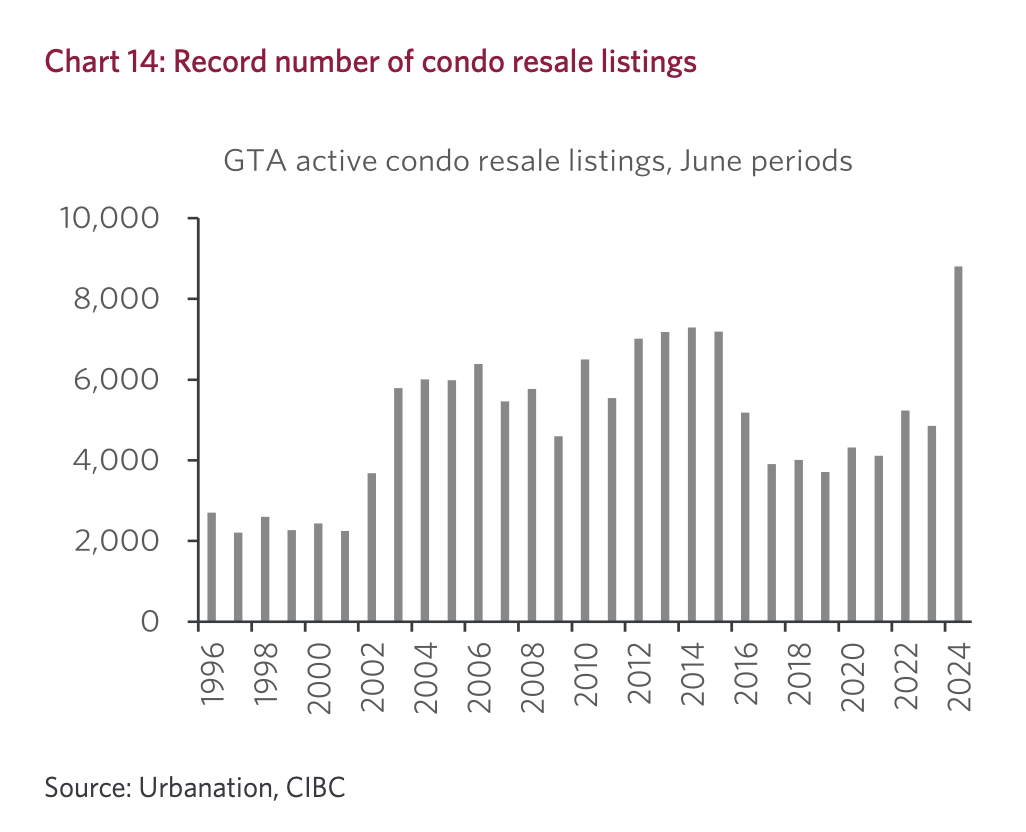
    The above excerpt is from a recent CIBC Capital Markets article by Benjamin Tal (CIBC) and Shawn Hildebrant (Urbanation). And what it ultimately means is that the supply of new condominiums in the GTA is falling and will continue to fall for the foreseeable future. Below are two charts, from the same article, that show that.

    Because of this, I actually think that, if you need or want a place to live, right now is a near ideal time to buy a condominium, especially if it’s from developer inventory (in an already completed project) or it’s a resale. Of course, most people won’t want to do this because they’d rather buy when most other people in the market want to buy. This is how markets tend to go.

    It has been a while since the GTA has gone through one of these real estate cycles, but it is typical: developers are prone to both over-building and under-building. It simply takes too long to build a building, and so it is natural for there to be moments when supply and demand don’t exactly line up.

    Pre-selling condominiums is — in theory only — supposed to protect against too much overbuilding. But as we have spoken about many times before, it can be challenging for end users to buy a new home so far in advance. And so the new condominium market has come to rely on investors who want to buy early and then either sell later or rent later.

    According to the above article (and MLS data), the share of newly completed condominiums used as rentals reached a peak of 34% in 2023. So a third of new condos. My gut tells me that the actual number is much higher. Many rentals never reach MLS. Overall, I think it’s very safe to assume that the majority of new condominiums are owned by investors.

    But right now, fewer investors want to own condominiums, which is why the number of resale listings has spiked this year:

    This is, again, why I think right now is an excellent time to buy a condo. You know, be greedy when others… Regardless, this inventory will need to get absorbed and that will ultimately happen. Some of it will go to end users and some of it will go to investors who can make sense of the rental math and/or want to take a long view on Toronto. But if more goes to the former, we will be losing a lot of new rental housing.

    At the same time, while all of this is going on, construction starts are likely going to remain depressed (chart 3 above). It’s impossible to know how long this lasts, but at some point we will reach a moment in the cycle where we are under-building new housing. Maybe we’re already there. Development simply can’t turn on fast enough when demand spikes. There will almost always be a lag.

    So, since the majority of new condominiums have been serving as new rental housing, there’s a strong case to be made that at some point we will run into a potentially severe shortage of rentals. Condo investors are sometimes vilified in the media, but we will soon find out what happens when you take a big chunk of them out of the housing market.

  • Lisbon House Mafia

    This past Monday, I got together with David Wex (of Urban Capital) and Rick Sole (my business partner) for a night of DJ’ing electronic music. We called it our inaugural developer rave session and it was a ton of fun. I (mostly) had no idea what I was doing. Rick and David were great. And together, we played to a sold out crowd that consisted of two of our wives.

    David was also kind enough to host us at his bar Lisbon Hotel (it’s closed on Mondays). Which is why when I posted some of the above photos on X, Affan Imran asked if we are calling ourselves the Lisbon House Mafia. I thought that was pretty good. And since I’m still in search of a proper DJ name, that’s the title of today’s post.

    Maybe when we do this again, we’ll open it up to more than 2 people. Maybe.

  • Ontario should have more solar energy

    I have a very close friend (Peter Vogel) who is in the solar business. He runs business development for a company called Otter Energy. And by volume, I believe they are the largest in Ontario. Since 2009, they have installed over 350,000 panels.

    So when Peter and I hang out, I get the benefit of learning about solar. And he is great at reminding me that installing panels on the roof of buildings in Ontario makes a ton of sense from both an environmental and financial standpoint.

    Generally speaking, the amount of benefit you will see depends on the building’s ratio of roof area to overall building area. Low-rise buildings with a lot of roof area (think industrial assets), are absolute no brainers. But it can also work very well on many other asset classes, including mid-rise multi-family.

    Here are some high-level figures that he recently walked me through:

    • As a rule of thumb, solar in Ontario typically generates between 12-14 kWh’s per year per square foot of roof area (usable flat roof).
    • The average payback period for an install is usually somewhere between 4.5 to 7 years.
    • However, on income producing properties, the permanent decrease in operating expenses and the corresponding increase in net operating income (NOI) will increase your asset value on day one.
    • Consider spending $100k on solar panels to increase your NOI — through lower electricity costs — by $10k. If you were to then capitalize this increase in NOI by 5%, it would mean your asset value has right away increased by $200k. If the cap rate for this asset is even lower, say 4%, the increase goes up to $250k.
    • These multiples can get even better with larger installs. Here are some numbers from a real-world 100,000 sf commercial building in Ontario. In this case, the solar system cost about $800k (net) and resulted in annual operating cost savings of about $140k. This means, that at a 5% cap rate, the owner spent $800k to increase the value of their asset by $2.8 million on day one.
    • Of course, in addition to all of this, you get long-term energy cost certainty. That’s worth something too.

    The business case is compelling. So I think more building owners should be looking at solar. We are certainly looking at it from a development perspective. If you’re interested in learning more, feel free to reach out to my friend. There are a lot of details that help strengthen the case for solar, including depreciation allowances and tax credits.

  • The French Alps and Utah are getting the Winter Games

    In my humble and partially biased opinion, two of the greatest places on earth to snowboard are the French Alps and Utah. I say the French Alps because, after 13 years of annual trips, I have yet to find better food and better après parties. And I say Utah because it’s, like, pretty hard to beat the greatest snow on earth.

    Well today, both of these places were announced as future hosts of the Winter Olympics. France will host the games in 2030 (once it has successfully met certain conditions) and Utah will host the games in 2034. This is exciting.

    But it was also entirely expected.

    France was the preferred choice since June. And Utah was the only choice for 2034. To host the Winter Games, you generally need to have at least two things: money and snow. And right now, fewer places want to spend the former on something that may or may not generate an ROI, and fewer places are getting the latter.

    Remember this post looking at the impact of climate change on the Winter Olympics?

    Because of these challenges, there is talk of the IOC adopting a permanent rotation of Winter Olympic cities. And Utah has been eagerly positioning itself to be one of the places. Biases aside, this feels like an obvious choice. Salt Lake City has some of the best and most accessible snowboarding in the world (SLC is a great airport) and — most importantly — it still snows there.

    Photo by Alex Moliski on Unsplash

  • EV charging stations > gas stations

    If you do a search for the number of electric vehicle charging stations in the US, you’ll likely get a number somewhere around 160,000. But to better understand what this means, you’ll probably want to ask a few follow-up questions:

    • Are these individual charging ports (for a single vehicle) or are these stations (locations with multiple charging ports)?
    • How many of these chargers are private versus publicly-accessible?
    • And how many of these are DC fast, versus just level 2? Level 2 is what most people have at home (I think), whereas DC charging is what you need if you’re stopping on the side of the road and need to supercharge your car in 20-30 minutes.

    Usually the biggest fear with EVs is range anxiety. We have come to expect that we’ll be able to find a gas station when we need it, but, for the most part, we don’t yet feel that way about EV charging stations.

    So for this concern, the more precise question would be: How many publicly-accessible DC-fast charging stations are there in the US? This is the filter that gives you stations that would be most comparable to how gas stations function today.

    The answer, according to the US Department of Energy, is about 10,597 stations and 44,160 charging ports. And according to Bloomberg Green, this puts the US on track to have public fast-charging sites outnumber gas stations in about 8 years.

    Of course, it’s probably safe to assume that the pace of EV adoption will only increase. And that means that this flip could happen well before 8 years. In my mind, that’s soon.

  • Nashville’s live music venues

    I’ve never been to Nashville, but I hear it’s a pretty good city for music. According to this new report from PennPraxis, titled the Nashville Independent Venues Study, the city has 252 venues that showcase live music. And more than 100 of them are solely dedicated to music.

    This gives Nashville one of the densest clusters of live music venues per capita, anywhere in the world. I also remember reading somewhere that the majority of venture funded startups in the city are in the music industry. So Nashville has a real music ecosystem going.

    Of course, when you’re really good at something it can create a dual-edged sword. In the case of Nashville, this success has led to growth, more bachelor/bachelorette parties being hosted in the city and, ultimately, developers wanting to build lots of new things.

    Right now, the city seems to be grappling with how best to balance this growth against the preservation of its live music scene. And that’s what this new report is focused on.