
Daily insights for city builders, delivered every morning at 6 AM ET. I’m Brandon Donnelly — a Toronto-based real estate developer and founder of Globizen. I’ve been writing here since 2013.

Month: July 2024

  • The Ontario Line is happening

    Yesterday afternoon, I took the 504 King streetcar from the Bloor-Dundas West mobility hub down to King & Bathurst to meet a friend at the Wheat Sheaf Tavern. In case you didn’t know, this is believed to be the oldest continually-operating pub in the city. It opened in 1849.

    My streetcar ride took an obscenely long time (over an hour) and so it was the wrong mobility choice for a peak summer afternoon. I should have biked. But once I did finally arrive at Toronto’s oldest pub, it was great to see all of the activity happening right at the intersection for the new King-Bathurst subway station (Ontario Line).

    I’m always a bit cynical when it comes to transit plans. Like, it’s hard for me to believe that something is actually happening. I’m still waiting for SmartTrack to open. So I need constant visual reminders like these:

    What you are seeing above is the northeast corner of the intersection, which is where one of the two station entrances will go. Naturally, the station platform and track itself are also aligned on a diagonal so as to minimize “significant construction impacts” to the Wheat Sheaf (southwest corner).

    This stop is also one of Infrastructure Ontario’s Transit-Oriented Communities, which means the intent is to have a private developer build things on top of the station. Directionally, this is, of course, the right approach. It didn’t happen on the Eglinton Crosstown line; but we know that the best way to maximize the value of transit investment is to combine it with smart land use planning (the rail + property model). Density is your friend.
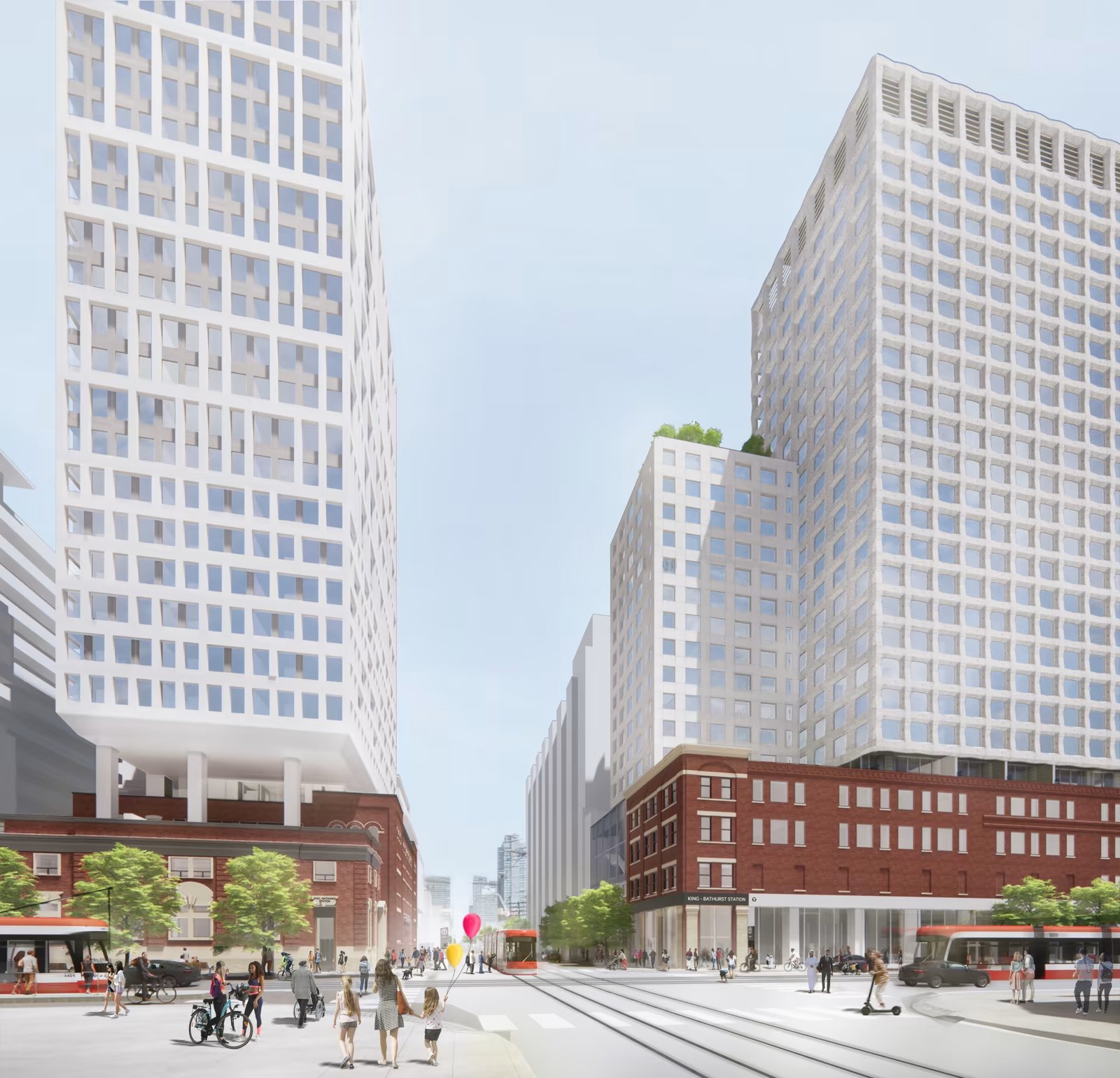
    From what I could glean during my time on the patio at the Wheat Sheaf, all of this appears to be moving forward. And already today, there is a ton of foot traffic in the area — meaning the future transit station should do very well from a ridership perspective. Now we just need this line extended up to the Bloor-Dundas West mobility hub so that the 504 streetcar can be relieved of some of its duties.

    Station Plan/Rendering: Metrolinx and IO
  • On-street residential parking is too cheap

    The minimum size of a parking space in Toronto is 2.6 m wide x 5.6 m long. (It can change based on other factors, but this is all you need to know for today’s post.) This works out to 14.56 square meters or ~157 square feet in area for a typical spot.

    Building a parking space of this size in an underground or structured parking garage is very expensive. I have seen the former cost over $200k per space once you include everything else that goes along with building below-grade parking.

    However, this opinion piece reminded me that if you’d like to rent an equivalent area on the streets of Toronto, you can do that for a lot less. If it’s your first vehicle permit and you have no on-site parking where you live, the 2024 cost is $22.19 (plus HST) per month.

    That works out to a monthly land rent of approximately $0.14 per square foot.

  • Density lowers infrastructure costs

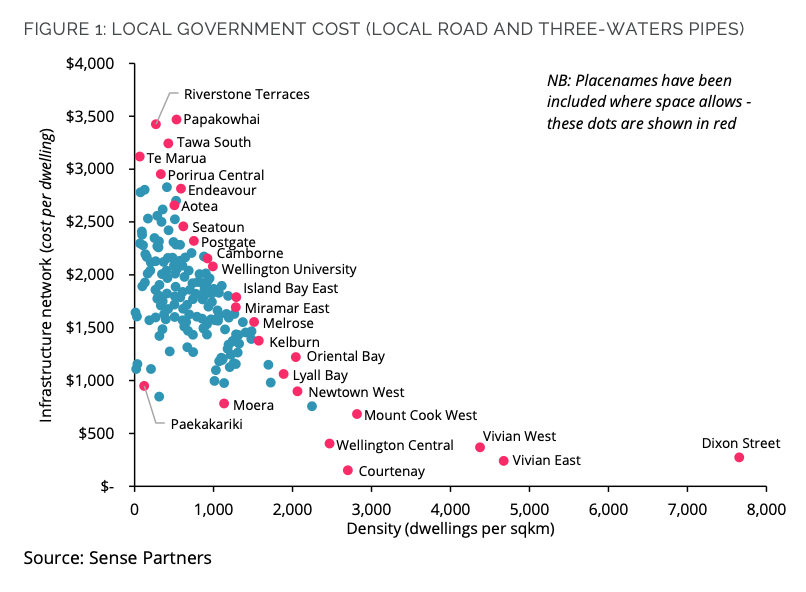
    This is an important chart from a recent study commissioned by Greater Wellington, New Zealand. The study looks at the cost benefits of urban intensification and the above chart shows the relationship been density and infrastructure costs. For this study, they specifically looked at the costs that local governments face in providing road, public bus transport, and “three-waters infrastructure.” I hadn’t heard this latter term before, but it refers to drinking water, wastewater, and stormwater.

    What they obviously found was that there are real economies to higher densities. More density lowers the per dwelling cost of delivering infrastructure. In the case of three-waters infrastructure, it doesn’t even really matter if you’re proximate to reservoirs or treatment plants. The bulk of the cost lies in the local connection pipes. So what matters most is how many dwellings you can service off of the main lines — even if these lines need to be upsized.

    The goal of this study is to enable more support for smart growth within the Wellington region:

    Regional councillor Thomas Nash says the report should give councils confidence to press on with plans that support compact mixed-use development in and around city centres and connected by high quality public transport. 

    “Regional growth needs to be smart growth. This report clearly shows that the best bang for our buck is to focus on upgrading existing water, public transport and local roading infrastructure so that we can build better quality, compact residential form, with improved amenities within our cities and towns,” Cr Nash says.

    Of course, this doesn’t just apply to Wellington. Every city should read the study.

  • 1,688 new condominiums were sold last quarter in the Toronto region

    Urbanation just released its Q2-2024 condominium market survey for the Greater Toronto & Hamilton Area (GTHA), and we should probably talk about some of the data:

    • The new condominium market reported 1,688 sales in the quarter. Outside of Q2-2020 (the pandemic), this is the lowest in the past 20 years. Note: This number is self-reported by developers.
    • Of the 3,625 homes launched for pre-sale during the quarter, only about 17% got absorbed/sold. That’s about ~616 homes, which isn’t very much when you spread it out across the region’s projects.
    • Unsold inventory increased to 25,893 homes. Urbanation equates this to 34 months of supply, versus a more “balanced level” of 10-12 months. This number breaks down to 15,157 homes in pre-construction projects, 9,788 homes in projects under construction, and 948 homes in recently completed buildings.
    • This is higher than Urbanation’s 20-year average, but the way I see it is that the ~15k homes in pre-construction projects could very quickly evaporate. If those projects don’t get to construction (and most probably won’t in the short term), then that inventory will disappear from the market. On the other hand, the ~11k homes under construction or recently completed is a hard number. These homes exist, or will soon exist, and they’ll need to get absorbed at some point.
    • There are also going to be homes that are currently sold, but where buyers ultimately say “yeah, I’m not going to be able to close.” So there will be some non-zero percentage of homes that will need to be reabsorbed. I don’t know what this percentage will be, but if it’s something like 5%, that’s not nothing. (See below for the number of condominiums under construction right now.)
    • Not surprisingly, average asking prices for unsold homes only declined about 2.6% over the past year. Prices have remained markably sticky. And this is how you know that development happens on the margin. Because developers are infinitely better off selling homes and starting construction, compared to holding lots of unsold inventory and starting construction, whenever. The fact that developers aren’t dropping prices to sell more homes demonstrates that they can’t. They’re hitting the floor of financial feasibility.
    • Finally, last quarter saw 727 new condominium homes start construction. In theory, this could have been a single tall building, though that probably wasn’t the case. As new starts fall, the number of condominiums under construction will naturally also fall. The current number is 87,508 homes, which is almost 19,000 less than a year ago. I expect this number to keep coming down.
  • I really want to live over there

    One way to describe cities is to call them labor markets. Historically, people have chosen to live in cities because they have provided economic opportunities (among, of course, many other things). That’s why the data is very clear: wages are higher in larger cities.

    But what we have also seen over the last few years — and what is causing a lot of dislocation in real estate markets — is an untethering of work. More people are working from home and from locations that offer greater lifestyle benefits (or greater tax benefits).

    We spoke recently about what this divide between in-person and remote work might mean, but regardless of this outcome, I think there’s an important truth here: Lots of people would like to live somewhere else. (In my case, my daydreams take me to Paris.)

    And for the first time ever, really, it is possible for more people to do this and stay connected to work somewhere else. Earlier innovations, such as the streetcar or car, also compressed geographies and empowered people to travel greater distances. But now the catchment area has seemingly expanded to the world.

    I’m not saying anything particularly novel here, but I do think it’s important to point out that this desire exists in many of us. Because this tension between “I do work here” but “I really want to live over there” seems like it’s only increasing.

  • Toronto got flooded out today

    It rained a lot today. According to Environment Canada, Toronto’s Pearson Airport saw 97.8 mm of rain fall before 2 PM. This is the fifth rainiest day on record; the record being July 8, 2013, which saw 126 mm fall. But today feels a lot like it did in July 2013. The same rivers, streets, and underpasses flooded. People needed rescuing. Cars got marooned. And more than 167,000 customers were left without power. I lost power in the Junction around lunchtime and it didn’t come back on until just before 7 PM. That really hurt productivity, although I did manage to get in a workout during the outage.

    Sadly, all of this is expected. The thing about air is that its ability to hold water depends on its temperature. For example, according to Nasa, a given volume of air at 20°C can hold 2x the amount of water vapor compared to air at 10°C. So as the earth’s atmosphere warms, it is automatically going to hold more water vapor, and that means the potential for bigger and more severe storms. Some scientists predict that for every 1°C increase in atmospheric temperature, we should expect precipitation intensity during extreme storms to increase by about 7%.

    This means that flood and water management are only going to become increasingly more important to all cities — not just the most vulnerable cities like Miami. And it’s going to require constant adaption as we figure out how to best manage the climate damage we’ve done. Of course, it’s easy to want to do something about this on days like today when everyone is sharing videos of flooded streets and floating cars. But the trick is continuing to do something about it once most people have forgotten what July 16 was like.

  • Toronto is the fastest growing metropolitan area in Canada and the US

    Last month, I wrote a post called, More people, fewer new homes. And in it, was a chart showing that for the 12 months ending July 1, 2023, Toronto grew by approximately 126,000 people, and the Greater Toronto Area grew by about 233,000 people. Big numbers. At the end of the post, I also mentioned that this is more growth than the city has seen over the six preceding years.

    But how does this compare to other cities in Canada and the US? If we look at only central cities (not metro areas), Toronto is, in fact, first. Canadian central cities, in general, also seem to be growing more quickly than their US counterparts. After Toronto is Calgary, which added nearly 87,000 people for the same time period.

    Looking at metro areas, Toronto is still first. I don’t know why the ~222k figure, here, doesn’t reconcile with the ~233k figure from last month’s post, but presumably it’s some sort of boundary difference. In any event, Toronto is first. But now, once you include metro areas, US cities do much better in this list. Number two is Dallas-Fort Worth-Arlington.

    This difference between central cities and metro areas likely tells us something about the way in which these city regions are growing. Still, it would be interesting to see how much of this population growth is being accommodated through infill development vs. greenfield development. One way to measure that might be to look at changes in the footprint of their built up areas.

    For more about the above two charts, check out this recent post from TMU’s Center for Urban Research and Land Development.

  • In-person vs. WFH might become a critically important distinction

    I’ve been thinking more about yesterday’s post and what it might mean for cities, and I’d like to add some additional thoughts. The report that I linked to looks at what the fiscal implications of WFH have been on a number of US cities (at least so far). That is the chart that I shared summarizing New York City’s “agglomeration losses.”

    But along with this, there is an important assumption that we have not yet reached a new equilibrium. In other words, we are still in a period of adjustment, which feels right, especially if you talk to anyone in the commercial real estate industry. And that means that there are alternative and largely unknowable scenarios for the future.

    In the report, they study the following three:

    • Doom loop prevails (current state where city finances get worse)
    • Recovery (cities regain their pre-pandemic levels of agglomeration economies)
    • Virtuous boom loop arises

    Obviously the objective with their recommendations is to help cities achieve this last one. This is the scenario where cities regain prosperity because firms are able to simultaneously increase their concentration of high-value in-person workers (who benefit from agglomeration economies) and shift all the other stuff to WFH (which allows firms to save money and drive efficiencies).

    More specifically, this scenario assumes that agglomeration economies start to grow again; that wages increase because of it; and that firms, overall, become 10% more productive. It also assumes that office real estate values recover to pre-pandemic levels.

    The future is, of course, notoriously difficult to predict. But I am optimistic that the best and most desirable cities will figure out how to create a new virtuous boom loop. History has shown us that cities are remarkably resilient.

    However, implicit to this discussion seems to be the creation of two classes of workers: workers who are expected to show up in-person and do innovative things with their colleagues, and workers who are encouraged to stay at home and do the tasks that do not benefit from co-location. Of course, lots of people do both of these things. But for the purposes of this post, let’s just compare and contrast these two.

    Importantly, these two types of workers are expected to have different wage outcomes (in the above report). For WFH workers, wages are initially modeled to fall because of the loss in agglomeration-related productivity. But interestingly enough, before this wage decline happens, WFH workers are unambiguously better off — they have the same salary and none of the direct costs of going into the office.

    On the other hand, in-person workers are modeled to have their wages increase because of the gains in agglomeration-related productivity. The authors of the report have calibrated their models so that these two types of workers eventually become equally well off, once you adjust for changes in wages and things like the direct costs of commuting. But what would this really mean in practice?

    To oversimplify, we’re talking about two different types of workers:

    • An in-person worker who is expected to have higher wages, be more productive, and live closer to a city center because of their need to be physically present
    • A WFH worker who is expected to have lower wages, be less productive, and live further out (or in a different city) in order to equalize their lower earnings by way of less expensive real estate

    If this is how our labor markets evolve, then it strikes me that there could be far-reaching socio-economic implications. What I worry about is further segregation within our cities. The above scenario means doubling down on the role of big cities as centers for innovation and agglomeration economies. But in doing this, how do we ensure that we don’t exclude everyone else?

    Once again, I suspect that a good place to start would be lowering the cost of new housing and increasing the pace of production.

    Photo by Lerone Pieters on Unsplash

  • Doom loop or boom loop?

    One of the interesting things about return-to-office trends is that there’s a meaningful difference between smaller and larger cities. In smaller cities, most people have returned to working in their offices. But in larger cities, this hasn’t been the case. This makes intuitive sense. Larger cities tend to have more expensive real estate (which forces people to decentralize) and, in turn, longer and more punishing commutes. So in a larger city, the individual benefits of WFH (i.e. having zero commute costs) tend to be far greater.

    However, in-person interactions are critical to what are known as agglomeration economies. This is why we have things like financial districts — because there are real economic benefits to even competing firms locating proximate to each other. WFH arguably reduces these benefits. And in this recent report called, Doom Loop or Boom Loop: Work from Home and the Challenges Facing America’s Big Cities, the authors, Richard Voith, David Stanek, and Hyojin Lee, have tried to estimate what these agglomeration losses might be for cities like New York, San Francisco, and Philadelphia.

    Here’s New York City:

    If you agree with their assumptions, then you might also agree with their policy recommendations. Among other things, the report argues that larger cities, like New York City, should be focused on promoting themselves to industries/jobs that benefit the most from in-person interactions, recognizing that WFH isn’t going away. At the same time, cities should understand that reducing the cost and increasing the pace of housing production also helps to reduce agglomeration losses. It keeps more people centralizing around a particular place.

    To download the full report, click here. It’s an interesting read.

  • In praise of leaving home

    As some of you know, I take a French class one evening every week. I have chosen to go in person, but apparently the majority of students enrolled at the school, don’t. They do it online, which is obviously easier for everyone. Call me old school, but I prefer being in a classroom, especially when trying to learn and perfect a language.

    I was reminded of this as I read through this recent article by Alain Bertaud. Alain is perhaps best known for his book, Order without Design: How Markets Shape Cities, and so it’s no surprise that he would write an article praising the randomness of cities. In it, he talks about how it is, of course, possible to never leave home. Meetings, food, entertainment, and exercise all happen online.

    This is convenient and all, but:

    Randomness makes city life exciting and productive, and how we design cities can multiply or reduce the chances of serendipitous encounters of people and ideas. Creativity and innovation, two of the most desirable traits of metropolitan environments, depend on unplanned meetings between people of different skills, tastes, and backgrounds.

    So here’s to leaving home, sometimes.