Daily insights for city builders, delivered every morning at 6 AM ET. I’m Brandon Donnelly — a Toronto-based real estate developer and founder of Globizen. I’ve been writing here since 2013.

Month: November 2018

  • Airbnb announces new Backyard initiative

    Airbnb has just announced a new initiative called Backyard, where it will be looking at new ways in which homes can be designed, built, and shared. They are, in a broad sense, becoming architects.

    The initiative has been in the prototyping phase for some time now, but the plan is to put forward some sort of product in 2019. Despite the name, the initiative won’t just be focused on small backyard cottages or accessory dwelling units.

    Here is an excerpt from Fast Company:

    “Backyard investigates how buildings could utilize sophisticated manufacturing techniques, smart-home technologies, and gains vast insight from the Airbnb community to thoughtfully respond to changing owner or occupant needs over time,” Gebbia says. “Backyard isn’t a house, it’s an initiative to rethink the home. Homes are complex, and we’re taking a broad approach–not just designing one thing, but a system that can do many things.”

    This is yet another example of tech and real estate coming together. But as I’ve mentioned before on the blog, I think eventually we’ll stop making that distinction; it will just become the way in which we build companies.

  • How road pricing impacts income groups

    The Pembina Institute has just published this report looking at the impact that road pricing could have on the various income groups across the Greater Toronto and Hamilton Area. One of the common arguments against road pricing is that it disproportionately impacts lower income folks.

    The study specifically looks at the proposal that Toronto put forward in 2016 to apply a flat congestion charge of $2 on the two highways leading into downtown. The proposal was ultimately rejected by the province, but I thought it was a step in the right direction. In my opinion, a dynamic road pricing model, similar to what is used in Singapore, would be preferable.

    The report concludes by arguing that road/mobility pricing is destined to become a tool in this region if we are serious about managing congestion. However, they also note that it must coincide with a strong and sustained investment in transit. And I would agree with that. That’s one of the reasons why you do this – to fund transit.

    To download a PDF of the report, click here.

  • How London became the center of the world

    Some of you may want to debate the “center of the world” title (New York may be more deserving), but Laura Parker of National Geographic recently published a great essay describing the tremendous growth that London has seen over the last 30 years thanks to in part the deregulation of the financial services industry. Here is an excerpt:

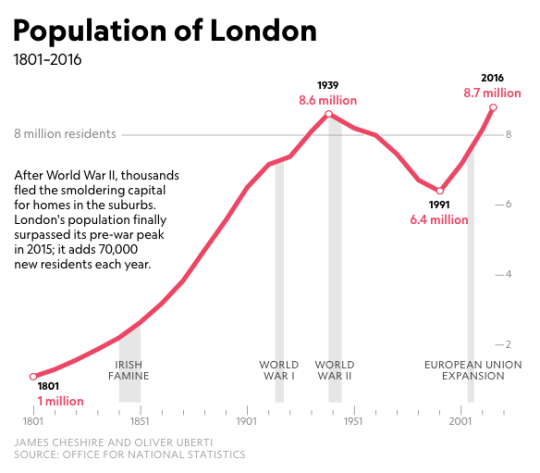
    As the manufacturing industry splintered, the docks of what was once the world’s largest port fell victim to shipping modernization and closed. The death in 1965 of Winston Churchill, the great prime minister, marked “the last time that London would be the capital of the world,” the Observer noted. Population continued a downward slide, bottoming out at 6.7 million in 1988. By then London’s fortunes had changed with deregulation of the financial services industry, known as the Big Bang, along with the shift to electronic trading, which enabled London to rival Tokyo and New York. A new financial district rose on the ruins of the West India Docks on the Isle of Dogs, a marshy nub that juts into the Thames. Canary Wharf, as the district is called, became London’s first modern large-scale regeneration project.

    According to National Geographic, London’s population grew by about 1.2 million between 2006 and 2016. That’s a pretty incredible number and is why the city estimates that they need about 66,000 new housing units a year just to keep up the growth. Like many supply constrained big cities, they’re not meeting that target.

    For the full essay, click here. It comes packaged with some incredible photographs by Luca Locatelli.

  • Evolution of online marketplaces

    I have written a lot about Opendoor over the past few years because it is one of the most promising “proptech” startups in operation today and I am obviously very interested in the impact of tech on the real estate industry. 

    I also have a fascination with online marketplaces. From the Greek agora to today’s mobile apps, the exchange of goods and services is a fundamental human activity. Uber, Alibaba, Instacart, Airbnb, Amazon, and Kickstarter are all marketplaces. I think sometimes people forget that.

    Andrew Chen, who is a general partner with the venture firm Andreessen Horowitz, recently published an essay on the future of online marketplaces, where he argued that what’s next is a reinvention of the $10 trillion service economy.

    Andrew posits that the internet has brought about 4 eras of marketplaces. They are:

    1. The Listings Era (1990s)
    2. The Unbundled Craigslist Era (2000s)
    3. The “Uber for X” Era (2009-)
    4. The Managed Marketplace Era (Mid-2010s)

    The listing era birthed marketplaces that were essentially online versions of the things that already existed offline. Craigslist, for example, simply took the classified section and put it on the internet.

    Over time, these online marketplaces began to focus on specific verticals (the unbundling of Craiglist) and they started to introduce services and features that were native to the internet and later to mobile. Uber obviously only works when everyone has a smartphone.

    Today we are living in the era of what Andrew calls the managed marketplace. Opendoor – to get back to the first paragraph of this post – is a managed marketplace. Instead of just connecting homeowners with buyers, they take on specific steps of the value chain. They buy and fix up the homes themselves.

    So what’s next? 

    Supposedly it is regulated services (2018-?). As of 2015, it was estimated that about 26% of employed people in the US carried some sort of license. These are healthcare practitioners, architects, engineers, real estate agents, financial advisors, trades people, and so on.

    And the argument is that a lot of how we regulate services today is a result of us creating them before the internet. We needed licenses and certifications to signal to us who was qualified and who was not. But now we have technology to help us do that, which is why this could be the next great era of online marketplaces.

  • Project Profile: Hotel Emiliano, Rio de Janeiro

    image

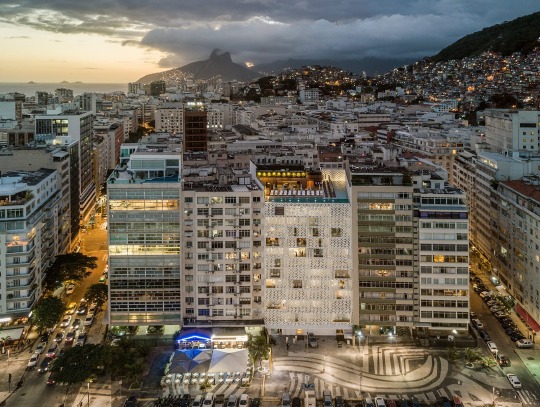
    This is not exactly a new project. The hotel, pictured above, opened in 2016 and was the brand’s second location (their first opened in São Paulo in 2001). But I like the story and how it was executed.

    Hotel Emiliano is the work of husband and wife team Gustavo Filgueiras and Andrea Colli Filgueiras. He is a hotelier. And she is a jewelry designer. Both wanted to pay homage to the glory days of Rio’s Copacabana Beach.

    Designed by Arthus Casas and Chad Oppenheim – who, by the way, recently built himself a stunning home in the Bahamas – the 90-room hotel is clad in white shutters that can be used to modulate the Brazilian sun. 

    image

    On the roof is an infinity pool with a glazed side. Here is a screen grab from the hotel’s website:

    image

    And here is an aerial view of the pool taken from Dezeen:

    image

    The uniforms for the hotel were designed by Barbara Casasola and a custom jewelry collection was created by Andrea Colli. 

    image

    For more photos, check out Dezeen and Wallpaper.

    Architectural photography: Fernando Guerra

  • Rendering of block 8

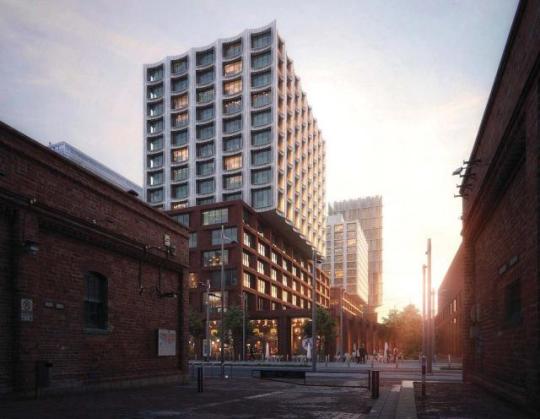
    I really like what has been put forward for Block 8 in the newly developing West Don Lands neighborhood of Toronto. Here is a rendering looking east from the Distillery District toward the proposed westernmost tower:

    image

    It feels like an extension of the Distillery District, which was clearly the intent. The materiality also reminds me of Junction House. Red brick at the base to fit within its context, and a more modern material palette on the upper floors. 

    I also like how, in this instance, the building steps out on its south side, as opposed to in. It’s something different. Not every building has to look like a wedding cake, right?

    The architecture is by COBE Architects and architectsAlliance. The developers are Dream, Kilmer Group, and Tricon. And the plan is for 756 rental apartments, of which 225 will be affordable and integrated throughout the 3 towers. 

    For more information, check out Urban Toronto.

  • Man behind the map

    For those of you who are regular readers of this blog, you’ll know that I love to snowboard and that I leave Ontario every winter in search of fresh lines. It is an annual tradition that has been going on for over a decade.

    One of the things I wish I had been more diligent about is collecting all of the trail maps. I am sure I have a number of old ratty ones in some of my snowboard bags and snow pants, but none of them are probably worth keeping.

    That’s why I think this is a terrific Kickstarter campaign by James Niehues. Over the last 30 years, James has researched, photographed, and painted almost every ski map in use across North America. Yes, these maps are all painted by hand. 

    If you would like to back James’ project – a hardcover coffee table book of his work – you can do that here.

    https://www.kickstarter.com/projects/orsc/james-niehues-the-man-behind-the-map/widget/video.html

  • Increasing housing supply in Ontario

    The Government of Ontario is currently working on a Housing Supply Action Plan that they hope will address “the barriers getting in the way of new ownership and rental housing.”

    Through initial consultations, they have already identified 5 key themes (my words below):

    1. The approvals/entitlement process for new housing is too slow
    2. There are too many restrictions on what is allowed to be built (that is, we should be encouraging more “gentle density” and “missing middle” type infill)
    3. Development costs are too high
    4. Tenants need protection; regulation is making it increasingly difficult to be a small landlord
    5. Overall housing innovation

    The province is also looking for public input and is currently running this online survey. It is open until January 25, 2019. And I would encourage all of you to complete it and help shape the action plan.

    My understanding is that the plan should be ready by Q2-2019.

  • Embracing our cities

    This is a great TED talk by Edward Glaeser about why it is time to embrace our cities. If you can’t see it below, click here.

    [youtube https://www.youtube.com/watch?v=ILDwnzQNlGc&w=560&h=315]

    The talk was filmed in 2012 – right around the time that Triumph of the City was released – but the video was published at the beginning of this year.

    It is also a good add-on to yesterday’s post about transportation costs and cities. I love how passionate Glaeser gets about these topics.

  • A decentralizing or centralizing force?

    I was on two panel discussions over the last week and, as is the case with all real estate panels, the topic of parking invariably came up, as did the impact of autonomous vehicles.

    There seems to be a general consensus that the advent of driverless cars will result in less demand for parking. Every developer I know is trying to build as little parking as possible and is thinking about how – when the time comes – they might convert their parking into something more productive. I have yet to speak to anyone who is building excess parking in order to prepare for autonomy.

    Where there’s a split, however, is whether autonomous vehicles will represent a decentralizing or a centralizing force for our cities. Historically, new technologies have lowered transportation costs and encouraged decentralization. Before the advent of rail, the US population hugged the coasts, because it was cheaper to navigate across the Atlantic than it was to move inland.

    A similar phenomenon also played out with our streetcar suburbs and with our car-oriented suburbs. These new technologies made it possible for people to travel further distances in order to get to work and other places. So it is not at all surprising that many people today are inferring that autonomous vehicles will produce this same outcome.

    But there is a counterargument. 

    We know that the demand for transportation services is highly elastic. Uber and other ride sharing apps have demonstrated this to us. Lower fares translate into dramatic increases in demand. So the opposing argument is that as the cost per kilometer drops – autonomous electric vehicles are going to be much more cost effective to operate – we’re going to see boatloads of induced demand.

    This induced demand will then force us to look toward road pricing and other demand management tools in order to cope, which then begs the question: How much cheaper and more convenient will autonomous vehicles really be? 

    At the same time, it is important to acknowledge that autonomous vehicles should correct many of the inefficiencies currently caused by humans acting like humans. There is also the opportunity to operate these autonomous vehicles more like public transit than as personal vehicles. And that will have a profound impact on urban mobility.

    Still, it is not yet clear, at least for me, that autonomous vehicles will be the decentralizing force that many assume they will be.