Daily insights for city builders, delivered every morning at 6 AM ET. I’m Brandon Donnelly — a Toronto-based real estate developer and founder of Globizen. I’ve been writing here since 2013.

Month: November 2018

  • Forever mural now complete

    image

    Ben Johnston completed his “Forever” mural at Junction House last week. More photos on his Instagram.

    If you would like to see it in person (worth it), stop by 2720 Dundas Street West in Toronto’s Junction neighborhood. Here is a before photo of the wall (along with some directions).

    If any of you have any blank walls in need of art, I would encourage you to give Ben a shout. The wall certainly doesn’t need to be in Toronto.

    Thank you once again Ben. We really appreciate you collaborating with us.

    Image: Ben

  • The [Next] Pepsi Generation

    The product matters. How big is the screen on this smartphone? How many horses does this all-wheel drive car have? And how high are the ceilings in this condo? (Some architects get grumpy with me when I call buildings a “product.” It’s so much more than that, right?)

    But here is a good reminder from Zander Nethercutt via a post he did on Medium earlier this year: People Don’t Buy Products, They Buy Better Versions of Themselves.

    The example he gives is that of Pepsi. While damn near identical to Coke in terms of its chemical composition, Pepsi was struggling until it decided to try something new. They stopped focusing on the product itself and instead starting selling the type of person you would become, if you drank Pepsi.

    These people, and this campaign, became known as the Pepsi Generation.

    We have talked about this idea before on the blog and this approach to selling is now quite commonplace. But I like how Nethercutt distills it down: Desire translates into consumption. And I want to buy a better version of myself.

    I also buy his add-on argument that social media has amplified our awareness and desires around self, because today we are so often externalizing it to the world and being instantaneously judged on it. Like. No like.

    Am I the kind of person who eats here, stays there, and consumes this?

    Photo by Christina Boemio on Unsplash

  • The next 20 years

    image

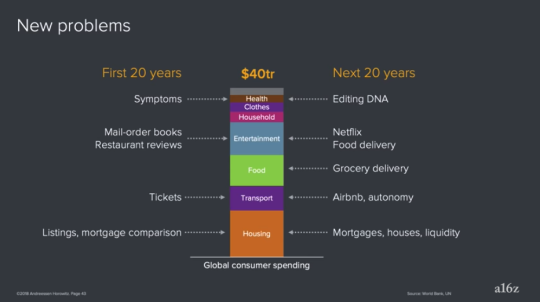
    Above is a screenshot from a presentation about the future of tech that Benedict Evans gave last week at venture capital firm a16z’s annual conference. And below is a video of the talk. If you can’t see it, click here.

    [youtube https://www.youtube.com/watch?v=RF5VIwDYIJk&w=560&h=315]

    The talk is positioned as “the end of the beginning.” In other words, here is where the internet and smartphones have taken us, but that’s just the beginning. Quote: “We used to do apartment listings [online] and now Opendoor will buy your home.”

    It’s only 24 minutes and well worth a watch.

  • Shortage of cities

    Joe Cortright of City Observatory recently looked at “the myth of revealed preference for [the] suburbs.” In it, he cites the work of Jonathan Levine, who is the author of a 2006 book called, Zoned Out: Regulation, Markets, and Choices in Transportation and Metropolitan Land-Use.

    There’s an argument out there that, on average, people prefer the suburbs to urban neighborhoods because, well, more people in the US live in auto-oriented neighborhoods compared to urban ones. What Levine wanted to figure out was whether this was truly a result of consumer preference or simply a lack of urban neighborhoods – or a “shortage of cities” as Cortright calls it.

    To do this Levine examined two cities with very different urban fabrics: Boston and Atlanta. The idea was to take a city with lots of urban neighborhoods (Boston) and compare it to one with relatively few (Atlanta). 

    For his comparison, he classified all of the neighborhoods in both cities on a scale according to how urban they were. “A” meant very urban. And “E” meant sprawling/exurban. He then went out and interviewed residents, asking them about both the kind of housing they would ideally like to live in and how happy they were with their current housing. 

    What Levine discovered, among other things, was that in Boston – where about half of all housing fell into the top 3 most urban categories – about 83% of people with a strong preference for urban neighborhoods were also living in one. Whereas in Atlanta, just 48% of people with a strong for urban neighborhoods were living in one.

    Put differently, the study suggests that in cities with fewer urban neighborhoods, it is more difficult for people with a preference for that housing type to find and live in it, which makes intuitive sense. The spread between preference and reality widens, once again suggesting that this could be about supply rather than an issue of demand.

    Anecdotally, I have seen this phenomenon play out here in Toronto. I often hear people talk about the neighborhoods that they would ideally like to live in, if only they could find a reasonably priced home. (Low supply leads to upward pressure on pricing.) How aligned would you say you are with your ideal level of urban-ness? 

    For more on Levine’s work, head over to City Observatory.

  • US cities with the most corporate HQs

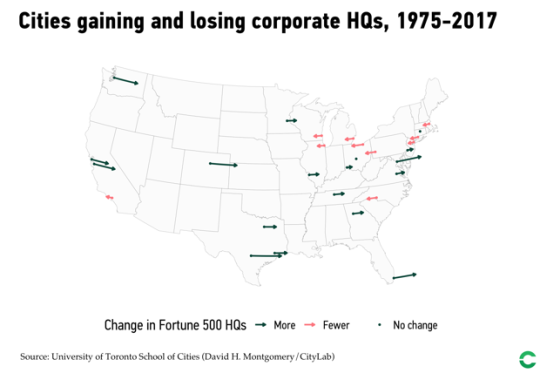
    The University of Toronto School of Cities recently looked at the changing economic geography of Fortune 500 companies across the US from 1975 to 2017. Here is a diagram of the results taken from CityLab:

    New York sits at the top with 70 corporate headquarters as of 2017. But the San Francisco Bay Area is now the second largest center with 35 headquarters – a testament to tech.

    The study does, however, omit service firms, as these weren’t tracked in Fortune’s list back in 1975.

    Also noteworthy is the specialization that has taken place across specific cities and regions. Here is another excerpt from CityLab:

    America’s headquarters geography reflects the substantial variation and specialization of the U.S. economy. New York leads in finance and business services, consumer services, and goods and materials. But Houston leads in energy, San Jose in tech, and Chicago in retail and wholesale. Chicago also ranks second in consumer services, and goods and materials, and Dallas takes third in energy. Other cities like Nashville and Minneapolis take third in consumer services, and goods and materials, respectively.

    The full article can be found, here.

  • Average price of a new condo in Toronto is now above $1,000 psf

    Urbanation released its Q3-2018 condo market results for the Greater Toronto Area earlier this month. 

    Here are a few highlights:

    – The unsold inventory of new condos in development is currently 33% below the 10-year average of 14,806 units.

    – Year-to-date sales of new condominiums decreased to 14,055 units from 25,839 units (same period last year). 2017 was a record year.

    – The average price per square foot for new project launches in Q3-2018 was $1,044 psf. This is the first time the average has broken the $1,000 psf mark. 

    – This is a significant price increase from last year and it is being driven by low supply, stable demand, and rising development/construction costs (my opinion).

    – The average unit size for project launches in Q3-2018 was 714 sf.

    – The average opening quarter absorption rate remains above 55%. It has been this way since Q1-2016.

    For the full press release, click here.

  • One year anniversary of the King Street Transit Pilot

    I had dinner tonight on King Street and I was reminded that this week marks the one year anniversary of the King Street Transit Pilot here in Toronto.

    The pilot has certainly had its share of controversy, but the improvements to both transit reliability and ridership are clear. Average travel times (in each direction) have increased by as much as 7 minutes on the route.

    Here’s the latest data from July and August of this year. Steve Munro can also tell you everything you ever wanted to know about the King streetcar.

    As our city continues to grow, many are naturally concerned about the ability of our infrastructure to handle the additional demands. Where will all the cars go?

    But the reality is that we will never be able to accommodate everybody driving around in their own car. Which is why we have to rely on transit and solutions like the King Street Transit Pilot.

    What’s your opinion of the pilot now that it has been in place for a year? I almost forget what it was like before we had it.

  • “BRAND”

    image

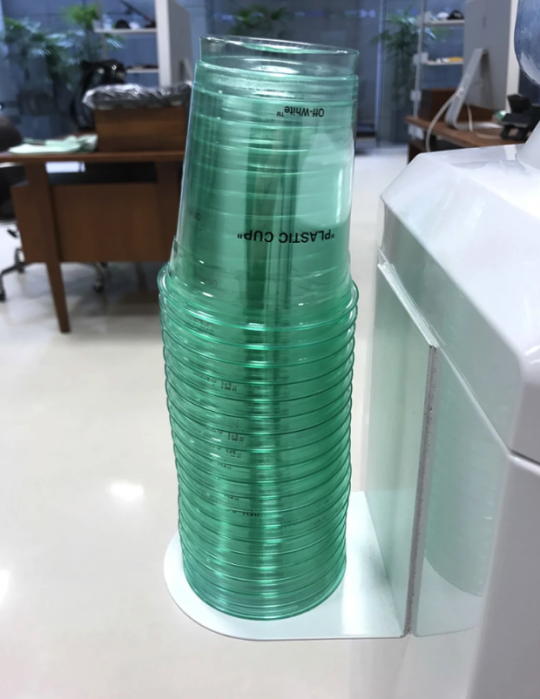
    For a number of reasons, I am fascinated by the streetwear label, Off-White

    It is one of the hottest labels in fashion, and yet there’s a part of me that doesn’t really get it. It’s mostly bold text, usually in quotations, on various apparel items. A set of Wellington boots might be plastered with “FOR RIDING.” A winter coat might be plastered with “DOWN JACKET.” And when they collaborate with Nike, the shoes might be tagged with “AIR.” Quotations included. Is that fashion?

    But then you hear Virgil Abloh – the founder of Off-White, who by the way was also trained as an architect before becoming creative director for Kanye West – talk about his brand and it starts to make more sense. The quotation marks are supposed to signal “ironic detachment and a comment on the idea of originality.” Okay, so a little more sense.

    Part of his inspiration comes from the work of Marcel Duchamp. In 1917, Duchamp shocked the art world with, Fountain. Some would consider this to be the most pivotal art piece of the 20th century. It was an off the shelf urinal that he simply signed, dated, and placed on a pedestal. Though initially rejected as art, it eventually redefined what art could be, shifting it from, “new physical creations to [the] moulding [of] ideas.”

    The corollary to this was that anything could be art, even something as utilitarian as the catch basin that you pee into. And this insight is something that Abloh has used to fuel his label. But he has taken it a step further. He has leveraged the ubiquity of these everyday-items-elevated-to-art as a way to elevate his own brand. Here’s a quote by Abloh from the Guardian:

    “The idea [that] an everyday object is art. Branding is generic and if I adopt the generic, then it becomes my branding, but it normally occurs in life.”

    In other words, he is co-opting generic and ubiquitous items – like, for instance, the patterning on caution tape – for his Off-White designs. And if you believe that a bit of brand equity is at least partially driven by brand ubiquity, well then you might start to see the value in this approach. He is simply assigning authorship to things that are already omnipresent.

    But, is that fashion? I guess that depends on whether you consider Duchamp’s Fountain to be art.

    Image: SSENSE

  • Thoughts on California’s wildfires

    What is happening in California right now is both sad and scary. I woke up to these photos in the New York Times. So I spent the morning reading up on wildfires and what causes them. 

    I am sure many of you are thinking: Is climate change doing this?

    It’s important to note that California is designed to burn. The characteristics that make the state a highly desirable place to live – mild winters and hot and dry summers – also make it a highly flammable place.

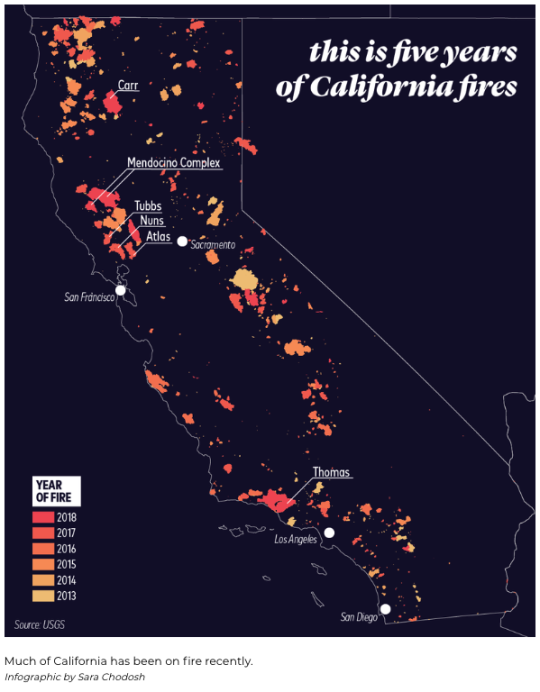
    Below is a map from Popular Science showing how much of California has burned over the last 5 years. Most of California’s hottest fires (13 of the top 20) have occurred since 2000.
    image

    But these naturally occurring fires are actually important for the regeneration of its forests. So one argument is that the current policy of “total fire suppression” is actually partially responsible for this increase in severe wildfires.

    Low-intensity forests aren’t burning like they used to and it is creating more densely packed forests for even larger wildfires. In other words, through our actions we could be exchanging smaller and more frequent fires for bigger and more severe ones.

    The other concern is development. 

    California had a population of about 24 million people in 1980. Today it is closer to 40 million. And much of that growth has occurred outside of existing urban areas (too hard to build). This has meant more people living in suburban and rural areas – adjacent to wildlands.

    Ed Glaeser has repeatedly argued that the best way to respect nature is to actually stay as far away from it as possible. Humans are a destructive species. Living in a dense city is good for the planet.

    Now let’s address the climate change issue.

    Daniel Swain, who is a climate scientist and author of the Weather West blog, published this popular thread on Twitter about a day ago. At the time of writing this post, it had been retweeted and liked over 10,000 times.

    From his perspective as a climate scientist, this is not all about climate change. That’s the wrong question to ask. It’s more complicated and nuanced than that. But climate does indeed act as a “threat multiplier” to the other factors we’ve already discussed.

    Fire season typically begins and ends with rain. When the fall rainy season starts, the fire season ends. One of the biggest risk factors is a dry fall, particularly after a hot and dry summer (or after multiple hot and dry summers, as has been the case in California). 

    Because according to Swain, fall means the start of “offshore wind” season, which can help to stoke these wildfires. 

    Unfortunately, one of the projected outcomes of climate change for California is more precipitation concentrated in the “winter” months, at the expense of precipitation in the shoulder seasons (spring and fall). So that means a longer fire season.

    Swain believes that if Northern California had received close to its typical amount of rain this fall, it is almost certain that this tragedy would have been avoided. 

    That, however, makes me wonder about the relative importance of all the factors we have discussed today.

    For Daniel Swain’s full thread, click here.

  • Leica Store Kyoto

    Yesterday I sent out this tweet about the, relatively new, Apple store in Kyoto

    It is the first in the city and I like what they did with the facade of the building. It is decidedly modern and yet there are hints of a local vernacular.

    Photographer Jonathan Castellino responded and suggested that I check out the new(ish) Leica store, which is also in Kyoto. 

    So here is that store (if you can’t see the video below, click here):

    [youtube https://www.youtube.com/watch?v=ouckkaj3XVc&w=560&h=315]

    I shoot on the Fujifilm X-T3, but Leica certainly makes some exquisite (and expensive) cameras. The Leica Store Kyoto does not deviate from that recipe.