Daily insights for city builders, delivered every morning at 6 AM ET. I’m Brandon Donnelly — a Toronto-based real estate developer and founder of Globizen. I’ve been writing here since 2013.

Month: September 2014

  • 10 things I learned from blogging every day for a year

    image

    Last month marked the one year anniversary of Architect This City. This means that I’ve been blogging every day for over a year. It’s been an incredible journey and I often tell people that they should give it a try if they have any inclination.

    So today, I’d like to share some of the things I’ve learned over the past year. I actually started this post at the end of last month, but I needed some time to collect my thoughts. Now that they’re collected, here are 10 things I learned from blogging every day for a year:

    1. Starting from zero sucks

    Lots of people have grand ambitions of blogging their way to prosperity. But then they start and they realize it sucks. It’s incredibly difficult to write content on a regular basis when all you get back is crickets. All you’re doing is giving without getting anything in return. But that’s why starting anything from nothing is always difficult.

    2. Passion actually means tenacity

    When people say that you should follow your passion (you know that cliche), what they’re really getting at is that anything worth doing is going to be a complete and utter slog at times. And the only way to make it through those periods is to actually enjoy the journey enough so that you keep doing it when it’s not so fun.

    3. Accomplishment has a lot to do with momentum

    As much as starting sucks, once you get going you develop momentum. People start telling you that they read your stuff every day and you get addicted. You realize that you can’t stop. Somebody is actually reading what I’m writing! You also notice that things are starting to snowball. For example, it took me about 11 months to get 250 followers on Tumblr. It then took me another 3 days to break through 2,000. There’s a snowball effect.

    4. It gets easier

    I follow wine guy and internet marketer Gary Vaynerchuk. I love his energy. And one of the things he’s said about his father’s wine business, that he famously helped grow, is that even though he took it from $3 million in sales to $45 million in sales, he recognizes that the truly hard part was actually going from zero to 3. Starting from nothing is hard.

    5. Good things come from putting yourself out there

    Often I’ve found that my most popular posts have been the ones that I felt a little uncomfortable posting or that I quickly wrote without seconding guessing myself. Social media and internet marketing today, at least in my view, is all about being authentic, genuine, and as transparent as you or your business can afford to be. Because that’s what engages people.

    6. Constraints can be great for creativity

    I can be a bit of a perfectionist. It’s the designer in me. In architecture school, my favorite line was: Perfection or nothing. I got it from the German engineering and design firm, Werner Sobek. But perfectionism can be a debilitating. Sometimes it becomes a form of procrastination, which is why I decided to write every day. Because then you don’t always have the time to be a perfectionist. You just have to post. And that can be a great thing. As Steve Jobs used to say, real artists ship.

    7. The internet democratizes

    When you write a blog and put yourself out there publicly, people all of a sudden consider you an authority. They want to know your opinion and they begin to consider you as an expert in the topic you write about. Now, I’m not suggesting that I’m an expert on cities, but I think it’s incredibly powerful that people now associate me with cities, real estate, design, and all the other things that I’m passionate about.

    8. Everybody is their own media company

    This ties into the last point. What shows up first when you Google your name? Do you use social media? Do you own and manage your firstnamelastname.com? (i.e. brandondonnelly.com) In other words, what is your personal brand? It used to be hard to put yourself out there. The media channels were simply too expensive for individuals to start building their own brands. But today, anybody can create a free account on Facebook, Twitter, Tumblr, Instagram, LinkedIn, Pinterest, Snapchat, and all the other social channels that people are now using to market. And that means that each and every one of us is basically their own little media company.

    9. The benefits of blogging are indirect

    All that said, the benefits of blogging for me, so far at least, have all been indirect. I’ve probably only made a total of $300 in revenue directly attributed to this blog. But I didn’t start blogging to make money. I started writing because I knew that it was going to be beneficial to get my thoughts down on paper every day (it’s my public journal). I knew that I was going to learn a lot from others and the process. And I knew that it was going to be a great networking tool.

    10. Lots of people care about cities

    Given the mission of Architect This City, this is probably the most important takeaway from the past year: Lots of people care deeply about cities and the built environment. I initially thought that it was just going to be city geeks like myself that would enjoy what I was writing. But it turns out that city dwellers and urbanists all over the world recognize the importance of building great cities. We know that the majority of the world’s population now lives in a city, and so it makes sense for us to address something that impacts so many people’s lives.

    On that note, thanks for reading Architect This City. I’m incredibly grateful. Here’s to another year!

    Image: Pinterest (I like blogging with my morning coffee)
  • When rent control goes too far

    I was catching up with a friend of mine over coffee this morning and he was telling me about his recent trip to Porto, Portugal. I’ve never been, but it’s fairly high up on my list of places to visit.

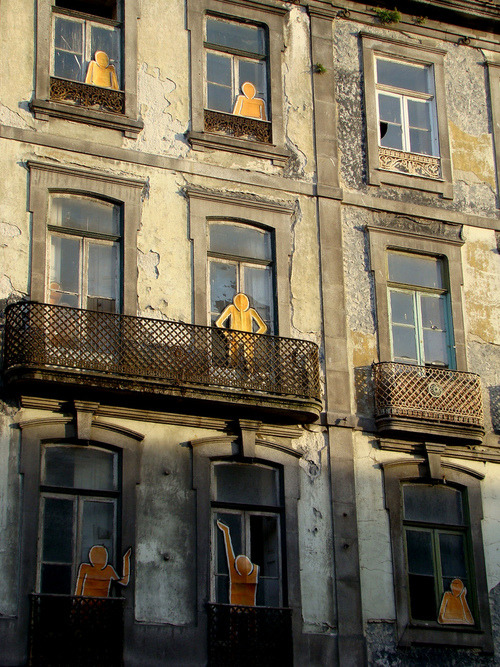
    He was telling me about how beautiful the center of the city is and how it’s a UNESCO World Heritage Site. But he was also telling me how eerie it was to see so many abandoned and decaying buildings.

    And part of the reason for this – I learned – is that up until fairly recently, Portugal had some incredibly onerous pro-tenant rent controls in place that dated back to the beginning of the 1900s.

    In fact, they were so onerous that, by some estimates, roughly 150,000 households in Portugal were paying less than €50 per month in rent before the laws were changed!

    Because of this, landlords in many cases could not, and cannot, actually afford to maintain their properties. Buildings were left to decay, and in some cases they were completely abandoned. That was their only option. And it led to a virtually non-existent rental housing market (according to the IMF).

    Clearly, this is a problem. If you have a market distortion as serious as this one – where there’s virtually no incentive to invest – you’re on a highly unsustainable economic trajectory.

    Which is why when Portugal received its bailout package from the International Monetary Fund and European Union following the 2008 financial crisis, it was asked to reform its rent control laws – which it agreed to do.

    The hope was that the reforms would allow Portuguese landlords to charge more reasonable and market-oriented rents, as well as do other crazy things like evict tenants that don’t actually pay their rent. Not surprisingly, many fought the changes.

    I don’t know precisely how these reforms have ultimately played out in the market over the past few years (if you do, I’d love to hear from you in the comments below), but I do believe that liberalization of the market was, and probably still is, needed.

    While paying €5 a month for a 4 bedroom apartment in a desirable central neighborhood might be great for that one individual family, it’s not so great for the economy as a whole. And ultimately that comes around to impact even that household.

    Image: Flickr

  • A walk down memory lane in the St. Lawrence Market

    I recently got lost looking through the Toronto Archives for old photos of my neighborhood. I’ve blogged about what the St. Lawrence Market neighborhood looked like in the 70s, but I wanted to go back even further. I wanted to see what exactly had been demolished and lost over the years.

    But by the end of it, I was just sad. As a lover of cities, it always makes me upset to see great buildings disappear. I think you too will be surprised at what I found.

    The following picture depicts the north side of Front Street East, about 2 blocks east of Yonge Street. I don’t know what year it is, but look at how stunning these buildings are. It looks like Soho, New York meets some glamorous European capital.

    Can you imagine what we could do with these buildings today?

    image

    If there’s any doubt in your mind that this is Toronto or that it’s Front Street East, take a look at the spire in the far left hand side of the picture. It belongs to the Toronto Board of Trade Building, which used to sit at the north east corner of Yonge Street and Front Street. When it was built in the late 1800s, it was considered one of the first “skyscrapers” in Toronto. It was demolished in the 1950s.

    Here’s a picture of the Board of Trade Building so that you can compare. Again, take a look at the spire.

    image

    For those of you who might not be familiar with the area, here’s a map to help you out. The Board of Trade Building is shown on the bottom left hand corner. And the buildings in the first picture are in the triangular land area between Wellington and Front.

    image

    Now, let’s fast forward to the late 1960s. Those same buildings shown in picture number one have been demolished and in their place is the following parking lot. It’s a bit less glamorous looking. There are still heritage buildings on the south side of Front Street, but the balance of the area seems to have been blown out. What a shame.

    image

    Finally, here’s an aerial view of the area. It’s also from the late 1960s or early 1970s. You can see the same triangular land area, with only the Flatiron Building still standing at the very tip of it.

    image

    Obviously the St. Lawrence Market has come a long way since the 70s. That triangular area has since become Berczy Park, which is actually in the midst of being completely revitalized, and all of those parking lots have been filled in. But I still can’t help but wonder what the neighborhood would be like today had we preserved all of those heritage buildings. 

    I think cities work best when you can figure out that delicate balance between preservation and progress. It’s not always the simplest approach, but as most things in life, the right decisions are often the toughest ones to make.

  • How are you being shaped?

    image

    “We shape the cities, and then our cities shape us.” That’s one of my favorite lines from the documentary The Human Scale, featuring Danish architect and urban designer Jan Gehl. I like it because I don’t think many of us think enough about the way in which the built environment – that we create – ultimately goes on to influence the way we live our lives.

    One of the most interesting connections for me is the link between urban form and public health. There’s been a lot of talk over the years about how suburban sprawl is, or might be, making us fat (among other things). We’ve created environments that are only navigable by cars and that has forced many of us into sedentary lifestyles. We sit in our cars, and then we sit in our offices.

    So today I’d like to conduct a bit of a poll. If you’d like to participate, please share the following 3 things in the comment section below: 1) your city, 2) the type of neighborhood you live in (urban, suburban, rural, etc.), and 3) the amount of time you spend walking or doing something active on an average day.

    Here’s me:

    I live downtown Toronto in the St. Lawrence Market neighborhood (urban). I take the subway to work and the station is a 10 minute walk from my place. So as a bare minimum, I spend at least 20 minutes a day walking. But since I also walk to do most of my regular errands, and since my gym is another 10 minute walk from my place, I’d say I average a good 30-45 minutes of walking each day.

    Now it’s your turn 🙂

    This is a pretty crude survey, but with the advent of things like smartwatches and health monitors, I think we’ll soon have lots of great data on the ways in which our cities might shape our health.

    Image: The Economist

  • Rise of rental

    image

    Last month Oxford Properties submitted a site plan application for the redevelopment of the rundown Cumberland Terrace in Toronto’s Yorkville neighborhood. If you’d like to browse the full application (including all the drawings), you can do that here.

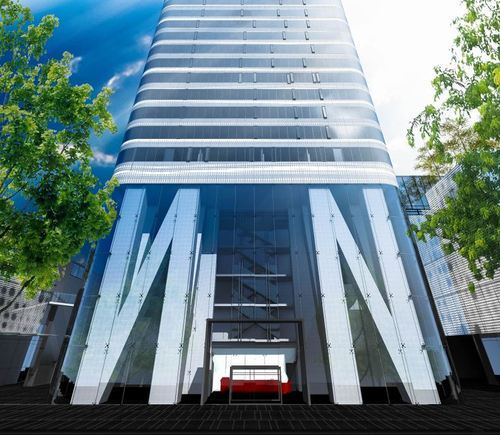
    The proposal is a departure from previous plans and now includes 3 buildings: a 4.5 storey building, a 2.5 storey building, and a midblock 54 storey residential tower (the lobby is shown above). There will be both retail and residential uses.

    For those of you familiar with the mall, it should go without saying that Cumberland Terrace is in desperate need of redevelopment. So I’m not going to talk about that today. Instead, I’d like to mention 2 other points that stood out to me about the application.

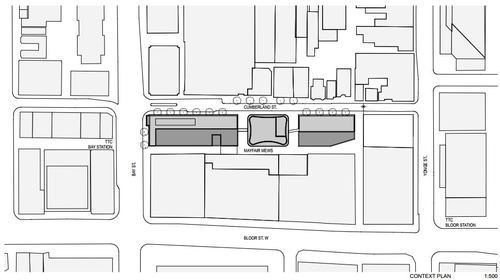
    The first is the 2 midblock connections on either side of the tower, running from Cumberland Street to Mayfair Mews in the rear (see below). Yorkville has a history of intimate laneways, and so it’s nice to see some of this being carried through in a new development. It also opens up the opportunity for an improved Mayfair Mews.

    image

    Secondly, it’s somewhat surprising to see that the 54 storey residential tower is being proposed as rental. Toronto doesn’t build a lot of purpose-built rental apartment buildings. There are some (from the likes of Morguard and Concert Properties), but we haven’t done it at scale for decades. And that’s largely because the demand for condos has been so great.

    But recently I’ve been noticing a renewed interest from the real estate community in multi-family rental assets. Cadillac Fairview also proposed a 65 storey rental building at the north west corner of Yonge Street & Queen Street last year – though they later withdrew their application.

    image

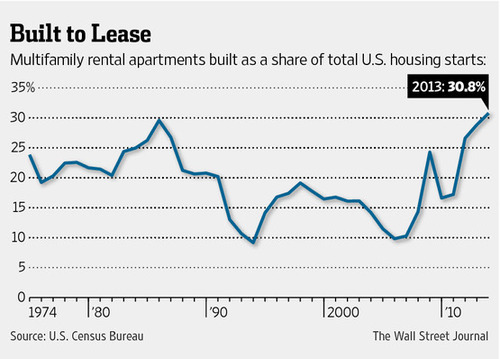
    In the US, rental apartments as a share of all new housing is also at record highs – over 30%. And that’s partly because credit remains tight (certainly compared to pre-2008) and economic growth has been tepid. But also because of demographic changes. People are having fewer children, later in life, and so many are putting off buying.

    So I think we’re going to see even more rental apartments being built in Toronto in the coming years.

  • The demand for character office space

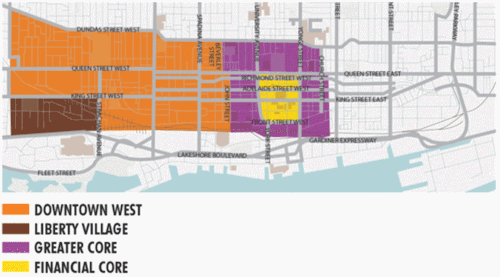
    Last Friday the Toronto Star published an article talking about the growing demand for character office buildings in submarkets outside of Toronto’s core. Specifically, it was talking about the Downtown West and Liberty Village submarkets (citing a report from CBRE).

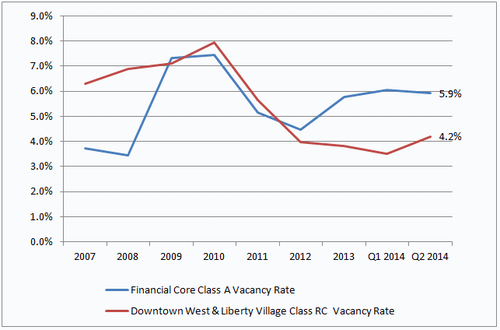
    I’m sure this isn’t news to most of you. Cool loft spaces have been popular for years. But it’s interesting to look at how rents and vacancy rates have changed for these submarkets and product types over time.

    Since 2002, average (net) asking rents for brick-and-beam buildings in the west end have gone from $16.12 to $22.23 per square foot. Almost a 38% increase. By comparison, office space in the core has gone from $28.40 to $32.38 per square foot. A 14% increase.

    And if you look at vacancy rates since 2007, you’ll see that the character office market has really tightened up over the past 4 years or so. There’s growing demand for a limited amount of supply.

    With the growth that the downtown core is seeing and with the rise of Toronto as a creative startup hub, I’m sure we’ll continue to see strong demand for this type of space. But there’s only so much of it to go around. So I think we’ll also end up seeing greater interest in the east side of downtown and also more interesting new builds.

    Images/Charts: CBRE

  • Should you own or rent your home?

    image

    I was at a good friend’s wedding last night (congratulations again to Adrien + Rachel!), and one of the topics that came up at our table was whether it is better to own or rent your home. Now, in North America, conventional wisdom would suggest – almost mandate – that you have to own your place. If you’re still a renter, well then you’re “throwing away your money” my friend.

    But are you really? 

    A big part of the value of owning your home is that it’s forced savings. Every month when you make those principal and interest payments, you’re paying down your mortgage and socking away money for the future. And this can be a great thing for a lot of people, particularly if you’re not disciplined enough to save otherwise.

    But when you own a home, you’re also spending time and money on maintaining that home, and you’re also tying up capital that could be used elsewhere. So consider this: what if, instead of putting your savings towards a downpayment, you simply continued to rent and created an investment portfolio that you then contributed to on a regular basis just as you would a home?

    Depending on your assumptions, renting could turn out to put you further ahead financially. Here’s an example of that scenario from the Globe and Mail.

    Similarly, I remember being told in business school that companies that own their own real estate tend to under perform those that do not. And the rationale is that owning lots of real estate ties up capital that could otherwise be reinvested in the core business. In other words, if your core business is making widgets, then invest your money in making better widgets, not in real estate.

    But this is not to say that everybody should rent. Obviously I’m a big believer in real estate. And for a lot of people, owning may make sense. This post was really just to say that the owning vs. renting decision may not be as black and white as you might think.

    Image: Flickr

  • Seattle’s first protected bike lane makes a quick adjustment

    Seattle recently installed its first protected downtown bike lane on Second Avenue. Here’s a short video of it in action (pay attention to the signalling setup and the pedestrians that walk into the bike lanes). Click here if you can’t see the video below.

    [youtube https://www.youtube.com/watch?v=x2iQCCHlR0s?rel=0]

    Shortly after it opened, they quickly discovered that the left green arrow and solid green circle (shown above) were confusing drivers. The intent was for the left green arrow to signal that you could turn and for the solid circle to signal that you could drive straight ahead.

    But even with the accompanying sign, drivers kept getting confused and thought a green circle meant you could go wherever you want.

    So the Seattle Department of Transportation quickly adjusted and changed the green circle to a north arrow. And it seems to have fixed the problem. I think it goes to show how important the details can be with these things. 

  • Fun Friday: Skateboarding city tours (Brisbane & Porto Alegre)

    Some of you told me that yesterday’s post on careers was actually quite sad. That it came across as if I were advocating for people, not to do what they love, but to instead do what makes them the most money. But that was not my intention. 

    There were a lot of reasons why I got into real estate development, and perhaps I oversimplified yesterday. But a lot of it actually came down to the fact that I’m passionate about building great cities (hence this blog).

    And I thought it was ultimately unfair that some investment-banker-turned-developer, who doesn’t really care about cities, might end up having more say over the built environment than me, the architect. 

    So I decided to sacrifice designing individual buildings in the hope that I’d one day be able to give back to cities on a much larger scale. And I still hope to be able to do that.

    In any case, to end the week on a more fun note, I thought I would do a post called Fun Friday and link to 2 city tours: one of Brisbane, Australia, and one of Porto Alegre, Brazil. 

    But these aren’t just any city tours. They are by local skateboarders showing you their city. I posted one for Toronto about 8 months ago, so some of you might be familiar with the series.

    I love how differently skateboarders look at the urban environment. I hope you can appreciate it as well. 

    Brisbane, Australia:

    [youtube https://www.youtube.com/watch?v=KEFQLjnhKT4?rel=0]

    Porto Alegre, Brazil:

    [youtube https://www.youtube.com/watch?v=taF71igPZY0?rel=0]

  • Why I didn’t go work for my favorite architect

    As a result of writing Architect This City, I’m fortunate enough to receive a lot of emails from random people. But I’m always open to meeting new people, and so I enjoy this very much.

    One of the most common questions I get is from architects, and students of architecture, who want to know about transitioning over to real estate development. (Posts related to this topic also happen to be some of my most popular.)

    So today I thought I would share a story with all of you about the one decision that ultimately lead me into real estate development.

    When I started graduate architecture school, I already had inklings that I was going to get into development. That’s one of the main reasons why I went to Penn. I knew that I could concentrate in real estate and I knew that I could take courses over at the business school. And that’s exactly what I wanted to do.

    But during my first year, I still wasn’t exactly sure how I was going to reconcile this dual interest. In fact, I remember feeling really conflicted. I loved architecture and design, but I also really enjoyed business and entrepreneurship. I was also interested in making money, and architecture isn’t often the best place to do that.

    So for my first summer internship, I decided to apply to both architecture firms and to real estate developers. I was fortunate enough to be offered jobs in both. And on the architecture side, I actually got my top choice, which was the Bjarke Ingels Group in Copenhagen. To this day, Bjarke remains one of my favorite practicing architects.

    But when I looked at the numbers, I quickly realized that real estate developers were prepared to pay me about 3x more than any architect would and that, if I were going to take an architecture job, I was going to end up going more in debt just to live throughout the summer.

    While internships are often career loss leaders, I took this as a sign of things to come. This was a 10 or 20 year decision in my mind. And even though I loved architecture, I figured I would quickly fall out of love with it if I couldn’t pay my bills or live the lifestyle that I wanted.

    So I accepted a real estate job and I moved to Dublin, Ireland for the summer to work for a small consultancy called Urban Capital (no relationship to the Toronto firm of the same name). And I haven’t looked back since.

    This may not have been the right decision for some of you, but it was for me. So if you’re at a crossroads, my advice is always to think about where you’d ideally like to be in 10 or 20 years. Because once you establish that, it’ll become much easier to make that decision today.