Daily insights for city builders, delivered every morning at 6 AM ET. I’m Brandon Donnelly — a Toronto-based real estate developer and founder of Globizen. I’ve been writing here since 2013.

Month: September 2014

  • Trying out the Oculus Rift virtual reality headset

    image

    This week on Architect This City is turning out to have a big focus on technology. And it’s not going to stop today, because this evening I had the chance to try the Oculus Rift virtual reality headset for the first time (many thanks to Dave Payne of Invent Dev for the demo). As a reminder, Oculus is the company that Facebook recently acquired for $2 billion.

    Now virtual reality certainly isn’t a new idea and lots of people have been promising – for a long time – that it was going to revolutionize the world. Which may be why I had somewhat low expectations going into this. But I have to say that I was blown away. Despite being a bit choppy (to get good visuals it ran at around 15 frames per second), I was shocked at how immersive the experience was.

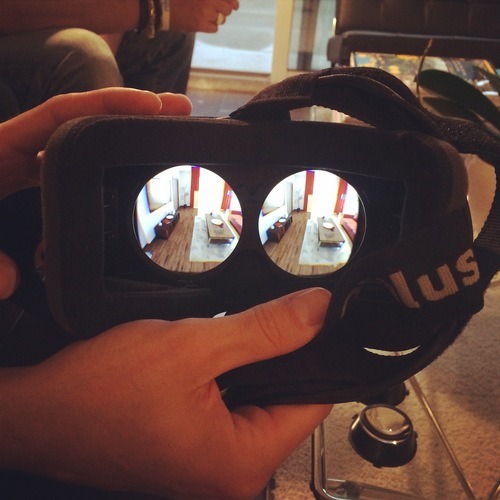
    Here’s a picture of Rick exploring the (virtual) space behind him:

    image

    It was actually really strange watching somebody move around as they explored another world. The demo that Dave showed us was of an apartment suite. You could walk around the living room. Turn around and see the front door. Walk up to the window and admire the view outside. It was incredible, but somewhat scary at the same time.

    Obviously there are ton of potential use cases for this. I’m imagining a buyer touring a condo suite and picking their finishes before it’s even built. I’m imagining an architect designing a building in 1:1 scale by waving their hands around in a virtual world. I’m imagining “traveling” to a beach to treat seasonal affective disorder. And the list goes on.

    This isn’t going to happen overnight. I actually got a bit nauseous because of how choppy the video got at times. But I can certainly see the potential. Virtual reality is coming. It’s clearly the future of gaming. And I’m sure it’ll get applied to many other areas of the economy. I guess that’s why Facebook bought these guys for $2 billion.

    If you have an interest or need in the 3D visualization space, I would encourage you to reach out to Dave at Invent Dev. He’s super passionate about the work that he’s doing and is looking to collaborate with more people in the design and real estate spaces. Thanks again Dave.

  • How smartwatches will augment location

    image

    So the rumors were right. Apple released a watch today. There will be 3 different “collections”, but lots of flexibility in terms of how each can be customized. There’s a big emphasis on health and fitness monitoring. Prices start at $350. And you’ll need an iPhone. Though you won’t be able to get one on your wrist until next year.

    Who knows whether or not it’ll catch on in the same way that iPod and iPhone did, but I think it has a damn good shot (more on this below). They’ve clearly put a lot of thought into both usability and the whole fashion side of the equation, which obviously needed to be done. Given that most people today use their phone for the time, the watch market strikes me as being heavily about style.

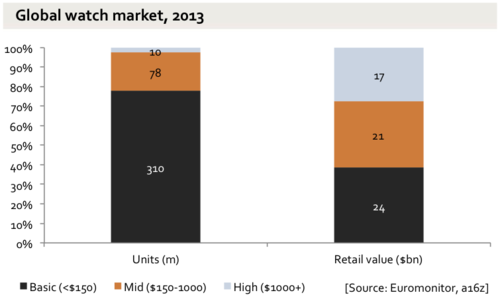
    In case you were wondering, here’s the watch market size as of 2013 (courtesy of Benedict Evans):

    image

    A lot of you might be skeptical about the need for a computer on your wrist (remember those watch calculators from the 80s?). But I think this time is different. Consider the number of people that now walk around with their phone in their hand and/or immediately pull it out whenever they have a free moment. We’ve become reliant (okay, addicted), to notifications and information.

    But in many of those cases, the smartphone isn’t the most efficient medium to be delivering those messages. Just like it’s not ideal to have to reach into your pocket to figure out what time it is, I think the watch could emerge as a new and better medium for a bunch of other pieces of information. And the big one could be location-aware or contextually-aware notifications.

    Here’s a tweet from Dennis Crowley – founder of Foursquare (Swarm) – talking about that exact thing:

    So what does this even mean?

    It means walking into a restaurant and having a tip pop up on your watch telling you what the best dish is (as shown in the tweet above). It’s driving down the street and having your watch notify you that there’s an open house 3 blocks away (and then giving you directions). It’s walking into a condo building and having your watch tell you that one of your friends is having a party on the 23rd floor. And so on.

    All of these notifications are currently already possible on your phone, but it’s not the ideal place for many of them. Which is why we’re all walking through life looking down at our phones. So while a computer strapped to your wrist may feel like we’re going further down that rabbit hole, it may actually free up more of our hands and our attention.

    And I’m sure there are many other possibilities that nobody has even thought of yet. Location just feels like a big one to me.

    //platform.twitter.com/widgets.js

  • Taxis just got 40% cheaper in Toronto

    UberX officially launched in Toronto today. Which means that Toronto’s taxi and limousine industry is about to get a lot more grouchy. For those of you who may not be familiar, uberX is Uber’s low-cost car service. Just like the regular version, you hail a car using your mobile phone. But this option will cost you 40% less than a regular taxi!

    Here are sample rates from the Financial District to Yonge & Eglinton (midtown):

    And from the Financial District to Pearson International Airport:

    image

    This is pretty exciting. Because as much as I think it’s great to use Hailo or Uber to hail and then pay for a car, the big problem in my mind has always been that cabs in Toronto are just far too expensive. The meter starts at $4.25 and shoots up faster than you can take a selfie in the backseat.

    But obviously there’s an entrenched industry here that is not going to be happy about a startup eating into their fares. So I wouldn’t be surprised if we see a lot more backlash here in Toronto – as has been the case in many other cities. However I don’t think that’s a viable long term solution for the incumbents.

    Uber is thought to be worth $18.2 billion right now. It’s probably not going to go away.

    So instead of protesting and trying to ban it, we should be figuring out how to adjust to this changing reality. For the incumbents, this might mean lowering fares or figuring out a better way to differentiate themselves. A 40% discount is a pretty compelling value proposition. For me personally, I don’t know why I would ever pay more for a regular taxi, unless there was no other option.

    On a side note, it’s worth pointing out that an uberX trip from downtown to Pearson is estimated to cost around $33 – roughly the same as what some people think the Union Pearson Express train will cost. That’s further evidence that charging a lot and targeting business travelers may not be the best strategy.

  • Exploring the Mimico waterfront

    This morning I explored Humber Bay Park, which is a waterfront park in the west end of Toronto. It’s in a neighborhood called Mimico that used to be a separate town, with its own mayor, until 1967. I honestly can’t remember the last time I was there, so it was fun to explore what felt like a new part of the city.

    Given its proximity to downtown and the fact that it’s very well connected to the water, the area is currently facing tremendous development pressures. In fact, as I was standing in line waiting to order an Americano, the conversation happening directly in front of me was all about how developers are fighting to buy up every piece of land they can find. Normally I would chime in, but today I decided to stay silent.

    Today the area is an interesting mix of old low-rise and mid-rise rental apartment buildings (many of which fell into decline a long time ago), and new high-rise condominiums that are all fighting for unobstructed views of the lake and downtown.

    There wasn’t a ton of street or public life going on, but it was certainly a beautiful place to spend a Sunday morning. As much as I’m looking forward to getting back into snowboarding, I’m not quite ready for summer to be over. So I’m happy that we’ve been having some great weather in the city.

  • TIFF: Getting ready for guests on King Street

    image

    Right now the Toronto International Film Festival is going on in the city. It’s actually one of my favorite times in Toronto. There’s so much going on and the city generally does things that it doesn’t normally allow, but that it should do all throughout the year, such as extending last call at bars and closing down streets to cars.

    This year, King Street between University Avenue and Peter Street has been made pedestrian-only. It encompasses an area known as the Entertainment District and includes the Bell Lightbox, which is the TIFF HQ. The street was closed last Thursday and will reopen this Monday. So it’s a 4 day thing, that TIFF is calling “Festival Street.”

    Some people – like me – are really excited about this. Here’s s picture I tweeted out on Thursday night. Given the engagement (retweets/favorites), I think there are others who feel the same way I do:

    //platform.twitter.com/widgets.js

    But there are others who are furious that their commute was disrupted last week and that we’re inconveniencing locals for the sake of hosting one of the top film festivals in the world. (King Street typically moves about 60,000 people per day on the streetcar and 20,000 vehicles.)

    But when I walked the entire 650 meter stretch on Thursday night, it was completely full of people. There were people playing large-scale chess. There were people eating at picnic benches. And there were lots of people just enjoying a wonderful summer stroll in the city.

    And all I could think about is that this is an unmet need in the city. King Street is a wonderful place to be right now and we don’t have an equivalent during the other 361 days of the year here in Toronto. So rather than be upset that we’ve closed down 6 blocks of downtown, I’m only upset that we don’t do more of this and make it permanent during the rest of the year. 

    I’m not necessarily saying that King Street is the best place to do this. Yonge Street initially strikes me as being a better place to start. But I am saying that if we have to reconfigure things to make our city more awesome for when guests come over, that maybe we should think about how to make it more awesome all the time.

  • How Energy Recovery Ventilation units work in a condo building

    Lately I’ve been thinking that I don’t talk enough about architecture and about buildings on Architect This City. So today I’m going to step away from transit, driverless cars, and the other topics I’ve been discussing lately, and instead talk about something a bit more technical: mechanical systems and Energy Recovery Ventilation (ERV) units. If you’re thinking about buying or investing in a condo, I think you’ll find it useful.

    Buildings work in many ways just like people do. They breathe in fresh air and they exhale out stale air. And just like you and I, once air has been exhausted out, it needs to be replaced, or made up, with more fresh air. In the world of buildings, this replacement air is called “makeup air.”

    It’s for this reason that you’ll often see no smoking signs directly outside of buildings. It’s because if you happen to be smoking next to a fresh air intake, you’d actually be distributing cigarette smoke throughout the entire building. The same goes for idling trucks and other pollutants.

    The amount of fresh air that needs to be pumped into a building will vary. For some uses – like hospitals and laboratories – the requirement for fresh air can be significantly higher. Sometimes as high as 100%. And that’s because you don’t want a building with toxic smells or lots of sick people to be relying on too much recirculating air.

    You might then be wondering why we don’t rely on 100% fresh air in all buildings. And the reason is that it is incredibly expensive to do so. When you take in fresh air from outside, it needs to be conditioned before it can be distributed. And that takes energy. In the winter when it’s -10 degrees outside (hello Toronto), you need to heat up that air. Whereas recirculating air is already conditioned. So you just, well, recirculate it.

    In most condo buildings, makeup air is supplied by dumping air into the corridors. To check if your condo functions like this, just look for a big vent outside in your hallway. This air then gets sucked into the individual suites by way of slits or openings around your front door.

    So another way to check if your building operates this way is to see if your front door is letting in air from the hallway (or if it’s sealed). There’s nothing necessarily wrong with this approach, but sometimes you might end up pulling in smells from outside of your suite.

    This now brings us to Energy Recovery Ventilation (ERV) units.

    The way an ERV works is very simple. Let’s use our winter example, where it’s -10 outside (and you’re questioning why you live in a place that’s so cold). In this scenario, you’d be pulling in freezing air and exhausting out warm air from your apartment.

    What the ERV does is transfer some of the warmth from the warm exhaust air to the cold intake air. This means the fresh air ends up coming inside your place at a warmer temperature and doesn’t need to be heated up as much. It’s “preconditioned.”

    This saves energy. And it saves in utility costs.

    But the other benefit of these ERV units is that, instead of pulling fresh air (or makeup air) from the corridor, it pulls it directly from outside of your condo suite. In other words, your front door is sealed and each suite is responsible for its own fresh air demands. The overall result is typically better indoor air quality, better energy efficiency, and lower utility costs.

    At both DUKE and Kingston&Co, which are two condo projects that I’m currently working on a TAS, we’re putting an ERV unit into every suite. We think it make sense. But there are always questions around how much purchasers actually care about measures like this. Things like fancy countertops and appliances are usually what sells. Not some hidden mechanical unit that you’ll never see or even know exists.

    But I think details like this matter. What about you?

  • The war on the car

    image

    In today’s post I’d like to focus on the second tweet I embedded in yesterday’s piece about downtown Toronto. Specifically, the fact that almost 75% of downtown residents walk, cycle, or take transit to work, leaving drivers firmly in the minority.

    For me, this then makes me question whether or not we’re optimizing well enough for the majority. However, it’s often not that simple. And that’s because the downtown core is clearly regional in its draw, and the further you move out from the downtown core, the more the modal split flips. In the suburbs, driving is obviously the majority.

    And herein lies the tension and the reason for all this “war on the car” rhetoric: We have a downtown core with completely different mobility preferences than the rest of the region.

    But as Toronto continues to intensify and grow (the population of the Greater Toronto Area is projected to reach almost 9 million by 2036), I truthfully don’t know how we could reasonably expect to (efficiently) move that number of people in private cars. I’ve just never seen it done before.

    Some people think that if we simply got rid of all those damn streetcars on our city streets, that we’d be doing a lot to eliminate traffic congestion. But it’s not that simple. The Highway 401 here in the city is already 18-lanes and one of the widest in the world. And yet it’s perpetually clogged. No streetcars there.

    So I look at this tension as a growing pain. Sooner or later I think we’re going to realize that this war should really be a war on inefficiency. How do we move lots of people around big cities while minimizing waste, maximizing economic output, and enhancing quality of life?

    Now that’s a war worth fighting.

    Image: Helibacon

  • Downtown Toronto in numbers

    Last week I tweeted out a Tweetstorm with some of the key facts from this City of Toronto study on the downtown core. Here are two of those tweets:

    //platform.twitter.com/widgets.js

    While I realize that reading city reports is probably not everyone’s idea of fun, it is a good one if you want to understand the massive change that is taking place in Toronto right now and also the importance of the downtown core for this region.

    To put things into perspective, consider that the downtown core (including King West, King East, and the Portlands) is estimated to be responsible for 51% of the entire wealth generated in this city. And yet its physical area is easily less than 10% of the entire city (which is about 630 square kilometers).

    That’s fascinating to me.

  • What are Boomers going to do with their suburban homes?

    The following chart represents births in the United States per 1,000 people. The segment in red demarcates the birth years between 1946 and 1964, which is generally considered to represent the Post-World War II population spike known as the Baby Boom. Besides this jump, we have for the most part been seeing declining birth rates.

    US Birth Rates.svgUS Birth Rates” by Saiarcot895. Licensed under CC0 via Wikimedia Commons.

    Given the magnitude of this population segment, demographers and others love to talk about the impact that this generation has had and will continue to have on society, particularly as many Baby Boomers now start to enter retirement.

    But arguably one of the most significant areas of impact could be the housing market. Today, I stumbled upon an interesting CityLab article from last year talking about “The Great Senior Sell-Off.” And it raises an important question: As Baby Boomers begin to sell off their large single-family homes in the suburbs, will there be enough people to buy them?

    For the most part, the next generation seems to still want a nice detached house in order to raise a family. But that doesn’t necessarily mean that the numbers will match up. Because if you factor in generation size, buying power, and even small shifts in consumer preference (towards, say, urban centers), the equation may not balance.

    If this ends up being the case, I don’t think it’ll impact large, growing cities as much. I mean, most are operating today with severe supply deficits. Instead it’ll probably be the smaller, perhaps already declining cities, that feel it the most. And this will ultimately serve to reinforce the “spiky” world that we’re already seeing today.

    At least that’s my hunch.

  • DSCRBD: Curating interesting minds through short video

    A good friend of mine recently launched a new project called DSCRBD (pronounced ‘described’). The goal is to “curate interesting minds” through short social video clips. Think Humans of New York but only creative types and only short videos.

    I think it’s a great idea. And I was fortunate enough to be one of the first test subjects. It was conducted as an interview between he and I, and we spoke for probably about 45 minutes on the sun deck of my building.

    He then took that entire interview and distilled it down to only a few seconds, extracting what he found most interesting. Perfect for social media consumption.

    image

    Click the image above for my video. What I’m talking about is my approach to architecture, and how I ended up not becoming an architect, but instead becoming a real estate developer.

    I think he’s on to something here and I would love to see it develop further. He’s using the right mediums and format to get the message out in today’s noisy social world. But there’s also no reason that it couldn’t grow to include more content or simply feed to other content, such as what he did with Architect This City.

    If you’re somebody that you think he should profile or know of someone that would be a good fit, drop him a line at hello@dscrbd.com.