Daily insights for city builders, delivered every morning at 6 AM ET. I’m Brandon Donnelly — a Toronto-based real estate developer and founder of Globizen. I’ve been writing here since 2013.

Tag: zoning code

  • What happens when you eliminate parking minimums? Lessons from Buffalo.

    Back in 2017, the City of Buffalo introduced something known as the “Green Code.” It was the first overhaul of its zoning code in over 60 years. I wrote about it here. One of most notable changes as part of the Green Code was the complete elimination of parking minimums. Which is another topic that has gotten a lot of air time on this blog.

    Now that it has been a few years, Buffalo provides an interesting case study: What do developers do once you eliminate parking minimums in a mid-sized city? I mention mid-sized because I think the size of the city is relevant here. There is a common argument that you can’t eliminate parking minimums unless you’re in a big and transit-rich city. “This isn’t [insert big city]. People drive here.” I am sure that many of you have heard this before.

    But is that really the case? Here is what Daniel Baldwin Hess & Jeffrey Rehler found when they studied the development response to removing parking minimums in Buffalo:

    • The study looked at 36 major developments in the first two years after parking minimums were eliminated
    • In aggregate, the 36 developments built 21% less parking spaces than what was previously mandated, likely demonstrating that the old zoning code was resulting in an excess supply of new parking
    • Mixed-used developments (of which there were 14, generally consisting of residential + retail) built 53% less parking than what was previously required
    • One exception to this trend is that single-use projects (both residential and commercial) built either the same or more parking (most of these projects were in the suburbs outside of the downtown core)

    What this suggests to me is that the previous zoning code was maybe appropriate for what the market was demanding (for parking) in suburban locations. Maybe. But it was certainly overshooting what the market was and is willing to accept in more urban locations in Buffalo. Mixed-used (i.e. being able to support retail at grade) is likely a good measure of the project’s urbanity.

    Perhaps more importantly, I think this study shows that developers are incentivized to build what the market wants — no more and no less. Building parking that nobody wants is bad business. As is building too little parking such that you can’t rent or sell your space(s). A Goldilocks parking ratio is what you’re after, but it is constantly changing and finding it can be a bit of an art. Eliminating parking minimums is a good way to let the market try and figure it out.

    Photo by Seth Yeanoplos on Unsplash

  • Zoning in Silicon Valley, New Haven, and Austin

    Robert C. Ellickson’s recent paper, titled Zoning and the Cost of Housing: Evidence from Silicon Valley, Greater New Haven, and Greater Austin, really holds back when it comes to the shortcomings of zoning ordinances. Here’s an excerpt:

    Zoning, as practiced in much of the nation, gravely misallocates resources. Some distortions are micro, such as the mediocre siting of Anton Menlo housing [a project by Facebook], and the lack of walkable neighborhoods in New Haven suburbs. Others are macro. If Silicon Valley were more populous, it would be a world tech center even more attractive to IT workers. The misuse of zoning squanders land, adds to the nation’s carbon footprint, warps interstate migrants’ choices about where to reside, and helps price poor households out of wealthier neighborhoods that would offer better life prospects for their children.

    The paper focuses on three metropolitan areas: Austin, Silicon Valley, and New Haven. Of these three, Austin is the most permissive in terms of allowing new and denser housing. Silicon Valley and New Haven, by contrast, have done a great deal to limit intensification by adopting exclusionary policies.

    In 1970, home prices in Silicon Valley were only slightly above the national average. Today, they are by far the highest in the United States, which is, of course, partially a result of high demand (tech salaries) and low supply (zoning ordinances). Ellickson’s paper examines the effects of the latter.

    If you’d like to download a copy, click here.

    Photo by Carlos Delgado on Unsplash

  • The Buffalo Green Code

    At the end of last year, Buffalo, New York approved the first major overhaul to its zoning code in 63 years old. 

    It is officially called the Buffalo Green Code Unified Development Ordinance, but, not surprisingly, most people seem to be just calling it the Buffalo Green Code. Its name should give you clues as to what it is trying to accomplish.

    Here’s a snippet from a City Journal article by Aaron M. Renn:

    The Green Code is a so-called “form-based code,” encouraging mixed uses. Buffalo will be only the third major city in the U.S. to adopt a citywide form-based code. The goal is to encourage development of buildings in a more traditional, Main Street style.

    As an older city, Buffalo is already built like this in many areas. But past zoning choices have had lingering negative consequences. “Sixty years ago planners sought to replace the city with a suburban auto-dominated (dominated, not oriented) model,” says Brendan Mehaffey, Buffalo’s executive director of strategic planning. “Most of the city as built was non-conforming with the existing development. Through urban renewal and other programs, planners sought to replace the city’s built environment block-by-block.”

    Perhaps one of the most noteworthy changes being ushered in with the Green Code is the complete elimination of parking minimums. This change makes Buffalo the first city in the United States to remove this requirement on a citywide basis.

    The Green Code also dramatically simplifies the current code, taking it down from 1,802 pages to 338 pages.

    I haven’t yet gone through the Green Code in detail (you can do that here if you’d like). But already other cities are starting to look to Buffalo as a model for how to rewrite their own zoning codes.

  • The value of cheap housing

    Photograph Houston Sunrise by Cliff Baise on 500px

    Houston Sunrise by Cliff Baise on 500px

    Urbanists generally don’t like to talk about cities like Houston. It sprawls. It’s car oriented. It’s over air-conditioned. In other words, it’s the antithesis of the dense and walkable cities that urbanists today like to tout as being exemplary. 

    But despite all this, Houston is one of, if not the, fastest growing city in America. According to The Economist, the population of the Houston metro area grew faster than any other city in America between 2000 and 2010. And between 2009 and 2013, its real GDP grew by 22%.

    So why is that? Here’s a snippet from that same Economist article (“Life in the sprawl”):

    Paradoxically, perhaps the city’s biggest strength is its sprawl. Unlike most other big cities in America, Houston has no zoning code, so it is quick to respond to demand for housing and office space. Last year authorities in the Houston metropolitan area, with a population of 6.2m, issued permits to build 64,000 homes. The entire state of California, with a population of 39m, issued just 83,000. Houston’s reliance on the car and air-conditioning is environmentally destructive and unattractive to well-off singletons. But for families on moderate incomes, it is a place to live well cheaply.

    So while Houston may not check off all of Jane Jacobs’ boxes, it does provide one important thing: cheap housing. And that’s clearly valuable for a huge number of people.

    But the other interesting thing about the snippet above, is that it starts to illustrate how frequently supply constrained markets operate with housing deficits. 

    The fact that the entire state of California issued only about 30% more building permits than the Houston metro – which you could easily argue is closer to a “perfect market” – tells me that there’s probably a lot of people bidding for the same housing in California.

    That’s less so the case in Houston.

  • Flux launches Austin Preview to help streamline development

    image

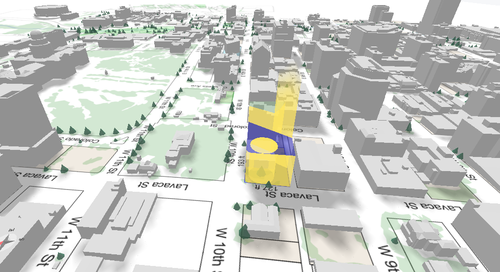
    I recently wrote about a startup called Flux.io in a post titled: How technology could completely change the real estate development industry. Given that I received a lot of positive feedback on this post, I thought I would let you all know that, as of today, you can now test out the product yourself for free online.

    Here are a few snippets from today’s announcement:

    At Flux we believe that data, analytics, and visualization can help bridge understanding between stakeholders and result in smarter growth and faster development and faster building. The Austin Preview of Flux Metro is an important first step in this direction.

    Flux Metro aggregates geographic data from public and private sources to build a three dimensional visualization, starting with downtown Austin. Alongside a rendering of the existing landscape, Metro shows what can be built on a lot or parcel under the zoning code. It considers more than 10,000 code sections for land use guidelines, height limits, floor area limits, setbacks, and view access rights as well as the locations of protected trees and daylight shadows to project what can be built and how it fits into the existing environment.

    We believe that everybody should be able to understand what a zoning code means for their city and that visual representations are the best way to create a shared understanding.

    Click here to signup and give it a try. It is based on Austin’s development code and on the same building site that was shown in the video I shared in my post.

    Image: Flux

  • How technology could completely change the real estate development industry

    If you’re involved in the built environment in any way, shape, or form – as a developer, architect, policy maker, and so on – I would highly recommend you watch the video below. My friend Candice Luck, who I went to Rotman with, sent it to me this morning with a link starting at the 24 minute mark. I haven’t yet watched the whole thing, but given how interesting this short section was, I plan to.

    The video is a talk by Steve Jurvetson, who is a venture capitalist with DFJ. He was one of the founding investors in Hotmail and currently sits on the board of companies like SpaceX and Tesla Motors. At the 24 minute mark he talks about a startup called Flux.io that hasn’t yet launched their product, but is working towards “reimagining building design”. They’re a spin-off from Google X and plan to officially launch in early 2015.

    Rather than try and describe the video here, I will just say that it’s an incredible example of how technology and digitization could completely change the real estate development industry. If you can’t see the video below, click here. The video starts at the Flux.io section.

    [youtube https://www.youtube.com/watch?v=IPgyb6euISs]

  • Is Chicago’s zoning code broken?

    This may sound crazy, but I’ve never been to Chicago. It’s on my list, but I just haven’t gotten around to it and I’ve never had a specific reason to go. Hopefully I can make it this summer.

    Lately though, I’ve found myself reading more and more about the city. Given that it’s also a Great Lakes city and it’s of comparable size, Chicago is an interesting case study for Toronto. But one thing that seems to keep coming up, is the need for zoning reform.

    About a month ago I wrote a post called “The tale of 2 Chicagos”, which was inspired by the blogging of Aaron Renn (The Urbanophile) and Daniel Hertz (City Notes). The discussion was around the prevalence of single-family zoning in most parts of Chicago and how it’s creating a supply constrained market (driving up prices).

    But there’s another outcome. Here’s what Daniel Hertz recently argued:

    When places in and around downtown become more desirable, developers build more housing, and more people get to live there. But when non-downtown neighborhoods become more desirable, developers can’t build more housing: it’s against the law. So instead, they profit by tearing down old two-flats and building mansions in their place. And as a result, fewer people get to live in those neighborhoods, even as more and more people want to.

    Effectively, his argument is that gentrification leads to a loss of housing units. Developers can’t build more housing, so they replace housing. And it all stems from a restrictive zoning code that aims to maintain the character and scale of established neighborhoods. I get that, but you could easily argue that it exacerbates the negatives of gentrification.

    It strikes me that Toronto and Chicago are in somewhat similar places in terms of their growth. Without any real natural barriers, both cities had the luxury of being able to develop through horizontal sprawl when they were younger.

    But with people now returning to city centers, we’re faced with a series of difficult decisions: How do we balance preservation and growth? How do we balance low-density with high-density? How do we maintain the character of what people love while still creating an inclusive city?

    It absolutely can be done, but it’s going to mean embracing a certain amount of change. And that’s not always an easy sell.