Daily insights for city builders, delivered every morning at 6 AM ET. I’m Brandon Donnelly — a Toronto-based real estate developer and founder of Globizen. I’ve been writing here since 2013.
Bloomberg columnist Barry Ritholtz recently interviewed Richard Barton about his startup companies. Barton founded Expedia while he was an executive at Microsoft (Gates and Ballmer era) and then went on to cofound Zillow (real estate site) and Glassdoor (jobs site).
I’ve been following the work of Barton for many years now because I admire the common thread among his startups: They’re about bringing transparency to industries where transparency is lacking. I used to try and dissect his thinking when I was working on my own real estate/tech startup.
I believe there’s still a lot of room for transparency in the real estate space, but that doesn’t negate the work that Barton has done. He’s all about using technology to bring “power to the people.” That’s a good thing.
Last month Zillow.com launched a new feature called “Instant Offers.” Press real estate can be found here.
It is:
“…a way for homeowners to sell their homes quickly by providing them with offers from investors and a comparative market analysis (CMA) from a local real estate agent, as an estimate for what the home might fetch on the open market.
Here is a bit more about how it works:
“To participate in Zillow Instant Offers, verified homeowners interested in receiving investor offers confirm information about the home (number of bedrooms, square footage, etc.), highlight any updates and provide several photos of the home. From there, select investors who buy homes in the area can present their offers alongside the CMA from a local real estate agent. Any investor offers and the CMA will include an overview of fees associated with each option, to enable sellers to make an informed apples-to-apples comparison.”
When I first saw the headline, I thought they were copying Opendoor. But it’s not the same model. They aren’t buying the homes, like Opendoor, they are simply working to coordinate an “instant” transaction. Still, I’m sure that Opendoor provided at least some of the impetus for this feature.
Of course, the most interesting question with these online real estate platforms is: Will they disrupt real estate agents? Mike Delprete wrote a great post about this in the wake of Zillow’s announcement.
But ultimately he concludes something that I have felt strongly for years:
“So, while real estate sites are best positioned to disrupt the real estate industry by displacing agents, they’re also the least likely to do so, because agents are their biggest customers and source of revenue.”
The irony.
About 70% of Zillow’s revenue comes from real estate agents. So it seems unlikely that they – at least currently – will be the ones that turn the tables on agents.
Some real estate platforms have started diversifying their revenue streams for probably this exact reason. But who knows, it may be a new entrant, rather than an incumbent, who pulls this off.
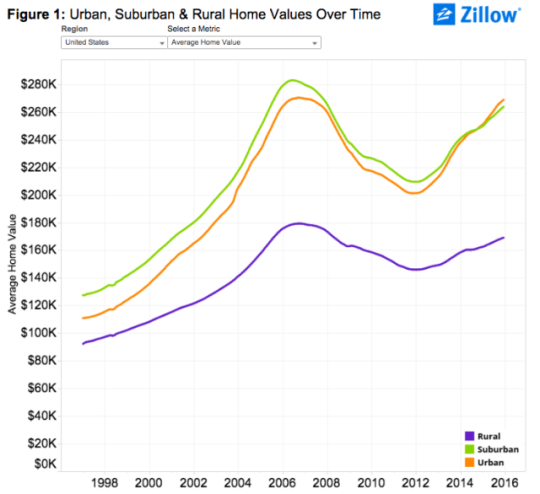
Zillow.com recently published some research where they looked at U.S. home prices broken down according to location: urban, suburban, and rural.
Here’s what they found:
As you can see, urban homes across the U.S. largely trailed their suburban counterparts in terms of absolute value up until the end of 2014. At that point, urban homes then surpassed suburban homes for the first time in the last two decades. (I wonder if this is a first or there was another crossover point before the late 1990s.)
But if you dig a little deeper and look at both the rate of appreciation and prices per square foot (as opposed to just absolute value), urban home prices appear even stronger.
“Over the past five years (2010-2015), average urban home values have grown 28.4 percent, compared to 21.1 percent for suburban home values. In the past year alone, U.S. urban home values grew 7.5 percent, compared to 5.9 percent for suburban homes.
On a per-square-foot-basis, homes in urban areas nationwide used to be worth roughly the same as suburban homes, before a gap started emerging in the late 1990s which has become progressively wider over the past roughly two decades. Currently the gap stands at 24.5 percent, with suburban homes valued at $156 per-square-foot and average U.S. urban homes worth $198 per-square-foot.”
And here is that same chart showing per square foot prices:
Everyone who reads this blog knows that there is a growing interest in urban centers. But if you look at the above charts for specific cities, there are still many cases where urban home prices are well below suburban ones.
To me, that serves as a reminder of the spikiness of this urban transformation, but also that it is likely still in its infancy. As recent as 20 years ago, Toronto largely didn’t believe that people would want to live downtown in modern apartments. Today we take that for granted.
So even with all of the gushing about urban centers, I still think we are only just getting started when it comes to creating the great urban neighborhoods of the future.
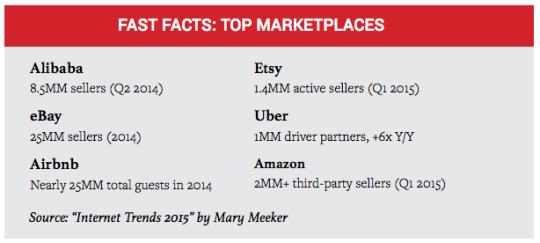
Online marketplaces are really fascinating because they are perhaps broader in scope than you might initially think. For example, Uber is a marketplace. There’s a supply-side (drivers with cars) and a demand-side (people needing rides). Uber connects these two groups together and acts as a kind of digital middle person. Uber does not own any of the cars.
This is an incredibly power business model and it can and is being applied in many different ways. Here are the top internet marketplaces (via the handbook):
I have been interested in this space for years because I have been very curious as to why we haven’t seen more innovation when it comes to online real estate marketplaces. Yes, there are platforms like Zillow.com. But Zillow has not done to real estate what Uber is doing to urban mobility.
My thinking is that it comes down to supply-side aggregation. Online marketplaces in general are hard to get started, which is why investors love them. They have defensibility. But real estate, in particular, is even harder to jumpstart compared to the incumbent models because of what I see as constraints on the supply-side.
If you’d like to download the guide to marketplaces in PDF, click here. It’s a great read and I’m glad that Boris and Angela took the time to assemble. Thank you 🙂
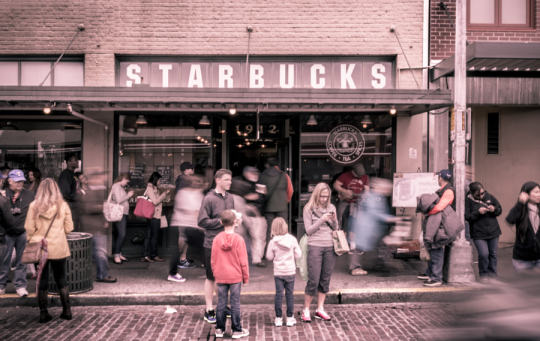
This afternoon I was chatting with some friends about Toronto real estate (which is something that happens a lot in this city), and we started talking about “The Starbucks Effect.”
Basically, we were talking about how this neighborhood just got a Starbucks and how that neighborhood already has one. We were, like a lot of people, using Starbucks as a proxy for neighborhoods that are emerging and neighborhoods that have already arrived.
There’s been a lot of discussion about the correlation between home prices and the presence of a Starbucks. But the big question is what comes first: the home prices or the Starbucks?
Earlier this year, the CEO, Spencer Rascoff, and Chief Economist, Stan Humphries, of Zillow.com argued that the mere presence of a Starbucks can cause gentrification.
They argued that Starbucks knows the next hot neighborhood before anyone else does and that they are “the fuel, not the follower.” And through their data they demonstrated that homes (in the US) near a Starbucks appreciated significantly faster than homes not near a Starbucks, or even homes near other coffee shops such as Dunkin’ Donuts.
But I – as well as others – wonder if this isn’t an oversimplification.
I certainly believe that Starbucks could help fuel home prices in a neighborhood. I think it gives people a comfort level that the neighborhood has arrived and that there are people in the area who are willing and able to spend money on discretionary items.
But I suspect that for Starbucks it’s a balancing act. They would never want to be late to an emerging neighborhood (and miss that prime corner property), but they also don’t want to be in the business of placing bets on neighborhoods with very few vital signs.
So I think it’s both. I think Starbucks is analyzing the data and watching home prices like a hawk (the follow) and when it reaches a certain point, they move. And that likely causes a further acceleration of neighborhood change (the fuel).
What do you think? I would love to learn more about their site selection process.
As a recent graduate of Rotman’s Morning MBA program (and presumably because somebody over there reads Architect This City), I was asked to write a guest post for their MBA blog. More specifically, I was asked to share my thoughts on the real estate industry and on my time at Rotman. And since I haven’t really done a post like this before, I thought it would be worthwhile to do.
But before I begin, I think it’s important to explain a bit about my background and my motivations for doing an MBA in the first place. Before going to Rotman, my first master’s degree was in architecture and real estate from the University of Pennsylvania. Basically it was a Master of Architecture combined with their MBA real estate concentration. So it included everything from real estate finance to real estate development.
Having already done this 3-year program, there were a couple of things I wanted out of an MBA program. First of all, I wasn’t prepared to go full-time. Five years out of the workforce was simply too high of an opportunity cost for me and so part-time was all I considered. I also only applied to Rotman because I didn’t want to waste any time traveling outside of the city (or to other parts of the city). I also saw Rotman as a rising star and one of, if not the, best option in Canada.
At the same time, I didn’t give much thought to the real estate curriculum being offered even though I fully planned to stay working in the real estate industry. I felt like I already had that sort of formal training and so, unlike some of my classmates who were looking to switch into real estate, I was after something else. I ended up majoring in Innovation & Entrepreneurship.
What I was trying to do was really round out my skillset and fill in some of the missing holes: accounting, marketing, and so on. But even more importantly, I had drunk the kool-aid around Rotman’s focus on integrative thinking (renamed “business problem solving”) and “design thinking”. And since there will always be a part of me that thinks of itself as a designer, it seemed like the perfect program for me.
Because at the end of the day, it’s not that hard to learn how to create a real estate development pro forma or calculate your expected exit cap rate on some piece of real estate. That stuff is all fairly mechanical. It might seem quite mythical when you don’t know how to do it, but once you do, you quickly realize that a financial model is only as good as the assumptions you put in. As we’re told in school, garbage in = garbage out.
The real value gets created in the assumptions. It’s created in the way you think about the market, your product, and your customers. And a lot of the time, the most value is created when you know or believe something that nobody else believes to be true. If you’re a lemming, you’re going to get lemming like returns and outcomes. So in a lot of ways, I went to Rotman to help me think better and think differently.
In some industries, resting on your laurels can kill you in a relatively short period of time. See Blackberry. Real estate, on the other hand, is generally a bit slower moving. But that doesn’t mean that change doesn’t happen and that there isn’t room for loads of innovation.
Just look at the Toronto of today versus the Toronto of 10-15 years ago. We’ve transformed ourselves into a city of high-rises where more and more people now want to live in the core of the city. This has brought commercial landlords back to the city center so that employers have downtown office space to attract the best human capital (see South Core) and it’s brought suburban retailers into the core to sell to these same urbanites. We’re seeing a complete reversal of the trends experienced with the last generation.
Amidst all of this, I’ve been noticing a growing awareness and passion around cities. My blog Architect This City started as a forum for architects, planners, and developers, but it has grown into a community of thousands of people who simply love cities. They’re passionate about everything from architecture to grade-separated bike lanes (as geeky as that probably sounds).
So I think that it’s not only the real estate market that’s changing, but also the professions involved with it. I’ve written a lot about the future of the architecture profession because I think we’re starting to see the emergence of new business models. Architects are becoming developers and developers are starting to become much more heavily involved in the shaping of the communities in which they build. Which is why in many ways, I think of my self as a city builder more than anything else.
Finally, to make matters even more complicated, technology is starting to have a huge impact on the business. Zillow.com just bought Trulia.com for $3.5 billion to form a portal that will now serve around ¼ of the online US residential market. And Opendoor.com is getting ready to launch a product that seems entirely poised to disrupt the way homes are bought and sold in America.
So what I’m getting at is that there’s absolutely no guarantee that the way we used to do something, is the way we’re going to continue doing it. In fact, I operate under the assumption that everything can and will be changed by somebody at some point. And if this is the way you approach things, then it should become abundantly clear to you that being able think critically is going to be one of your most important assets.
When I was just starting at Rotman, I met for lunch with an upper year classmate who told me that one of the best things he’s taken away from the program is the ability to think about the way he thinks. That may sound silly to some, but in our uncertain world, it’s actually a great skill to have.
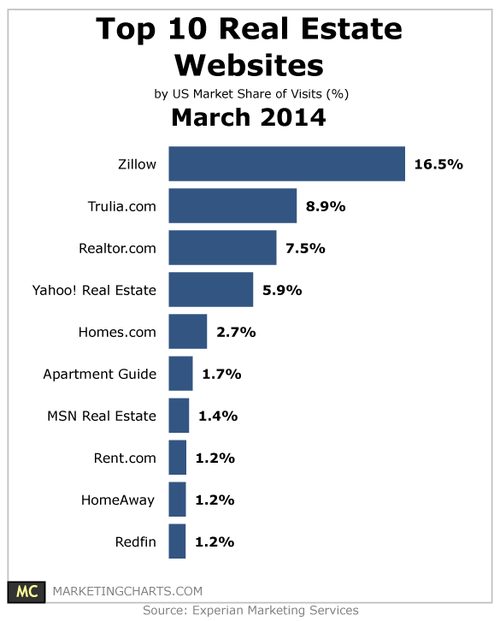
Today it was announced that Zillow.com will be buying Trulia.com for $3.5 billion in a stock-for-stock transaction. Based on share of web visits, the biggest real estate website in the US has just acquired the 2nd biggest.
Both companies make the bulk of their money through advertising sales to real estate professionals (i.e. agents and brokers). But what was interesting to read in their press release is that, even with this merger, the combined revenue of both Zillow and Trulia still only represents about 4% of the estimated $12 billion that US real estate professionals spend on marketing each year.
Zillow says it’s because the real estate industry hasn’t fully made the switch to online and mobile – and thus it represents a huge market opportunity for them. And from my experience I would say that this is likely the case. But it could also be because the real estate community is putting their marketing dollars elsewhere online.
Whatever the case may be, Zillow.com (and its portfolio of companies) is now firmly positioned as the largest real estate website in the US. But even still, Zillow.com has never felt fully “net native” to me. It has never felt as if it were specifically built for the internet and that it’s only possible because of the internet. Instead, it feels like an offline model ported over to online. And the two are quite different.
The reason I feel this way is because there’s an inherent tension to the way the online residential real estate market works today. Virtually every lead generation tool (that agents use) is intended to funnel buyers and sellers to them. That’s why so many real estate websites have sucked for so long. Because the goal wasn’t to keep you locked into a website, it was to get you to connect, in person, with an agent.
Zillow and Trulia started to break with that tradition by offering a lot more information online. Before they came along, it was a lot harder for real estate consumers to do their own research. But at the end of the day, Zillow makes money when it’s an effective sales funnel for agents. And since that’s always been the way the market has worked, it doesn’t feel net native to me.
If my gut is right, then it means there’s still lots of opportunities in this space.
TechCrunch is a leading technology media property, dedicated to obsessively profiling startups, reviewing new Internet products, and breaking tech news.
“Real estate, by far, is the most screwed up industry in America,” he told CBS News’s 60 Minutes in 2007. “We feel like things that Amazon or EBay (EBAY) or Yahoo! (YHOO) have done in other industries, we can do for the real estate industry.” Kelman [CEO of Redfin] now regards that statement as an error. “The biggest mistake I made in starting out at Redfin was bringing some Silicon Valley swagger into a traditional industry,” he says. “It was unnecessarily provocative.”