Daily insights for city builders, delivered every morning at 6 AM ET. I’m Brandon Donnelly — a Toronto-based real estate developer and founder of Globizen. I’ve been writing here since 2013.

Tag: zillow

  • Crossing the chasm in Austin

    I can’t open Twitter these days without seeing someone in the tech industry talking about moving or talking about someone who just moved to either Austin or Miami. “What’s the best neighborhood in Miami for startups? My friend just moved to Edgewater. Where did so-and-so move?”

    Here’s a recent article from the WSJ talking about how accelerated tech-fueled growth is straining Austin. And below is a set of charts (from the article) comparing home prices in Austin and San Francisco. (Reminder, the California-to-Texas migratory pattern recorded the highest number of “net movers” last year.)

    But in reading through the article, I am reminded that the challenges facing Austin are not entirely unique. Growing cities all around the world are being put in a position where they need to decide whether they want to remain car-oriented and relatively low-density, or if they want to make the shift toward more transit-oriented urbanism.

    It’s admittedly not easy, both politically and practically speaking. It’s hard to rewrite deeply entrenched built form. But Austin is naturally looking at what happened in San Francisco, where restrictions on new development are thought to be partially (largely?) responsible for the city’s unaffordable housing.

    According to the same WSJ article, voters in Austin turned down two previous transit proposals. One was in 2000 and the other was in 2014. There was concern over too much urbanization. There was concern it would induce more people to move to the city. And there was concern that it would threaten the city’s low-rise single-family homes.

    But this year a transit plan was approved that includes three new rail lines, one of which will tunnel through downtown. Provided that Austin can effectively pair this with more housing, more uses, and more density — which is generally what you need to make transit work — then it may be well on its way to crossing, if you will, the chasm of urbanity.

    Charts: WSJ

  • Knock knock — more on Opendoor

    Packy McCormick’s latest “Not Boring” essay is up and it’s about Opendoor. It’s a good follow up to last week’s announcement.

    Maybe that’s why housing is one of the last major categories that technology has left alone. Sure, companies have tried. Tons of them. The startup graveyard is filled with companies led by entrepreneurs who realized that the way we buy and sell homes sucks, but couldn’t ultimately figure out how to change it. They weren’t thinking big or long-term enough. The companies that have made the biggest impact, like Zillow and Redfin, make it easier to search for houses, but then kick buyers over to agents to go through the offline process, the same way it’s always been done. 

    This is topic/problem that is near and dear to me because I spent a year of my life working on a startup that initially set out to solve this exact problem. But like countless others, we couldn’t figure out how exactly to change things. So we pivoted.

    Has Opendoor finally cracked the code? I don’t know. But they’re on to something. It is, however, worth noting that the company was founded in 2013. And so what is happening today is already 7 years in the making — and probably longer if you consider the founder’s past startups.

    Tough problems clearly require time. Money doesn’t hurt either.

  • Home listings are up 96% in San Francisco

    A recent market report from Zillow has found that urban and suburban housing markets in the US haven’t actually diverged all that much as a result of this pandemic. Despite what you might be reading in the news, Zillow’s national listing data does not seem to suggest that an urban exodus might be underway. Suburban and rural home listings are seeing about the same attention (views) as they were last year. And the rates of appreciation seem to be holding. As of June, annual home value growth was 4.3% for urban areas and 4.1% for suburban areas.

    There are, however, some exceptions and local nuances. Rents in urban zip codes have fallen more compared to their suburban counterparts. This seems to make intuitive sense given that I would have expected demand to be less from young professionals, students, and immigrants. Many cities probably also saw a bunch of their short-term rental inventory flip over to the long-term rental market (how much, I don’t know). But my view is that this will prove to be a short-term phenomenon.

    There are also some markets that have performed quite differently. San Francisco is one of those cases. The city proper has seen home prices fall 4.9% and inventory (listings) increase by 96% year-over-year. This is a massive outlier. If I were to speculate as to why this is the case, it would be that (1) this was brewing even before COVID-19 and (2) the tech community is perhaps more convinced of this whole working from home thing. Why remain in expensive San Francisco? It’ll be interesting to see how this plays out. For a full copy of Zillow’s urban-suburban market report, click here.

    Image: Zillow

  • Airbnb’s predictive abilities

    I recently discovered and subscribed to Packy McCormick’s “Not Boring” newsletter. So far it’s quite good, and so here I am mentioning it to you all on the blog. In his latest newsletter, he makes the case for why Airbnb and Zillow — the two largest residential real estate tech companies — should merge. Naturally this new company would be called Zillbnb. You can read all about why he thinks this is a good idea over here, but I would like to point out one thing that I found interesting.

    Packy makes the argument that “easiest-to-book, shortest duration reservations” are a leading indicator for changes in demand. In other words, platforms like Airbnb can start to tell you where people might want to live and platforms like Breather can start to tell you where people might want to work.

    To support this argument he uses the example of his Airbnb rental outside of New York City. Sure, demand initially fell off a cliff at the beginning of lockdown, but then it started to surge as New Yorkers sought refuge outside of the city. And while I think that this particular change in demand will likely end up being short-term in nature, a similar trend is being reported around in the world. Did we hear it first on Airbnb?

  • Algorithmic home buying expands to Los Angeles

    Algorithmic home buying companies (or iBuyers) have now started to expand into Los Angeles. If you recall, most of these companies started in smaller markets where the homes are more homogenous, relatively inexpensive, and generally less liquid. Places like Phoenix.

    By tackling the second largest housing market in the US (after New York City), the algorithms of Opendoor, Redfin, and Zillow will now need to content with an older housing stock, greater variability, and higher values.

    All of these companies have increased their maximum offer price. The sweet spot for algorithmic home buying has typically been in the $150,000 to $300,000 range. Last year, two-thirds of all homes bought by iBuyers were in this range. I can’t imagine that gets you very much in LA.

    I keep expecting these companies to scale into something more beyond just iBuying and flipping. Perhaps we will see that happen once they establish themselves in country’s biggest markets.

    Photo by Josh Rose on Unsplash

  • Redfin is rolling out an online purchase option for homes

    There’s a lot of money at work right now trying to reinvent the way that homes are bought and sold. Perhaps the most popular trend is “instant buying” or algorithmic home buying. I have been writing about this for years, mostly because of Opendoor. But now there are lots of companies competing in this space. With this model, home sellers get the benefit of an almost immediate sale, though usually it’s at a slightly lower price.

    Redfin, on the other hand, is returning to something that it first tried out back in 2006: a buy now button on its online listings. It failed back then. But maybe it was simply too early. The feature allows unrepresented buyers — that is, buyers without an agent — to make online offers. Naturally, it’s far from a single click process. But when accepted, the seller ends up paying about half the amount of commission.

    According to the New York Times, the company started testing the feature in late March in the Boston area. Of the 120 homes listed on Redfin with a “start an offer” button, 5 ended up being purchased via an online bid. That’s more than I would have expected. But Redfin positions these offers as being the stronger option because they save sellers money. There’s also an option to tour the home on your own.

    Given this initial response, the company is now working to roll out this feature nationally, market by market. Is this the future of home buying?

  • How Opportunity Zones may have impacted real estate prices

    The Tax Cuts and Jobs Act of 2017 (US) created something known as Opportunity Zones. These are low-income and high-poverty census tracts that are designed to attract investment by offering a number of different tax benefits. I first wrote about it on the blog, here.

    Now that some time has passed since the final Opportunity Zones were announced, Zillow Economic Research decided to look at the possible impact of this designation on real estate values. In other words: To what extent, if at all, are the tax benefits getting capitalized into the value of the properties?

    Below is a chart showing the year-over-year change in the 12-month moving average sale price for low-income census tracts that were (1) eligible and selected as an Opportunity Zone; (2) eligible and not selected; and (3) not eligible.

    My understanding is that the “not eligible” category represents census tracts with similar characteristics to the other two categories but, for whatever reason, were not eligible to become an Opportunity Zone. There are criteria.

    The program is still quite new, but what Zillow found was that the eligible census tracts (green and yellow lines) seemed to exhibit similar sale price increases after the Act was signed, but before the final Opportunity Zones were announced. Once the final Zones were announced, sale prices in the selected category (green line) began to surge and move away from the pack.

    This may be evidence that the tax benefits are starting to get capitalized, or it may not be. One question I have is about why pricing in the selected Opportunity Zones seems to be a lot more volatile — even before the Act was announced.

  • Algorithmic home buying — what’s the end game?

    Bloomberg recently published a good summary of Zillow’s business and their move into algorithm home buying and flipping. (They are trying to avoid the “flipping” moniker because of the negative connotations associated with it.)

    Zillow started buying homes directly from owners last spring. They charge the seller between 6-9%, so more than using a typical agent, but inline with their competitors. There’s clearly a segment of the market willing to pay a premium for the added convenience.

    The thinking used to be that discount brokerages were the way to disrupt the housing market. This is the opposite strategy.

    Interestingly enough, Zillow felt that they needed to make this pivot with their business model. It used to be about selling ads. They were definitive in that they were not a disruptor of real estate agents.

    But now:

    If getting an offer from an iBuyer became a crucial step in the selling process, they worried, Zillow could lose its audience and its advertising base. What’s more, market researchers kept finding that consumers said they’d pay a modest premium to get a cash offer. “People expect to press a button and have magic happen,” says Rascoff, a 43-year-old former Expedia executive who’d earlier started the travel search engine Hotwire, which he sold to Expedia for $700 million. Getting into the business of buying homes directly, Rascoff says, was “the only way to remain in a leadership position.”

    Here is a map of the companies in this particular space and the cities in which they operate:

    Some investors aren’t sold on this strategy and have begun short selling Zillow (according to the Bloomberg article). I keep getting the sense that there’s a greater end game in the cards here. It is about building up A (algorithmic home buying and flipping) in order to unlock B.

    But what’s B — a new end-to-end transactional model for the housing market?

  • Urban vs. suburban home prices

    Aaron Terrazas, who is a Senior Economist at Zillow, recently gave this presentation about the US and Virginia Beach housing markets. (I discovered it through City Observatory.)

    There are a bunch of interesting graphs/stats in the presentation. Home values in Virginia Beach, for example, have yet to fully recover from the 2007-2008 financial crisis. They are still 8% below their pre-crisis peak, which was in July 2007. (I presume the presentation is dealing in nominal dollars.)

    I’ll give two more examples. 

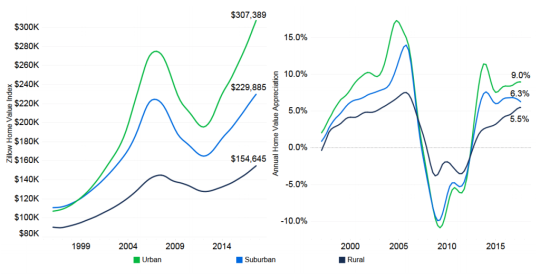
    Below is a chart comparing average home prices for rural (dark blue/purple), suburban (blue), and urban (green) homes. In the late 90′s, suburban and urban homes were roughly equal in terms of average prices. But since then, urban homes have shown greater appreciation. The spread also appears to be widening.

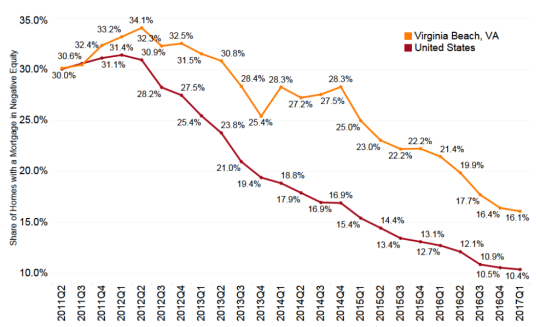
    And here is a graph showing the share of mortgage borrowers in a negative equity position. That is, the value of the home is less than the outstanding balance of the mortgage.

    Now this is only covers people who have a mortgage. According to this Washington Post article, about 34% of all US homeowners don’t have one. Either they have paid it off or they never had one.

    Still, the above numbers stood out to me. They speak to the severity of the financial crisis. At the end of 2011 and the beginning of 2012, over 30% of borrowers were in a negativity equity position. And in Virginia Beach it was more than 1/3 of all borrowers at the peak.

    For the full presentation, click here.

  • How Trump’s tax plan would impact the mortgage interest deduction

    image

    In the US you can reduce your taxable income by deducting the mortgage interest you pay toward your principal residence. You can’t do this in Canada, at least not on the property where you live.

    However, there are limitations. It is capped at loans up to $500,000 or up to $1M if you’re married and you file jointly. On the other end of the spectrum, you also need a loan big enough such that an itemized deduction will save you more money than the standard deduction.

    Not surprisingly, the MID is popular among homeowners. And from a public policy standpoint, one of its selling features is that it’s supposed to stimulate homeownership. But many have argued that it doesn’t actually do this – it unequally benefits people with larger mortgages. (Canada has a higher homeownership rate than the US.)

    Right now it looks like you need to buying a home worth at least $305,000 in order for the mortgage interest deduction to make economic sense for you. Again, if your loan isn’t big enough, you’re simply going to opt for the standard deduction. 

    In 2015, about 22% of all US taxpayers opted to take advantage of the MID. According to Zillow, only about 29% of all homes in the US are valuable enough for the MID to actually make sense. Though in some cities, like San Francisco, it’s pretty much all of the homes. Of course.

    Zillow also recently looked at what the recent tax reforms put forward by the Trump Administration would mean for the MID and the real estate market

    One of proposed changes is a doubling of the standard deduction. What this means, based on Zillow’s math, is that you would need to be buying a home worth at least $801,000 today for the MID to make sense. This also means that the deduction would now only benefit about 5% of all homes in the US.

    This would seem to only exacerbate the criticism that the MID does not in fact stimulate homeownership in the segment of the market that needs it the most. But perhaps this is the only politically palatable way of removing it – gradually.

    Photo by Erol Ahmed on Unsplash