Daily insights for city builders, delivered every morning at 6 AM ET. I’m Brandon Donnelly — a Toronto-based real estate developer and founder of Globizen. I’ve been writing here since 2013.

Tag: witold rybczynski

  • Every building is a prototype

    Witold Rybczynski’s recent blog post about architecture’s “curious business model” gets at one of the core challenges of new construction: “Every project is, in effect, a custom job; there are no real economies of scale.” There are also no reoccurring cash flows for the architect, Witold explains, unlike a writer who might earn ongoing royalties or a business owner whose wealth will grow as the business grows.

    There are two items to discuss here: (1) The “curious business model” used in the practice of architecture and (2) the inefficiencies of construction.

    The first one is not unique to architecture. You could say the same thing about the planning and real estate lawyers who also work on new buildings. But I take Witold’s point in that even a painter’s work could appreciate in value after it’s done, whereas there’s typically no mechanism for any of this to accrue (to the architect) in the world of architecture.

    When I was young, I was told that there are two ways to make money. You can either trade your time for money or you can own assets that make you money. An example of the latter might be a farm where the tenant farmer pays you rent every month. You’re not trading your time by actually doing the farming, you just own the asset.

    This may seem obvious, but it’s fundamental. And it’s one of the reasons why, when I was in architecture school, I admired the practices of people like Jonathan Segal out of San Diego. Jonathan is one of the pioneers of the “architect as developer” approach. He simply became his own client and started building his own projects.

    Moving on to topic number two.

    Everyone in the business of building new buildings is looking for repeatable methodologies. Many have thought: How do we make the construction of buildings more like the assembly of cars? How do we create a standardized kit of parts? And that has lead to longstanding efforts around prefabrication. Today, as you know, we are also looking at how 3D printing might make this easier/cheaper.

    In some ways, that is happening. There are examples of prefabrication and panelization, and there are developers who are using this approach. (See H+ME Technology.) But for the most part, we still build on site and it’s still a messy process with lots of waste and inefficiencies. If there was a cheaper and more effective way to do it, the industry would certainly move in that direction. Eventually that will happen.

    In the meantime, we will continue building our prototypes.

    Photo by Ivan Bandura on Unsplash

  • Holding a shadow

    Debating the merits — or shortcomings, depending on which camp you’re in — of all-glass buildings isn’t new. But there seems to be a bit of a resurgence happening right now because of the recent opening of Hudson Yards in New York.

    There’s an important environmental consideration here: Glass is, as a rule, a poor insulator. But often the other concern with all-glass buildings is their sameness. Witold Rybczynski recently wrote about this on his blog in a post called The Transparency Trap:

    Le Corbusier described (modernist) architecture as “the masterly, correct and magnificent play of volumes brought together in light.” Corbusier used glass but he never designed all-glass buildings. Neither did Mies; he added superfluous I-beams to his facades (which also had substantial spandrels). The problem with transparent glass is that it doesn’t hold a shadow, and without a shadow there can be no “play of volumes.” Since minimalist modernist architecture doesn’t offer decoration or ornament, that doesn’t leave much to look at.

    Witold isn’t usually appreciative of that which is new and I often find myself disagreeing with this critiques. But I like his metaphor of “holding a shadow.” Light and shadow are, of course, fundamental to architecture.

    Photo by LinedPhoto on Unsplash

  • City building reading list (and an event)

    Today’s post is going to be about a handful of things that have caught my attention.

    – Gary Hack, who is the former dean of the University of Pennsylvania School of Design, recently published a book called Site Planning: International Practice. It is a textbookish guide to planning processes, new technologies, and sustainability, with an emphasis on rapidly urbanizing countries. Thank you to my friend Michael Geller for bringing this to my attention.

    – Sidewalk Labs Toronto is opening a new experimental workspace here in Toronto at 307 Lake Shore Boulevard East (Queens Quay & Parliament) on Saturday, June 16th from 12 – 6pm. It’s an old fish processing plant that they have turned into their office. The team will work there during the week and on the weekends they will open to the public to showcase what they’re up to. Register for the June 16th event, here. I just did.

    – Alexandra Lange has a recent piece in the New Yorker called, The Hidden Women of Architecture and Design. It’s about the important role that women have played in the “design of childhood”, which is the title of a book by Lange. There’s also a short but interesting story about Detroit’s Lafayette Park (Mies van der Rohe) at the beginning of the article.

    – Finally, here is a blog post by Witold Rybczynski where he talks about the shortcomings of architectural education. Obscure theories. Technical or made-up jargon. And no concern for budgets and schedules. I have always shared a similar view and have long felt that there needs to be more business school in architecture school.

    Hopefully there’s something in here that is of interest to you.

  • Architectural fashion cycles

    Witold Rybczynski wrote on his blog this week about historic preservation. He cites a number of reasons for why one might want to renovate, restore, and preserve an old building. But he also provides a reason for why one might not want to renovate, restore, and preserve an old building.

    “What seems to me a less compelling reason is the idea that a building should be preserved simply because it is representative of a previous period or architectural fashion. In architecture, as in many human endeavors, not all periods are equally admirable; there are ups and downs.”

    I thought this was an interesting comment because it reinforces the idea that this is a fairly subjective exercise. One of his reasons for preserving a building is that it might be particularly beautiful or represent some sort of human achievement. But beautiful to whom?

    Similarly, who determines which architectural period or fashion is an up or a down? Is brutalist architecture worth preserving or is it not yet old enough to have perceived value? Will it ever be widely admired? And is there really an architectural cycle?

    Many of us can probably agree that New York City’s original Penn Station by McKim, Mead and White was a tragic loss. But I am sure that many of us will also disagree on what are considered to be the most admirable periods of architectural fashion.

  • What’s with all the black houses?

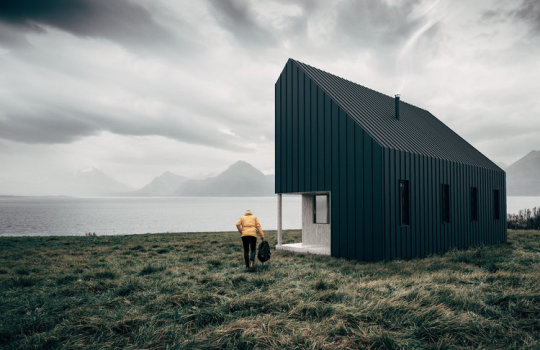
    Author and professor Witold Rybczynski recently asked: “What’s with all the black houses that have appeared in recent years?” Black brick. Black paint. Blackened Timber. Lots of black.

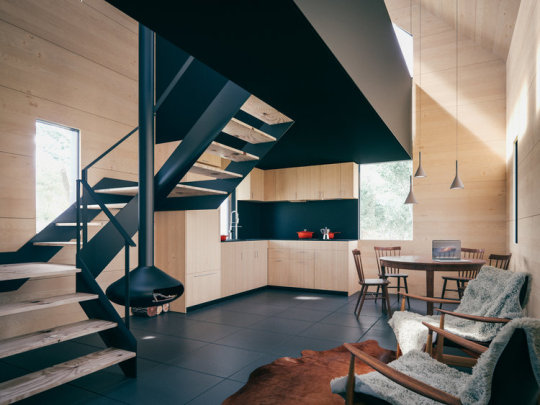
    Alongside his post was an image of a “backcountry hut” by Leckie Studio Architecture + Design. I am adding a picture of the interior for completeness, but he only posted a picture of its exterior.

    Witold makes a great point about shadows, but when I read the post this morning I immediately thought to myself: Wow. What a beautiful cabin and what a beautiful setting.

    I like how the lighter carve out at the corner contrasts against the black. And because of this carve out, I assumed that the interior would have similar and lighter tones of wood. It does.

    At the same time, I thought of Urban Capital’s River City complex here in Toronto, which also features “black” as a prominent architectural expression. I am a big fan of these projects.

    So I guess it goes to show, once again, that beauty is really in the eye of the beholder.

  • So is this Brutalism or not?

    image

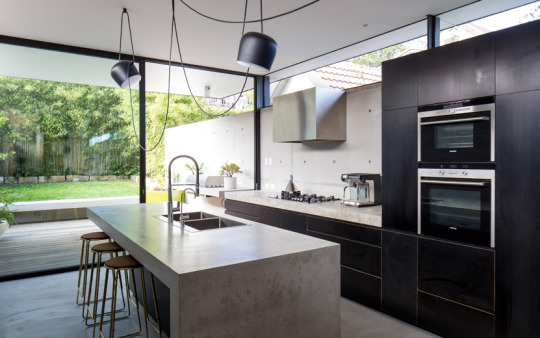
    The Spaces just featured 21 Scott Street in Bronte (a suburb of Sydney) as its property of the week. (The home is currently listed.)

    Designed by MCK Architects, the home is also called the “Upsilon House” and was supposedly designed for a fashion-industry couple.

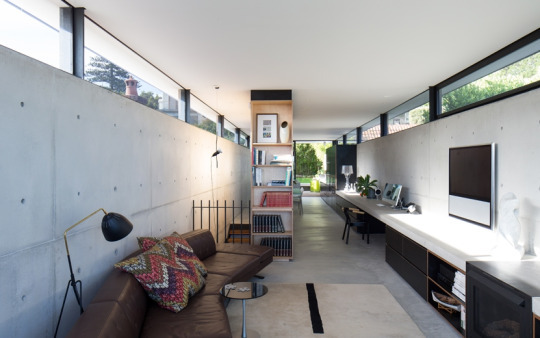
    Two things should immediately stand out to you about the house. One is how long and narrow the site and house are.

    Here is a lengthwise view of the main living floor:

    image

    Based on the plans provided by The Agency (listing agency), the house is about ~3.9m wide. That’s because of its tight site. However, the clerestory windows that run the length of the house would provide ample light.

    The other thing that should stand out is all of the exposed concrete. The Spaces calls it “soft brutalism.” I personally love it, but I recognize that it’s not for everyone.

    In any event, it reminded me of a recent blog post by Witold Rybczynski in which he responded to the New York Times calling Habitat in Montreal a brutalist building. His rebuttal: that’s a gross over-simplification. Brutalism, in its truest sense, is about dramatizing the “rough character of concrete.”

    But I particularly enjoyed how he ended the post:

    “There is another litmus test of Brutalism. Buildings like Habitat remain popular with their users. If people don’t hate it, it can’t be Brutalist.”

    If that’s the case, then 21 Scott is certainly not Brutalism in my book.

    Images via MCK Architects

  • Franchise starchitecture

    Back in 2014, Witold Rybczynski (who taught at Penn while I was there) wrote an article in The New York Times Style Magazine called The Franchising of Architecture. In it, he argued against the trend of “starchitecture.” 

    Here’s an excerpt:

    “Architecture, however, is a social art, rather than a personal one, a reflection of a society and its values rather than a medium of individual expression. So it’s a problem when the prevailing trend is one of franchises, particularly those of the globe-trotters: Renzo, Rem, Zaha and Frank. It’s exciting to bring high-powered architects in from outside. It flatters a city’s sense of self-importance, and fosters the perception of a place as a creative hotbed. But in the long run it’s wiser to nurture local talent; instead of starchitects, locatects.”

    Following this, James Russell (a longtime architecture critic) wrote a searing rebuttal called The Stupid Starchitect Debate. He called Witold’s story a piece of utter laziness and urged us to stop whining about celebrity architecture.

    Here’s an excerpt:

    “Celebrity architecture is not a franchise (McDonalds is a franchise), but branding. Branding is repellently ubiquitous, and it is pure romanticism to think architecture can escape a trend that so powerfully guides spending. A friend became a museum director in part because building a new building was part of the job. I thought he would bring up an energetic young local talent, but he ended up with an international big name because, he said, only the stars would bring in the donors. That’s sad, but emblematic of an era when private wealth builds the cultural facilities the public won’t pay for. That’s why celebrity architects are brands—a title none of them sought, though all are adept at exploiting. Even wealthy, sophisticated trustees like to bask in the glow of a name that’s got cachet, rather than look hard for someone with obvious talent but who is not well known.”

    This is a fascinating debate. And I would be curious to hear your thoughts in the comment section below.

    My own view is that, yes, it is wonderfully romantic to think that we can go back to a period of time when London architecture was designed only by English architects, Paris architecture designed only by French architects, and so on. But the world has changed. The genie is out of the bottle on that one.

    I also don’t think that brand needs to be a dirty word in the context of architecture. There’s value in brand equity. And everything can be construed as a brand. This blog is part of my personal brand. That’s our world.

    The problem I have with this line of thinking is when architecture gets reduced to style, to form, to a veneer. Architecture is an opportunity to solve problems and respond to real (including local) constraints. That also creates value – arguably much more value. And I don’t believe that only “locatects” have the ability to respond to that challenge.

    There’s so much more that can be said about this topic.

  • Fabricating a new urbanism

    image

    Last night I was in CityPlace, West Palm Beach. Completed in 2000, CityPlace is a quintessential example of New Urbanism. (For those of you from Toronto, this is a different kind of a CityPlace.)

    In case you’re unfamiliar with this movement, here’s a snippet from The Charter of New Urbanism (via Wikipedia):

    “We advocate the restructuring of public policy and development practices to support the following principles: neighborhoods should be diverse in use and population; communities should be designed for the pedestrian and transit as well as the car; cities and towns should be shaped by physically defined and universally accessible public spaces and community institutions; urban places should be framed by architecture and landscape design that celebrate local history, climate, ecology, and building practice.”

    At a high level, New Urbanism makes a lot of sense. American cities were sprawling uncontrollably and so advocates had decided that something had to change. The Congress for New Urbanism was founded in 1993.

    But the New Urbanism movement has had its share of critics. Here’s how Witold Rybczynski – professor at the University of Pennsylvania – talked about it on his blog:

    “What are the important ideas that have affected American cities in the last 20 years? The development of waterfronts. The renaissance in constructing urban parks. The move of genXers and retirees into downtowns. High-rise urban living and Vancouverism. The popularity of urban bicycling and bike-rental programs. Ditto for Zipcars. Urban farmers markets and community gardens. Urban charter schools. The dramatic expansion in attendance of urban cultural institutions, especially art museums. Urban tourism. Downtown trophy buildings. The emergence of influential big-city mayors. Have any of these been the result of the new urbanism movement?”

    Frankly, I have never been a big follower of New Urbanism. It has always felt artificial to me. But I recognize the immense challenge in transforming car-oriented cities and communities into walkable ones. It’s one of the greatest challenges in city building. You’re asking people to change their habits.

    If any of you are experts on New Urbanism (because I am certainly not), I would love to hear from you in the comment section below.