Daily insights for city builders, delivered every morning at 6 AM ET. I’m Brandon Donnelly — a Toronto-based real estate developer and founder of Globizen. I’ve been writing here since 2013.

Tag: waterfront toronto

  • Hybrid 1-2-3

    For those of you who have been reading this blog since last summer, you’ll know that I’m particularly passionate about the Gardiner Expressway East here in Toronto.

    Last night a public meeting was held to discuss the 3 alternative designs for what has become known as the “hybrid” option. If you’d like a visual summary of the options, click here.

    But essentially as you go from hybrid 1 to hybrid 3, the elevated Gardiner Expressway just gets pushed further north, away from the water. So as you go from 1 to 3, the hybrid option becomes less offensive to the waterfront and its associated public realm, and it opens up more land for development. However, it also becomes more expensive.

    Here’s a graphical summary of the costs, which my friend Gil Meslin tweeted out last night:

    //platform.twitter.com/widgets.js

    Notice that the boulevard (remove) option, which City Council rejected last summer, remains by far the most cost effective option. At a time when the city is searching for cash, I am surprised that nobody is looking here.

    I am also surprised to read that some are commenting on which of the above hybrid options will be the easiest to tear down should we want to remove the Gardiner East in the future. If that’s the lens we are applying, why rebuild it in the first place?

    But enough from me. What do you think? Here’s a Twitter poll I created this morning:

    //platform.twitter.com/widgets.js

  • 10 reasons to visit Toronto right now

    https://500px.com/embed.js

    Next weekend a good friend of mine from architecture school will be visiting Toronto from Philadelphia. And I’m really excited to show him the city. (Next month it’s my turn to go to Philadelphia.)

    He’s a fellow city geek. He hasn’t been to Toronto in a number of years. And I haven’t seen him since our trip to Detroit 2 years ago.

    For those of us living and working in Toronto, there’s a lot to celebrate. Sure the Gardiner Expressway East decision didn’t go as I – as well as many other urbanists, including our Chief City Planner – had hoped. But there’s no shortage of other things to brag about.

    So here are 10 reasons to visit Toronto right now:

    1. We’ve created an entirely new business district south of Union Station called South Core. Now the region’s primary mobility hub is in the middle of the country’s most important business district, as opposed to on the edge of it. It’s a better use of infrastructure.

    2. We now have a dedicated train (the Union Pearson Express) that takes you from the country’s busiest airport directly to downtown in 25 minutes. You’ll find local retailers at the stations and a brand created by the brain behind Monocle Magazine. You can even use a smart card to ride it and our local transit system.

    3. We didn’t shut down Uber. Instead our mayor wants to create new policy that will allow these services to coexist with conventional taxi services. We don’t yet know how this will turn out, but I believe it’s a step in the right direction. It’s Toronto taking a leadership approach to innovation as opposed to trying to stomp it out.

    4. We are about to host the largest sporting event in Canadian history. The 17th Pan American Games will have double the number of athletes competing as the 2010 Winter Olympics in Vancouver.

    5. We created an entire neighborhood from scratch in order to house all of these athletes (Canary District). And I think it’s destined to become one of Toronto’s great neighborhoods. I’m saving my first visit for next weekend, so expect a follow-up post on this.

    6. We are dramatically rethinking this city’s public realm. From the plaza out front of Union Station to the new Queens Quay Boulevard along the waterfront, we are prioritizing people and creating more complete streets. It has given Toronto an entirely new urban feel.

    7. We are slowly starting to embrace our forgotten laneways and alleys through the help of organizations like The Laneway Project. And this is going to eventually lead to a further rethink of our pubic spaces and urban fabric.

    8. We continue to be one of the fastest growing cities in the world (certainly in the developed world). As a result, we are building some really exciting buildings by some of the top architects in the world. This includes everyone from Norman Foster to Frank Gehry.

    9. According to a recent report coming out of the Martin Prosperity Institute, Canada is one of the most creative and globally competitive countries in the world, as well as the most open to “ethnic and religious minorities and gay and lesbian people.”

    10. The ATC community is in the process of identifying a new, quintessentially Toronto food dish. But since we have every type of imaginable cuisine here, we’re struggling to pick just one. When you visit, you can help us identify the best and most Toronto dish.

    So there’s a lot to be excited about. I for one can’t wait for us to host the Pan Am Games, starting tomorrow. It’s a chance to show off this great city. 

    So if you’re also in town next weekend and want to geek out about cities, drop me a line.

  • Before & After: Queens Quay Boulevard

    Yesterday I spent the evening walking Toronto’s new Queens Quay Boulevard, which fully reopened this past Friday after a number of years of construction. 

    It is part of Waterfront Toronto’s revitalization efforts and represents a solid decade in the making. West 8 of Rotterdam and DTAH of Toronto won the international design competition for the central waterfront back in 2006. And this past weekend a big component of that vision was unveiled.

    But first, let’s take a look at what Queens Quay Boulevard used to be like. Here’s a Google Streetview image from 2009:

    image

    The streetcars ran in the middle of the street. Cars drove on the north and south side on both sides of the tracks. And the sidewalks were fairly small and usually at capacity during the busy summer months. It wasn’t a great street.

    Now here’s a photo that I took yesterday from that same vantage point (2015):

    image

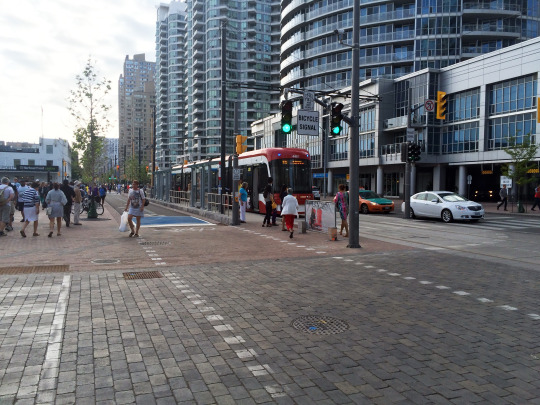
    The street has been completely reorganized. On the north side of the streetcar tracks is where the cars now drive in both directions. On the south side of the tracks the lanes of traffic have been replaced with a 2-way bike trail (part of the Martin Goodman Trail). And on both sides the pedestrian areas have been greatly expanded. It’s now a magnificent street.

    If you haven’t yet been down to the new Queens Quay, I would encourage you to check it out on either foot or bicycle. (If you go on bicycle, let me know and I’ll join you.) 

    Toronto may have taken a giant step backwards with its recent decision on the Gardiner East, but we also took a giant step forward with the reopening of Queens Quay Boulevard.

  • 14 CityBuilders come together in support of removing the Gardiner East

    This will probably be my last Gardiner East post before the decision goes to City Council next week on June 10th. But I have such good news that I need to share it with you all.

    This morning 14 “CityBuilders” came together for the first time in support of removing the elevated Gardiner East and replacing it with a surface boulevard. They are real estate developers, investors, and other prominent business leaders in the city. And they sent a letter this morning to every single Toronto City Councillor outlining their position. 

    I can’t tell you how thrilled I am to see this happen, so I’d like to call out each and every member of the CityBuilders. They are (in alphabetical order):

    1. Castlepoint Numa
    2. Cityzen Development Corporation
    3. Context Development
    4. Continental Ventures
    5. Daniels Corporation
    6. Distillery Historical District
    7. Dream Unlimited Corporation
    8. Greybrook Capital and Greybrook Realty Partners
    9. Kerbel Group Inc.
    10. Manulife Real Estate
    11. QQE 162
    12. Streetcar Developments
    13. TAS
    14. Tridel Group of Corporations

    These are some of Toronto’s most important city builders and I am sure this will get the attention of both Mayor John Tory and the rest of City Council.

    If you haven’t yet signed the Gardiner East petition that Stephen and I started, please do so by clicking here.

    Happy Friday 🙂

  • 5 designs (and my pick) for Jack Layton Ferry Terminal in Toronto

    Earlier this week, 5 design proposals were unveiled for Jack Layton Ferry Terminal & Harbour Square Park along Toronto’s waterfront. They are part of an international design competition being organized by Waterfront Toronto – the arm’s length agency in charge of revitalizing this city’s waterfront.

    The first proposal – called Cloud Park – was submitted by Stoss Landscape Urbanism, nARCHITECTS, and ZAS Architects.

    image

    I really like how they integrated water features, pools, and hot tubs into the park and lake. Their proposal made me realize how great it would be to have these functions along the water. It has been done in many other cities around the world. And I think a hot tub could be a big draw during the winter.

    The second proposal was submitted by Clement Blanchet Architecture, RVTR and Batlle i Roig.

    image

    The big ideas here are a grand staircase (”social carpet”) that runs in line with Bay Street and an elevated east-west platform that runs from York Street in the west all the way across the Yonge Street slip in the east. 

    When I first saw this proposal I thought it was by Rem Koolhaas (OMA) and I doubt I’m the only one with that feeling. That’s not a criticism though. I like the work of OMA. But I think that many Torontonians have an intrinsic aversion to things that are elevated near our waterfront. (We’re currently pontificating about whether we should tear down a portion of our elevated urban highway.)

    That said, I think the connection over the Yonge Street slip is an important one. The larger opportunity with this project is to use it as a mechanism to better stitch together our waterfront. I hope we take advantage of that.

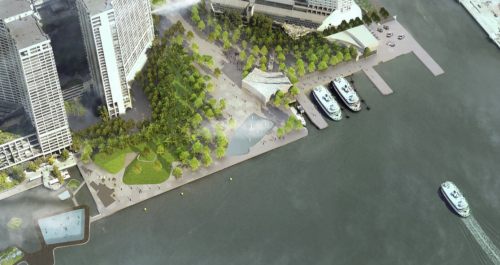
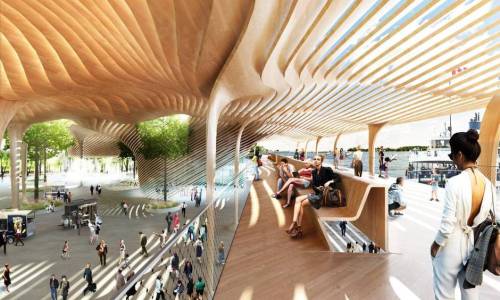
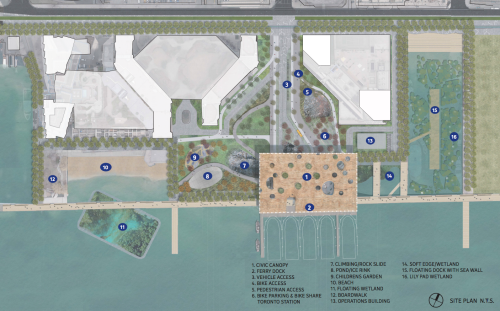
    The third proposal – called Civic Canopy – is by Diller Scofidio+Renfro, architectsAlliance, and Hood Design.

    image

    This proposal immediately caught my eye. It’s one of the more sculptural designs and it reminds me of something you might find in Barcelona or Madrid. It also includes a beach (#10 on the site plan shown below).

    image

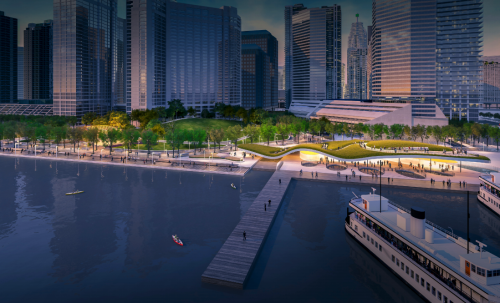
    The fourth proposal – called Harbour Landing – was submitted by KPMB Architects, West 8, and Greenberg Consultants.

    image

    It consists of an undulating green roof terminal building and a more natural surrounding at the foot of Bay Street.

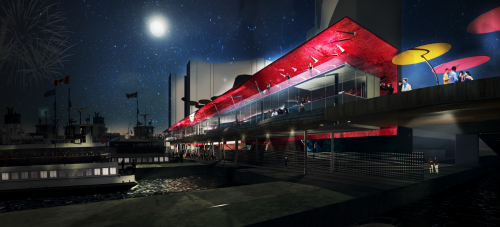
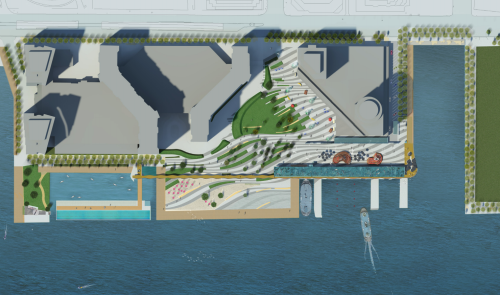
    Finally, the fifth proposal was submitted by Quadrangle Architects, aLL Design (Will Alsop), and Janet Rosenberg & Studio.

    image

    This proposal consists of a hot pink terminal building running east-west along the water (shown above) and many other features that will strike you as being quintessentially Will Alsop.

    My favorite part of this proposal though is the patterning of the surrounding urban park and the pool located towards the bottom left of the site plan shown below. Can you tell that I would really like to see usable water features along the lake?

    image

    When I first set out to write this post I was determined to pick one design to recommend. And if I were asked to do that I would pick Civic Canopy by Diller Scofidio+Renfro, architectsAlliance, and Hood Design.

    However, as I was going through the designs, I instead found myself taking from all of the proposals and mentally accumulating a list of things that I would love to see happen on this site.

    • Connections to the surrounding area (such as across the Yonge Street slip)
    • Usable water features along and in the lake (pools, hot tubs, fountains, and so on)
    • An iconic terminal building that you can see when you’re out in the lake and on the Toronto Islands
    • Urban spaces that could be truly used and programmed in all seasons

    Do you have a favorite proposal? What are the most important design elements in your opinion?

    Images via Waterfront Toronto

  • The Fundamental Law of Road Congestion

    A few days ago I wrote a post talking about what happens when you demolish an urban highway. It was a link to an article giving 5 examples of cities that have removed their urban highways and benefited.

    After I wrote the post, a number of people responded on Twitter. Some thought it was a great idea and gave examples of other cities, such as Detroit, that are thinking about doing the same. But others responded and said that I was out of line. And that while it might work in some cities, it simply isn’t a viable option in cities like Toronto.

    So as somebody who believes we should be taking down the Gardiner Expressway, I thought it would be worthwhile to revisit the topic and provide a bit more information.

    To be clear, I’m not suggesting we remove the Gardiner and replace it with nothing. My belief is that we should replace it with a broad surface street that would still move lots of cars, but that would make our waterfront much more open and accessible to everyone.

    So how is this feasible?

    Again it comes back to the concept of induced demand. Back in 2009, two economists from the University of Toronto and University of Pennsylvania – which are actually both of my alma maters – published a study called The Fundamental Law of Road Congestion.

    In it they discovered something really fascinating: there’s a near perfect relationship between new roads and highways built and the total number of miles driven. In other words, as cities increased road capacities (during their study period of 1980 to 2000), the amount of driving went up just as much.

    What this should tell you is that trying to build your way of out road congestion is usually a losing proposition. That’s why every large city has a traffic problem. Try and think of one that has solved this. And as much as it might seem intuitive to tell people at cocktail parties that your city simply needs to build more roads and highways, it’s typically not that simple. (In my view, the solution is road pricing.)

    The other really interesting thing that this study revealed is that it works both ways. When you reduce road capacity, drivers start to disappear. People choose to live closer to where they work. People choose transit. People go into the office at different times. People make all sorts of different decisions in response to this road change, just as they do when there are more free roads available to them.

    So within a reasonable band (obviously you can’t remove all roads), there is no perfect amount of road capacity. If you added another lane to your highway, it would be full. If you took away a lane, it would end up equally full. That’s why removing the Gardiner Expressway isn’t lunacy.

    Instead, it actually makes a lot of sense:

    • It’s the cheapest solution (compared to repairing it or burying it)
    • It would free up money for transit and other mobility solutions
    • It would make our waterfront more open and accessible
    • It would beautify our downtown
    • It would increase land values all along the waterfront

    And since we’re still in the early days of developing our eastern waterfront, now is the time to do it. The longer we wait, the harder it’ll get and the more expensive it’ll get.

    So I hope that the leaders in this city will think long and hard about this as opposed to immediately assuming we need an elevated highway to keep this city moving. The last time I checked, it doesn’t work so well in its current state.

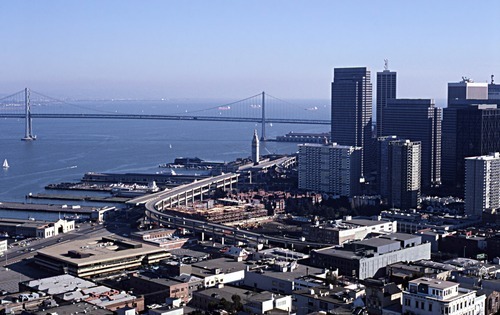
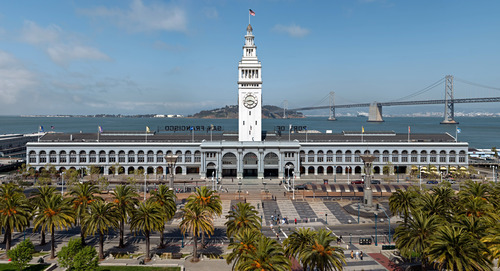
    Images: Before and After the Embarcadero Freeway in San Francisco (via Gizmodo)

  • $12,000 pink umbrellas

    image

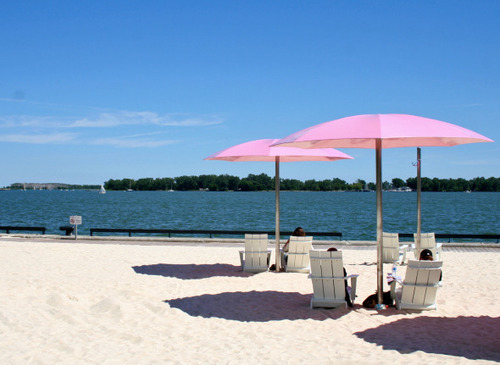
    Sometimes I like to start my mornings off by grabbing a coffee and walking down Jarvis Street to Sugar Beach and the lake. 

    I’ll find a Muskoka chair (Adirondack chair for you Americans) and position it underneath one of the iconic pink umbrellas. I mostly like to look out at the lake, but I also like the shade so that I can see the screen on my phone in case my Type A tendencies kick in and I want to check emails or mess around on Twitter.

    Oftentimes when I’m there–even early in the morning–there will already be other people at the beach. One time I came at 730am and a lady was there tanning in a bikini. I admired her dedication.

    Sometimes I need these moments. I like that sobering feeling you get when you take a time out from the everyday to just sit and think. It helps put things into perspective. And you could argue that great cities provide those kinds of spaces.

    But how valuable are those spaces? Can you put a price tag on it? Is it worth $1M? How about $14.1M, including $12,000 for each pink umbrella?

    Image: blogTO

  • Looking east

    There’s a fairly real divide between east and west here in Toronto. When people talk about real estate or describe the kind of person they are, they often say things like: “I’m an east end kind of person” or “I only want to buy on the west side.” There’s such a split that somebody recently said in a meeting I was in that the east vs. west real estate divide is like Christianity vs. Judaism. 

    Historically, the west has generally been considered more desirable than the east–regardless of what scale you’re looking at. Downtown west vs. downtown east, Etobicoke vs. Scarborough, and so on. And for whatever reason, this seems to be the case in a lot cities I’ve been to. Consider Montreal, Vancouver, New York, and London, to name a few. 

    But lately, I’ve been noticing a growing acceptance of the east side. Friends are telling me that, even though they don’t know the east all that well, they’re almost agnostic to which side they buy a home on.

    At the same time, we’re seeing Toronto’s development boom spread to the east along streets like Church and Jarvis; paralleling the kind of intensification we’ve already seen on the west along Bay Street, University Avenue and further. I’m also noticing a lot of west end restauranteurs open up on the east side. See Carbon Bar and Gusto 501 as two recent examples.

    But with the neighborhoods like the Distillery District and Leslieville attracting lots of yuppies and with neighborhoods like Regent Park and the West Don Lands coming online, it shouldn’t come as a big surprise to you that developers and other entrepreneurs are looking east. Maybe you should too.

  • Why the Gardiner East should be torn down

    Warning: This post turns into a bit of a rant near the end 🙂

    Since 2009 (well, much earlier actually), Toronto has been trying to figure out what to do with the eastern portion of the elevated Gardiner Expressway (the portion from Jarvis Street to the Don Valley Parkway). The process used to help make this decision is called an Environmental Assessment (or EA) and that’s what is currently underway. But it’s a painstakingly slow process.

    Recently though, a third public meeting was held in order to solicit feedback on the various design solutions and so there’s been a renewed interest in this city building issue. Since the beginning, my position has been that we should tear it down. And in this post I’m going to explain why I think that is exactly what the city should do. 

    But first, a bit of background.

    The EA started by identifying four “Alternative Solutions” to the problem of the Gardiner East. And they are: 

    1. Maintain the elevated expressway (Basically do nothing)
    2. Improve the urban fabric while maintaining the existing expressway
    3. Replace with a new above or below grade expressway
    4. Remove the elevated expressway and build a new boulevard

    They then went out and assigned these solutions to a bunch of architects and designers—whom are some of the world’s best—and asked them to come up with specific design proposals. These proposals are available online and that’s part of what the public has been commenting on.

    City Council seems to generally want the Gardiner down, but there are some naysayers. 

    Rob Ford doesn’t want it removed (option #1) because it’ll add to driver commute times (no surprise there) and Councillor Denzil Minnan-Wong is worried that tearing it down will just lead to another wall—a wall of waterfront condos.

    But I think these views are terribly shortsighted and I’ve made my position clear by submitting a formal response through the City’s public engagement portal. To explain my view here on Architect This City, I thought the best way would be to simply share my answers. So here they are.

    What do you like?

    [slideshare id=22945545&sc=no]

    I can honestly say that I love my city. I was born in this city. And I was raised in this city. This city has given me so much, which is why I feel so compelled to try and give back to it. It’s also the reason why I’m first to defend it when people talk about how great this or that city’s waterfront is and how much ours sucks. I mean, I know ours sucks. But we’re fixing it.

    We have a lot of great plans in the pipeline for our waterfront, but there’s a remaining obstacle: our elevated expressway. Boston buried theirs. And San Francisco transformed theirs into a magnificent public space. What are we going to do with ours? Now is the time to be bold and not settle for the status quo. That’s too easy. We need to remove the eastern portion of the Gardiner Expressway today and the design proposal by Field Operations offers a brilliant way to do it.

    Not only is removing the Gardiner the most cost effective solution ($470M, versus $870M to maintain, $865M to improve and $1.4 billion to replace), but it’s also the most desirable from a city building standpoint.

    The Gardiner is not the only barrier. We also have the rail lines. So while repurposing the Gardiner might be doable in isolation, we simply have too much friction standing between us and the lake. We need to remove the barriers that we can. It’s for this precise reason that Field Operations spent so much time worrying about the north-south connections. And I think their “architectural sleeves” are a really interesting way to solve this problem.

    At the same time, timing is an important consideration. As the surrounding East Bayfront area develops, it’s only going to become more costly to remove this stretch of the Gardiner. If we’re going to do this, now is the time.

    Finally, I think it’s important to note that Field Operations is the landscape architecture firm behind the wildly successful High Line in New York. So what we have is a firm that made a name for itself repurposing an old elevated rail line, telling us that our own elevated structure is worthless and uninspiring. Think about that for a minute. Should we really be spending more money to salvage the Gardiner East?

    What concerns do you have?

    That we’re getting hung up on commute times as one of the key decision making criteria. It’s a red herring. Let’s face it: irrespective of whether we tear down the eastern portion of the Gardiner or not, Toronto is fucked from a transportation and infrastructure standpoint. We’re sitting on decades of disinvestment and some of the longest commute times in North America.

    Field Operations put it well when they said that the tearing down of the Gardiner East needs to be thought of as a paradigm shift. We have a 25-year transportation plan waiting to be funded. Let’s go out and do that instead of trying to sacrifice our waterfront so that suburban commuters can save a few minutes. Let’s give them a shiny new train instead. They’ll like that.

    Either that or Torontonians need to stop talking about how great Chicago’s waterfront is, because we can do it too. Now is our chance.

    What advice do you have for the Project Team as the study moves into the next phase?

    Don’t listen to Rob Ford.

  • Why the Pan Am Games are good for Toronto

    The Pan American Games are coming to Toronto in 2 years – 559 days to be exact. While not as high profile as the Olympics, some of you may be surprised to learn that the Pan Am Games will involve three times as many athletes as the Vancouver Olympics did.

    However, the big question with these sorts of events is always whether or not they create a lasting economic boon for the host city. History is littered with examples of economic disasters and lingering Olympic debts. I’d love to see a full analysis of what it costs to bid for a game, how much public money has to go up, how much private investment it spurs, and so on.

    At the same time, I suspect that some of the positive externalities might be hard to measure. How do you attach a value to the brand equity you get from hosting a major international sporting event? It’s hard, but for many people around the world the 2015 Pan Am Games could be the event that embeds Toronto into their psyche. 

    But there is another big benefit to playing host. It creates a real deadline. When cities bid for games they make all sorts of promises about the kinds of things they’re going to build and provide. In the case of Toronto, it accelerated the creation of a new mixed-income neighbourhood called the West Don Lands (which will be used to house the athletes during the games).

    “Originally, build out of the 32 hectare (80 acres) West Don Lands was planned to unfold in three strategic phases and take between 10 and 12 years, subject to market conditions. With the Pan Am Games, more than half of the community will be in place for the Games in 2015.” -Waterfront Toronto

    So in effect, we’ve leveraged the games in order to expedite capital projects that were already in the pipeline. I like this, because without a hard and fast deadline, I can almost assure you that these publicly run projects would have fallen behind schedule. Deadlines and goals are good.

    Here’s an example why:

    When I first started my MBA program at Rotman, we did an interesting organizational behaviour exercise involving origami cranes. The class was split into groups and each group was asked to go away and build paper cranes. If you’ve ever built one of these, you’ll know that they can be tough at first.

    But what each group wasn’t aware of was that they were all given different instructions in terms of the number of cranes they were expected to build. Their goals were different. At the end of the exercise, all of the cranes were counted and each group wrote their “production” levels on the board.

    What was discovered was that each group more or less built the exact number of cranes that they were asked to build. This is interesting, because presumably every group had the raw ability to produce the same number of paper cranes. All that changed was the motivation.

    Returning to the case of the Pan Am Games, the mandate is clear: We need to house 10,000 athletes and officials by the summer of 2015, or else we’ll look utterly incapable in front of the world. We have a deadline. And that’s a good thing.